Astrocartography — Free Map
Your free astrocartography map
Swiss Ephemeris precision. Every planet line plotted. Click any city for a one-line read. Free, no signup.
Last updated: October 6, 2026 · Birth dates from 1900 onwards supported
- Calculated with Swiss Ephemeris (the standard engine the field uses)
- Your birth data stays with you. We don’t sell, share, or resell.
- Free, no signup required
Use your recorded birth time to generate a free map, or compare possible times if you only know a range. If your time is missing, start with the guide and worked example.
What you’re looking at
The map re-projects your birth chart onto the world. Each planet you had at the moment of birth traces up to four lines across the globe — the longitudes where that planet was rising, setting, on the upper meridian, or on the lower meridian at the exact instant you were born. Where you stand on Earth in relation to those lines is the proposition the technique tests.
Five planets render by default (Sun, Moon, Venus, Jupiter, Saturn) — the rest are one tap away in the legend. Click any blank point on the map to see which lines are nearby; click directly on a line to see what it names.
For the deeper read, the full reading guide explains what each line means, planet by planet and angle by angle.
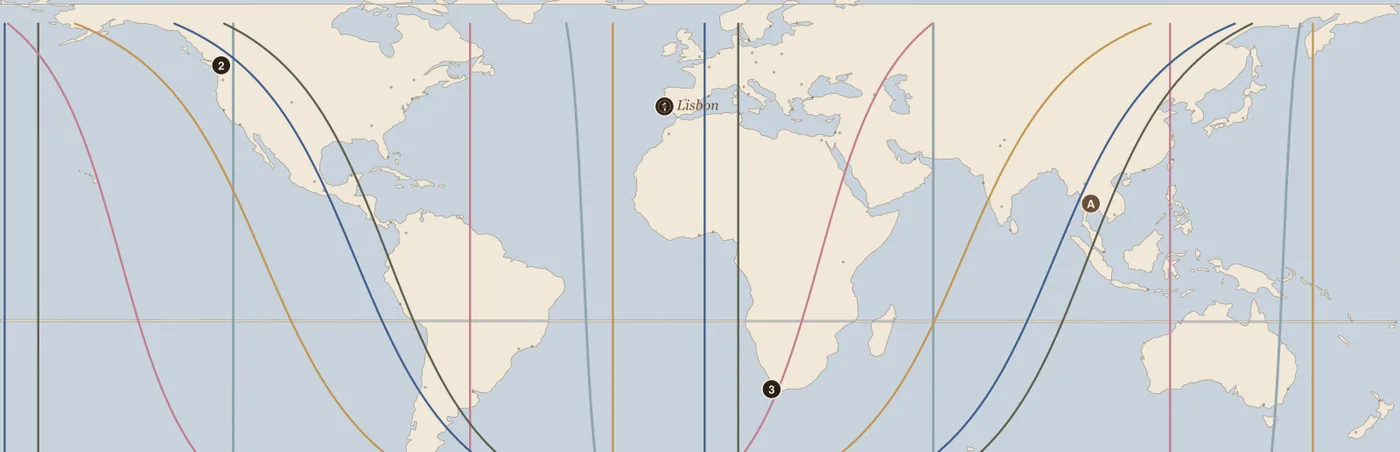
A sample map — each coloured line is one planet on one of the four angles
How the calculator works
We use the Swiss Ephemeris — the standard astronomical engine the field uses — in Moshier-precision mode. Planetary positions resolve to roughly one arc-second; geographic line positions for the four angles (AC / DC / MC / IC) are derived from standard equatorial-coordinate transforms. The tropical zodiac is the default; we don’t do sidereal in v1.
Place autocomplete uses Mapbox geocoding. Timezone resolution and DST handling run server-side using the IANA timezone database via Luxon, so historical birth dates with awkward zone history (pre-1970) are handled correctly. Birth dates from 1900 onwards are supported.
What this map shows — and what it can’t
The map is your natal chart re-drawn on Earth. It shows where the themes in your chart speak loudest. It is not a transit-aware map — the lines are fixed for life, not for next month. It is not a substitute for therapy or psychological context. It is not a causal predictor: the line through a city is a thematic register, not an outcome promise. A Venus line through Lisbon names a feeling-tone the city tends to amplify; it doesn’t guarantee that you’ll find love in Lisbon.
Read it as a working hypothesis you can test against your actual experience in places, not as an instruction.
Three things to look at first
01
Where do your Sun, Venus, and Jupiter lines run?
These three are the most-named lines in popular astrocartography and the most asked about. The Sun line names the place you stand most clearly as yourself; Venus, attraction and beauty; Jupiter, the place where doors open without negotiation.
02
Are any cities you’ve lived in near a paran?
Parans are latitudes where two of your planet lines meet at the same moment of birth. Helena Woods and Paulina Davie both note that parans often pinpoint cities of unusual personal significance, even when those cities are far from major lines on the map.
03
What does your Saturn line cover?
Saturn lines aren’t bad — they’re difficult, which isn’t the same thing. The line where the work demands you build for years is often the line of the most professionally formative chapter of a life.
For the planet-by-planet, angle-by-angle reading, the full reading guide explains what each line means. Bring this map; the guide is built to be read with a real map open beside it.
The next step
Your personalised astrocartography report
The free map shows you where the lines run. The paid report tells you what they mean for you — with your specific natal chart, your top five regions named with cities, the travel-vs-relocate split for each, and the caution regions honestly named. 28–32 pages. $14.99. 30-day money-back guarantee.
Have these lines interpreted in your natal context — $14.99No birth time?
Every planet’s AC/DC/MC/IC lines depend on birth time. If yours is approximate, compare a plausible range in the calculator above. If it is unknown, explore the worked example and learn how to find records; read the no-birth-time guide.
Frequently asked questions
Accuracy, privacy, sharing, and what happens to your birth data.
How accurate is this calculation?
We use the Swiss Ephemeris in Moshier mode — the standard astronomical engine the field uses — with ~1 arc-second precision. Lines you see here should match any other Swiss-Ephemeris-based tool to within a fraction of a degree of geographic longitude. The dominant source of map-positioning uncertainty is birth-time accuracy: a 60-second error shifts the AC/DC and MC/IC lines more than the precision difference between Moshier and the full ephemeris.
Does this match other astrocartography tools?
It should — we run regression checks for six reference birth charts (Steve Jobs, Martin Luther King Jr., Frida Kahlo, Mandela, Einstein, Rachmaninoff). If you spot a meaningful difference between our map and another Swiss-Ephemeris tool for the same input, please tell us via the contact form. The most common source of apparent disagreement is a different timezone resolution; double-check the resolved zone in the form before assuming a calculation issue.
What is "Mapbox"?
Mapbox is the map-rendering layer beneath the planet lines — it provides the world map and the place autocomplete that lets you find your birth city. Your search query is sent to Mapbox to resolve a place name into latitude and longitude; we don't send your birth date or time to Mapbox.
Can I share my map?
Yes. Tap the Share button at the top of the map to copy a link or use your device's native share sheet. The link encodes your map without exposing your birth data — it's a one-way hash, so a recipient can see your lines but cannot recover your birth date, time, or place.
What data do you store?
We store the calculated map (the line positions) keyed by a one-way hash of your birth inputs. In some cases — for example, to carry your details into checkout — your birth date, time, and place are also stored on a session record that is not linked to any account. Your form values can optionally persist on your own device (in localStorage) for the 30-day convenience window; nothing about that copy is sent to us.
I don't have my birth time. Can I still use this?
All planetary angular lines depend on time. If you know a plausible range, choose “I know a range” to compare candidate maps. If your time is completely unknown, choose “I don’t know” for guidance and a labelled worked example. We do not substitute noon for a missing birth time.
Still have questions? We're here to help!
Contact Support →Or take the free 13-question quiz — or read the explainer at what is astrocartography.