Twin Flame Runner & Chaser: The Psychology Behind the Dynamic
The runner/chaser dynamic isn't just a spiritual concept—it's a well-documented attachment pattern. This guide uses psychology and attachment theory to explain why it happens, what keeps it going, and how to break free.

Taro
Runs Taro's Tarot
In This Guide
The Runner/Chaser Dynamic: What's Really Happening
In twin flame communities, the runner/chaser phase is described as the most painful stage of the journey—one person flees the connection while the other desperately pursues. It's framed as a spiritual test, a necessary darkness before union.
But when you strip away the spiritual language, what you find underneath is something psychology has studied for decades: the anxious-avoidant trap. One person has an avoidant attachment style (the Runner) and the other has an anxious attachment style (the Chaser). They lock into a self-reinforcing loop where each person's behavior triggers the other's deepest wound.
This doesn't mean the connection isn't real or meaningful. It means the pain has a name, a mechanism, and—most importantly—a path out. Understanding the psychology doesn't diminish the spiritual experience; it gives you tools to actually heal instead of endlessly cycling through the same pattern.
Why This Guide Exists
Our twin flame & soulmate guide covers the full twin flame journey. This article goes deep on the single most painful stage: the runner/chaser dynamic. If you're in it right now, this is written for you.
The Psychology of the Runner
The Runner is often described as the "Divine Masculine" in twin flame spirituality, though anyone of any gender can occupy this role. What defines the Runner isn't cruelty or indifference—it's terror.
The twin flame connection confronts the Runner with a level of intimacy their nervous system was never wired to handle. Their attachment system, typically dismissive-avoidant, learned early in life that emotional closeness equals danger. When the Chaser's love feels overwhelming, the Runner doesn't run from the Chaser—they run from the parts of themselves the Chaser activates.
Attachment Style
Dismissive-Avoidant
Core Fear
Engulfment - losing autonomy and sense of self
Core Wound
Not good enough - the Chaser's adoration feels like pressure they can't live up to
Typical Behaviors
Ghosting/blocking
Entering rebound 'karmic' relationships
Burying in work/substances
Rationalizing exit with logic
Hot/cold communication cycles
Inner Dialogue
The Runner's exit often looks cold and calculated from the outside. But internally, they're frequently in turmoil. Many Runners report thinking about the Chaser constantly while maintaining absolute silence. The logic they use to justify leaving—"it's too intense," "I need to find myself"—is their avoidant system constructing a rational narrative over a fundamentally emotional reaction.
Understanding this doesn't excuse harmful behavior. Ghosting causes real pain. But understanding the mechanism is the first step toward compassion—for the Runner, and for yourself if you're the one being left.
The Psychology of the Chaser
The Chaser is typically the "Divine Feminine" energy, though again, gender is irrelevant. What defines the Chaser is an anxious-preoccupied attachment style that makes the Runner's withdrawal feel like an existential threat.
For the Chaser, the Runner's departure doesn't just hurt—it confirms their deepest belief: "I am not enough. People always leave." This activates a protest response: the Chaser pursues, pleads, bargains, and sometimes engages in behaviors they later feel ashamed of. The twin flame label can make this worse, because it frames the obsession as spiritually mandated.
Attachment Style
Anxious-Preoccupied
Core Fear
Abandonment - 'people always leave me'
Core Wound
Codependency - can't feel whole without the other person
Typical Behaviors
Excessive texting/calling
Obsessive seeking (psychics, tarot, Google)
Protest behaviors to re-establish contact
Spiritual bypassing (reframing neglect as 'part of the process')
Difficulty eating/sleeping during separation
Inner Dialogue
The Chaser's pain is visceral and all-consuming. They may lose weight, stop sleeping, neglect responsibilities, and spend hours seeking answers through tarot readings, psychics, or spiritual forums. The twin flame community can inadvertently enable this by reinforcing the narrative that the Runner will return—encouraging the Chaser to wait rather than heal.
The hardest truth for the Chaser: the intensity of their pain is not proof of the connection's depth. It's proof of their attachment wound's depth. Healing means learning to distinguish between the two.
Attachment Theory: The Framework Behind the Dynamic
Attachment theory, developed by John Bowlby and Mary Ainsworth, describes how our early relationships with caregivers shape our patterns in adult relationships. There are four primary attachment styles, and understanding yours is key to breaking the runner/chaser cycle.
Take our attachment style quiz to identify your pattern, then read how each style manifests in twin flame connections:
Secure
Comfortable with intimacy and independence. Can express needs without anxiety or avoidance.
In Twin Flame Dynamics
Rarely gets stuck in runner/chaser dynamics. Can hold space for intensity without losing themselves. The goal state for both partners.
Healing Path
Already the target. Secure individuals model healthy relating and can help heal insecure partners through consistent availability.
Anxious-Preoccupied
Craves closeness, fears abandonment. Hypervigilant to signs of rejection. Needs constant reassurance.
In Twin Flame Dynamics
Becomes the Chaser. The Runner's withdrawal activates their deepest wound. They obsess, pursue, and lose themselves in the connection.
Healing Path
Build self-worth independent of the relationship. Learn to self-soothe. Practice tolerating uncertainty without spiraling. Therapy focused on abandonment wounds.
Dismissive-Avoidant
Values independence above all. Suppresses emotional needs. Withdraws when things get 'too close.'
In Twin Flame Dynamics
Becomes the Runner. The Chaser's intensity triggers their core fear of engulfment. They shut down, rationalize, and flee to preserve autonomy.
Healing Path
Learn that vulnerability is not weakness. Practice staying present when emotions arise. Therapy focused on emotional availability and fear of intimacy.
Fearful-Avoidant
Wants closeness but fears it. Push-pull pattern: draws people in then pushes them away. Often linked to trauma.
In Twin Flame Dynamics
Can alternate between Runner and Chaser roles. The most volatile attachment style in twin flame dynamics. Triggers are unpredictable.
Healing Path
Trauma-informed therapy is essential. Work on recognizing the push-pull pattern in real time. Build a window of tolerance for emotional closeness.
The Anxious-Avoidant Trap: Why the Loop Never Ends on Its Own
The reason the runner/chaser dynamic feels so inescapable is because it's a closed feedback loop. Each person's reaction is the exact trigger for the other person's wound:
Step 1: The connection deepens. Intimacy increases.
Step 2: The Runner's avoidant system activates: "This is too close. I'm losing myself." They pull away.
Step 3: The Chaser's anxious system activates: "They're leaving. I'm being abandoned." They pursue harder.
Step 4: The Chaser's pursuit confirms the Runner's fear of engulfment. They withdraw further.
Step 5: The Runner's withdrawal confirms the Chaser's fear of abandonment. They chase harder.
Step 6: Return to Step 2. The cycle intensifies with each rotation.
This is why the dynamic can last years. Neither person is "wrong"—both are reacting from genuine pain. But the system itself is self-perpetuating. No amount of love, spiritual practice, or good intentions will break the loop while both people remain in their wounded attachment patterns.
The Paradox of Twin Flame Intensity
Anxious and avoidant people are magnetically attracted to each other precisely because the dynamic feels familiar. It mirrors childhood attachment patterns, which the brain interprets as "love." The intensity isn't necessarily a sign of a deep spiritual connection—it can also be a sign of activated attachment wounds. Both can be true simultaneously.
Breaking the Cycle: 6 Steps to End the Dynamic
The runner/chaser dynamic doesn't resolve through wishful thinking or waiting it out. It requires deliberate, often uncomfortable inner work from both people. Here's the path:
The Chaser stops chasing (the circuit breaker)
This is the single most important shift. When the Chaser stops pursuing, the anxious-avoidant loop loses its fuel. The Runner no longer has something to flee from. This isn't a manipulation tactic - it's genuine surrender.
Both do individual shadow work
Each person must face their own wounds separately. The Runner must ask: 'What am I actually running from?' The Chaser must ask: 'Why do I need this person to feel whole?' These are individual journeys that cannot be done together.
Chaser heals codependency and becomes Secure
The Chaser builds a life that doesn't revolve around the Runner. They develop self-worth from within, establish healthy boundaries, and learn that being alone is not the same as being abandoned.
Runner heals avoidance and becomes Secure
The Runner learns to sit with uncomfortable emotions instead of fleeing. They recognize that intimacy does not equal loss of self. They practice vulnerability in safe, measured steps.
Energetic pressure lifts naturally
When both people heal, the desperate, grasping energy of the dynamic dissolves. What remains is two whole individuals who can choose each other freely rather than from wound-driven compulsion.
Runner often returns during the silence
Paradoxically, when the Chaser genuinely lets go (not as a strategy, but from real inner peace), the Runner often feels safe enough to return. Without the pressure, they can approach on their own terms.
Shadow work is essential at every step of this process. Our shadow work tarot guide provides spreads and journaling prompts specifically designed for uncovering and integrating the wounds that fuel the runner/chaser dynamic.
Spiritual Bypassing: When "Twin Flame" Becomes Harmful
Spiritual bypassing is using spiritual concepts to avoid dealing with painful emotions or uncomfortable truths. In twin flame communities, it's rampant—and it can keep you stuck in unhealthy dynamics for years. Watch for these signs:
Using 'twin flame' to justify staying in neglectful dynamics
Reframing abuse as 'soul lessons'
Believing you can't be happy without this person
Stalking labeled as 'following divine guidance'
Ignoring red flags because 'the Universe brought us together'
The Litmus Test
Ask yourself: "If I removed the twin flame label, would I tolerate this behavior from anyone else?" If the answer is no, the label is being used as a shield against reality. Genuine spiritual growth never requires you to abandon your boundaries, mental health, or self-respect.
Healing for Each Role: Practical Steps
Healing looks different for the Runner and the Chaser because they carry different wounds. Both paths lead to the same destination: earned secure attachment.
Name the fear. Say it out loud: "I'm afraid of being consumed by this relationship." Naming it reduces its power.
Practice staying. When the urge to flee arises, sit with the discomfort for 10 minutes before acting. Build your tolerance gradually.
Challenge the narrative. "They're too needy" might actually be "I'm uncomfortable with normal emotional needs."
Therapy focus: Emotionally Focused Therapy (EFT) or Internal Family Systems (IFS) for accessing suppressed emotions.
Journal prompt: "What did vulnerability cost me as a child? What would it give me now?"
Stop all pursuit. No texts, no checking socials, no "one last message." Every contact resets the cycle to zero.
Redirect obsessive energy. Channel the intensity into yourself: fitness, creative projects, career goals, friendships.
Challenge the narrative. "I can't live without them" is not love—it's codependency. You existed before them.
Therapy focus: Codependency work, EMDR for abandonment trauma, building self-worth from internal sources.
Journal prompt: "Who am I when I'm not in love with someone? What do I like about that person?"
The Destination: Earned Secure Attachment
"Earned security" means you weren't born secure, but you did the work to become secure. Both the Runner and the Chaser can reach this state through therapy, self-awareness, and consistent practice. When two earned-secure people come together, the dynamic transforms entirely—from compulsion to genuine choice.
When It's Not a Twin Flame: Safety First
This is the most important section of this guide. The twin flame narrative can be genuinely dangerous when it's used to rationalize staying in an abusive or manipulative relationship.
You feel afraid of this person—physically, emotionally, or financially
They isolate you from friends, family, or support systems
They use the twin flame label to control, manipulate, or guilt-trip you
You're experiencing depression, anxiety, or suicidal thoughts because of this relationship
The connection has led to self-harm, substance abuse, or disordered eating
You can't tell the difference between spiritual growth and trauma bonding
A genuine twin flame connection—even in its most painful phases—ultimately leads to personal growth, expanded self-awareness, and becoming a better version of yourself. If the connection is consistently diminishing you—your health, your self-worth, your capacity for joy—it may be a trauma bond, not a twin flame.
There is no spiritual connection on earth that is worth your mental health or physical safety. A therapist who understands attachment theory can help you untangle what's spiritual growth from what's self-destruction.
Resources
If you're in crisis or experiencing abuse, please reach out: National Domestic Violence Hotline: 1-800-799-7233. Crisis Text Line: Text HOME to 741741. You deserve support from a real human, not just a tarot card.
“The runner doesn't run because they don't love you. They run because the connection activates wounds they haven't healed yet. Understanding this shifts the entire dynamic from rejection to compassion.”
Frequently Asked Questions
Why does the twin flame runner run?
The runner typically has a dismissive-avoidant attachment style. The intensity of the twin flame connection triggers their core fear of engulfment - losing their sense of self. Running is a protective mechanism, not a rejection of the chaser. Their nervous system literally perceives deep intimacy as a threat to survival, activating fight-or-flight responses.
Will the runner come back?
There's no guarantee. Some runners return once the energetic pressure lifts - often when the chaser genuinely stops pursuing. Others don't. The healthiest approach is to focus on your own healing rather than waiting for a return. If they come back, you'll be a healthier person to receive them. If they don't, you'll have built a fulfilling life regardless.
How long does the runner/chaser phase last?
There's no fixed timeline. It can last weeks, months, or years. The duration depends on how quickly both people address their individual attachment wounds. The phase ends when the pattern - not the person - is healed. Some people stay stuck for decades because they focus on the other person instead of their own growth.
Am I the runner or the chaser?
Ask yourself: when the relationship gets intense, do you pull away or pursue harder? If you need space and feel smothered, you're likely the runner. If you feel desperate and can't stop reaching out, you're the chaser. Note that roles can switch - some people alternate depending on the phase of the relationship.
Is the runner/chaser dynamic the same as an abusive relationship?
Not inherently, but it can become one. The key difference is intent and impact. A twin flame runner withdraws from their own fear, not to control you. But if someone uses 'twin flame' language to justify manipulation, gaslighting, or abuse, that's not a spiritual connection - it's a harmful relationship. Always prioritize your safety and well-being over any spiritual label.
Can both people be the runner at different times?
Yes, especially if one or both have fearful-avoidant attachment. Roles can reverse when circumstances change. The person who chased may start pulling away once the former runner returns. This is particularly common in on-again, off-again dynamics and indicates that both people have unresolved attachment wounds.
How do I stop chasing my twin flame?
Start by recognizing that chasing is driven by your own abandonment wound, not by the connection itself. Redirect the obsessive energy toward yourself: therapy, journaling, building friendships, pursuing goals. Delete or mute their social media. Stop seeking psychic readings about them. The goal isn't to 'get them back' through reverse psychology - it's to genuinely become whole on your own.
Free Cheat Sheet: Card Meanings + Spreads
Keep this 44-page PDF open during your readings. All 78 card meanings plus 8+ spread layouts in one guide.
- All 78 upright & reversed meanings
- Love, career & money interpretations
- 8+ popular spreads included
- Print it or use it on your device

Inside the report: The Runner-Chaser Dynamic
Why do they keep pulling away?
The Tower card in the Runner position is a powerful indicator that Jordan's separation isn't rejection — it's a spiritual crisis. They're not running from you; they're running from the intensity of a connection that demands they dismantle every wall they've ever built...

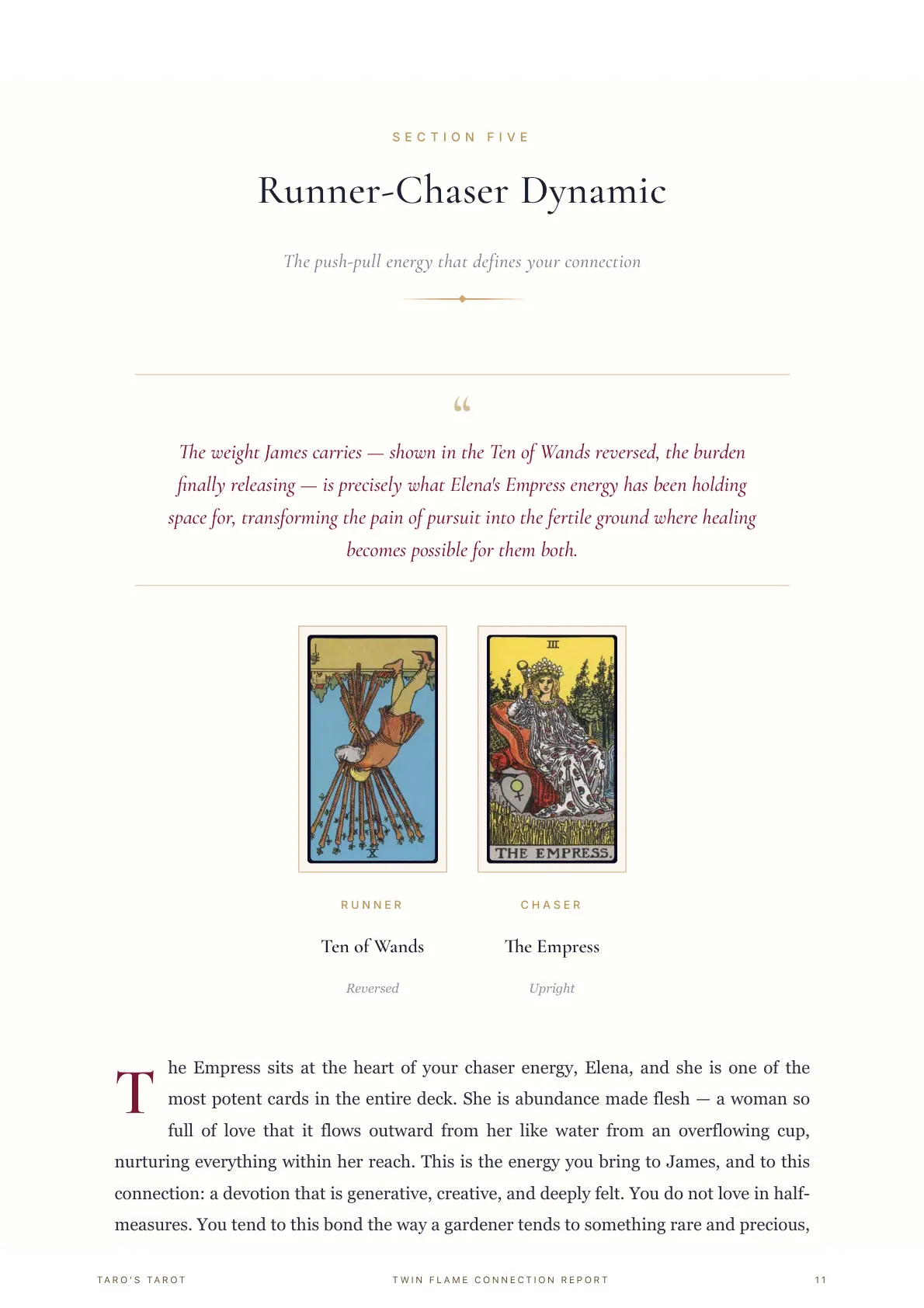
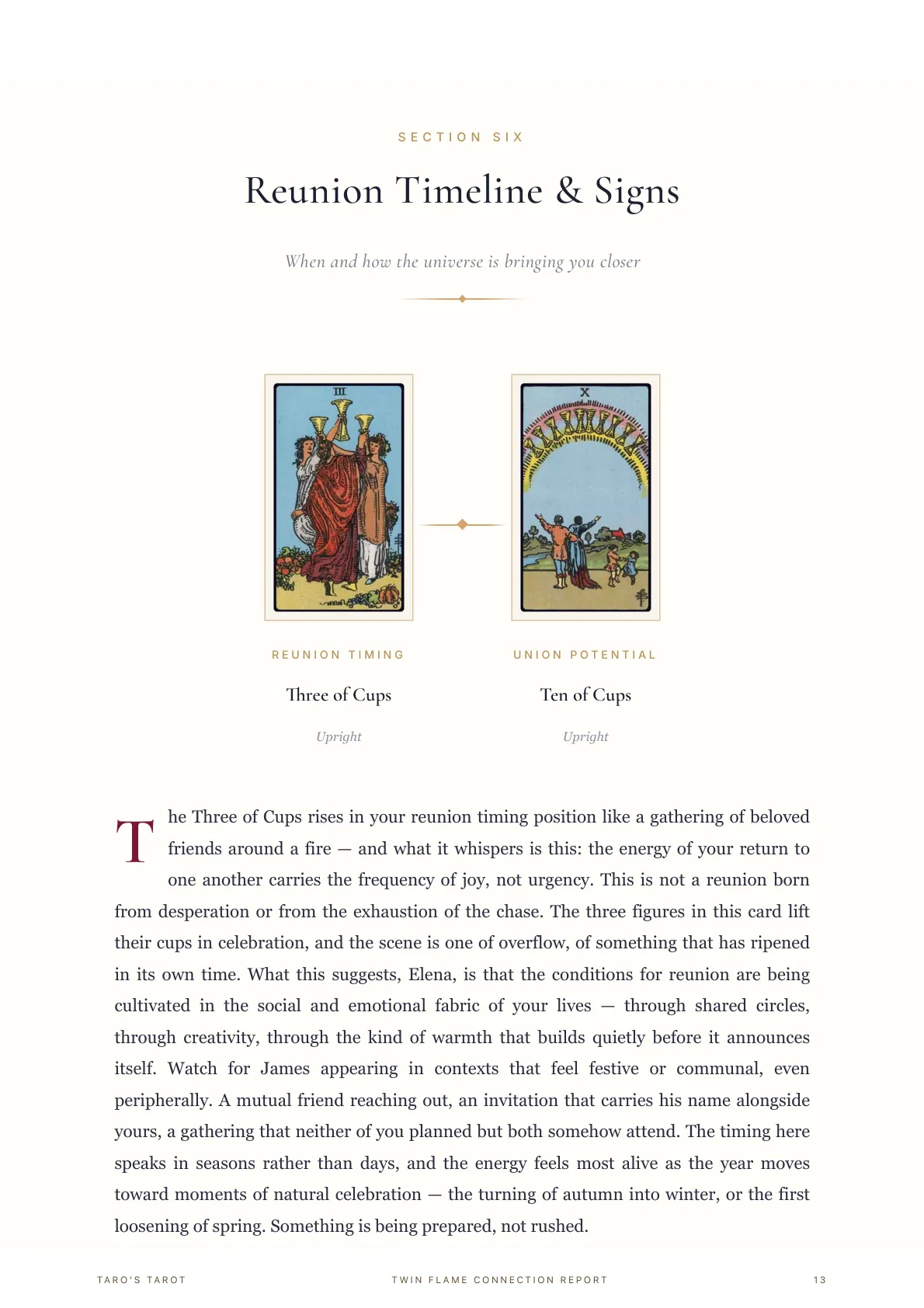
Sample pages from a real generated report — yours is written for you
$14.9930-day money-back guarantee — if your report doesn't feel genuinely specific to you, full refund, no questions asked.

Book
Twin Flames: The Honest Guide
The 8 stages, attachment theory, false twins, trauma bonds, and shadow work. Both frameworks, no fluff.
Get the Book — $14.99Understand Your Connection
Explore your attachment style or get a twin flame reading for personalized guidance.