Structured reflection for anxious thinkers
Tarot for Anxiety: A Grounding Practice for Overthinking Minds
How a deck of cards helps when the mind runs loops — not through prediction, but through constraint and externalisation. Three spreads that work, one clear warning about what to avoid, and honest clinical guidance on when to seek more.
Last updated: April 24, 2026

Why tarot helps anxious minds
Anxiety runs on unbounded thinking. A worry enters, spawns variants, and the mind iterates. The characteristic symptom is not the content of the worry — it's the open-endedness of the thinking. There is no edge, no constraint, nowhere for the loop to close.
Tarot, used well, interrupts this in three specific ways:
Constraint
A single card is a finite frame. Instead of thinking about everything, you think about this one image. Bounded thinking is less anxious thinking.
Externalisation
Putting the worry outside your head — onto a card, onto a page — creates observational distance. Narrative therapy calls this “externalising the problem”; it works the same here.
Grounding
Physical shuffling, choosing a card, writing about it — all tactile, deliberate actions. Anxious minds live in abstraction; a tactile ritual returns you to the room.
None of these require belief. They're structural properties of the practice. For the fuller psychology case, see the tarot psychology guide.
Three spreads for specific anxiety states
Different flavours of anxious thinking respond to different structures. Match the spread to the pattern.
1. Tarot for decision paralysis — the clarity spread
You know what the options are. You cannot choose. Every time you try to think about it, the thinking goes in circles. The problem isn't lack of information; it's that you're avoiding naming the trade-offs out loud.
Structure: Three cards. Card 1 = what Option A gives up. Card 2 = what Option B gives up. Card 3 = what staying put costs. The point is not that the cards tell you the answer; the point is that the question forces you to articulate what you're losing either way.
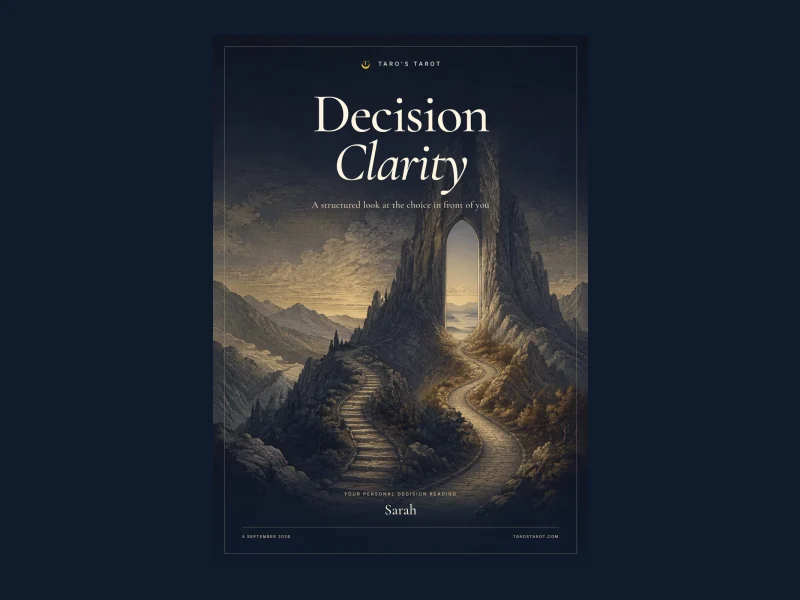
Inside the report: The Frame You're Avoiding
Stuck on a decision you've been turning over for weeks?
The Two of Wands in this position poses an awkward question: what if the decision isn't between staying and leaving — but between staying and being honest with yourself about why you haven't already left? You've been treating this as a coin-flip about a job. The alternative framing is that you decided months ago, and what you're actually deliberating is how to tell yourself you've decided...
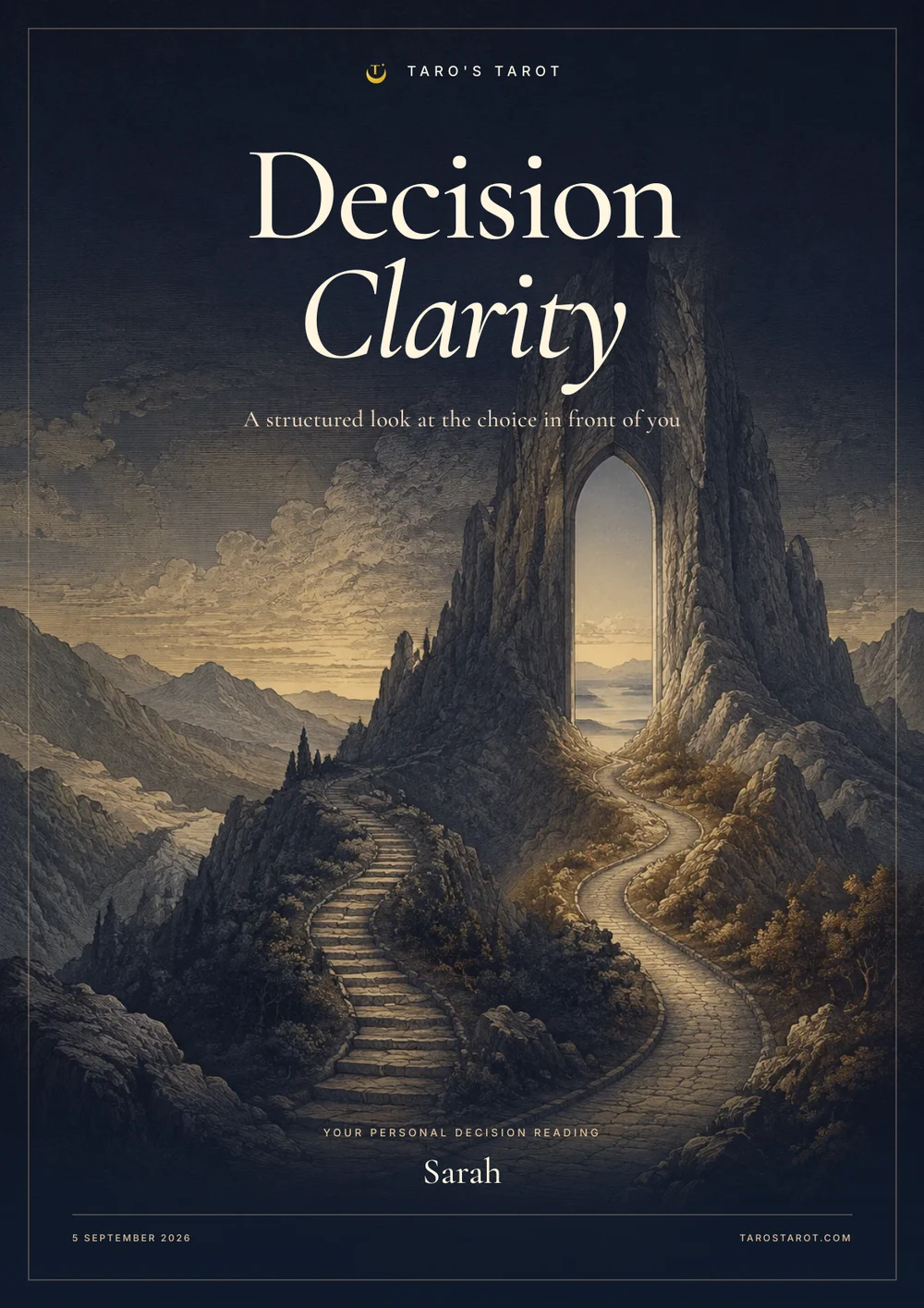
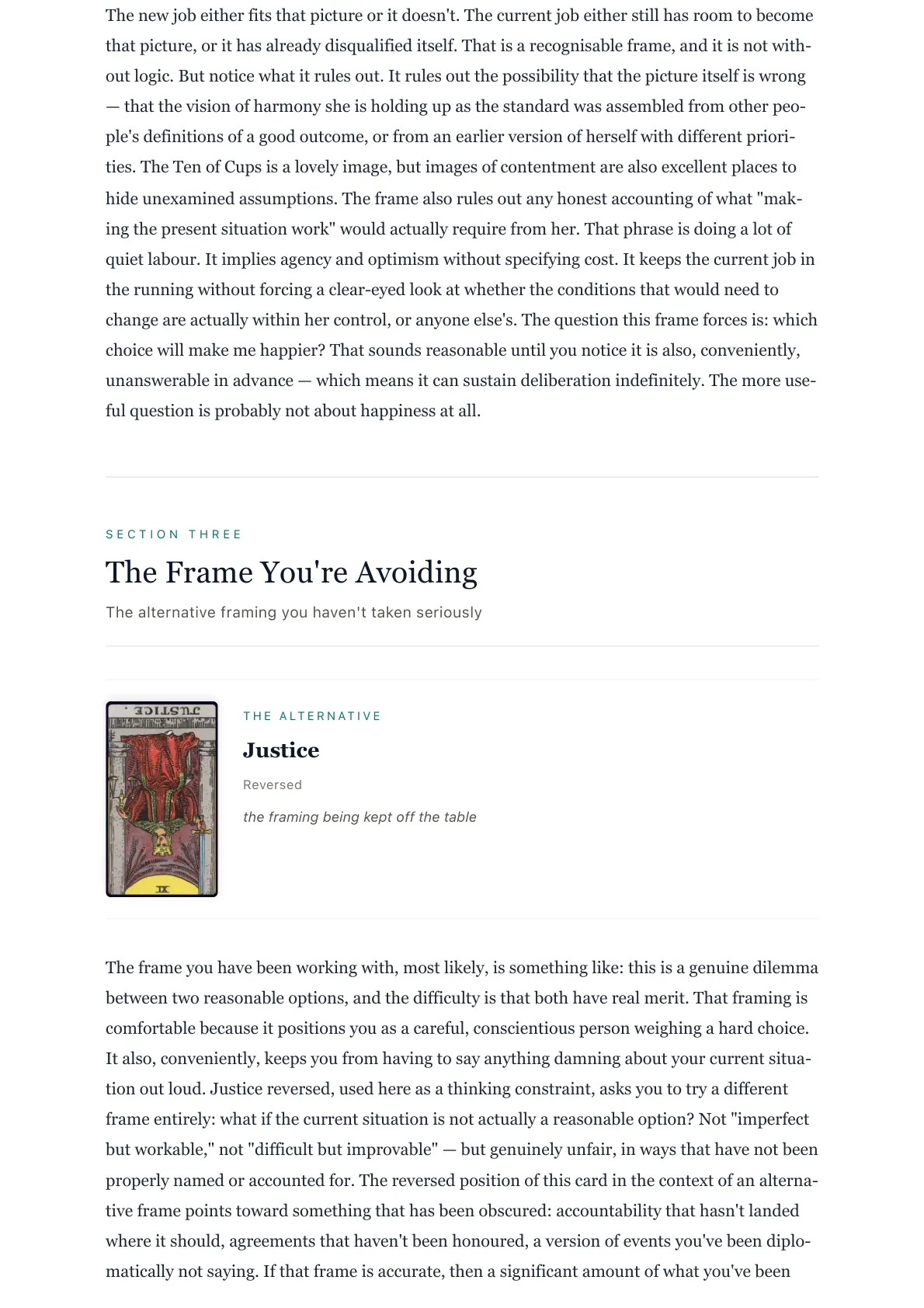
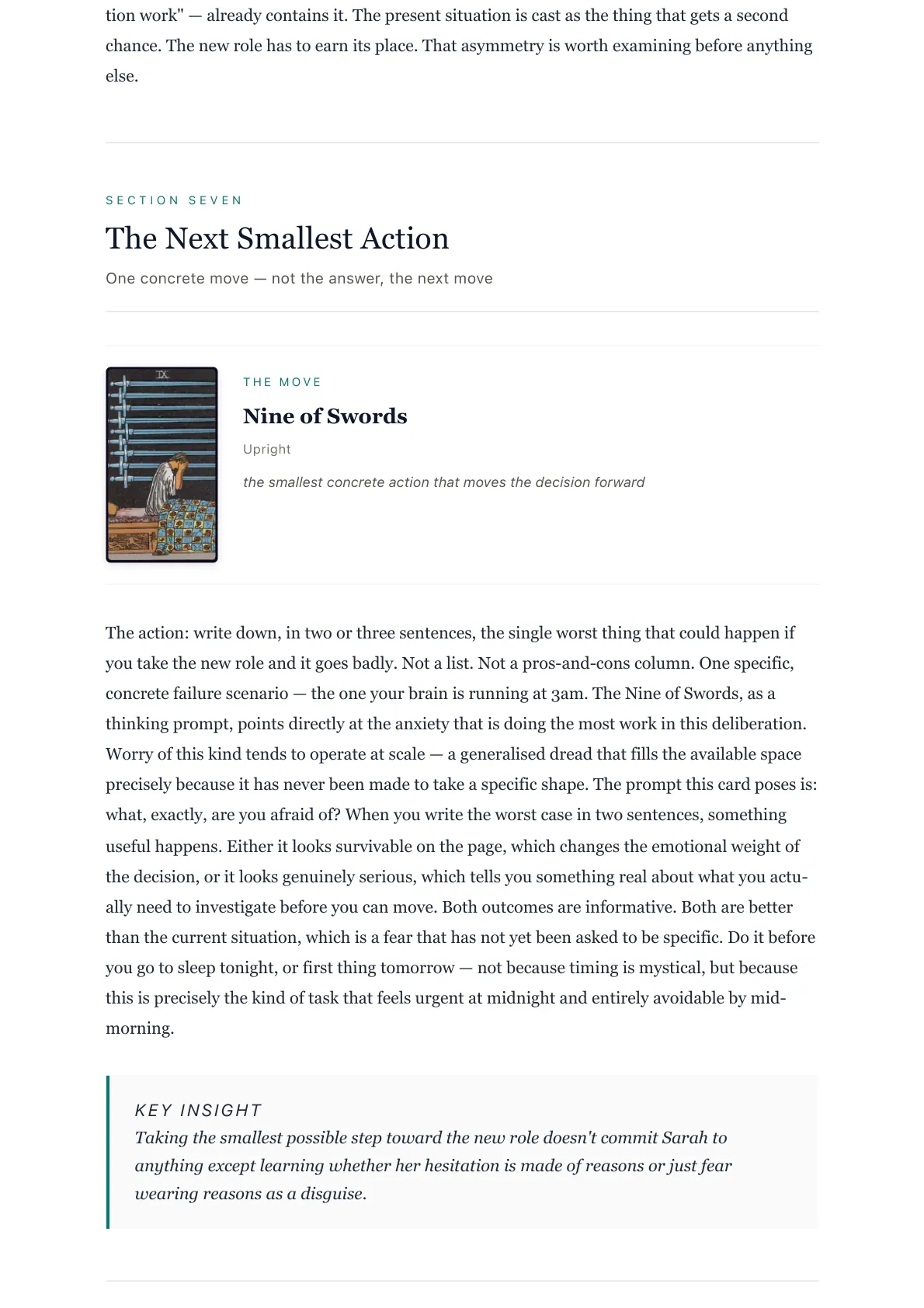
Sample pages from a real generated report — yours is written for you
$14.9930-day money-back guarantee — if your report doesn't feel genuinely specific to you, full refund, no questions asked.
2. Tarot for overthinking and rumination — the breaking-patterns spread
Same thought, different day. The worry resurfaces on a schedule, often attached to a person, place, or self-narrative. The pattern is the problem; any single pull is just a symptom.
Structure: A layered spread that identifies the recurring loop, what reinforces it, and what would interrupt it. Designed to surface the scaffolding under the thought, not the thought itself.
3. Tarot for the worry loop — the one-card pull
For the free-floating, low-grade anxiety that doesn't attach to anything specific. You don't know what you're worried about; you just know the mind won't settle.
Structure: Pull one card. Ask: “what am I not looking at?” Write for ten minutes. Stop. The deliberate smallness of the spread is the point — a single finite frame instead of the whole horizon.
“Anxiety is bad at being bounded. The card's job is to be a boundary — finite, visible, one frame only. You don't think about everything. You think about this.”
What NOT to do (predictive spreads spike anxiety)
Most anxiety-worsening tarot use comes from a predictable mistake: asking the cards to predict outcomes you can't control. The format of a predictive question — will X happen? — is exactly what anxious thinking is trying to resolve, and the card can't resolve it, so you pull again, and again, and the loop tightens.
Questions that will worsen your anxiety
- · “Will my ex come back?”
- · “Will I lose my job?”
- · “Will this health scare be okay?”
- · “Is everything going to be alright?”
- · “Does [person] secretly hate me?”
- · Any question you've already asked more than twice this week
Questions that will help
- · “What am I avoiding looking at?”
- · “What trade-off am I refusing to name?”
- · “What would grounded action look like right now?”
- · “What do I already know that I'm pretending not to know?”
- · “What would I tell a friend in this situation?”
The shape of a useful question, for anxious readers, is always: what is already here? The shape of a harmful question is always: what will happen later?
The CBT term for this: a “safety behaviour”
Cognitive behavioural therapy has a specific name for the pattern of repeatedly checking — pulling card after card about the same worry, hoping for a better answer. It's called a safety behaviour: an action that reduces anxiety in the short term but reinforces the underlying anxious belief in the long term. The relief lasts about twenty minutes; the anxiety comes back stronger because you've just taught your brain it needed checking in the first place.
The honest sign you've crossed into safety-behaviour territory: you're reading more tarot when anxious, not less. If that's the pattern, the move is to put the deck down for two weeks and bring the underlying worry to a therapist or a grounded friend. Tarot can't fix what tarot is being used to avoid.
When to also seek therapy (clinical red flags)
Tarot is a grounding tool. It is not a treatment for clinical anxiety. If any of the following are true, the right next step is a GP or a clinical psychologist, not another card pull:
- ·Anxiety is interfering with sleep, appetite, work, or relationships most days for weeks.
- ·Panic attacks: sudden surges of physical symptoms (racing heart, chest pain, derealisation).
- ·Intrusive thoughts you can't dismiss, or compulsive checking/rituals (including compulsive tarot pulling).
- ·Avoidance has narrowed your life: places, people, situations you've stopped engaging with because of fear.
- ·Thoughts of self-harm or suicide — call 988 (US), Samaritans 116 123 (UK), or your local emergency number immediately.
The tarot vs journaling vs therapy comparison explains where tarot belongs in a stack that includes proper clinical care. The short version: tarot is a between-session grounding aid, not a replacement for the trained second party therapy provides.
Related practices and reading
Clarity spread
The decision-framework spread for trade-off articulation.
Breaking patterns spread
For rumination and recurring worry loops.
Tarot for skeptics
The secular hub — no woo, no prophecy.
Why this works
The psychology case for projection, constraint, and externalisation.
One-card pull
Lowest-friction practice for free-floating anxiety.
Tarot journaling
Templates to capture what each reading surfaces.
Tarot for Anxiety — FAQ
Honest answers for anxious readers
Can tarot actually help with anxiety?
Yes, but through a specific mechanism: externalisation and constraint, not prediction. Anxiety thrives on open-ended, unbounded thinking — the mind running worst-case scenarios on loop. A card pull provides a visual boundary and a finite frame to think inside, which reliably interrupts rumination. This is closest to what cognitive behavioural therapy calls a thought-record exercise, with the card as the prompt.
Won't pulling cards make my anxiety worse?
It depends on what you ask. Predictive questions — "will I be okay?", "will X happen?" — almost always worsen anxiety, because they invite catastrophic imagery. Process questions — "what can I attend to today?", "what am I avoiding?" — reliably help. The guidance on this page is built entirely around the second category.
Is tarot a replacement for anti-anxiety medication or therapy?
No. If you have a clinical anxiety disorder — panic disorder, generalised anxiety disorder, OCD, PTSD — you need professional care. Tarot is a between-session grounding tool at best. It can help with everyday anxious thinking and decision paralysis; it cannot treat a diagnosed condition. See your GP or a clinical psychologist if symptoms are interfering with daily life.
What cards are "bad" for anxious people?
There are no bad cards, only bad framings. The Tower, Death, the Devil, and the Ten of Swords all look alarming and often trigger anxious readers who interpret them literally. They are not predictions — they are archetypes for disruption, transformation, compulsion, and rock-bottom. For anxious readers, the move is to treat every card as a prompt about what you are avoiding looking at, not a prophecy about what will happen.
How often should I pull a card if I have anxiety?
Once per day, at a consistent time, is the sustainable rhythm. Multiple pulls per day — especially asking the same question repeatedly hoping for a different answer — is a compulsion pattern and will worsen anxiety. If you notice yourself reaching for the deck multiple times for the same worry, that is a flag to stop and speak to someone who is not a tarot reader.
What should I do if a reading freaks me out?
Put the cards down. Write the reading in a journal without interpreting it for 24 hours. Then return to it with the question: "what about my current life could this be naming honestly?" The card is a projection surface, so what surfaced is material you brought. If the reaction is persistent or severe, that is information worth taking to therapy.
Can tarot help with decision paralysis specifically?
Yes, and this is one of its strongest use cases. A structured three-card decision spread forces you to articulate the trade-offs you have been avoiding — what Option A gives up, what Option B gives up, what staying put costs. The card is not telling you which to choose; it is forcing you to write down what you already know about each path.
Are there any spreads I should NEVER do when anxious?
Yes: any predictive spread about outcomes you cannot control ("will my ex come back", "will I lose my job", "will this test result be okay"). These spreads reliably amplify anxiety because they encourage catastrophic imagery without any grounding function. If you catch yourself wanting to pull cards to predict, that is the cue to put the deck down and write instead about what you are afraid of.
Still have questions? We're here to help!
Contact Support →Explore More Tarot Readings
Discover different ways to gain insight and guidance through our free tarot card readings