MOON PHASE COMPATIBILITY
Moon Phase Compatibility
Two birthdays. Two moments under the same sky. Discover how your birth moons come together.
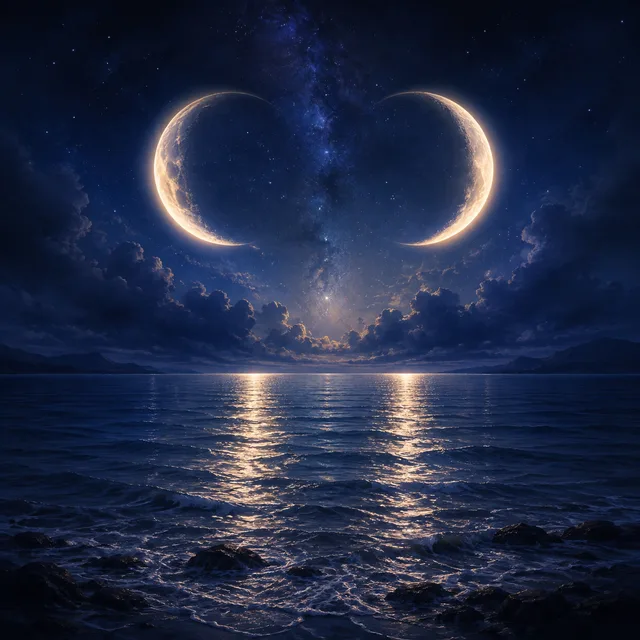
TWO MOMENTS UNDER ONE SKY
See how your moons meet.
Two birthdays · Real lunar phases
TWO MOMENTS UNDER ONE SKY
Every connection has its own orbit.
How the Moon Phase Soulmate Test Works
The idea went viral as a video edit: take a picture of the moon on the night you were born, take one from the night your partner was born, lay one over the other — and if the lit halves fill the circle, you have found your person. It is a beautiful image and most versions of it guess the phase from a chart. This calculator computes it. Each birth date is run through a real lunar ephemeris to get the exact phase angle, and the two discs are overlaid for you.
The rule is simple: opposite phases complete each other. A waxing crescent and a waning gibbous together light almost the whole disc — the Complete Moon match. Neighbouring phases are Kindred. The same phase is a Mirror. A quarter-cycle apart is the tension pairing. Each result comes with a reading of how your two moons love, and the percentage of the circle your moons light together.
The Eight Birth Moon Phases
Your birth moon phase is the point in the 29.5-day lunar cycle on the day you were born. Each phase carries a way of loving:
🌑 New Moon
beginnings · instinct · privacy
Born under a new moon, you lead with instinct and keep a lot beneath the surface. You are drawn to fresh starts and tend to fall for people quickly and privately — often before they know. In love you need a partner who reads what you do not say, and who is patient while you decide whether to let them all the way in.
🌒 Waxing Crescent
hope · effort · building
A waxing crescent birth moon makes you a builder in love — hopeful, willing to put in effort, and happiest when a relationship is growing toward something. You can over-invest early and struggle to notice when the other person is not building alongside you. You need a partner who shows up with their own bricks.
🌓 First Quarter
decision · action · friction
First-quarter people act. You make decisions fast, push through obstacles, and would rather have the difficult conversation than sit in ambiguity. In love that reads as decisive and sometimes as impatient; you need a partner who can hold their ground without either caving or escalating.
🌔 Waxing Gibbous
refinement · analysis · almost there
Born just before the full moon, you are a refiner — always adjusting, improving, asking whether this could be better. You are devoted once committed and prone to analysing the relationship to death. You need a partner who welcomes the attention and can also tell you, kindly, when it is already good enough.
🌕 Full Moon
intensity · visibility · feeling
A full-moon birth makes you emotionally vivid — you feel a lot, show a lot, and relationships with you are rarely lukewarm. You are drawn to people who are your opposite and then wrestle with the difference. You need a partner who is not frightened of intensity and who does not need you to be smaller to feel safe.
🌖 Waning Gibbous
sharing · teaching · generosity
Waning gibbous people are the givers and explainers — you want to share what you have learned, and you love by teaching, feeding, and making sense of things for the people you care about. The risk is turning a partner into a project. You need someone who receives well and has something to teach you back.
🌗 Last Quarter
release · reflection · independence
Born under a last-quarter moon, you are reflective and independent, always quietly editing what no longer fits. You let go of relationships that have stopped working more easily than most, and you can seem detached when you are actually processing. You need a partner who gives you room and does not mistake your silence for absence.
🌘 Waning Crescent
depth · intuition · rest
A waning crescent birth moon makes you the old soul of the cycle — intuitive, private, drawn to depth over novelty, and easily drained by relationships that run on drama. You love in a quiet, all-in way. You need a partner who values calm as much as you do and does not confuse your stillness with a lack of feeling.
The Five Moon Phase Matches
Complete Moon
Your moons are opposites — together they fill the circle.
This is the match the moon-phase soulmate test is looking for: one of you was born while the moon was growing, the other while it was shrinking, at nearly opposite points of the cycle. Overlay the two and the disc is almost entirely lit. In the language of the trend, you complete each other. In practice it means you are built differently — one of you initiates where the other reflects, one pushes where the other releases — and the relationship works when you treat that as complementary rather than as a problem to fix. Opposite-phase couples argue about pace more than about values. Learn each other’s rhythm and the fit is unusually strong.
Nearly Complete
Almost opposite — most of the circle lit, a sliver left dark.
Your birth moons sit on opposite sides of the cycle but not quite at the poles. Overlaid, they light most of the disc, with a small crescent of shadow where neither of you naturally shines. That gap is the growth edge of the relationship: a quality you both have to learn rather than one of you supplying it. Otherwise this pairing carries the strengths of the complete match — genuine difference, real complementarity — with slightly less friction over pace. Couples in this band tend to describe each other as “what I didn’t know I needed.”
Mirror Moons
Born under the same phase — you recognise yourselves in each other.
You were both born under the same moon phase. Overlaid, your moons trace the same shape — nothing new is lit, but everything that is lit is lit twice. This is the kindred-spirit match: instant recognition, the feeling of being understood without explanation, shared instincts about pace and privacy. Its risk is the blind spot you share. Two new moons can both hide; two full moons can both escalate; two last quarters can both drift. Mirror couples thrive when they deliberately borrow the qualities their phase lacks, rather than assuming that being alike is enough.
Kindred Phases
Neighbouring moons — same direction, slightly different timing.
Your birth moons are close on the cycle — both waxing or both waning, one a step ahead of the other. You move in the same direction in love and you understand each other’s instincts easily, with just enough difference to keep it interesting: one of you is a little further into the phase, and tends to see where the other is going. This is a comfortable, low-friction pairing that can feel like coming home. Its work is to keep it from becoming too comfortable — the shared rhythm can drift into routine unless one of you is willing to introduce the unfamiliar.
Quarter Tension
A right angle apart — the moons that challenge each other.
Your birth moons sit roughly a quarter cycle apart — the position astrologers call a square, the moon’s own crisis points. This is neither the mirror nor the complement; it is the pairing that pushes. One of you is in a phase of action while the other is in a phase of reflection, and the friction between those can be the most productive thing in either of your lives or the most exhausting, depending on whether you both respect the other’s mode. Quarter-tension couples grow more than any other type. They also need more explicit communication about what each of them is doing and why.
Is Moon Phase Compatibility Real?
Two honest things at once. The astronomy here is real: the phase we show for each date is the phase the moon was actually in, computed from the same ephemeris used for eclipse predictions. The pairing rule — opposites complete each other — is modern. It comes from a viral trend, not from traditional astrology, which reads the moon by its zodiac sign and by the aspects it makes to the other person's planets.
Use it the way it is best used: as a prompt for noticing how each of you loves — who initiates, who reflects, who lets go — rather than as a verdict. When you want the traditional version, the synastry chart compares all ten planets between your two charts, and the twin flame moon phase calculator asks the twin-flame question specifically.
Frequently Asked Questions
What is the moon phase compatibility test?
It compares the moon phases two people were born under. Each birth date is matched to the real lunar phase on that day — new, crescent, quarter, gibbous or full — and the two are overlaid on one disc. The trend’s rule is that opposite phases "complete" each other: a waxing crescent and a waning gibbous together light almost the whole circle. This calculator does the astronomy for real rather than guessing from a chart, then reads the pairing for how you each love.
How do I find my birth moon phase?
Enter your birth date above and the calculator looks it up using the same ephemeris astronomers use. The moon moves through its cycle in about 29.5 days, so the phase changes roughly 12 degrees per day — birth time can nudge the exact angle but almost never changes which of the eight phases you fall in. The eight phases in order are: New Moon, Waxing Crescent, First Quarter, Waxing Gibbous, Full Moon, Waning Gibbous, Last Quarter, Waning Crescent.
What does it mean if our moons complete each other?
It means you were born at nearly opposite points of the lunar cycle — one while the moon was growing, the other while it was shrinking. Overlaid, the two lit halves fill the circle. In the trend this is the "soulmate" result. In practice it describes two people built differently: one initiates where the other reflects, one pushes where the other releases. Those couples tend to fit unusually well once they learn each other’s pace.
Is the moon phase soulmate test real?
The astronomy is real — we compute the actual moon phase for each date. The pairing rule is modern; it comes from a viral trend rather than from traditional astrology, which reads the moon by zodiac sign and by aspects between two charts rather than by phase alone. Treat it the way you would treat any compatibility lens: a prompt for noticing how you each love, not a verdict. If you want the traditional version, the synastry chart compares all ten planets between your two charts.
What if we were born under the same moon phase?
That is the Mirror Moons match — overlaid, your moons trace the same shape. It is the kindred-spirit pairing: instant recognition, shared instincts about pace and privacy, the feeling of being understood without explaining. Its risk is the blind spot you share. Two new moons can both hide; two full moons can both escalate. Mirror couples thrive when they deliberately borrow what their phase lacks.
How is this different from the twin flame moon phase calculator?
Same astronomy, different question. The twin flame moon phase calculator asks whether a connection has the specific mirror-and-runner signature people mean by "twin flame" and returns a twin flame match percentage. This page is the general couple version: any two people, any relationship, read for how your two moons fit. If you are asking about a twin flame specifically, use that one.
Weekly Love & Lunar Guidance
Relationship insight and moon-cycle wisdom in your inbox each week — free forever.
Twin Flame Moon Phase Calculator
The twin-flame version — lunar match percentage.
Soulmate Calculator
Numerology + astrology compatibility from two birth dates.
Synastry Chart
Real planet-to-planet aspects between your two charts.
Moon Sign Calculator
Which sign your moon was in — the emotional core of your chart.
Love I Ching
Cast the coins on your relationship question.
Explore More Spiritual Tools
Discover more ways to explore your spiritual journey
Looking for more spiritual guidance?