Personalised reading
Drew Death and Knight of Swords? Read your exact spread
Already have these cards in front of you? Add the third card from your own spread — or draw one live — and we'll read your exact cards together.
What Do Death and Knight of Swords Mean Together?
When a Major Arcana card lands beside a court card, the court card is a person, or the role you are playing, and the Major card is the situation they are standing in. Ask who the Page, Knight, Queen or King is in your life, then read the Major card as what is happening to them, or through them.
What Death brings
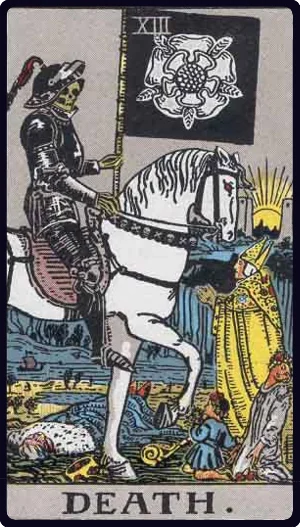
Death ends something in any pairing. A skeleton in black armour rides a white horse past a fallen king under a black banner carrying a white rose, while a bishop, a woman and a child wait and the sun rises between two towers. Whatever the other card describes, part of it is finished and will not return in that form.
What the Knight of Swords brings
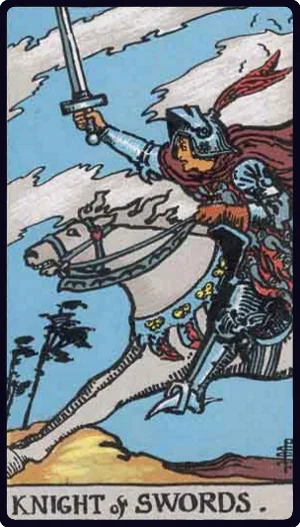
The Knight of Swords rushes any pairing. He charges on a horse at full stretch with his sword held high, clouds torn ragged and trees bent flat behind him, so whatever the other card describes is about to be acted on at speed and without a second look. The Knight supplies the pace; the other card is the target.
Side by side
With a Minor Arcana card, Death says the everyday matter in that suit is closing for good. A Pentacle makes it a job or an income that ends, a Cup a relationship or a phase of one, a Sword a belief given up, a Wand a project abandoned. Whatever the suit, it lies in front of the horse.
Next to a Major Arcana card, the Knight of Swords charges across whatever ground the Major lays down. A card of patience says the speed is the mistake; a card of justice means the cause is right and the argument wins; a card of upheaval means he is riding straight into it.
Learn more about each card individually: Death meaning and Knight of Swords meaning.
What Does This Combination Mean in Love?
In love readings, Death with Knight of Swords points to an ending in love: a separation, a loss or a relationship that has run its course.
Death in love
In a love pairing, Death is the end of a relationship or of a version of it: single life ending at a wedding, a marriage ending, a couple leaving one way of being together. The other card is what grows after. A card of renewal means a better bond; a card of grief means the loss is still the story.
The Knight of Swords in love
In love the Knight of Swords is the partner who says it all at once, the fast pursuit, the argument begun on the doorstep. What the speed hits is the other card. A card of tenderness means the bluntness is forgiven because it is honest; a card of hurt means the words landed before they were thought through.
Read together
Read together, this pairing signals heartbreak or a chapter closing, and the ending makes room for what comes next.
Give yourself time to grieve what is ending. Moving on gets easier once you stop trying to hold together something that has already changed.
For more on how individual cards shape romantic readings, explore Death in love and Knight of Swords in love.
Wondering about a specific person?
Based on your card combination: Death + Knight of Swords
What are they thinking in the silence?
Your card combination — Death + Knight of Swords — is where it starts. The No-Contact Report shows how it actually plays out for you.
- Find out what they're thinking during the silence
- Know whether no-contact is actually working
- Clear guidance on when to break silence
If your report doesn't feel genuinely specific to you — full refund, no questions asked.
What Does This Combination Mean for Career?
For career and finances, Death with Knight of Swords signals career transitions, job changes, or major shifts in your professional identity.
Death at work
At work, Death next to any card means the job, role or business in the other card is ending, usually completely. Redundancy or a closed company in Pentacles, a career changed in Wands, a desk cleared either way. The practical reading is to stop resuscitating it and start on what the sun is rising over.
The Knight of Swords at work
At work the Knight of Swords is the decision taken in an afternoon, the lawyer who writes the letter, the deal in the other card closed by someone in a hurry. Beside a Pentacle the speed costs a detail found later; beside a Wand a competitor justifies the rush; beside a Queen a colleague who rightly slows him down.
Money
For money, Death points to financial transformation, ending of old money patterns, economic rebirth. The Knight of Swords points to impulsive financial decisions, quick money actions, or charging ahead with investments.
See how each card influences work individually: Death for career and Knight of Swords for career.
What Does This Combination Mean Reversed?
Reversed, Death turns to resistance to change and incomplete transformation, the Knight of Swords to reckless action and harsh communication.
Death reversed
When Death is the reversed card in a pair, the ending is being refused and the thing is kept past its time. The upright card says what is being held. A card of comfort or habit means a situation preserved out of fear; a card of pressure means the change comes anyway and resisting only makes it later and harder.
Knight of Swords reversed
When the Knight of Swords is the reversed card in a pair, the charge goes wrong: a rash message, a plan launched without its one needed check, or a rider who talks and never moves. A calm card beside it says slow down and the damage is small. A hot card means two people racing each other off one cliff.
Death and Knight of Swords: Yes or No?
Death and Knight of Swords pull in different directions. Death signals necessary endings - the current path must transform rather than continue, but Knight of Swords charges straight through, fast and blunt, whatever it knocks over.
Death
NoThe rider on the white horse stops for nobody, king or child. The answer is no to the question as asked, because the thing you want to continue is ending. The card is not a disaster: the sun rises between the towers behind the figure, but only on the far side of the ending.
In a yes or no question Death votes no to keeping anything as it is, and the answer to the real question is the change itself. Paired with a yes card, the answer is yes once the old form is let go. Paired with another no card, the answer is no and it is final.
Knight of Swords
YesThe knight charges at full gallop through a storm with the sword forward. The answer is yes, and the yes is immediate: decisive action, direct words, a problem cut through rather than negotiated. The cost is collateral; the knight does not slow down to check what he hits.
In a yes or no question the Knight of Swords votes yes, now, and would rather be wrong fast than right late. Beside another yes card the answer is yes and it is already in motion. Beside a no card the answer is yes to the action and no to the outcome: the charge happens, and it costs.
For a deeper look at individual card yes/no meanings, see our complete yes or no tarot guide or check any other pairing with the tarot combination calculator.
Individual Card Meanings
Death
Death represents profound transformation and the ending of one phase of life to make way for something entirely new.
Knight of Swords
The Knight of Swords represents taking quick action on ideas, charging ahead with mental determination and intellectual courage.
Common Questions
About Death and Knight of Swords
What does Death and Knight of Swords mean together in a tarot reading?
Is Death with Knight of Swords a positive or negative combination?
What does Death and Knight of Swords mean for love and relationships?
What does Death and Knight of Swords indicate for career?
What if Death or Knight of Swords appears reversed?
Still have questions? We're here to help!
Contact Support →Explore More Tarot Readings
Discover different ways to gain insight and guidance through our free tarot card readings