THE WAY YOU CONNECT
Twin Flame or Karmic Relationship? Free Quiz
How did this connection begin?
Choose the answer that feels most like you.
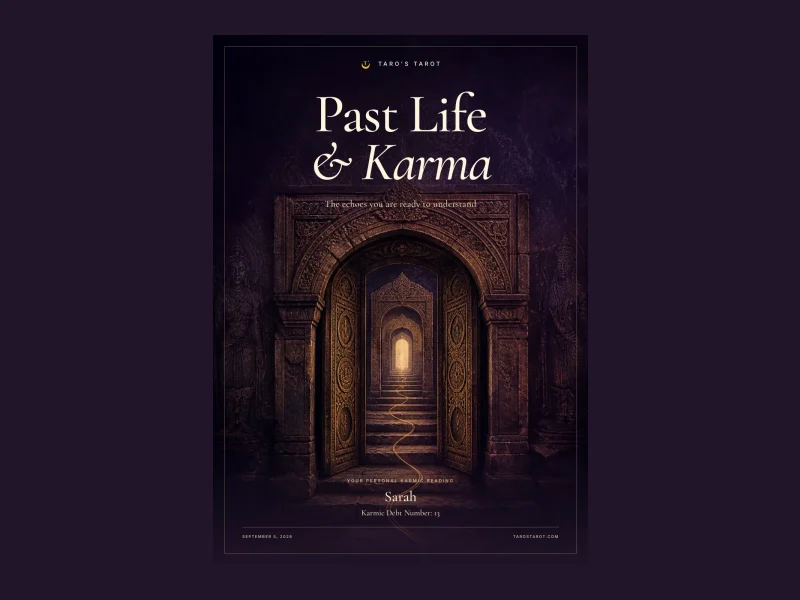
Inside the report: Your Past Life Imprint
What pattern keeps following you?
Death in the Echo position speaks to a past life that ended abruptly — not gently, not in its own time, but through a sudden severance. This is not necessarily a physical death. More precisely, Death here represents a complete ending of identity: a life in which everything you knew yourself to be was stripped away...
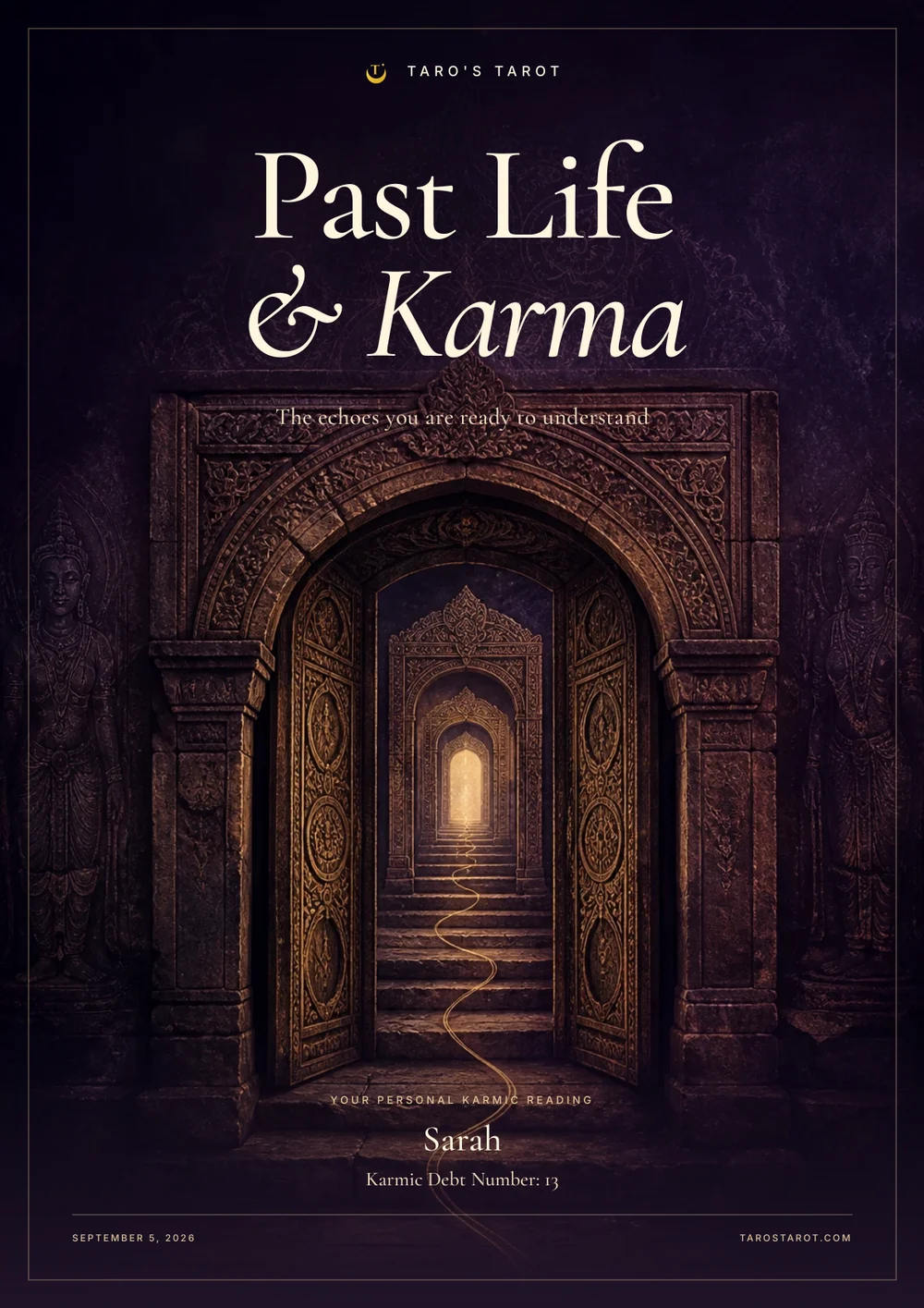
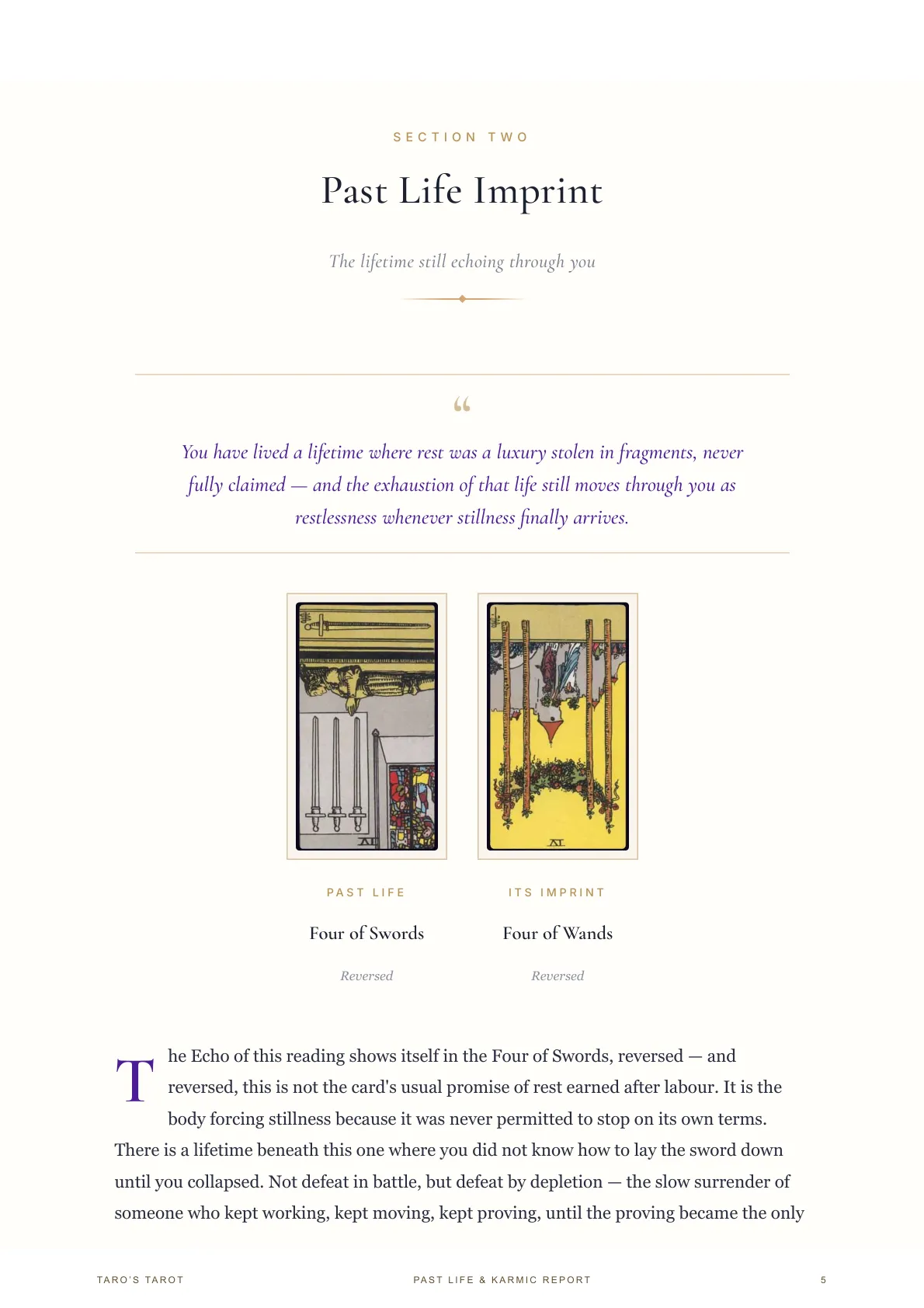
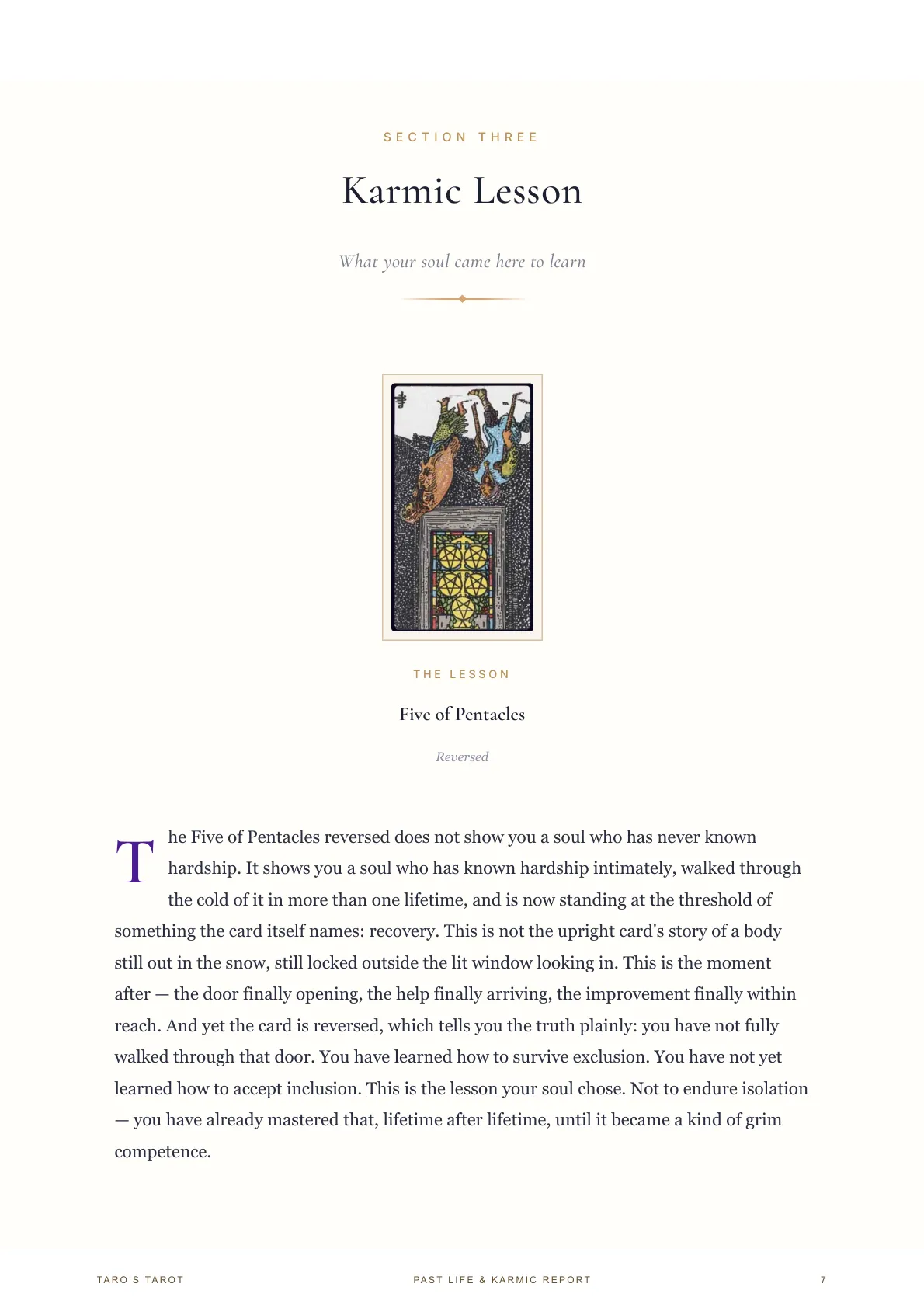
Sample pages from a real generated report — yours is written for you
$14.9930-day money-back guarantee — if your report doesn't feel genuinely specific to you, full refund, no questions asked.
“A karmic relationship doesn't ask you to stay forever. It asks you to learn something — and the moment you truly learn it, the pull that felt like fate begins to feel like a choice.”
Jump to a Connection Type
The Five Connection Types
Not every intense connection is a twin flame, and not every painful one is karmic. Each type below has a distinct signature — how it begins, how it fights, how it ends — and a tarot archetype that captures its shape. Find the one that feels like yours.
Karmic Lesson Relationship
This connection arrived with a curriculum. It found the exact place where you were unfinished — your boundaries, your self-worth, your voice — and it has been pressing on that place ever since. Karmic lesson relationships are rarely gentle, but they are precise: the same wound gets touched again and again until you finally tend to it.
You keep noticing that this relationship asks something of you that no other relationship has. Maybe it demands that you speak up when you've always gone quiet, or hold a boundary you've always folded on, or stop earning love you should be given freely. The friction isn't random — it's specific. And part of you already suspects that the day you truly learn the lesson is the day the relationship changes form or completes.
Strengths
- You are growing faster inside this connection than you ever did in comfortable ones
- The friction is showing you exactly where your unfinished work lives
- Karmic lessons, once learned, tend to stay learned — this is durable growth
- Your willingness to look at this honestly (you're here) is the first sign the lesson is landing
Watch For
- It's easy to mistake the intensity of a lesson for the depth of a love
- You may stay past the lesson's completion out of loyalty to the pain
- The relationship can become a classroom you never graduate from
- Repeating the same conflict without change means the lesson is circling, not landing
Tarot Archetype
Justice — the karma card itself. The scales weigh cause and effect without sentiment: what was set in motion must balance. Justice doesn't punish; it corrects. This relationship is the correction — the place where an old imbalance in how you love, give, or protect yourself is finally being weighed and settled.
Guidance
Ask the question this relationship keeps asking you — you already know what it is. Write it down. Then ask: "Have I actually answered it yet, or have I just endured it?" Karmic lesson relationships complete in one of two ways: the lesson is learned and the bond either transforms or releases, or the lesson is refused and it repeats — here or with the next person. Do the work here, whatever you decide about the relationship. The lesson travels with you; the person doesn't have to.
Twin Flame Dynamic
This connection behaves like a mirror with a heartbeat. The recognition was instant and unnerving, the intensity is unlike anything you've known, and the person seems to reflect back both the best of you and the parts you've spent years avoiding. Twin flame dynamics run on magnetism — including the push-pull of running and chasing.
You feel seen by this person in a way that is almost uncomfortable. They trigger you like no one else can — not because they're cruel, but because they hold up everything you haven't made peace with in yourself. The connection swings between euphoric union and painful separation, and even at maximum distance, the pull never fully switches off. You may have already noticed the pattern: one of you approaches, the other retreats, then you trade roles.
Strengths
- No relationship has ever shown you yourself this clearly
- The intensity is burning away personas you've hidden behind for years
- This connection is accelerating growth that might otherwise have taken decades
- The love underneath the chaos is real — mirrors only work because something true is reflected
Watch For
- The runner-chaser cycle can masquerade as destiny while functioning as instability
- Intensity addiction: calm connections may now feel "dead" by comparison
- You can lose your own center orbiting someone else's reflection
- "Twin flame" can become the story that keeps you in a dynamic that hurts you
Tarot Archetype
The Lovers — but read closely. The card isn't about being swept away; it's about conscious choice between paths. The two figures stand exposed before something larger than themselves. A twin flame dynamic forces the same nakedness: you cannot hide in it. The question The Lovers asks is not "is this destined?" but "what do you choose, now that you can see everything?"
Guidance
Stop asking whether they're your twin flame and start asking what the mirror is showing you. Every trigger is coordinates: it marks a place in you that wants healing, and that healing is yours to do whether this person stays or goes. If you're in a runner-chaser loop, the most loving move — for both of you — is to stand still: work on your own reflection instead of managing theirs. Union, if it comes, only holds between two people who no longer need the mirror to know themselves.
Soulmate Connection
This connection feels less like a collision and more like a homecoming. There's recognition here — a sense of "oh, it's you" — but instead of burning, it settles. Soulmate connections are marked by ease: you can be fully yourself, conflict gets repaired instead of weaponised, and time together restores you rather than draining you.
You keep waiting for the catch, and it keeps not coming. This person feels familiar without feeling fated-in-a-frightening-way. You disagree without destroying, you can sit in silence without static, and being with them makes you more yourself, not less. If you've survived intense or karmic bonds before, this calm might even confuse you — a part of you may whisper that peaceful means passionless. It doesn't.
Strengths
- The love is regulated: your nervous system rests around this person
- Conflict leads to repair and understanding, not cycles of rupture
- You are becoming more yourself inside this bond — growth without demolition
- This connection models what secure love actually feels like
Watch For
- If you're wired for intensity, you may mistake this peace for boredom
- Ease can breed complacency — soulmate bonds still need tending
- You may sabotage calm love to return to the chaos that feels like home
- Idealising the "soulmate" label can make normal rough patches feel like betrayals
Tarot Archetype
Two of Cups — tarot's card of mutual, reciprocal love. Two figures meet as equals and exchange cups: nothing is taken, nothing is owed, everything is offered. Unlike the consuming fire of The Lovers under pressure, the Two of Cups is love at eye level — recognition that nourishes instead of devours.
Guidance
Protect this. Not with vigilance — with presence. Soulmate connections don't demand the frantic work karmic bonds do, and that's exactly why people neglect them. Keep choosing each other on the ordinary days. If a part of you itches for the old intensity, name it honestly: that itch is usually an old wound missing its familiar pain, not a signal that something is missing here. Calm love is not a lesser love. It's what the lessons were for.
Karmic Cycle on Repeat
This isn't just a relationship — it's a loop. You break up and come back. You have the same fight in different costumes. You leave certain you're done, and the pull drags you back before the certainty cools. A karmic cycle is a lesson that hasn't landed yet, repeating with increasing volume until it does.
You know this script by heart: the rupture, the silence, the ache, the message, the reunion that feels like relief, the slow slide back into the exact same dynamic. You've probably said "this time is different" more than once — and meant it. The pull toward this person operates below your logic; your friends don't get it, and honestly, neither do you. That's the signature of a cycle: it doesn't need your agreement to repeat.
Strengths
- You already see the pattern — most people inside a cycle can't
- Every repetition has been showing you the same lesson more clearly
- The exhaustion you feel is real data: the cycle is completing its teaching
- Cycles CAN be broken — and you're one honest decision away from beginning
Watch For
- Each return deepens the groove, making the next exit harder
- Intermittent reunion works like a slot machine on your attachment system
- The cycle is consuming years, energy, and self-trust
- Staying in the loop often means repeating it later with someone new anyway
Tarot Archetype
The Wheel of Fortune — the great cycle turning. Souls ride the wheel up into reunion and down into rupture, again and again, until someone steps off. The Wheel's secret is written at its center: the hub doesn't spin. There is a still point in you that can watch the cycle instead of riding it — and from there, choose.
Guidance
Name the loop out loud, in one sentence: "We break up, then X happens, then we come back, then Y happens." Seeing the mechanism is the beginning of breaking it. Then interrupt ONE link — usually the reunion trigger (the late-night message, the "accidental" run-in, the anniversary ache). Cycles don't end through willpower at the hardest moment; they end by removing one gear when things are quiet. And do the deeper work: the cycle is powered by an unlearned lesson, and until it's learned, leaving this person only relocates the loop. Learn it here, and you're free everywhere.
A Human Relationship (And That's Enough)
Here's the honest result almost no quiz will give you: this connection doesn't show the signature of a karmic contract, a twin flame mirror, or a fated soulmate bond. It shows two humans — with compatibility, friction, history, and choices. And that isn't a lesser answer. It might be the most freeing one.
Your answers describe a relationship that began the way most real ones do — gradually, imperfectly, without lightning — and runs on ordinary human forces: how you communicate, what you each need, how much you've both grown. The struggles you face don't look cosmic; they look like the solvable (or sometimes unsolvable) problems of two people building something. If you came here hoping for a mystical explanation, notice what that hope might be doing: sometimes we reach for destiny language to avoid a plainer question.
Strengths
- You get to evaluate this relationship on its actual merits — no cosmic obligation
- Ordinary problems have ordinary solutions: communication, boundaries, effort, honesty
- No "fated bond" story is trapping you in something that hurts you
- Real, chosen, human love is the thing all the mystical labels are reaching for anyway
Watch For
- Without a destiny narrative, you have to sit with a harder question: do I choose this?
- You may feel oddly disappointed — notice that feeling, it's informative
- "Just human" can be misread as "not special" (it isn't — specialness is built, not assigned)
- Ordinary relationships still fail from neglect; no karma will hold this together for you
Tarot Archetype
Ten of Cups — the rainbow over an ordinary home. Tarot's picture of fulfilled love isn't a burning tower or a cosmic union; it's two people in a garden they planted themselves. The Ten of Cups is earned, not fated — which makes it the most hopeful card in the deck. Nothing decided this for you. You get to build it.
Guidance
Take the question you were really asking this quiz — "is this connection meant to be?" — and translate it into human language: "Is this relationship good for me? Do we treat each other well? Can we grow here?" Answer those with the same honesty you'd want from a friend. If the answer is yes, invest without needing the universe's permission slip. If the answer is no, you're allowed to leave without needing a karmic justification. Either way: the meaning of this relationship is not hidden in a past life. It's visible in how you feel on an average Tuesday.
Karmic Relationship vs Twin Flame vs Soulmate
These three labels get used interchangeably, but they describe fundamentally different connections. A karmic relationship is a teacher: it arrives carrying a specific lesson — boundaries, self-worth, letting go — and it presses on that exact wound until you address it. Karmic bonds are intense but usually temporary; their purpose is completion, not permanence.
A twin flame is a mirror: the connection reflects your deepest insecurities and your highest potential back at you simultaneously. Twin flame dynamics are marked by instant, unnerving recognition, extreme intensity, and often a runner-chaser pattern where closeness triggers retreat. The relationship's work is self-confrontation — you cannot hide in it.
A soulmate is a companion: recognition that settles instead of burns. Soulmate connections feel like homecoming — ease, repairable conflict, and a nervous system that rests. The quickest diagnostic: karmic bonds repeat, twin flames mirror, soulmates regulate. And some connections are none of the three — just two humans choosing each other, which needs no cosmic label to matter.
Signs of a Karmic Relationship
The clearest sign is repetition with precision: the same fight in different costumes, always landing on the same nerve — your voice, your worth, your boundaries. Where ordinary relationship conflict is varied and situational, karmic conflict is a single lesson wearing many disguises.
- An instant, magnetic beginning that turned turbulent unusually fast
- A pull toward the person that persists even when the relationship is hurting you
- On-off cycles — breaking up and returning as if the door never fully closes
- A sense of familiarity, debt, or grief that feels older than the relationship itself
- The relationship keeps demanding the one thing you've always struggled to do in love
- Growth through friction: you're changing faster here than in any calm connection you've had
One caution: intensity alone is not proof of karma. Anxious attachment, trauma bonding, and plain incompatibility can all generate the same heat. The karmic signature is specifically the lesson — a repeating demand for growth that follows you until it's met.
Why Karmic Relationships End
Karmic relationships end because ending is their design. In the karmic framework, the connection exists to deliver a lesson carried over from a past life or an earlier pattern — and once that lesson is genuinely learned, the bond's purpose is complete. This is why karmic breakups often carry a strange double feeling: devastating grief alongside an unmistakable sense of release, as if something that gripped you for years finally opened its hand.
The endings tend to arrive in one of three ways. Some burn out — the intensity that fuelled the connection consumes it. Some complete — one or both partners learn the lesson, and the magnetic pull simply fades, often faster than seems possible. And some transform — the couple breaks the karmic cycle together and rebuilds on new ground, which is rare and requires both people to do the work.
What karmic relationships cannot do is continue unchanged. If yours keeps ending and returning without anything shifting, that's not the bond refusing to die — it's the lesson refusing to be skipped.
Breaking a Karmic Cycle
A karmic cycle breaks in the quiet moments, not the dramatic ones. Willpower at the hardest moment — the 2am message, the anniversary ache, the "accidental" run-in — almost always loses to the pull. What works is dismantling the loop while it isn't running.
- Name the mechanism. Write the loop as a sequence: rupture → silence → ache → contact → reunion → slide back. A cycle you can see is a cycle you can interrupt.
- Remove one gear. Identify the link that restarts the loop for you — usually the reunion trigger — and eliminate it during a calm stretch: mute, block, change the route, tell a friend the plan.
- Learn the lesson underneath. The cycle is powered by unfinished work — boundaries, self-worth, speaking truth, letting go. Until that work is done, leaving one person only relocates the pattern to the next.
- Grieve the fantasy, not just the person. Karmic cycles survive on the almost — the version of the relationship that was always one reunion away. Release requires mourning what it never quite became.
The measure of a broken cycle isn't that you never think of them. It's that the pull, when it comes, is a memory instead of a command.
Frequently Asked Questions
What is a karmic relationship?
A connection believed to exist for the purpose of teaching a soul lesson — often carried over from a past life or an earlier chapter of this one. Its signature is repetition: the same conflict, wound, and threshold returning until the lesson is learned. Karmic relationships are intense, often painful, and rarely permanent.
Is a twin flame the same as a karmic relationship?
No. A twin flame is a mirror — reflecting your wounds and potential, often with a runner-chaser dynamic. A karmic relationship is a teacher — built around one repeating lesson, and it typically completes once that lesson lands. Both are intense, which is why they're so often confused.
Can a karmic relationship last, or do they always end?
Most complete and release once their lesson is learned. A rare few transform: both partners break the cycle together and rebuild on healthier ground. What a karmic relationship cannot do is continue unchanged — the loop either completes through release or through genuine transformation.
How do you break a karmic cycle?
Name the loop precisely, interrupt one link (usually the reunion trigger) while things are calm rather than trusting willpower at the hardest moment, and do the underlying work — boundaries, self-worth, voice, or letting go. The cycle runs on that unfinished lesson, and until it's learned, leaving one person only moves the pattern to the next.
This quiz is for self-reflection and entertainment purposes only. It is not a substitute for professional relationship or mental health support.

Book
Twin Flames: The Honest Guide
The 8 stages, attachment theory, false twins, trauma bonds, and shadow work. Both frameworks, no fluff.
Get the Book — $14.99Explore More Quizzes
Discover more ways to explore your spiritual journey
Looking for more spiritual guidance?