A LITTLE MORE UNDERSTANDING
Is My Mother a Narcissist?
Something genuinely good happens to you. What happens when you tell her?
Choose the answer that feels most like you.
Inside the report: What They Can't Give You
Some of the hardest relationships are the ones you never chose.
The Four of Cups in the Limit position names something you have probably suspected for years: the acknowledgement you keep waiting for is not being withheld to punish you — it may simply not be in their repertoire. There is a difference between a door that is locked and a door that was never built, and this card leans toward the second. That distinction changes what you grieve, and what you stop asking for...
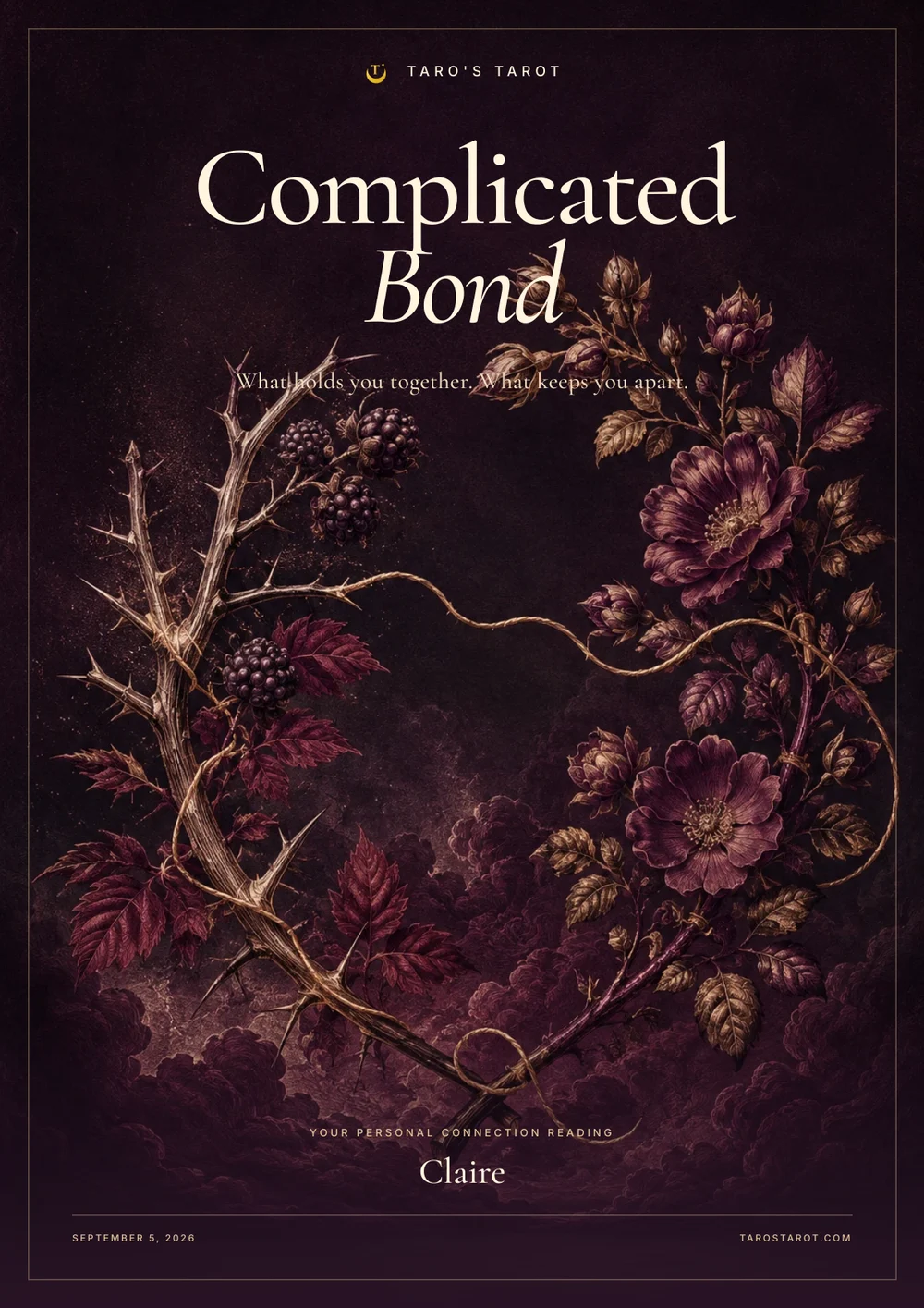
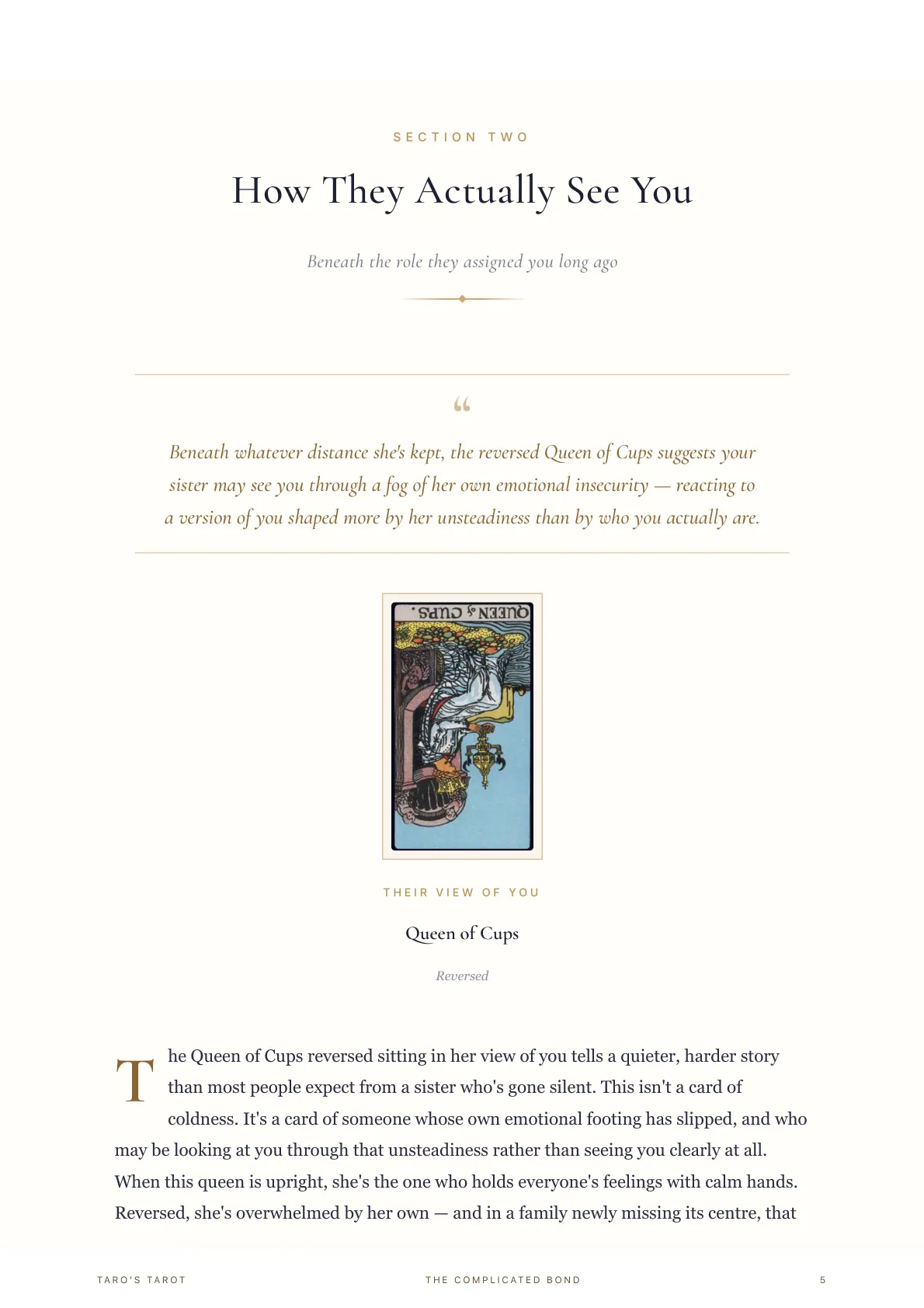
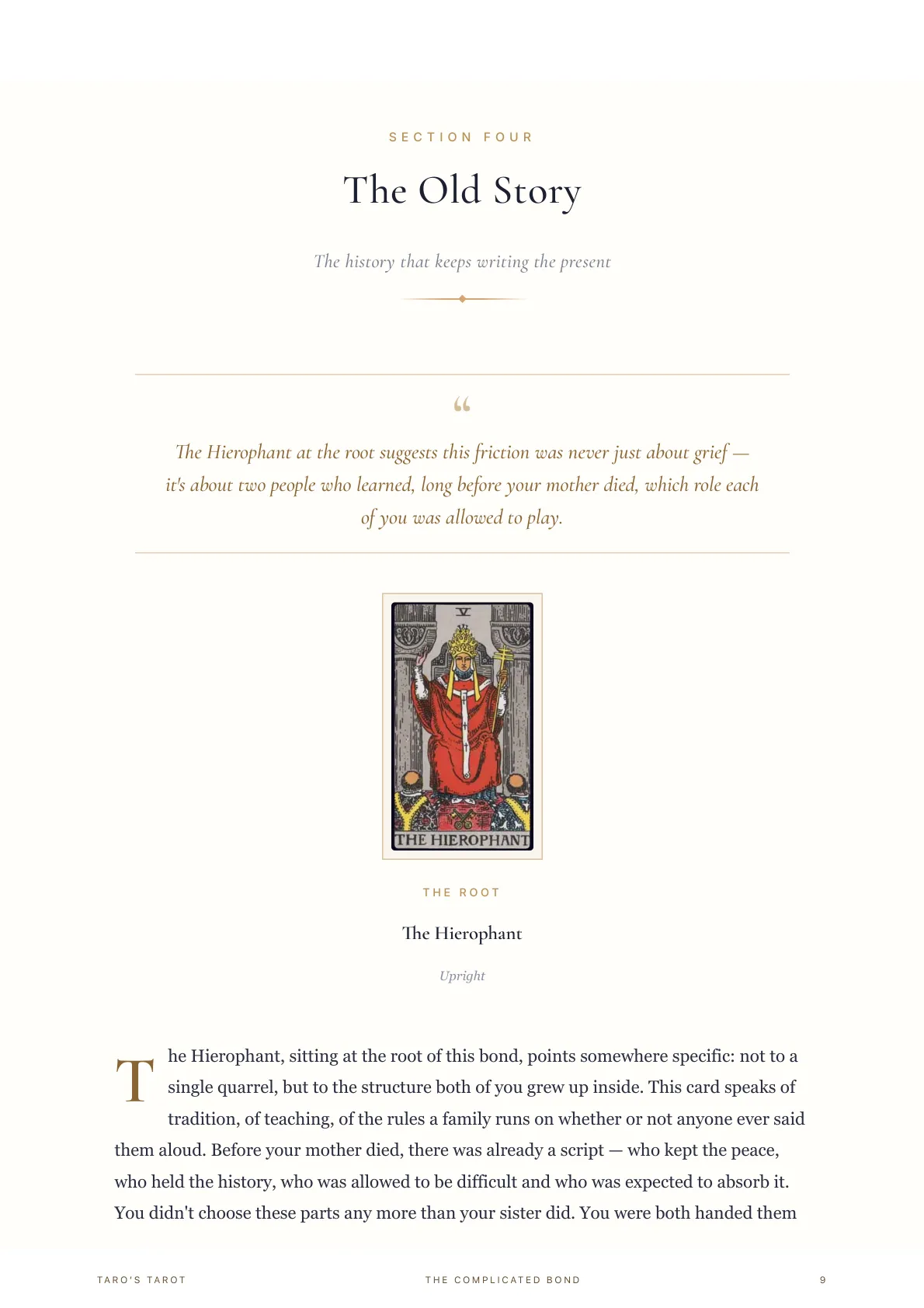
Sample pages from a real generated report — yours is written for you
$14.9930-day money-back guarantee — if your report doesn't feel genuinely specific to you, full refund, no questions asked.
“Not every difficult mother is a narcissist. But every child who has to ask the question deserves a straight answer.”
A note on what this quiz can and can't do: it reads the relational pattern between you and your mother — it is not a diagnosis. Narcissistic Personality Disorder is a clinical diagnosis only a qualified professional who has assessed her can make. A mother can be deeply hurtful without being a narcissist, and a narcissistic pattern can hide behind a charming public face. This quiz names the pattern of the bond, not the person. And if the relationship involves ongoing abuse — emotional, physical, or financial — support matters more than labels: a therapist, a helpline, or someone you trust comes before any quiz result.
Jump to a Mother-Bond Pattern
The Five Mother-Bond Patterns
This quiz doesn't hand everyone the same verdict — two of these patterns are strongly narcissistic, one leans that way, and two are honest answers that the pain is real but narcissism isn't the name for it. Each pattern comes with a tarot archetype and concrete guidance. Find the one that sounds like your bond.
The Covert Martyr — Love Billed as Debt
Your answers describe a bond that runs on guilt. Her sacrifice is the currency, your gratitude is never sufficient payment, and every gift arrives with an invisible invoice attached. She rarely attacks directly — she suffers at you, and the suffering does the controlling. This is one of the strongest narcissistic patterns this quiz can detect, and one of the hardest to name, because it wears the costume of devotion.
You grew up fluent in a language most people can't hear: the sigh that means you've failed her, the "no, it's fine" that means it is very much not fine, the silence after a boundary that is louder than any shouting. You have probably spent years wondering whether you're the selfish one — and that wondering is the design working. Covert control doesn't forbid anything; it makes your freedom cost so much guilt that you decline it yourself, and then it lets you believe declining was your idea. If you feel confused rather than certain, that isn't evidence against this pattern — confusion is its signature. Overt cruelty gets named in a year. Martyrdom can take decades, because the person doing it genuinely believes she is the victim of the story, and she has cast you as the ingratitude.
What You Got Right by Noticing
- You detected a form of control that is engineered to be undetectable — the guilt was manufactured, and some part of you always suspected it
- Your conscience is real: the guilt only ever worked because you genuinely care, and that care is worth keeping
- You learned to read rooms, moods, and micro-signals with unusual precision — a genuine skill once it stops being a survival requirement
- Naming this doesn't make you ungrateful — it makes you the first person in the pattern to tell the truth about it
What to Watch For in Yourself
- Guilt-trained people over-apologise and over-give everywhere — watch the reflex in your friendships and relationships, not just with her
- You may mistake other people's ordinary needs for invoices; not everyone who loves you is billing you
- Martyrdom is heritable — watch for the moment your own sacrifices start needing an audience
- Explaining and defending yourself to her is a trap: the argument's currency is guilt, and she owns the mint
Tarot Archetype
The Hanged Man — but held wrong. The card's true meaning is chosen surrender in exchange for genuine insight: a private act, done for oneself. In this bond the suspension is performed for spectators, and the sacrifice is converted into leverage the moment it's witnessed. Your work is the card's honest face: getting your feet back on the ground without needing anyone to watch you climb down — and without buying the descent with one more apology.
Guidance
Stop trying to pay the debt. It is not payable, because its function was never to be paid — an open account is what keeps you orbiting. Practise the two-part sentence that guilt cannot metabolise: warmth plus an unchanged decision. "I love you, and I can't come on Sunday." No defence, no itemised justification — justification is the invoice being negotiated, and negotiation concedes that it's owed. Let the sighs and silences happen without fixing them; they are weather, not verdicts. A therapist who knows covert narcissistic family dynamics can help you separate real obligation from manufactured obligation — most people in this pattern can no longer tell them apart from the inside. And if contact reliably costs more than it gives, stepping back further is allowed. Distance taken to protect yourself is not cruelty, whatever the sighs say.
The Engulfing Mirror — You as Her Reflection
Your answers describe a bond with no membrane: your achievements are her achievements, your privacy reads to her as betrayal, your differences as disloyalty. You exist, in her eyes, primarily as a reflection — polished and displayed when you make her look good, corrected when the image doesn't flatter. This is a strong narcissistic pattern: engulfment plus image management, the combination that makes a child into an extension instead of a person.
You were watched constantly and seen almost never — and you know, in a way that's hard to explain to people with ordinary mothers, that those are not the same thing. She may know your schedule, your salary, your relationships, and still not know you: what you're afraid of, what you actually want, who you are when no one is grading the performance. So you likely built two selves — a public one, curated for her consumption, and a real one that lives in the gaps she doesn't check. If the question "what do I actually want?" is genuinely hard for you to answer, that isn't emptiness. It's that wanting was never a safe activity: every desire of yours was either absorbed into her plans or treated as a defection from them. The self isn't missing. It's in hiding, where you sensibly put it.
What You Got Right by Noticing
- You noticed the difference between being watched and being known — many people in this pattern never do
- A private self survived: the parts of you she never got access to are intact, not absent
- Your discomfort with her pride in you was accurate — applause for a performance is not love for a person
- You're asking the identity question now, and asking it is exactly how a self gets rebuilt
What to Watch For in Yourself
- Enmeshment-trained people swing between over-sharing and total armour — watch for both poles with new people
- Performing may be your default in every relationship; being genuinely known will feel dangerous before it feels good
- Guilt about "abandoning" her will spike exactly when you individuate — that's the tether tightening, not the truth arriving
- Don't measure your recovery by her reaction: she experiences your boundaries as amputation and will describe them that way
Tarot Archetype
The Moon — the card of reflected light and things not being what they seem. The moon has no light of its own; it shines by borrowing, and in this bond you were the surface she needed in order to see herself shine. The card's counsel is its path: between the two towers, out of the reflected glow, walked in low light one uncertain step at a time — toward a sun that is actually yours.
Guidance
Individuate in small, sustainable doses. Keep one opinion, one hobby, one plan she doesn't get access to — not as punishment, but as practice at existing unobserved. Put her on an information diet: answer the questions you want to answer, and let "I'd rather keep that to myself" stand without softening it into an apology. Then build the central muscle this pattern atrophies: letting her be disappointed without rushing to fix it. Her disappointment is not an emergency; it is the sound a mirror makes when you step out of frame. A therapist experienced with enmeshment can speed this up considerably — especially the part where you learn to answer "what do I want?" without checking anyone's face first.
The Critical Ledger — Approval on Condition
Your answers describe a bond kept as an account: love that flows when you perform and thins when you slip, criticism dressed as concern, comparisons to siblings and cousins, a scoreboard you never see but always feel. This is a narcissistic-leaning pattern — perfectionism and conditional regard are core narcissistic materials — but it sits below the strongest patterns because scorekeeping can also be inherited anxiety, passed down by a mother who was graded the same way. What it does to you is real either way.
You learned early that love has a review process. Every achievement bought a short warm spell; then the bar moved, and the account fell back into deficit. So you may now be a high achiever who can't feel achievements, an adult who hears her voice in every mistake before you hear your own, someone who reads "I'm just worried about you" and correctly translates it as a grade. Here is the arithmetic no one says out loud: the standard was calibrated so the account never quite closes. That is the point of a moving bar — it moves. Which means the deficit you have spent your life trying to clear was never a measurement of you. It was a mechanism, and you were its fuel.
What You Got Right by Noticing
- You saw the audit behind the individual criticisms — the pattern, not just the items on it
- Your competence is real: it was built under scrutiny, but it belongs to you, not to the scrutiny
- You can now translate "concern" that is actually criticism in costume — most children of the ledger never learn to
- You know exactly what unconditional love isn't — which is a strangely precise map of what to build instead
What to Watch For in Yourself
- The ledger internalises: watch for the voice that audits you when she isn't even in the room
- You may keep trying to close the account with one more achievement — the account is designed not to close
- Perfectionism will keep offering itself to you as safety; it's the pattern wearing your clothes
- Watch how you score the people you love — children of scorekeepers can inherit the pencil without noticing
Tarot Archetype
Six of Pentacles — a figure hands out coins with one hand while holding scales in the other. Generosity, measured; warmth, weighed to the ounce. The card asks whose hand holds the scales in your life now — and whether love that must be earned by instalments is a currency worth staying poor in.
Guidance
Stop reporting for review. Share finished decisions, not drafts — a draft invites grading, and grading is the bond's reflex. When the assessment comes anyway, receive it without entering it: "interesting — I'll think about that" ends an audit that arguing extends. Notice, without excusing anything, that she may be running the only love-model she was ever issued; understanding where the ledger came from can soften your anger without obligating you to keep balancing it. The deeper work is internal: the auditor now lives in your own head, and a good therapist can help you retire it. Start with one deliberate act a month that cannot be graded — done badly, on purpose, for pleasure — and watch what it brings up. That discomfort is the ledger objecting to its own irrelevance.
The Weathered Wall — Absent, Not Predatory
Here is an honest answer you may not have expected: your responses describe self-absorption, emotional unavailability, and limited empathy — but not narcissistic architecture. There's no guilt machinery, no engulfment, no scorekeeping. There's absence: a mother walled off behind her own unhealed history, unable to go where feelings live — yours or, in all likelihood, her own. She didn't harvest you for supply. She failed to find you. The hunger that brought you to this quiz is completely real; her having a disorder is probably not the explanation for it.
You raised yourself in the ways that matter most. Your feelings didn't get punished or confiscated — they simply bounced off, and you learned to stop throwing them. This is genuinely different from a narcissistic bond, and the difference matters for how you heal: a narcissistic mother uses the child she sees; a walled mother never quite sees the child at all. What you are grieving is not something she did to you. It is everything that never happened — the interest never taken, the comfort never offered, the mirroring you needed and did without. Psychologists call this ambiguous loss, and it is among the hardest griefs to hold precisely because there's no event to point to. You can't show anyone the wound; it's made entirely of absence. That doesn't make it lighter. In some ways it makes it heavier, because you've been carrying it without permission to call it a wound.
What You Got Right by Noticing
- You came asking an honest question and can hold an honest answer — "unmet" is real even when narcissism isn't the name for it
- The self-reliance you built is genuine, load-bearing strength — it just no longer has to be your only mode
- Because the wall isn't malice, some limited real connection may exist on her terms — knowing its actual size lets you stop paying for a larger one
- You can stop searching her behavior for hidden cruelty; an absence has no code to crack, and you're free to stop decoding
What to Watch For in Yourself
- Don't upgrade the diagnosis to legitimise the pain — pain doesn't need a disorder attached to count
- Watch the habit of never asking anyone for anything; the wall taught you that needs go unanswered, and you may be pre-emptively agreeing
- Notice if you're drawn to emotionally unavailable people — familiar hunger can feel like home
- Waiting for her to become someone else keeps the wound open; she would have to heal a history you can't reach
Tarot Archetype
Five of Pentacles — two figures move through snow past a lit church window, and the door never opens. The warmth in that window is real; so is the fact that it was never offered. The card's quiet second reading is the one that matters here: she may be one of the figures in the snow too — locked out of a warmth no one ever showed her how to enter. That explains the wall. It does not heat the snow you grew up in.
Guidance
The work here isn't confrontation — there's no crime to prosecute, and prosecuting an absence just exhausts you. The work is grief: mourning the mother that never happened, deliberately, the way you'd mourn any real loss. Then resize the relationship to its actual dimensions: take what the bond genuinely offers — practical loyalty, presence at events, whatever form exists — and stop re-running the experiment of asking her for the thing she has never once been able to do. Source mirroring where it actually lives: friends who ask real questions, a partner who looks at you, a therapist who knows ambiguous loss. The literature on emotionally immature parents will likely fit your childhood better than anything written about narcissistic mothers — it's worth reading the shelf that describes your actual house.
A Hard Season — Difficult, Not Narcissistic
Your answers describe real friction and real hurt — and, crucially, the things a narcissistic bond cannot produce: genuine apology, genuine curiosity about you, respect (however grudging) for a boundary, happiness for you that isn't secretly about her. The conflict is real. But the architecture underneath it is a relationship between two people, not a mirror and its supply. This quiz's honest reading: you're in a hard season with a difficult mother — not in the pattern the search bar suggested.
You might feel a flicker of embarrassment for having asked the question at all. Don't. You searched this because something hurt, and the hurt is legitimate — hard seasons with a mother can feel annihilating precisely because the bond matters so much. Maybe it's the long renegotiation from mother-of-a-child to mother-of-an-adult; maybe it's a partner she resisted, an old role you've outgrown, a wound one of you pressed without meaning to. But notice what your answers kept including, almost despite you: she comes back. She repairs. She knows things about you that serve no purpose for her. She is happy for you in ways that don't route through her image. That is not what narcissism looks like. That is what two people who love each other badly sometimes looks like — and the difference between those two things is the difference between a wall and a doorway.
What You Got Right by Noticing
- You checked the evidence instead of installing a diagnosis — that instinct for accuracy will protect every relationship you have
- Repair exists in this bond, and repair is the single strongest predictor that conflict can be metabolised rather than accumulated
- The friction is likely about something specific and nameable — and nameable things are addressable things
- You're allowed to be genuinely hurt by her and keep the bond; this result holds both without contradiction
What to Watch For in Yourself
- Don't let checklist culture retro-label every ordinary conflict as abuse — that frame, once installed, is very hard to uninstall
- A "not narcissistic" verdict doesn't mean "nothing to fix" — real grievances still deserve to be raised out loud
- Watch for scorekeeping creeping in from your side of the table during the hard stretch
- If this season is new and unusually sharp, something may have changed in her life — worth asking about rather than just enduring
Tarot Archetype
Five of Wands — five figures with raised staves, and the reading that surprises everyone: it's sparring, not war. Friction without malice, a scuffle where nobody is actually trying to wound. The card's counsel is to stay in the practice honestly — because the alternative to sparring isn't peace. It's distance.
Guidance
Have the conversation the quiz can't have for you. Name the specific hurt — one incident, not a lifetime of charges — ask for her side, and watch for the repair reflex this result predicts; in a bond like this one, it usually shows up, even if it arrives clumsy and a day late. If the deeper issue is the role itself, say that: many hard seasons are just an outdated mother-child contract that nobody formally renegotiated. And hold your result honestly in both directions — if you raise a real hurt and no repair appears, not once, over months, then take that new evidence seriously and retake your bearings. But from what you've described, this is weather, not architecture. Seasons pass — faster when both people admit it's raining.
Signs of a Narcissistic Mother
No single behavior makes a mother a narcissist — the pattern is a cluster, held over years, plus two crucial absences. The signs that most reliably mark a narcissistic mother-bond:
- Everything orbits her. Your news, your crisis, your wedding — within minutes, the conversation is about her feelings, her stress, her role in it.
- Love is conditional on performance. Warmth flows when you achieve, flatter, or make her look good — and thins the moment you don't.
- Guilt is the steering wheel. Sacrifice gets itemised, sighs replace requests, and your freedom is priced in obligation.
- Boundaries are treated as betrayal. A simple "no" triggers outrage, tears, punishment campaigns, or weaponised silence — not disappointment that passes.
- Two faces: public charm, private control. Outsiders adore her; only the family sees the other face — which makes the child doubt their own record.
- The absences: no real apology, no real curiosity. Apologies reverse the charge onto you, and she knows your facts but not your inner life — because your inner life has no use to her.
The honest counterweight: a stressed, depressed, or emotionally immature mother can show several of these signs in a bad stretch. What separates the narcissistic pattern is persistence across decades, the whole cluster together, and — above all — the absence of repair. That's why the quiz weighs what happens after the hurt, not just the hurt itself.
Narcissistic Mother — or Just a Difficult One?
This is the question underneath the question, and three tests answer it better than any checklist. First: the repair test. Difficult mothers eventually apologise for something real — badly, late, through gritted teeth, but genuinely. A narcissistic pattern produces apologies that reverse the charge: "I'm sorry you feel that way," delivered with a list of her sacrifices attached. Watch what happens in the week after a conflict; that's where the two patterns separate.
Second: the curiosity test. Does she know things about you that serve no purpose for her — your fears, your inner weather, the name of the thing you're quietly proud of? A difficult mother knows you and hurts you anyway sometimes. In a narcissistic bond, what she holds about you is inventory: facts she can use, display, or grade. Being watched closely and being known are not the same thing.
Third: the boundary test. Tell her no about something small and watch the shape of the response. Protest followed by adaptation is a difficult mother inside a real relationship. A campaign — guilt, escalation, recruitment of other family members, punishment by silence — is a pattern defending its access to you. The quiz above runs all three tests through 10 questions; two of its five results are honest verdicts that the answer is "difficult, not narcissistic" — because that answer is sometimes the true one, and you deserve the true one.
What to Do Next
If your result names a narcissistic pattern, the first move is the counterintuitive one: stop trying to make her see it. The pattern's defining feature is that it cannot see itself — insight delivered to it becomes ammunition against you. Everything workable starts from managing your exposure instead of reforming her character.
- Grey rock. Brief, boring, low-emotion responses to provocation — no defence, no drama, nothing for the pattern to feed on. It feels unnatural precisely because you were trained to engage.
- Boundaries as actions, not announcements. Don't debate the line — enforce it. Leave when it's crossed, end the call, shorten the visit. A boundary explained is a boundary negotiated.
- An information diet. She can't weaponise what she doesn't know. Share finished decisions, not plans; headlines, not drafts.
- Specific support. A therapist familiar with narcissistic family systems or emotionally immature parents — this is a well-mapped territory, and general counselling often misses it.
- Permission to step back. Low contact — and in sustained, harmful cases, no contact — is a legitimate act of self-protection, not a moral failure. Distance taken to stop ongoing harm is protection, not punishment.
And if the bond is complicated rather than simply cut-or-keep — most are — the Complicated Bond Report reads your specific tie: the old story driving the same argument, what she honestly can't give you, and whether this bond calls for repair, steady distance, or stepping back. Our inner child quiz looks at the other half of the pattern — what your younger self still carries out of that house.
Frequently Asked Questions
How do I know if my mother is a narcissist?
Look for the sustained cluster, not single moments: conversations that orbit her, love conditional on performance, guilt as steering, boundaries punished as betrayal — and the two absences: no genuine apology, no genuine curiosity about you. Any mother shows one of these in a bad year; the signature is the cluster held over decades, without repair. NPD itself is a clinical diagnosis only a professional can make — but you don't need the diagnosis to name the pattern and protect yourself.
Can a narcissistic mother love her child?
Often something real exists — but it passes through a self-referential filter and arrives as ownership, image-pride, or love-with-conditions. The more useful question isn't "does she love me?" but "does what she calls love function as love by the time it reaches me?" You can accept that a feeling exists in her and still protect yourself from how it's delivered.
What's the difference between a difficult mother and a narcissistic one?
Three tests: repair (a difficult mother eventually genuinely apologises; a narcissistic pattern reverses the charge), curiosity (does she know things about you that serve no purpose for her?), and boundaries (protest-then-adapt versus a punishment campaign). Difficult mothers hurt you inside a relationship. Narcissistic patterns replace the relationship with a role.
How do I deal with a narcissistic mother?
Stop trying to win insight — the pattern can't see itself, and your evidence becomes her ammunition. Manage exposure instead: grey rock, boundaries enforced by actions rather than announcements, an information diet, and a therapist who knows narcissistic family systems. Stepping back — low or no contact — is self-protection, not a moral failure.
This quiz is for self-reflection purposes only. It reads the pattern of a relationship, not the clinical status of a person, and it is not a substitute for therapy or professional support.
Explore More Quizzes
Discover more ways to explore your spiritual journey
Looking for more spiritual guidance?