A LITTLE MORE UNDERSTANDING
Toxic Friendship Quiz
How do you usually feel in the hour after you've spent time with this friend?
Choose the answer that feels most like you.

Inside the report: What They Can't Give You
Some of the hardest relationships are the ones you never chose.
The Four of Cups in the Limit position names something you have probably suspected for years: the acknowledgement you keep waiting for is not being withheld to punish you — it may simply not be in their repertoire. There is a difference between a door that is locked and a door that was never built, and this card leans toward the second. That distinction changes what you grieve, and what you stop asking for...

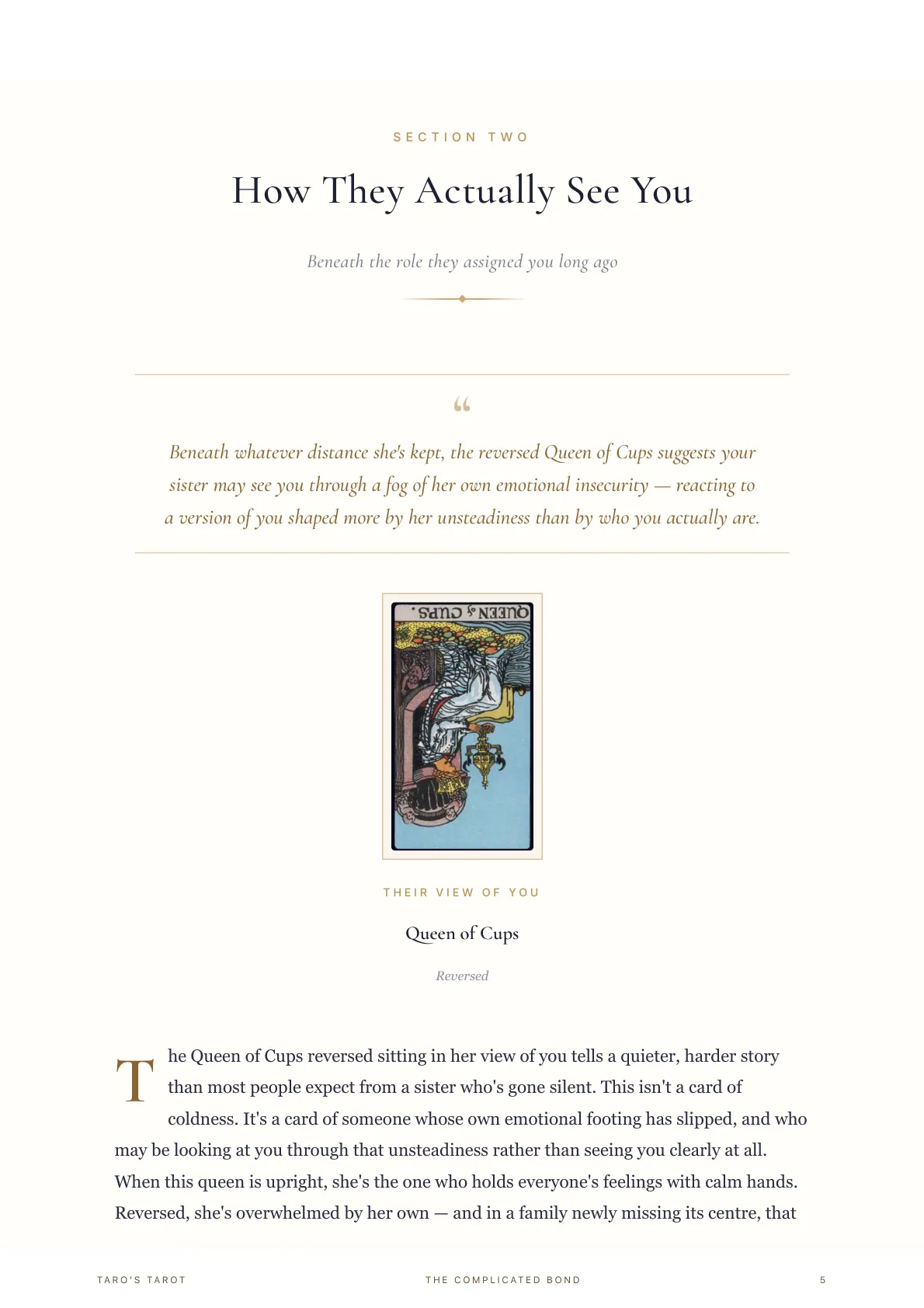
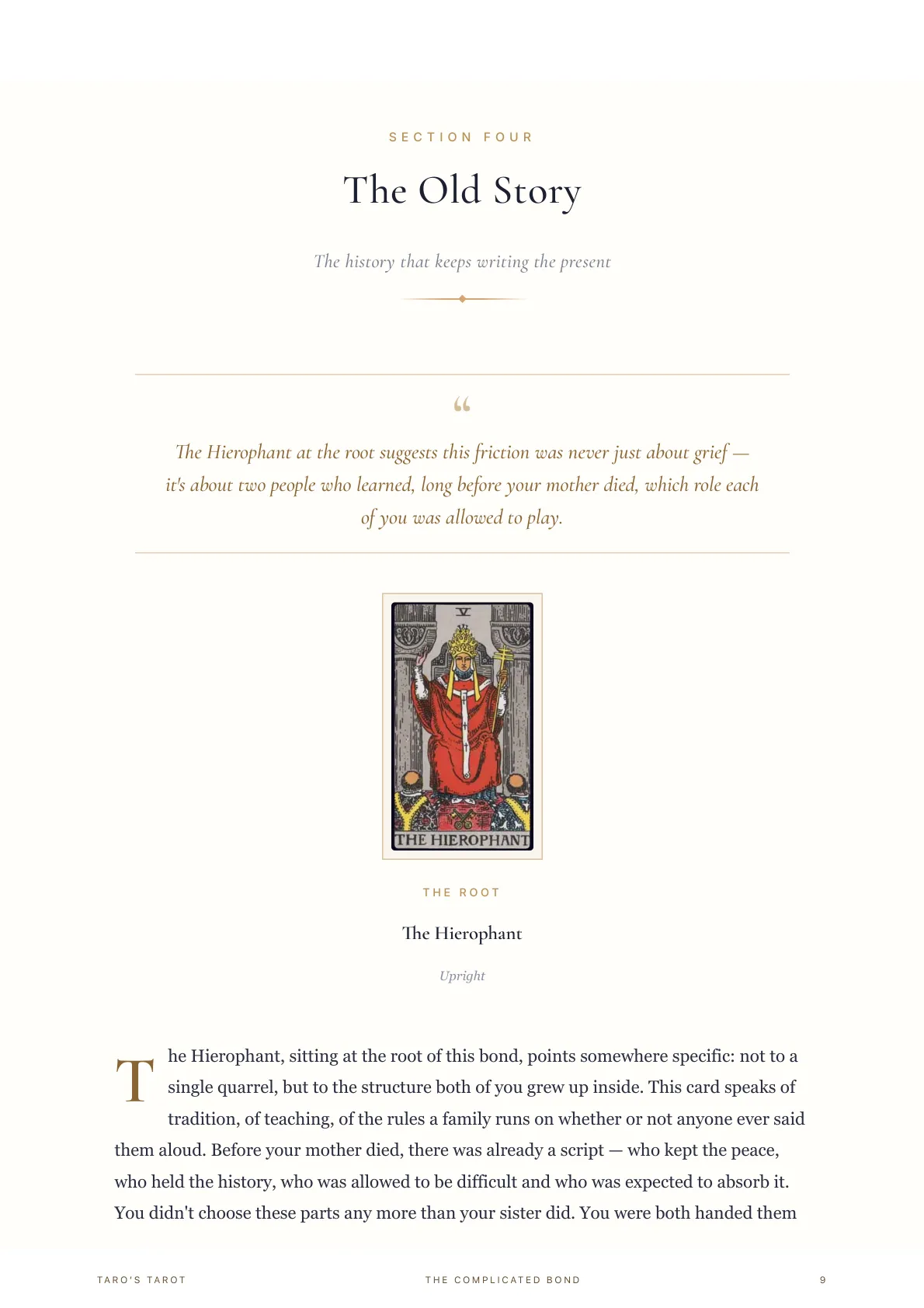
Sample pages from a real generated report — yours is written for you
$14.9930-day money-back guarantee — if your report doesn't feel genuinely specific to you, full refund, no questions asked.
“A good friendship costs energy sometimes. A toxic one charges interest.”
Jump to a Friendship Pattern
The Five Friendship Patterns
"Toxic" is an easy word and an imprecise one. Two of these patterns are genuinely toxic, one is draining without malice, one is a no-villain outgrowing, and one is a good friendship having a hard season. Each pattern comes with a tarot archetype and honest guidance for what to do next — find the one that sounds like yours.
The One-Way Street
Your answers describe a friendship with one engine: you. You initiate, you remember, you accommodate, you show up — and they receive. This isn't cruelty; your friend may be genuinely fond of you. But fondness that never converts into effort isn't friendship maintenance — it's friendship consumption, and you're the one being consumed.
You've probably run the experiment in your head a hundred times: "if I stopped texting first, would I ever hear from them again?" The fact that you already suspect the answer is the finding. Somewhere along the way, the roles calcified — you became the organizer, the listener, the one who asks follow-up questions — and they became the guest of honor at a party you keep throwing. The exhaustion you feel after seeing them isn't because they're terrible company. It's because you're doing the emotional labor for two people and calling the total a friendship.
What You Saw Clearly
- Your capacity to show up is real — the problem is the recipient, not the instinct
- There's no malice in this pattern, which means an honest conversation has room to work
- You see the imbalance clearly — most over-givers years deep in this can't
- You haven't become bitter yet; the goodwill you'd need for repair is still intact
What to Watch For
- Over-giving trains people to under-give — every accommodated absence sets the new price
- You may be reading their passivity as depth ("they're just not a texter") when it's simply comfort
- Your own part: you've never actually asked for more, so they've never actually refused
- Resentment is compounding quietly — and unspoken resentment tends to exit as an explosion, not a conversation
Tarot Archetype
Six of Pentacles — a merchant weighs coins and gives to kneeling figures, and the card's uncomfortable question is which figure you are. Upright it depicts generosity; read honestly, it depicts an arrangement where one side always stands and one side always kneels. The scales in the merchant's hand are the card's real message: giving without measure isn't virtue — it's how imbalance becomes permanent.
Guidance
Run the experiment for real — not as a trap, but as data. Stop initiating for three or four weeks and watch what happens; a friend who notices and reaches for you has just told you this is fixable. Then say the quiet thing plainly, without a prosecution: "I feel like I carry most of this friendship, and I'm tired — I need you to reach for me sometimes." A real friend will be stung, and then they'll change. If nothing changes, downgrade honestly: stop budgeting best-friend effort for an acquaintance-level return. You don't have to end it. You just have to stop being the only one holding it up.
The Quiet Competitor
Your answers describe a friendship that has a scoreboard you never agreed to. The put-downs arrive dressed as jokes, your good news gets minimized or one-upped, favors are invoiced later, and your wins land in the room like a challenge. This is a toxic pattern — not because your friend is a monster, but because somewhere underneath the friendship, they are playing against you.
You've learned things you shouldn't have to know about a friend: not to share good news too enthusiastically, not to show weakness that might get used, to brace slightly when they open with "no offense, but." The tell you keep noticing is the direction of their warmth — they're at their kindest when you're struggling and at their sharpest when you're thriving. That inversion is the signature of this pattern. A friend who can only love you from above isn't offering friendship; they're offering a ranking system with a smile, and your job in it is to stay one rung down.
What You Saw Clearly
- You clocked the pattern — the digs are engineered to be individually deniable, and you saw the aggregate anyway
- You've kept succeeding despite the headwind, which is exactly what the pattern is designed to prevent
- Your instinct to guard your news and your soft spots around them is healthy calibration, not paranoia
- Naming this frees you from the exhausting project of earning their approval — it was never on offer
What to Watch For
- Every dig you laugh along with gets re-filed as "just our banter" — silence is read as license
- Competing back feels like winning but it's actually joining — the game itself is the problem
- Your own part: check whether you've been shrinking your wins to keep the peace; that habit follows you into other rooms
- Intermittent warmth is the trap — the good days keep you paying dues to a club that charges you for existing
Tarot Archetype
Five of Swords — a figure gathers swords with a smirk while the defeated walk away, and the card's cold insight is that someone here treats connection as a contest with trophies. In a friendship, the Five of Swords asks the only question that matters: when you win at life, do they celebrate — or do they reach for a sword? A bond where your shine is their loss was never a bond; it was a siege with visiting hours.
Guidance
Name it once, directly and without the softening laugh: "That joke was at my expense, and it's a pattern — I need it to stop." Their response is the whole diagnostic. Genuine surprise and changed behavior means insecurity was driving and there's a friend underneath worth keeping. Deflection — "you're too sensitive," "it was a joke" — means the competition is the relationship. If it's the second, stop feeding the scoreboard: share your news after it's public, keep your vulnerabilities for safer hands, and let the friendship shrink to the size that's actually safe. Some friendships can't be fixed, only right-sized — and some can't even be that.
The Velvet Cage
Your answers describe the pattern that's hardest to see from inside, because it wears devotion as a costume: the friend who needs constant access, sulks at your other friendships, keeps a tally of everything they've done for you, and punishes your no with silence until you apologize for having a boundary. This is a toxic pattern — control doesn't stop being control because it comes wrapped in "but I care about you the most."
The clearest evidence is in your own behavior: you edit texts before sending them, you downplay plans that don't include them, you feel a small spike of dread — not joy — when their name lights up your phone. You've started managing them the way people manage weather. And the guilt works precisely because it's built on real material: they have shown up for you, there is history, they would call it loyalty. But loyalty that has to be repaid with your autonomy isn't loyalty — it's a debt you never signed for, with interest set by them. The velvet in the cage is real. So are the bars.
What You Saw Clearly
- Your unease survived the guilt — that instinct is accurate and it's the way out
- You never stopped wanting other friendships, which is exactly the health they couldn't regulate away
- You can now name the mechanism — sulk, guilt, tally, repeat — and a named mechanism loses half its force
- The eggshell-walking skill you developed proves your sensitivity works; it just deserves a safer room
What to Watch For
- Every apology you offer for a reasonable boundary teaches them the punishment works
- Their jealousy can quietly do its job even if you never leave — check how many friendships have already thinned
- Your own part: rescuing them from every disappointed silence is participation, not kindness
- The tally of what they've "done for you" only ever grows — you cannot repay your way out of a debt that's designed to be endless
Tarot Archetype
The Devil — two figures stand chained beneath a looming presence, and the detail every reader eventually notices is that the chains are loose. They could lift them off. The Devil isn't the card of captivity; it's the card of consented-to captivity — bonds maintained by guilt, habit, and the fear of what leaving will cost. Its message here is exact: the door to this cage has been unlocked the whole time. The lock is the guilt.
Guidance
Stop negotiating and start demonstrating. Pick one small boundary — an unanswered evening, a plan with someone else mentioned plainly and undefended — hold it without apologizing, and let the sulk arrive and burn out on its own. Their reaction over the following weeks is the verdict: a friend with control issues and a conscience will adjust, grudgingly, and the friendship may find a healthier size. A friend for whom control is the point will escalate — more guilt, more tallying, maybe recruiting others — and escalation is your answer. Rebuild the friendships that got thinned. And if it comes to an ending, you don't owe a trial or a verdict — "this friendship doesn't leave me room to be a whole person" is complete. Guilt will call that cruelty. It's the opposite.
The Outgrown Bond
Here's the result you may not have expected from a toxic friendship quiz: your answers don't describe toxicity at all. No control, no competition, no one-way drain — just two people who grew in different directions while the friendship stood still. The discomfort you're feeling isn't damage. It's the gap between who you were together and who you've each become, with nostalgia quietly doing all the maintenance.
The friendship runs almost entirely on stored fuel: the old stories, the shared history, the person they knew you as. When you're together it's pleasant — genuinely — but it's the pleasantness of a reunion, not a relationship. They know everything about who you were and surprisingly little about who you are; your current life doesn't quite fit through the door of the conversations you have. You searched "toxic friendship quiz" because something feels wrong, and something is — but the wrong thing isn't them, or you. It's that you've been grading a past-tense friendship on a present-tense scale, and the guilt of that mismatch was starting to look like evidence of a crime.
What You Saw Clearly
- Nothing here is poisoned — no apology tour or boundary campaign is required
- What you shared was real; outgrowing a friendship doesn't retroactively falsify it
- You can honor this bond honestly at its true size instead of resenting it at an inflated one
- Recognizing the drift now spares you years of confusing distance with betrayal
What to Watch For
- Guilt may push you to perform closeness you don't feel — which is less kind than honesty, not more
- Nostalgia can keep you over-investing in the past at the expense of friendships your present self needs
- Don't invent a villain to justify the distance — some part of you may prefer "they're toxic" to "we changed"
- Letting it drift with no acknowledgment at all can leave a wound where a graceful shift would have left a good memory
Tarot Archetype
Six of Cups — two children exchange a cup of flowers in a walled garden, and it's the deck's card of nostalgia: sweetness that is real and past at the same time. Its gentle warning is that the garden has walls — stay too long among the old cups and you'll miss the ones being offered now. The card doesn't ask you to spill what you shared. It asks you to notice which direction you're facing.
Guidance
Take toxicity off the table — that's not what this is, and treating it as a villain hunt will wound someone who didn't earn it. Then choose deliberately instead of drifting: either invest in who they are now — one honest conversation about your actual current lives, not the greatest hits — and see if a present-tense friendship wants to exist, or consciously let the bond settle to its true size: the warm text on birthdays, the easy dinner twice a year, the history held with genuine affection and no guilt. Both are honorable. The only wrong move is resenting them for a distance neither of you caused — and calling a finished season a failure when it was actually just finished.
The Rough Patch
Your answers describe friction — real friction, or you wouldn't be here — inside a friendship that is structurally sound. The load-bearing walls are all intact: effort runs both directions, honesty survives contact, apologies actually happen, and they still celebrate you without a flicker of scorekeeping. This isn't a toxic friendship having a good day. It's a good friendship having a hard season.
Something sent you to this quiz — a fight that went further than usual, a stretch of shortness, a distance you couldn't name — and it's worth taking seriously rather than waving off. But look at what your answers kept reporting alongside the friction: you can tell this person hard truths and the friendship absorbs them; conflict between you ends in repair, not in silence or scorekeeping; when you win, they're genuinely in your corner. Those are the exact features toxic friendships cannot fake for long. The most likely story here isn't poison — it's pressure: stress, life changes, or one unresolved thing that's been leaking into everything else.
What You Saw Clearly
- Repair actually happens between you — the single strongest predictor a friendship survives
- Honesty is safe here: you can be fully yourself, including the unpolished parts
- Their delight in your wins is real — no ledger, no leaderboard, no invoice
- Even mid-friction, the effort stays mutual; nobody has quietly put down their end
What to Watch For
- A rough patch left unnamed can wear grooves — don't let "we're fine" postpone the one conversation you need
- Check whether the friction has one specific source you've both been stepping around
- Your own part: worry can turn into monitoring, and a watched friendship starts performing instead of relaxing
- Don't let one bad season rewrite the whole story — recency is loud and history is quiet
Tarot Archetype
Five of Wands — five figures clash with staves, and at first glance it's a battle. Look closer: no one is wounded, the footing is playful, and the staves never quite land. It's the card of friction without malice — sparring, not war. Its counsel for a friendship is precise: the noise between you is energy, not enmity, and energy can be pointed at the problem instead of at each other.
Guidance
Trust the structure, and service it. Name the rough patch out loud — "we've been off lately, and I don't want to just wait it out" — because friendships this healthy repair fastest when someone goes first, and it might as well be you. If there's one specific splinter under the friction, pull it now while it's small. Then do the unglamorous thing that actually restores friendships: unstructured time together with no agenda, where the ease comes back on its own. And take the reassurance you came for — you searched "toxic friendship" and the evidence answered "no." Some worry is just love checking the locks.
Signs of a Toxic Friendship
Toxic friendships rarely announce themselves — the individual incidents are almost always deniable. It's the pattern that convicts. The signs that most reliably mark a friendship as toxic, rather than merely strained:
- You consistently leave smaller than you arrived. Drained, deflated, second-guessing yourself — a friend can tire you out; a toxic pattern spends you down.
- Your wins land like a challenge. Minimizing, one-upping, a fast subject change — a friend who can only warm to you when you're struggling is running a ranking, not a friendship.
- There's a ledger. Favors get invoiced, history gets tallied, and what they've "done for you" is currency spent whenever they want something.
- Your no gets punished. Guilt-trips, disappointed sighs, silence until you apologize for having a boundary.
- They're possessive of your attention. Coldness when you enjoy other people, sulking at your other friendships, jealousy dressed up as loyalty.
- You've started editing yourself. Softening texts, hiding news, managing their moods — when a friendship requires a performance, the friendship is the audience you're afraid of.
The honest counterweight: every friendship produces one of these signs on a bad month. One incident is a Tuesday; the cluster, repeating, with the cost always flowing your way, is a pattern — and patterns are what this quiz is built to read.
Toxic Friend or Drifting Apart? How to Tell the Difference
These two get confused constantly, because from inside they can feel identical: something is wrong, seeing them feels off, and guilt fills in the blanks. The difference is the direction of harm. Drifting apart is symmetrical — both lives moved, contact thinned, and time together feels pleasantly hollow rather than damaging. Nobody leaves diminished. A toxic friendship has a mechanism running: one person consistently exits smaller, drained, guilted, or managed.
The second test is what distance does. Distance heals drift — the warmth survives at lower frequency, and a twice-a-year dinner feels genuinely good. Distance from a toxic friendship gets punished: the guilt calls arrive, the tally gets read aloud, your absence becomes a charge against you. If pulling back is treated as a crime, you've learned what the closeness was for.
Getting this distinction right matters in both directions. Calling a drifted friend toxic invents a villain where there's only a finished season — and wounds someone who didn't earn it. Calling a toxic friend "just drifted" keeps you paying a bill that was never yours. The quiz above separates the two on evidence.
Am I the Toxic Friend?
An honest quiz has to allow for the harder possibility: sometimes the person searching "toxic friendship" is contributing to one. If any of the patterns above stung with recognition from the other side — you're the one keeping score, the one whose jokes cut, the one whose no doesn't exist for other people — that discomfort is worth more than reassurance. The fact that you can even ask the question is a genuinely good sign; the people most caught in toxic patterns rarely do. This quiz reads your friend's behavior, so it can't answer that question for you — but our Am I the Toxic One? quiz is built to, with the same honesty in the other direction.
Frequently Asked Questions
How do you know if a friendship is toxic?
Watch the dynamics, not the incidents: you consistently leave drained or smaller, your good news gets minimized or one-upped, favors and history function as a ledger, your no gets punished with guilt or silence, and you've started editing yourself to stay safe. Any friendship produces one of these on a bad month. Toxicity is the pattern — repeating, with the cost always flowing in your direction.
Can a toxic friendship be fixed?
Sometimes. Name the pattern once, directly and without hostility, and read the response: a friend acting from insecurity or obliviousness will be stung and then change — those friendships can recover, often smaller and healthier. A friend who deflects ("you're too sensitive") is telling you the pattern is the relationship. And fixing isn't all-or-nothing: many friendships can't be repaired to full depth but can be right-sized to a distance where the toxicity stops reaching you.
How do I end a toxic friendship?
Match the ending to the pattern. Draining or one-sided: quietly downgrade — stop over-initiating and let contact find its honest level. Controlling or undermining: be direct once — "this friendship isn't good for me anymore" — with no trial and no negotiation. Expect a guilt wave; it's the pattern's last argument, not evidence you're wrong. Then hold the line, and let yourself grieve the real history.
What's the difference between a toxic friendship and growing apart?
Direction of harm, and what distance does. Growing apart is symmetrical — nobody leaves diminished, and distance heals it: the warmth survives at lower frequency. A toxic friendship spends one person down, and distance gets punished — guilt, tallies, renegotiation. If pulling back is treated as a crime, you've learned what the closeness was for.
This quiz is for self-reflection purposes only. It reads patterns, not people, and it is not a substitute for counselling or professional support.
Explore More Quizzes
Discover more ways to explore your spiritual journey
Looking for more spiritual guidance?