The twin flame workbook that measures the change you make.
Companion to the Twin Flames book. Eight chapters of structured exercises drawn from attachment theory, IFS, EFT, and limerence research. The book teaches; the workbook is where the work gets done.
$11.99 once · 66 pages · print-first, yours to keep.
Instant PDF download. Pay by card via Stripe — no account needed.
Not sure yet? See inside first ↓A look inside
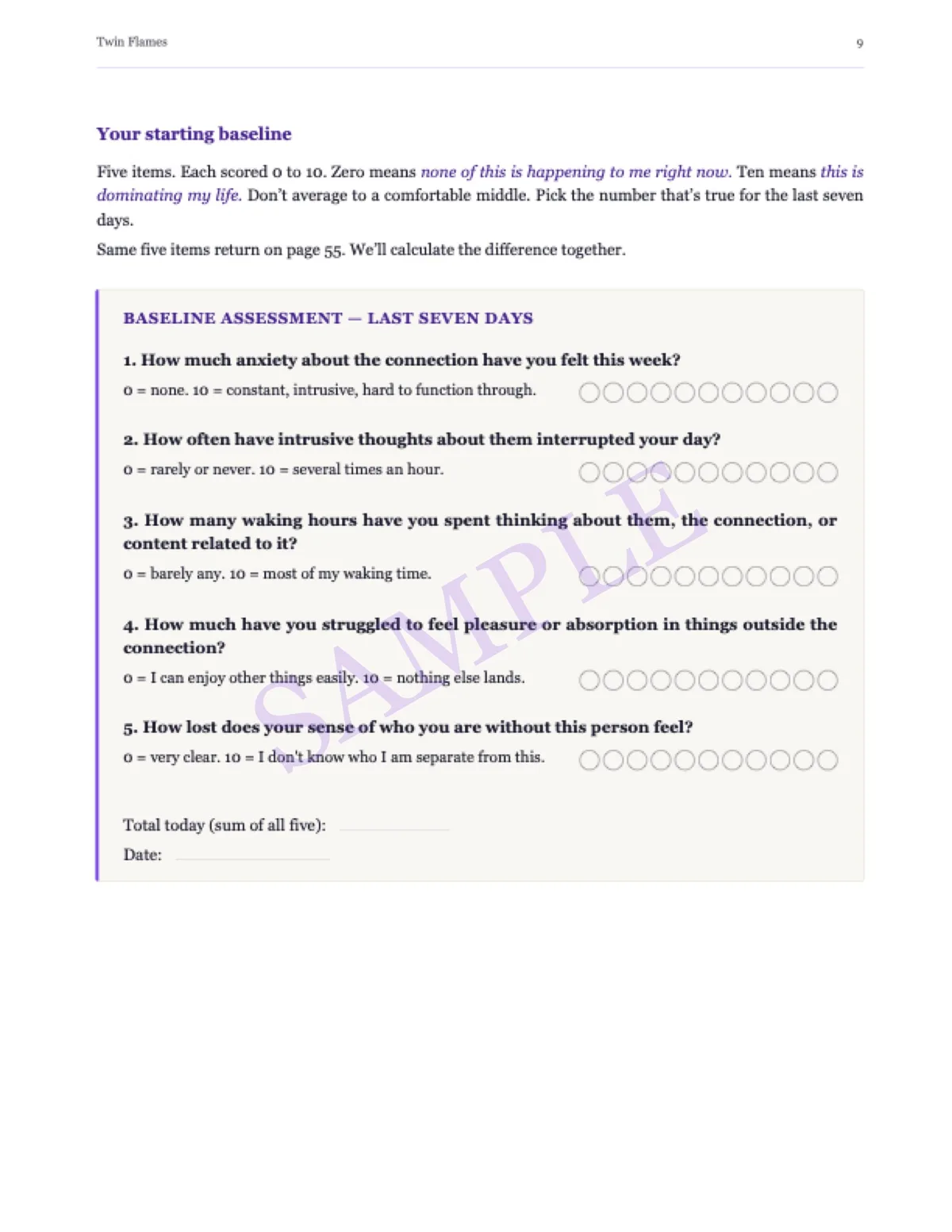
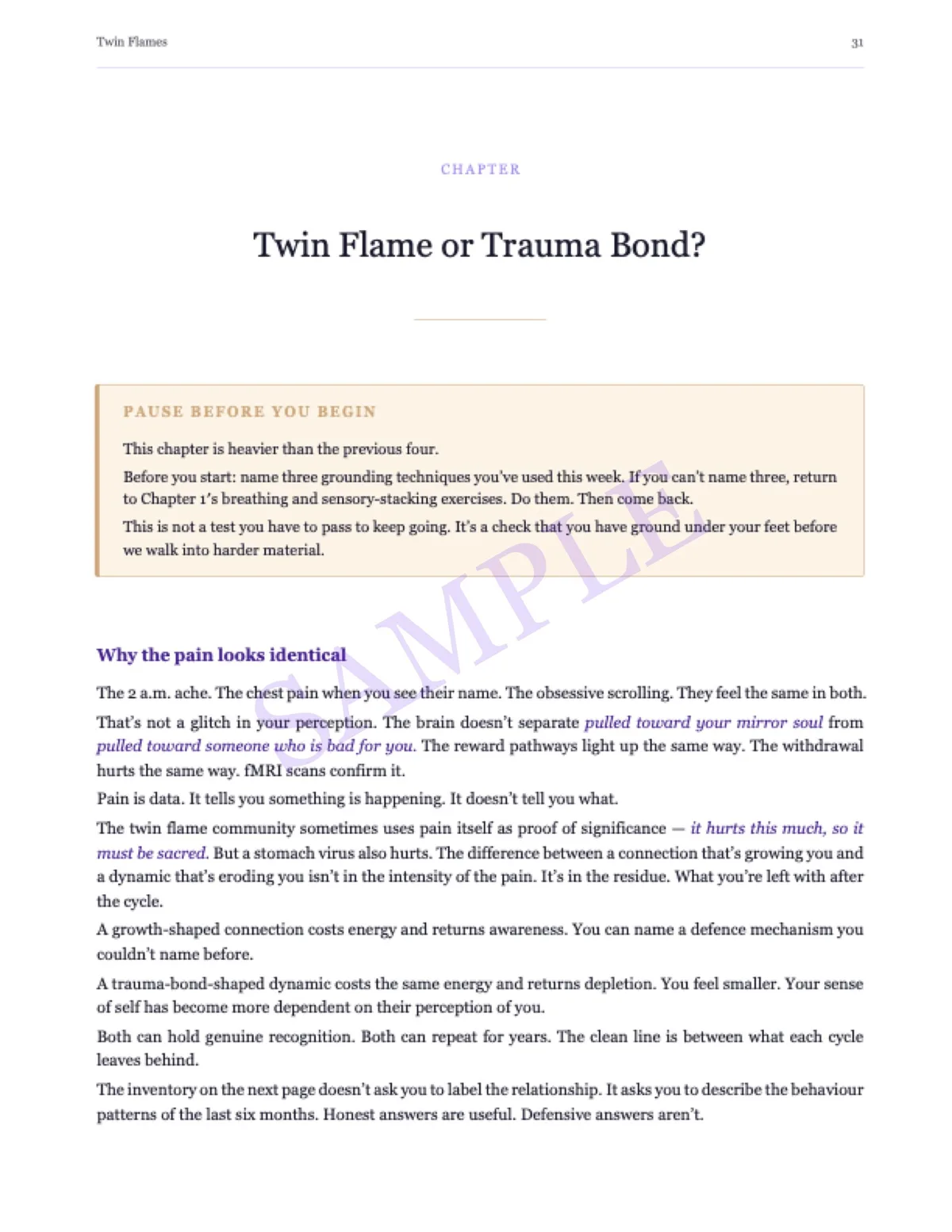
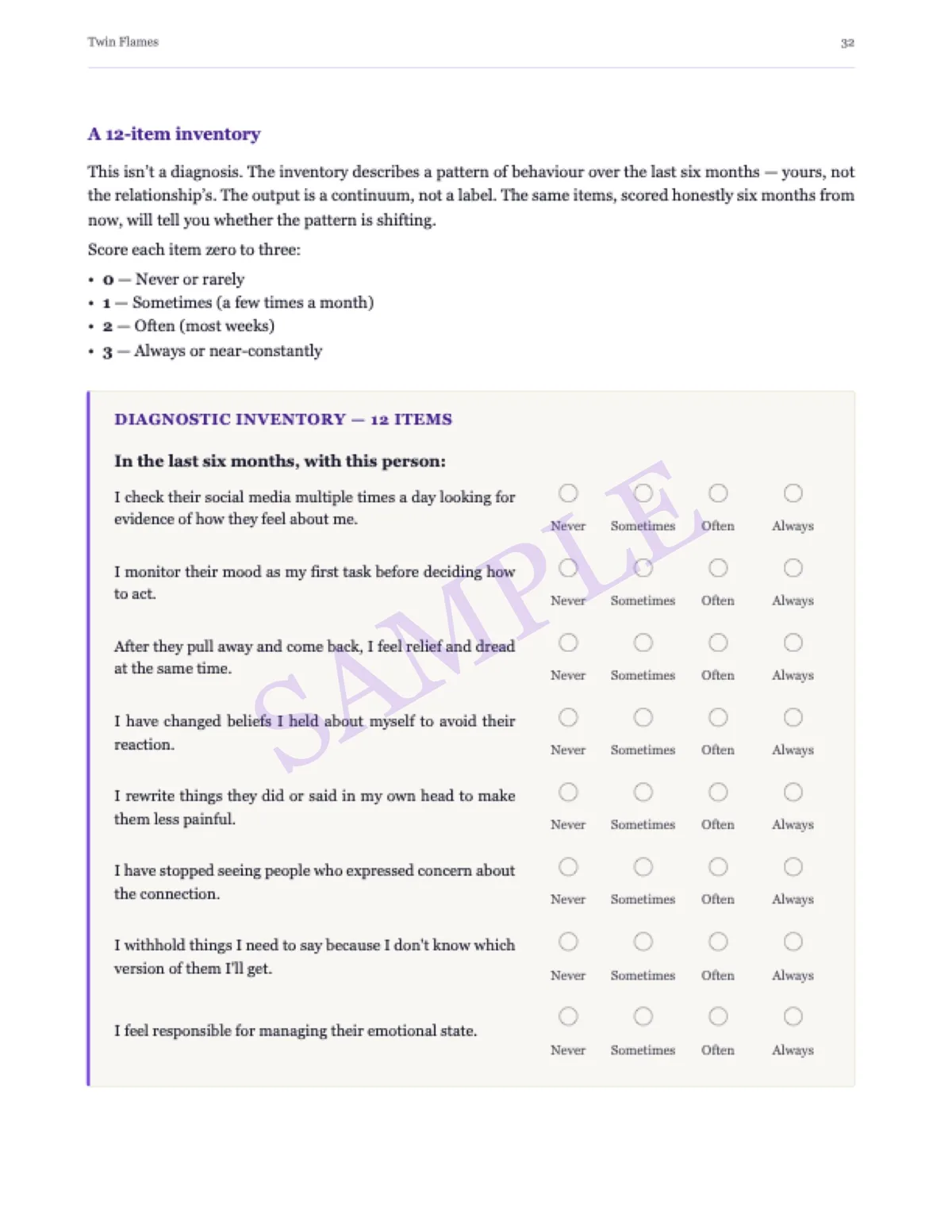
Pages from chapters 1, 5, and 5. Watermarked previews.
Why the assessment matters
Five Likert items at the start. The same five at the end. The difference between your score on day one and your score on the last page is the only proof you'll have that this work moved anything.
A four-point drop is meaningful. So is a flat line that holds steady through a hard week. Most workbooks make you feel something. This one measures it.
From Chapter 7 — Building a Life That Doesn't Revolve Around Them
The compression rarely happens deliberately. You don't decide to drop your art class. You miss it once because they reached out. You miss it again because you're waiting for a text. The third week, your seat at the studio is gone, and so is the version of you that went there.
Who is this for?
What's inside
Chapter 1.Where Are You Right Now?
Baseline assessment + stage locator
Chapter 2.Recognition or Pattern? The Litmus Test
Growth vs erosion audit
Chapter 3.Mapping the Dance
Pursue-withdraw cycle map (EFT) + IFS Soulmate Parts Map
Chapter 4.The Crystallisation Audit
What your mind has edited (Tennov) + synchronicity audit (Jung)
Chapter 5.Twin Flame or Trauma Bond?
12-item diagnostic + safety audit
Chapter 6.The Chaser Inside You
Adaptive responses — chaser and runner branches (Levine, Heller)
Chapter 7.Building a Life That Doesn't Revolve Around Them
Shrinkage audit + identity reconstruction
Chapter 8.Forward, With Or Without Them
Two letters + post-assessment + delta
Reference pages
- The Week After — seven days of five-minute check-ins
- When to Seek Help — signs the work needs a clinician
- Resources & Crisis Lines — international helplines, therapist directories
Where you'll be when the work is done
- A measurable answer, not a mood: your score on page one set against your score on the last page — the only proof you'll have that anything actually moved.
- A clear read on whether this connection is growing you or eroding you, drawn from your own behaviour over six months — not your hopes about what they feel.
- The honest verdict on twin flame or trauma bond, scored item by item, with a safety screen that names the exact moment to put the pen down and call someone.
- Your own pattern named out loud — chaser, runner, or both — and three concrete substitutes ready for the next time the urge hits at 2 a.m.
- The friendships, hobbies and parts of you this thing quietly ate, listed by name, with a week-one plan to start taking them back.
- The proof, in your own handwriting, of what your memory has edited to keep the story alive — so you stop mistaking the edit for what happened.
Also included: the pursue-withdraw cycle map (EFT), the IFS Soulmate Parts Map, the two-letter exercise for life with and without reunion, a Stop-Go signpost and a containment close on every chapter, seven days of Week After check-ins, plus crisis lines and therapist directories.
Get the workbook.
66 pages. Eight chapters. The pre- and post-assessment that proves the work moved.
Instant PDF download. Secure payment via Stripe.
See the sample pages above before you pay. If it's not the practice space you need, don't buy it.
At checkout you can add a personalised reading for $9.99 instead of the usual $14.99 — skip it if you just want the workbook.
Common questions
Who's behind this, and why should I trust it with something this raw?
Taro's Tarot — the same people behind the free twin flame reading, the false-twin quiz and the trauma-bonding quiz you may have just taken. Every exercise here holds the line we hold everywhere we publish: psychology first, no spiritual bypassing, your safety over any framework. That's why Chapter 5 opens with a mandatory pause, and its safety screen names the exact moment to put the pen down and call a helpline if that's what your answers show. If you wanted a workbook that promises reunion, this isn't it.
Is this just a journaling workbook?
No. Each chapter is built around structured exercises — diagnostic inventories, audit tables, parts maps, cycle mapping. There's writing space, but every prompt has a defined purpose, a clinical reference, and a layer of metacognitive reflection at the close.
Do I need to read the book first?
No. The workbook is designed to stand alone. The frameworks are introduced inside each chapter's prose before the exercises. The book and the workbook read as a set on the shelf, but neither requires the other.
How does the assessment work?
Five Likert items at the start (Chapter 1) and the same five at the end (Chapter 8). The delta is the only proof you'll have that the work moved anything. A four-point drop is meaningful. So is a flat line that holds steady through a hard week.
Is this safe to do alone?
Mostly. Chapter 5 (Twin Flame or Trauma Bond?) opens with a mandatory pause and a safety audit. If any item flags, the workbook redirects you to a helpline before continuing. The "When to Seek Help" reference page lists the signs the work needs a clinician, not a journal.
Digital or print?
Print-first PDF. You can do it on a tablet, but it's designed to be printed and worked through with a pen. Print-at-home, US Letter, 66 pages. Instant download after purchase.
Why no exercises asking what he's thinking?
Every prompt is oriented toward your own experience, body, and pattern. The voice rejects mind-reading prompts on principle — they keep you stuck in the same loop the workbook is trying to interrupt.
New to the framework? Start with the Twin Flames book — the workbook reads as the practice arena for it.
Want the psychology angle without the spiritual framework? The Psychology Behind Your Love Patterns