THE STORIES WITHIN YOU
What Goddess Am I? Free Goddess Archetype Quiz
You're handed real power — a room full of people waiting on your word. What's your first instinct?
Choose the answer that feels most like you.
Inside the report: The Heart of Your Archetype
What is the core pattern that drives you?
The Empress in your Core Energy position names something you have always sensed but rarely claimed: your power moves through creation, not control. You do not push the world into shape — you grow it. The Knight of Wands beside it as your Driving Force reveals the restlessness underneath...
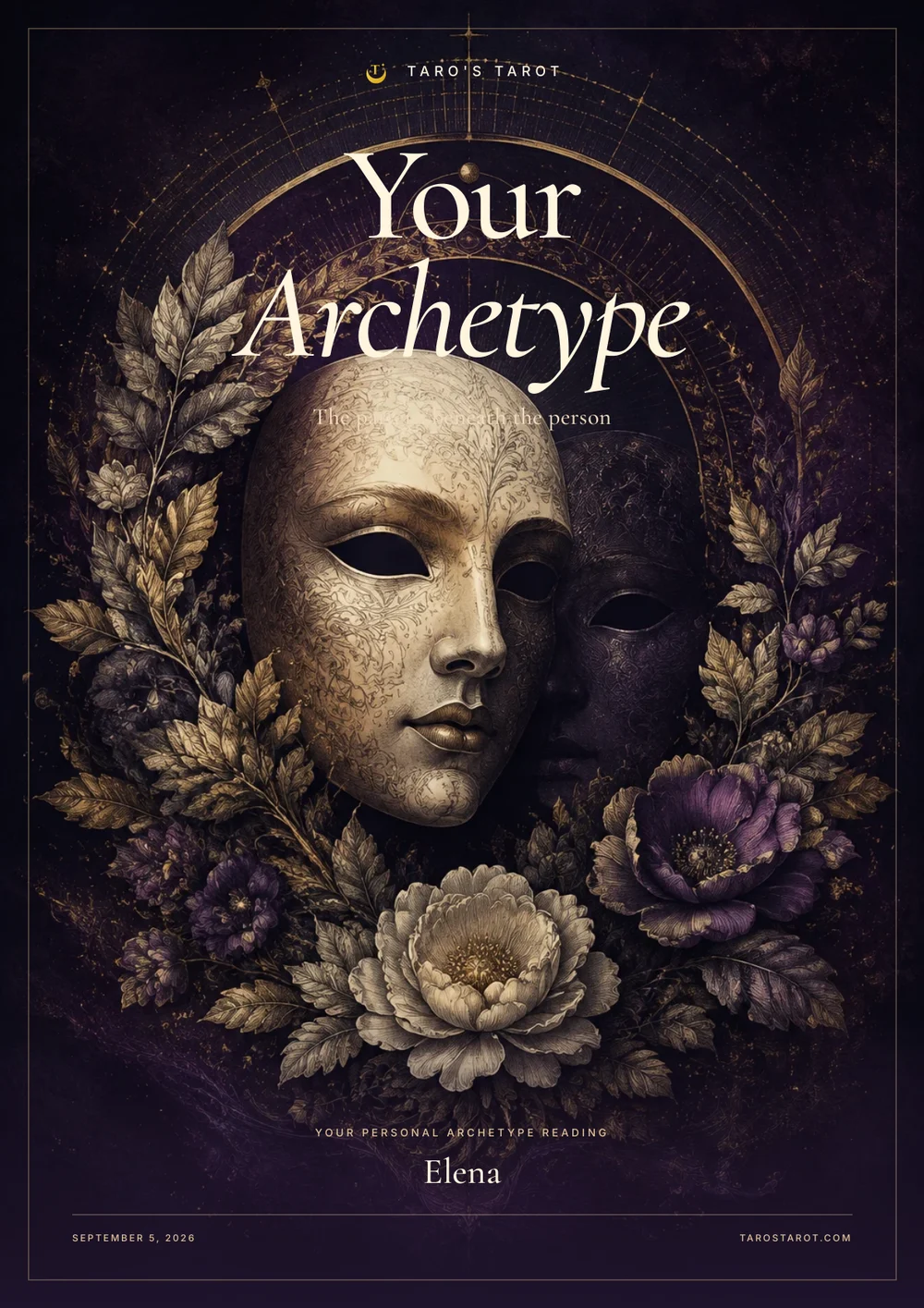
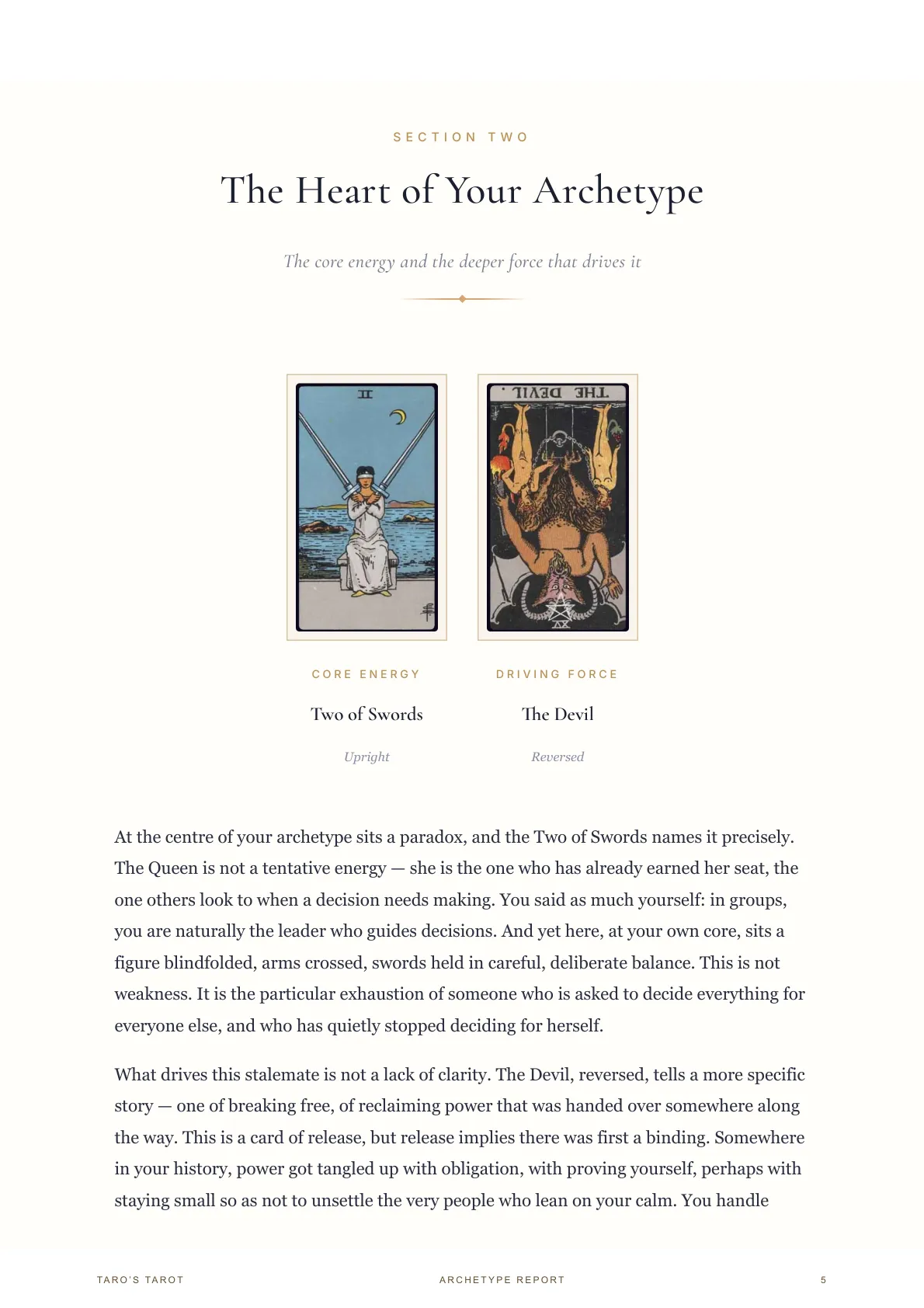
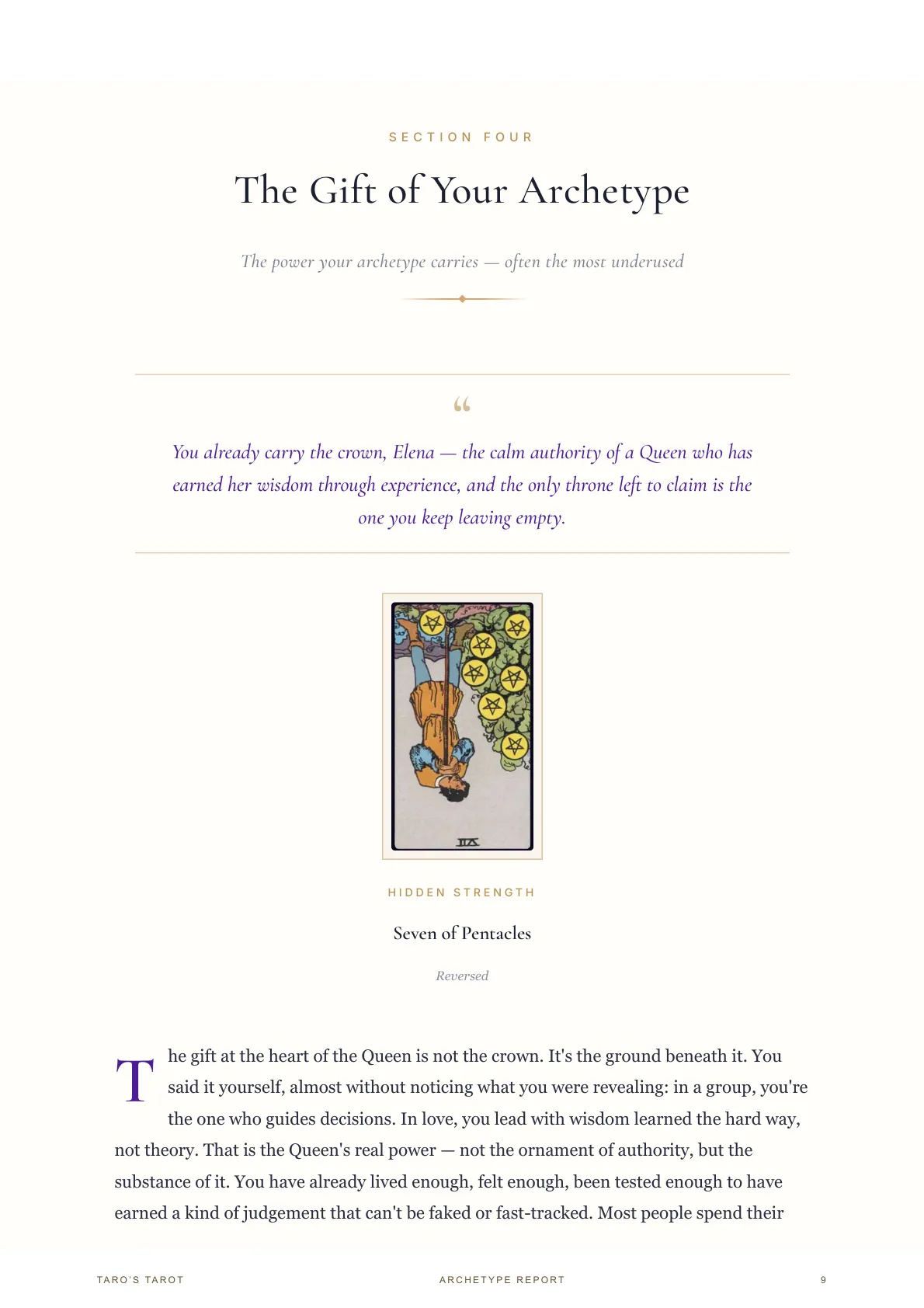
Sample pages from a real generated report — yours is written for you
$14.9930-day money-back guarantee — if your report doesn't feel genuinely specific to you, full refund, no questions asked.
“Every woman has a goddess she performs and a goddess she starves. The quiz names the first; the interesting work begins with the second.”
Jump to a Goddess
Which Goddess Are You? The Six Archetypes
Six goddesses, three pantheons, six distinct kinds of power. Read the full portraits below — most people recognise themselves in one immediately, and then spot a second goddess hiding in the weaknesses of the first.
Aphrodite
Your goddess archetype is Aphrodite — the Greek goddess of love, beauty, and desire, born from sea foam and impossible to ignore. Your power isn't force; it's gravity. People orbit you without quite knowing why. You lead with the heart, you feel everything at full saturation, and you turn ordinary rooms into places people don't want to leave.
You're the friend people confess their crushes to, the one who notices when someone's wearing a new perfume, the one who believes — genuinely, unfashionably — that love is the point. Beauty isn't vanity to you; it's a language. Pleasure isn't indulgence; it's information. Your instinct in almost any situation is to connect first and strategise later, which makes you magnetic in a crowd and occasionally defenceless in love.
Strengths
- Magnetism that can't be taught — you draw people in without performing
- Emotional fluency: you read desire, longing, and heartbreak like large print
- You make others feel beautiful, chosen, and awake in your presence
- Courage in love — you'll risk the whole heart where others offer instalments
Growth Edges
- You can mistake being desired for being loved
- Rejection hits you at identity level, not just event level
- You may soften conflicts that actually needed your anger
- When depleted, you go grey — disconnected from pleasure, beauty, and your own body
Symbols & Mythology
Aphrodite's symbols are the rose (beauty with thorns — softness that can still draw blood), the seashell and sea foam she was born from (emotion as origin, not accessory), the dove (love as peace-bringer), and the mirror (not vanity, but the power of reflection — people see their most alive selves in her). In myth she was married off to Hephaestus but answered to no one, a reminder that the Lover archetype is sovereign, not decorative. In tarot her energy is The Empress: creation through pleasure, abundance through openness.
Guidance
Your work isn't to become less — less romantic, less feeling, less much. It's to stop outsourcing your worth to the gaze of others. Practice wanting without auditioning: wear the thing, light the candle, make the beautiful dinner when no one is watching. In love, notice the difference between people who worship the effect you have on them and people who are curious about you. Aphrodite's lesson is that magnetism turned inward — self-devotion, not self-display — is what makes the outward kind unshakeable.
Athena
Your goddess archetype is Athena — the Greek goddess of wisdom, strategy, and craft, born fully armoured from the head of Zeus. You are the one who stays calm when everyone else is flooding, who sees the whole board while others fight over one square. Your power is precision: the right word, the right move, the right moment.
People come to you when it actually matters — for counsel, not comfort. You'd rather be respected than adored, understood than admired. You think before you feel out loud, which people sometimes misread as coldness when it's actually care: you refuse to hand someone a half-finished thought. You collect competence like others collect compliments, and there is almost nothing you can't learn your way through.
Strengths
- Strategic sight — you see three moves ahead while staying calm in the current one
- Discernment: you're nearly impossible to manipulate or flatter into bad decisions
- Mastery orientation — you do things properly or not at all
- You're the person a crisis is lucky to have
Growth Edges
- You can live from the neck up — strategy where feeling belongs
- Vulnerability feels like handing over your armour, so you rarely do
- You may over-function for people who then never learn to function
- Being right can quietly matter to you more than being close
Symbols & Mythology
Athena's symbols are the owl (sight in the dark — wisdom that sees what others miss), the aegis shield (protection as a form of love), the olive tree she gifted Athens (strategy that feeds people for generations, versus Poseidon's flashy salt spring), and the loom (craft, patience, the long game — she was goddess of weaving as much as war). She is the only Olympian who won wars without loving war. In tarot her energy is the Queen of Swords: clarity as kindness, truth without cruelty.
Guidance
Your growth edge is the armour. It was forged for good reasons — somewhere along the way, feeling was unsafe or unrewarded, and thinking was praised. But the fortress that protects you also processes your loneliness as a rounding error. Practice being witnessed mid-thought: say "I don't know yet" out loud, let someone see the draft version of you. Athena's lesson is that wisdom hoarded is only cleverness; wisdom shared — including the unfinished, uncertain kind — is what actually builds the city.
Artemis
Your goddess archetype is Artemis — the Greek goddess of the hunt, the moon, and the wilderness, who asked her father for eternal freedom before she asked for anything else. You are sovereign territory. Your solitude isn't loneliness; it's where you're most yourself. You can love deeply, but only from freedom — never from a cage, however lovingly it was built.
You're allergic to being managed, defined, or displayed. You'd rather walk alone in the right direction than be carried in the wrong one. People sense there's a part of you they'll never have — and they're correct. But those you choose get a loyalty that's almost feral: you defend your people the way you defend wild things, fiercely and without needing thanks. You measure relationships by one metric: does this leave my wildness intact?
Strengths
- Self-possession — your compass is internal and nearly impossible to hijack
- Fierce protectiveness of the vulnerable, the young, and the wild
- You genuinely don't need the room's approval, which makes your presence honest
- Endurance: you can walk further, alone, than almost anyone
Growth Edges
- Independence can quietly become a wall no one is allowed to knock on
- You leave first — jobs, cities, people — sometimes before you've checked whether you wanted to stay
- Needing help feels like failure, so you go without
- Your distance can wound people who never got to hear the reason
Symbols & Mythology
Artemis's symbols are the bow and silver arrows (aim — a life pointed at what she actually wants, not what she's offered), the crescent moon (light that belongs to the night and needs no sun's permission), the deer (the wild thing she protects rather than tames), and the untouched forest (the inner territory that is nobody's to develop). In myth, when the hunter Actaeon violated her privacy, she turned him into a stag — the archetype of boundaries with real consequences. In tarot her energy is The Moon crossed with the Nine of Pentacles: instinct, and a garden of one's own.
Guidance
Your work isn't to soften your independence — it's to check what it's guarding. Freedom chosen is power; freedom as a reflex, running from every hand that reaches for you, is just fear wearing hiking boots. Practice staying thirty seconds past the urge to leave: in the conversation, in the conflict, in the closeness. Let one person see you tired. Artemis's lesson is that the wild isn't the opposite of intimacy — the deer eats from the hand it trusts, and loses nothing of the forest.
Persephone
Your goddess archetype is Persephone — the Greek goddess who was taken into the underworld as a girl and walked back out as its Queen. You are the one who has been to the dark and returned fluent in it. People see your surface — pleasant, adaptable, lighter than you are — and almost no one guesses at the throne room underneath. Your power is transformation: you don't just survive descents, you're crowned by them.
You live between worlds. You can do the bright, functional, spring-flowers version of life convincingly — but your real conversations happen after midnight, your real self surfaces in journals, dreams, and the two people you've ever fully let in. You're not afraid of other people's darkness; you're the one they bring it to, because you don't flinch. What was done to you, or what happened to you, became — slowly, at great cost — the deepest thing about you.
Strengths
- Depth: you can sit with grief, shadow, and truth that make others bolt for the exits
- Transformation is your native skill — you've already died and come back at least once
- People trust you with what they've never told anyone
- You hold complexity: spring and underworld, both true, no contradiction
Growth Edges
- You show most people a decoy self and then feel unknown
- You can disappear into the dark — days underground you can't explain to anyone
- Being chosen by circumstances so long, you may hesitate to do the choosing
- Melancholy can start to feel like identity rather than weather
Symbols & Mythology
Persephone's symbols are the pomegranate (the six seeds that bound her to the underworld — the way what we've tasted of the dark becomes part of us, not a stain but a citizenship), the spring narcissus (the innocence before the descent, which she carries rather than mourns), the torch (she becomes the guide for souls in the dark she was once dragged into), and the two crowns — flower and iron. She is the only Greek deity with a throne in two worlds. In tarot her energy is Death followed by The Star: the ending that turns out to be a coronation.
Guidance
Your work is to stop treating your depth as a secret you protect people from. The decoy self — sunny, agreeable, seasonal — was survival once; now it's the thing standing between you and being actually known. Practice surfacing on purpose: tell one safe person one underground thing. And notice where you're still waiting to be taken — chosen, summoned, dragged — instead of choosing. Persephone's lesson is the second half of her myth: she wasn't made Queen because she was stolen. She was made Queen because of what she became down there.
Freyja
Your goddess archetype is Freyja — the Norse goddess of love and war, who wept tears of gold, led the Valkyries, and claimed half of every battle's slain before Odin got his share. You refuse the choice other people accept: soft or strong, desired or feared, lover or warrior. You are both, at full volume, and you negotiate with no one about it. Your power is sovereignty — you belong to yourself first, always.
You want things unapologetically in a world that trains women to want quietly. You love with your whole chest and fight the same way. People call you "a lot" and mean it as a warning; you've learned to hear it as an inventory. You have an instinct for your own worth that reads as arrogance to small rooms and as leadership to honest ones. When you cry, it's gold — even your grief has value, and you don't apologise for either.
Strengths
- Unapologetic desire — you know what you want and say it in declarative sentences
- You hold passion and power in one body without diluting either
- Your anger is clean: it defends real boundaries, and people learn where they are
- You make other people braver about wanting their own lives
Growth Edges
- Intensity can become your only setting — everything a battle, everything a blaze
- You may torch bridges that only needed a hard conversation
- Softness can feel like surrender, so you armour the very tenderness people are trying to reach
- When your fire has nowhere meaningful to go, it turns on you or on the nearest person
Symbols & Mythology
Freyja's symbols are the necklace Brísingamen (beauty she acquired on her own terms and answered for to no one), the falcon-feather cloak (the power to change form and leave — sovereignty as mobility), her chariot drawn by cats (power that cannot be herded, only partnered with), and the boar Hildisvíni (the battle-companion form of love). She practised seiðr — the magic of fate itself — and taught it to Odin, not the other way round. In tarot her energy is Strength and the Queen of Wands sharing one throne: the lion isn't tamed, it's hers.
Guidance
Your work isn't to turn the fire down — everyone who told you that was warming their hands on it at the time. It's to choose what's worth burning for. Sovereignty without aim becomes reactivity: every slight a war, every want a demand. Practice the warrior's actual discipline — not less passion, but chosen battles. And let someone see the gold tears; being witnessed in grief is not surrender, it's the one battlefield you keep dodging. Freyja's lesson is that she gets first pick of the fallen: your intensity was never the problem. Aim is everything.
Isis
Your goddess archetype is Isis — the Egyptian goddess of magic, healing, and devotion, who gathered the scattered pieces of Osiris from the ends of the earth and sang him back to life. You are the one who restores what the world breaks. People bring you their scattered pieces — their crises, their grief, their unfinished healing — because something in you knows how things go back together. Your power is quiet and enormous: you work miracles and let others take the credit.
You're the still point in other people's storms. Friends call you first, family assumes you'll handle it, and strangers tell you their life story in queues. You have an almost supernatural instinct for the wound under someone's behaviour, and you tend it before they've named it. Ritual comes naturally to you — candles, prayers, tea made a specific way — because you understand that meaning is medicine. Your devotion, once given, crosses worlds. The question you rarely ask: who gathers your pieces?
Strengths
- Healing presence — people knit back together in your orbit
- Devotion with real spine: you don't abandon people or projects mid-restoration
- Intuitive magic — you sense the unseen layer of every situation
- You transform grief into power; your worst chapters became your deepest skills
Growth Edges
- You give from the wound, not just the overflow — and call the depletion love
- You can enable what you mean to heal, holding people together so well they never learn to
- Your own needs are so quiet even you stop hearing them
- Resentment builds interest silently until it breaks something
Symbols & Mythology
Isis's symbols are the throne hieroglyph she wears as a crown (she IS the throne — the power behind every visible power), the outstretched wings (protection wide enough to shelter the dead), the tyet knot (the binding force that holds what's broken together), and the ankh (life itself, hers to give back). In myth she tricked Ra into surrendering his secret name — the archetype of a woman whose gentleness conceals the sharpest mind in the room. Her worship outlasted Egypt itself, spreading across the whole Roman world. In tarot her energy is The High Priestess: the veil, the moon at her feet, the knowledge that doesn't announce itself.
Guidance
Your work is to come off the throne's underside and sit on it. You've built a life as the power behind — behind partners, families, workplaces, friendships — that stands on you like a foundation stone: essential, invisible, walked on. Practice being tended: ask for the specific thing, out loud, before you're desperate. Let something stay broken that isn't yours to fix. Isis's lesson is hidden in her greatest spell — she resurrected Osiris, but she never did it twice. Even the goddess of healing knows the difference between devotion and endless repair.
The Goddess Archetypes Explained
A goddess archetype isn't a belief system — it's a pattern. Cultures separated by oceans and millennia kept inventing the same handful of powerful women: the irresistible lover, the strategist, the wild huntress, the queen of the underworld, the sovereign warrior, the great healer. Carl Jung called these recurring figures archetypes: universal templates of human energy that live in the collective unconscious and surface in myth, story, and personality.
Jungian analyst Jean Shinoda Bolen made the goddess framing famous in Goddesses in Everywoman, arguing that every woman is "cast in a leading role by one or more goddesses" — that Athena women, Artemis women, and Aphrodite women move through the same world with visibly different operating systems. Your dominant goddess shapes what energises you, what depletes you, how you love, how you fight, and what you secretly want more of.
The archetype is a mirror, not a cage. Knowing you lead with Athena doesn't forbid you Aphrodite's pleasure or Freyja's fire — it shows you which energies come cheap to you and which ones you'll have to consciously reclaim. Most people find the quiz result names the goddess they already are; the more interesting question is which goddess they've been performing, and which one they've been starving.
Goddess Energy in Daily Life
Goddess energy isn't robes and rituals — it shows up in the small, unglamorous moments. Athena energy is the pause before you reply to the infuriating email. Artemis energy is declining the invitation without inventing an excuse. Aphrodite energy is wearing the good perfume on an ordinary Tuesday, for no one. Freyja energy is saying "that doesn't work for me" in a flat, unapologetic sentence. Isis energy is tending someone's crisis at 2am; Persephone energy is being the only one who can sit in the dark with them and not flinch.
Working with your archetype means two moves. First, feed the dominant goddess deliberately instead of accidentally: the Artemis woman who never gets solitude and the Aphrodite woman who never gets beauty are the same person — someone running on empty and not knowing why. Second, borrow from the goddesses you're weakest in at the moments that call for them: Athena's detachment in a negotiation, Freyja's fire at a boundary, Isis's softness with someone you love.
The pattern to watch for is the gap between the goddess you perform and the goddess you are. Many women run Isis in public — endlessly capable, endlessly giving — while a Freyja or an Artemis paces underneath, unfed for years. That gap is where burnout, resentment, and the feeling of "living someone else's life" come from. Naming it is the first repair.
Greek vs Norse vs Egyptian Goddesses
Greek goddesses are specialists. The Olympian pantheon divides feminine power into precise portfolios: Athena holds wisdom and strategy, Artemis holds wilderness and independence, Aphrodite holds love and desire, Persephone holds death and rebirth. The gift of the Greek system is clarity — each goddess is a pure, concentrated dose of one energy, which is why they map so cleanly onto personality types.
Norse goddesses refuse the split. Freyja is the scandal of comparative mythology: goddess of love and war, beauty and battle-dead, weeping gold while commanding Valkyries. Where Greek myth asks a woman to choose between being Aphrodite or being a warrior, the Norse answer is simply: both. Freyja energy appeals to women who feel their softness and their ferocity are one thing, artificially separated.
Egyptian goddesses merge power with restoration. Isis is at once the greatest magician in Egyptian myth, the devoted wife who reassembles her murdered husband, the fierce protector of the dead, and the throne itself — kings ruled by sitting in her lap. Egyptian divinity doesn't separate power from care; magic, healing, sovereignty, and devotion are one continuous force. Isis energy belongs to women whose strength is quiet, structural, and constantly underestimated.
This quiz deliberately crosses all three pantheons. A framework built only on Greek goddesses misses the woman who is love-and-war in one body, and the one whose power looks like healing. Whichever goddess you land on, her culture's idea of power is part of the reading.
Frequently Asked Questions
What goddess am I? How does the quiz decide?
The quiz reads your instinctive responses to six core situations — power, love, conflict, solitude, creation, and injustice — and matches the pattern to one of six goddess archetypes: Aphrodite, Athena, Artemis, Persephone, Freyja, or Isis. Your result reflects the energy you lead with, not a fixed label.
Are goddess archetypes from real mythology?
Yes — each result is grounded in an actual goddess and her myths: Aphrodite and Athena from Greece, Freyja from Norse tradition, Isis from Egypt. Jungian psychology, most famously Jean Shinoda Bolen's Goddesses in Everywoman, has used these figures for decades as archetypes of feminine energy.
Can I have more than one goddess archetype?
Almost everyone does. Most people lead with one dominant goddess and carry one or two secondary influences — an Athena at work who is pure Aphrodite in love. Retake the quiz answering as your private self versus your public self and you may meet your second goddess.
What's the difference between Greek, Norse, and Egyptian goddesses?
Greek goddesses tend to be specialists (wisdom, independence, love as separate portfolios), Norse goddesses like Freyja hold love and war in one body, and Egyptian goddesses like Isis merge power with healing and devotion. This quiz draws from all three pantheons so your result isn't limited to one culture's idea of what a goddess can be.
This quiz is for self-reflection and entertainment purposes only. It is not a psychological assessment.
Explore More Quizzes
Discover more ways to explore your spiritual journey
Looking for more spiritual guidance?