THE WAY YOU CONNECT
What Type of Girlfriend Are You?
You and your partner are both busy all day. What do your texts look like?
Choose the answer that feels most like you.
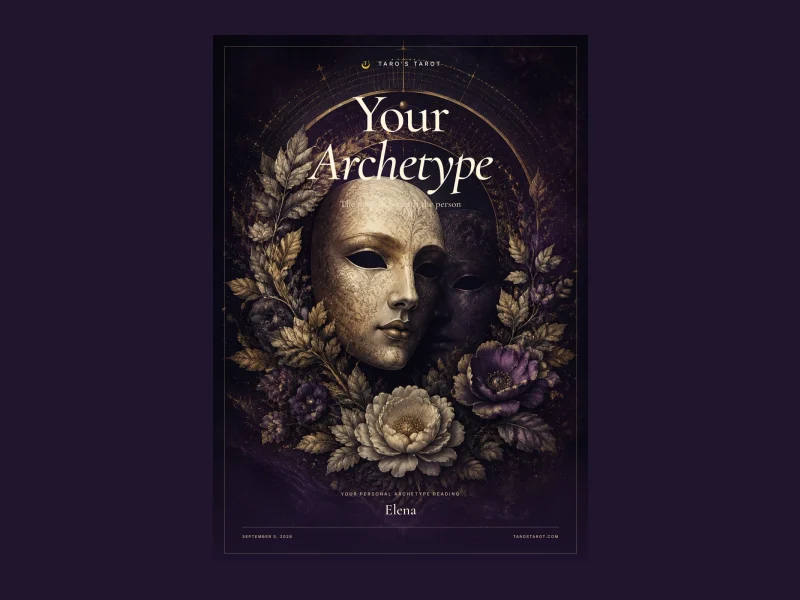
Inside the report: The Heart of Your Archetype
What is the core pattern that drives you?
The Empress in your Core Energy position names something you have always sensed but rarely claimed: your power moves through creation, not control. You do not push the world into shape — you grow it. The Knight of Wands beside it as your Driving Force reveals the restlessness underneath...
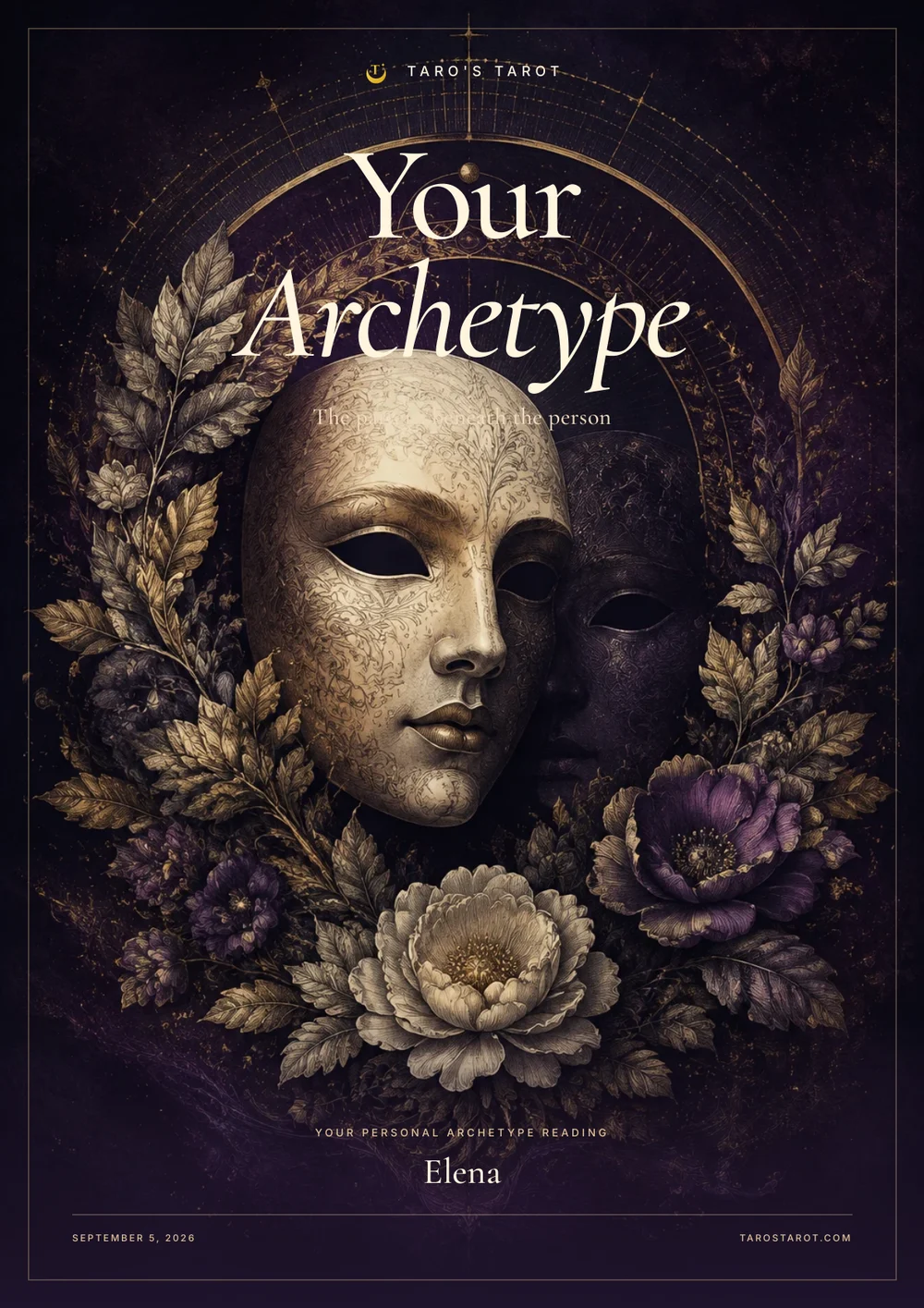
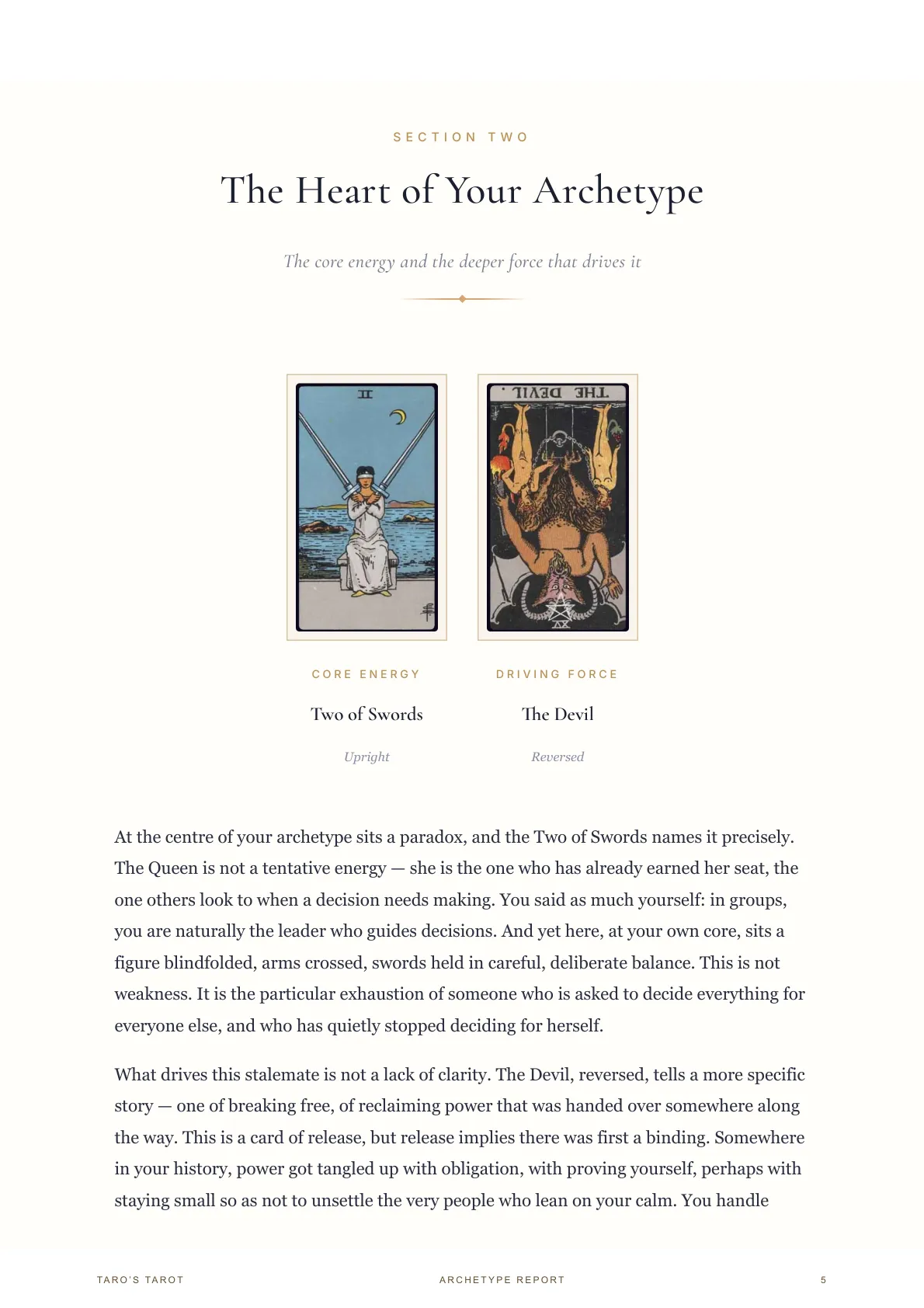
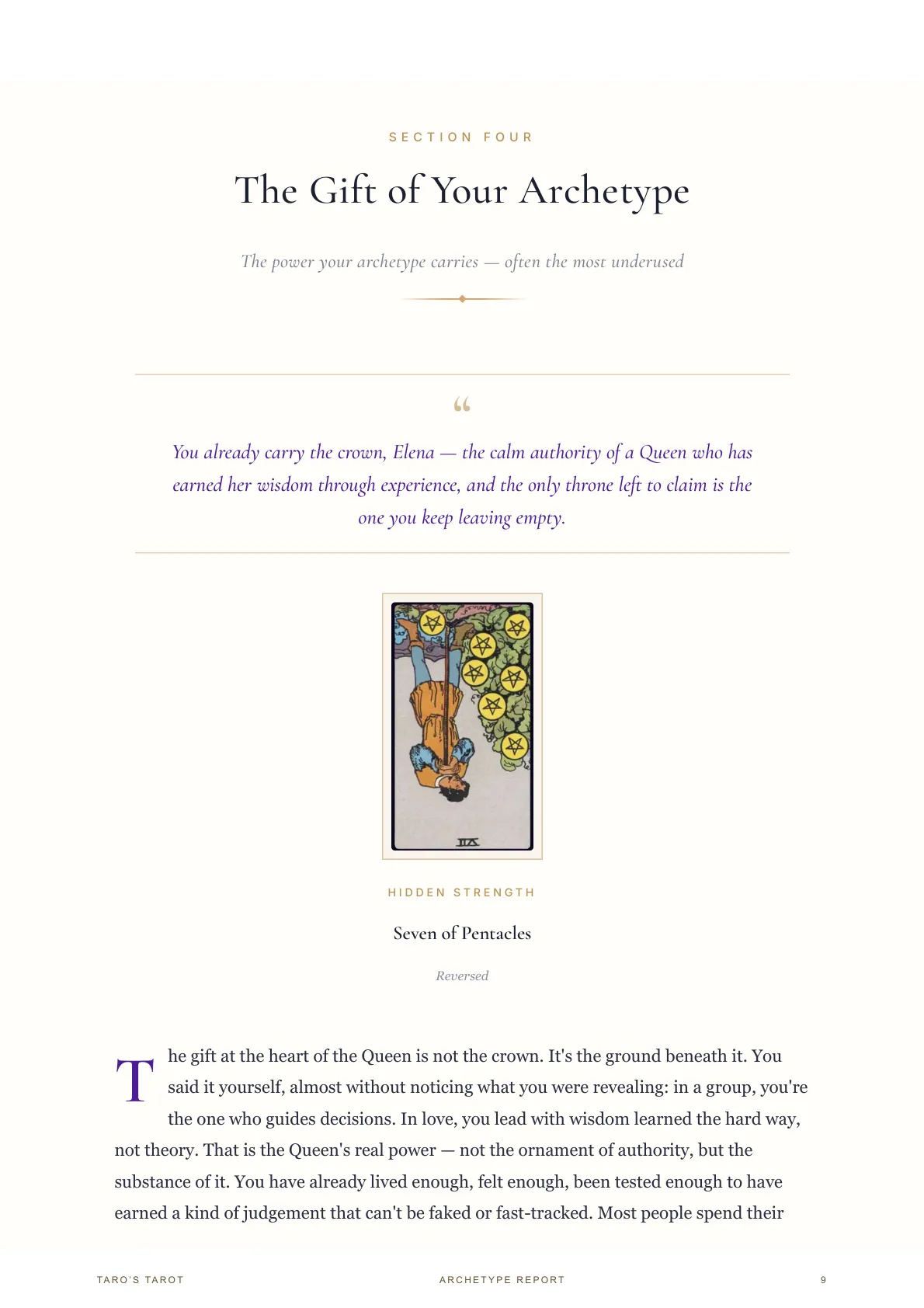
Sample pages from a real generated report — yours is written for you
$14.9930-day money-back guarantee — if your report doesn't feel genuinely specific to you, full refund, no questions asked.
“Most couples don't argue about who loves more. They argue because each of them shows love in a different way and misses the other's.”
Jump to a Girlfriend Type
The Six Girlfriend Types
Each type is a set of habits: how you show love, what you do after an argument, how much closeness you want and what you need back. Many people recognize themselves in two of them. Each card below covers the type's strengths, what to watch for, and what that type needs from a partner.
The Nurturer
You show love by looking after people. You notice when your partner hasn't eaten, you remember which day the hard meeting is, and you have painkillers in your bag before anyone asks. Your answers kept choosing care: checking in, taking over the evening, making home comfortable. Partners feel safe with you because they can tell you pay attention.
Care comes naturally to you, and you're good at it: practical, observant, rarely showy. You were probably the friend people called when something went wrong long before you were anyone's girlfriend. In a relationship it means your partner rarely has to ask for help. The risk is that care becomes the only way you know how to be close, so you keep giving it even when you're the one who needs it, and feel hurt when nobody notices. A good relationship for you has care going both ways, which means letting the other person look after you too.
What You Do Well
- You notice what your partner needs, often before they do
- You make a home, or even one evening, feel comfortable and safe
- You show up for illness, stress and bad news, when plenty of people back away
- Your care is practical: it gets things done, not just said
What to Watch For
- Looking after a partner can slide into managing them, which some people resent
- You may give care as a way of avoiding asking for it
- Quiet score-keeping ("after everything I do") is a sign you've given more than you wanted to
- Partners who like being looked after aren't always the ones who look after you back
Tarot Card
The Empress. In the Rider-Waite deck she sits in a field of ripe wheat with a stream running past, beside a shield marked with the symbol of Venus. She stands for care that makes things grow, from gardens to people. Her reversed meaning is the Nurturer's warning: care that smothers, or a woman who has given until there is nothing left for herself.
What You Need From a Partner
Someone who notices you the way you notice them, and says thank you out loud. You need a partner who takes over sometimes without being asked: cooks when you're tired, remembers your hard meeting, asks how you are and waits for the real answer. Look for a person who is comfortable being cared for but doesn't expect it as a service. Avoid partners who only call when they need something.
The Adventure Partner
For you, a relationship is something you do together. You find the new restaurant, book the weekend away, and say yes when your partner suggests something odd. Your answers kept choosing new experiences, energy and quick recoveries after a fight. Being with you is rarely boring.
You fall for people you can do things with, and love grows for you through shared stories: the trip that went wrong, the concert in the rain, the hike that took twice as long as the map said. You forgive quickly and don't hold grudges, so arguments with you are short. What you find hard is the stretch of a relationship where nothing is new: the third year, the same weeknight routine. You can read that restlessness as a sign something is wrong, when often it only means the two of you need a new plan. Your best relationships keep some novelty in them on purpose, so you don't go looking for it elsewhere.
What You Do Well
- You keep a relationship from going stale, and you do the planning that takes
- You get over arguments quickly and don't hold grudges
- You're up for your partner's ideas, not only your own
- Your shared experiences give the two of you stories nobody else has
What to Watch For
- Boredom can feel like a warning sign when it's only a quiet stretch
- You may skip the slow conversations that need a whole evening and no plan
- A partner who needs rest and routine can seem like they're holding you back, which isn't fair to them
- Trips and plans can cost more than the two of you can comfortably afford
Tarot Card
The Knight of Wands: a knight in armor on a rearing horse, his tunic covered in salamanders, riding across open desert. The card stands for energy, travel and acting on enthusiasm. Its warning matches yours: he sets off quickly and doesn't always stay for what comes after.
What You Need From a Partner
A partner who says yes more often than no, and who brings ideas too, so you're not always the one planning. You also need someone steady enough to tell you when you're restless rather than unhappy. Look for a person who enjoys new things but also likes their home life, so the two of you have somewhere to come back to. Avoid partners who treat your energy as a phase you'll grow out of.
The Best-Friend Girlfriend
You're the girlfriend your partner can tell anything. The relationship runs on inside jokes, easy silences and a lot of evenings on the same sofa. Your answers kept choosing friendship: humor after arguments, getting on with their friends, no performing. Partners often say it's the easiest relationship they've ever been in.
You don't see a line between being in love and being best friends, and the relationships that last usually have both. You're easy to be around, quick to laugh and hard to offend. You tend to meet partners through friends, or become friends first. The risk is that ease turns into flatness: the dates stop, the compliments stop, and romance gets saved for anniversaries. You may also use a joke to get out of a conversation that needs to be serious. The fix is simple but takes intention: keep the friendship and add deliberate romance on top of it.
What You Do Well
- You make a relationship feel easy to be in
- You and your partner can talk about anything, including the embarrassing things
- You get on with their friends and family without trying hard
- Your relationships hold up through ordinary life because that's where they started
What to Watch For
- Romance can fade into roommate life if nobody makes an effort
- A joke can become a way to avoid a serious conversation
- A partner may not realize how much they matter to you, because you rarely say it seriously
- You may stay in a relationship that's comfortable but no longer romantic
Tarot Card
The Two of Cups: two people face each other as equals and exchange cups, with a winged lion's head above them. It is the card of a partnership built on mutual respect and genuinely liking each other, not attraction alone. Reversed, it means imbalance or drifting apart, which for you usually starts when romance gets left out.
What You Need From a Partner
Someone who's funny, or at least laughs at you, and who can be serious when it counts. You need a partner who plans a real date sometimes and tells you you're attractive in plain words, because friendship won't supply the romance by itself. Look for a person who gets on with your friends and wants you in their circle too. Avoid partners who need drama to feel anything.
The Romantic
You believe love should be said, shown and marked. You write the card, plan the anniversary weeks ahead and remember the date of the first kiss. Your answers kept choosing words, gestures and emotional honesty. With you, a partner never has to wonder how you feel.
You take love seriously and you want it to feel like something. You say "I love you" easily and mean it, and you notice small moments other people walk past. In an argument you want to talk about feelings, sometimes at length, because unresolved hurt sits badly with you. The risk is expectation: you may picture how a moment should go and feel let down when a partner who loves you just as much shows it more quietly. Learning to count other kinds of love, like a fixed faucet or a filled gas tank, will save you a lot of disappointment.
What You Do Well
- Your partner always knows they're loved, because you tell them
- Small gestures from you make ordinary days feel special
- You're emotionally honest and don't play games
- You remember the details: dates, songs, what they said on the first night
What to Watch For
- You may expect a partner to show love the way you do, and read quieter love as less love
- Early intensity can hide whether the two of you actually suit each other
- Small slights can hurt more than the other person meant them to
- Planning the perfect moment can put pressure on a partner who isn't a planner
Tarot Card
The Knight of Cups: a knight on a white horse, riding slowly and holding out a cup, with a river running through the landscape. He is the card of romantic offers, invitations and following your heart. Reversed, he warns of moodiness and of being more in love with the idea of someone than with the person.
What You Need From a Partner
Someone who says it back: who tells you they love you, notices your effort, and marks the dates that matter to you even if they wouldn't on their own. You also need a partner steady enough not to be thrown by big feelings. Look for a person whose everyday actions match their words, because grand gestures are easy to fake and consistency isn't. Be wary of anyone who showers you with attention in the first weeks; you're the type most likely to be swept up by it.
The Independent One
You have your own life and you intend to keep it: your friends, your work, your plans, your evenings alone. You're with a partner because you want them, not because you need someone. Your answers kept choosing space: time to think before talking, few texts during the day, little drama over jealousy. Being with you means being with someone who is complete on her own.
You're direct, self-reliant and calm about things that make other people anxious. You don't need constant contact to feel secure, and you give your partner the same freedom you want. Many people find that a relief. The risk is distance: a partner may read your need for space as a lack of interest, and you may not notice they feel shut out until they say so. You can also be slow to ask for help, even when you'd like some. The relationships that work for you run on clear, spoken agreements: how often you see each other, when you need a night alone, what you tell each other.
What You Do Well
- You don't smother, cling or check up on a partner
- You say what you mean, which saves both of you from guessing
- You have a full life, so a partner is a choice, not a rescue
- You stay calm in situations that set off other people's jealousy
What to Watch For
- A partner may feel shut out or unneeded, even when you're perfectly happy
- You may leave a problem unspoken because you'd rather handle it alone
- Needing time to think can look like going cold in the middle of an argument
- Protecting your independence can turn into never fully committing
Tarot Card
The Queen of Swords: she sits alone on a high throne, seen in profile, sword held upright and one hand raised, with clouds below her and a single bird above. She stands for independence, clear thinking and honest speech. Her reversed meaning is coldness, the point where self-reliance starts shutting people out.
What You Need From a Partner
A partner with a life of their own, who is glad when you go out without them and still happy when you come back. You need someone secure enough not to read your space as rejection, and direct enough to tell you when they want more of you. Look for a person who asks what you need instead of guessing. Avoid partners who want to merge schedules, friends and phones by the third month.
The Loyal Anchor
You're dependable. You do what you said you would, you answer messages, and you're the same person on a Tuesday as you were on the first date. Your answers kept choosing consistency: a routine that belongs to the two of you, talking arguments through until they're settled, trust unless there's a real reason not to. Partners rarely have to wonder where they stand with you.
You love through reliability. You remember, you turn up, and you stay when things get dull or hard, which is exactly when many people leave. You're usually calm in a crisis and patient in an argument. Change is harder for you: you may keep a routine, or a relationship, going past the point where it works, because ending it feels like breaking a promise. You may also assume your partner knows how you feel because you show it every day, and forget to say it. Long relationships suit you best, with a partner who values what you give and sometimes pushes you to try something new.
What You Do Well
- Your partner can rely on you completely
- You stay calm and fair during arguments
- You're loyal in the hard times, not only the good ones
- You build the long-term things: savings, plans, a home, trust
What to Watch For
- Routine can crowd out romance and surprise
- You may stay too long in a relationship that has stopped working
- A partner who gives less can start taking your loyalty for granted
- You may not say what you feel, because you think your actions already said it
Tarot Card
The Knight of Pentacles: the only one of the four knights whose horse is standing still. He holds up a coin, with a plowed field behind him, and the card stands for patience, hard work and seeing things through. Reversed, he warns of stubbornness and a routine that has turned into a rut.
What You Need From a Partner
A partner who is as reliable as you are, so the loyalty goes both ways. You need someone who notices what you do every day and says so, and who will pull you out of the routine now and then with a new place or a change of plan. Look for someone who keeps small promises early on; it's the clearest sign of the kind of person you want. Avoid partners who are exciting but inconsistent, because you'll spend years waiting for them to settle down.
What Kind of Girlfriend Am I?
Your girlfriend type is the pattern that shows up in ordinary moments, not the one you would describe on a first date. To check your result, hold it up against the last month: the texts you sent, what you did after your last argument, how you spent a free evening. If the description fits those, it's your type. If another type fits better, your answers may have described the girlfriend you would like to be. This is how each type shows up day to day:
- The Nurturer. You know your partner's coffee order, the date of their dentist appointment and whether they've eaten today.
- The Adventure Partner. You keep a list of places to try, and a weekend spent at home feels like a wasted one.
- The Best-Friend Girlfriend. Most of your messages to your partner are jokes, and an hour of silence together doesn't feel strange.
- The Romantic. You keep ticket stubs and cards, and you notice when an anniversary is forgotten.
- The Independent One. You have plans your partner isn't part of, and an evening alone feels like a treat rather than a warning sign.
- The Loyal Anchor. You reply, you're on time, and your partner's family already counts on you.
If two types fit, read both. For how you give and receive care in particular, the love language quiz goes into more detail.
Which Type of Partner Suits Each Girlfriend Type
No type rules out another. Whether two people suit each other depends mostly on whether they can say what they need and adjust. Some pairings still start with less friction than others:
- The Nurturer suits a partner who gives care back and says thank you, often a Loyal Anchor. It clashes with partners who accept care and never return it.
- The Adventure Partner suits someone curious who brings ideas too, such as another Adventure Partner or a Best-Friend type. It can clash with a partner who needs a predictable week, unless you agree how much is new and how much is routine.
- The Best-Friend Girlfriend suits a partner with a sense of humor who will also plan a date, such as a Romantic. Two Best-Friend types can drift into roommate life without noticing.
- The Romantic suits a partner who says how they feel and keeps their word, such as a Loyal Anchor who has learned to say it out loud. It clashes with partners who go quiet for days, or who pour on attention early and then fade.
- The Independent One suits someone with a full life of their own who doesn't read space as rejection, such as another Independent One. It clashes with partners who want daily reassurance, unless you agree how often you'll check in.
- The Loyal Anchor suits a partner who values reliability and will sometimes change the routine, such as an Adventure Partner. It clashes with partners who are exciting but inconsistent.
If closeness makes one of you anxious and the other distant, the attachment style quiz explains why. For a reading about a specific relationship, try a love tarot reading. To see which kind of partner you usually pick, take the What's My Type? quiz.
Taking This Girlfriend Quiz With Your Partner
This quiz also works as a quiz for couples. Take it yourself first, then have your partner take it answering the way they think you would, and compare the two results. If you both land on the same type, your partner sees you the way you see yourself. If the results differ, look at the questions where your answers split: they usually point to a habit one of you notices and the other doesn't, such as care that goes unthanked or space that gets read as coldness.
Frequently Asked Questions
What type of girlfriend am I?
It depends on your habits more than on how you would describe yourself. This quiz sorts you into one of six types from ten everyday situations: the Nurturer (care), the Adventure Partner (new experiences), the Best-Friend Girlfriend (friendship and humor), the Romantic (words and gestures), the Independent One (space and self-reliance) and the Loyal Anchor (consistency).
How accurate is a girlfriend quiz?
It is as accurate as your answers. It is not a psychological test and cannot diagnose anything; it sorts the habits you report into a pattern. It works best as a starting point for a conversation with a partner about what each of you needs.
Can my girlfriend type change?
Yes. Your answers describe your habits now, and habits change with a new partner, a stressful year or a long relationship. Take the quiz again later and you may get a different result.
Can my partner take this quiz for me?
Yes. Have your boyfriend or girlfriend answer every question the way they think you would, then compare the two results. Where they differ is worth talking about: it usually points to something one of you does that the other does not notice.
Which girlfriend type is the best?
None of them. Each type has real strengths and real problems, and each suits some partners better than others. A good relationship depends more on both people saying what they need than on which type either of you is.
This quiz is for self-reflection and entertainment. It describes habits, not your worth as a partner.
Explore More Quizzes
Discover more ways to explore your spiritual journey
Looking for more spiritual guidance?