THE WAY YOU CONNECT
Why Am I Single? Take the Free Quiz
If you had to summarize your dating history in one honest sentence, which is closest?
Choose the answer that feels most like you.
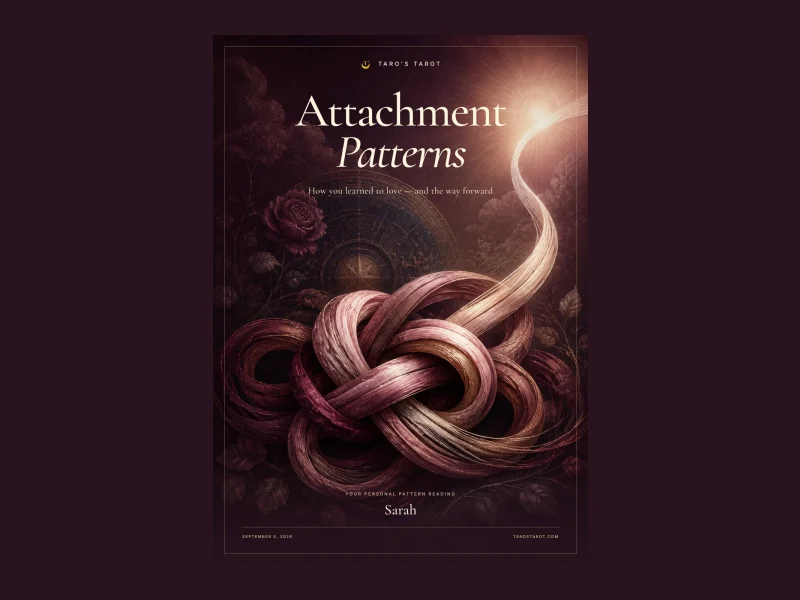
Inside the report: Your Defense System
Why do you love the way you do?
The Moon in the Mask position reveals something quietly devastating: the face you show the world when love gets close isn't cold — it's careful. You've learned to pre-empt abandonment by never fully arriving. The distance you create isn't indifference. It's a finely tuned survival mechanism built in a home where presence was punished...
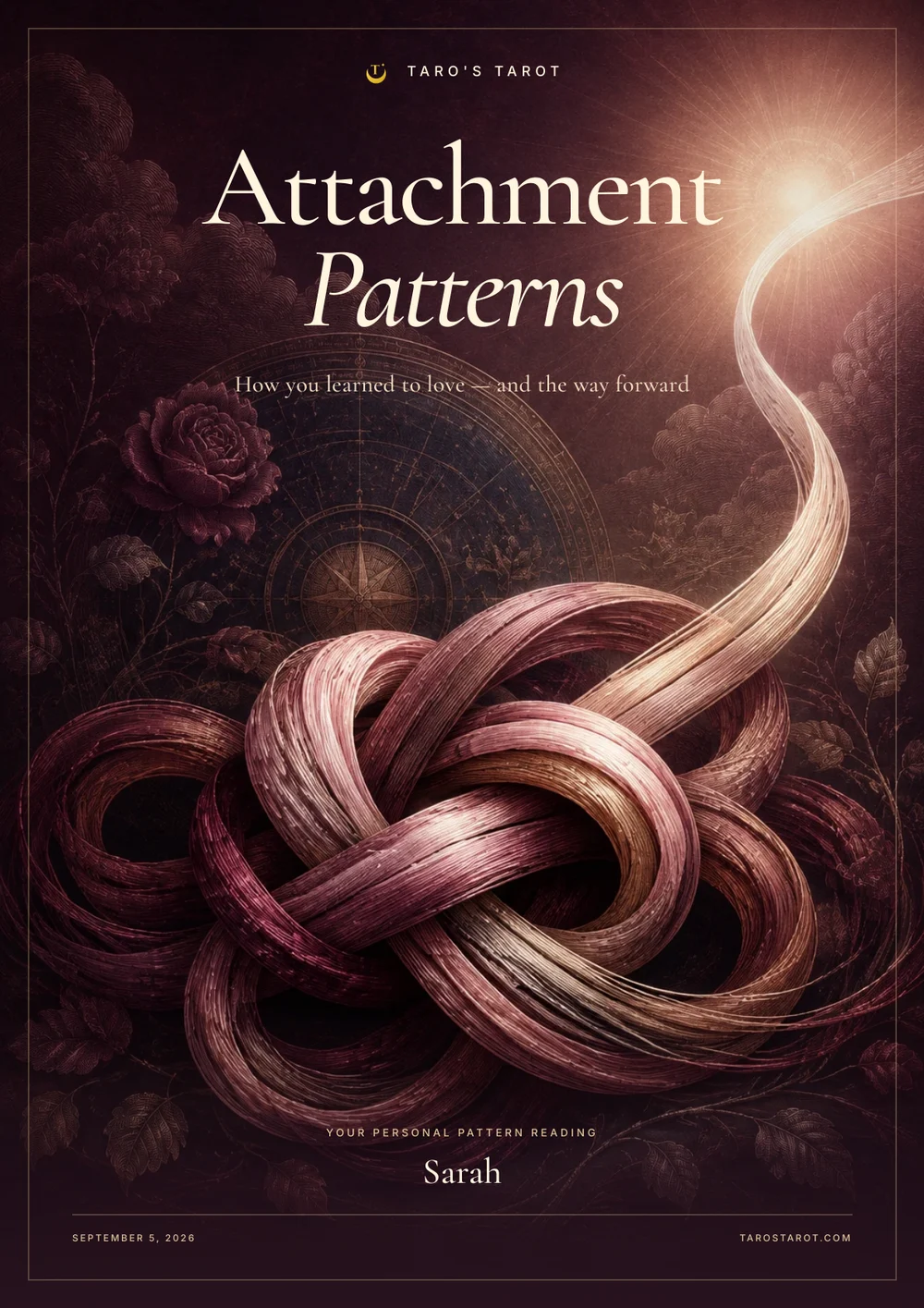
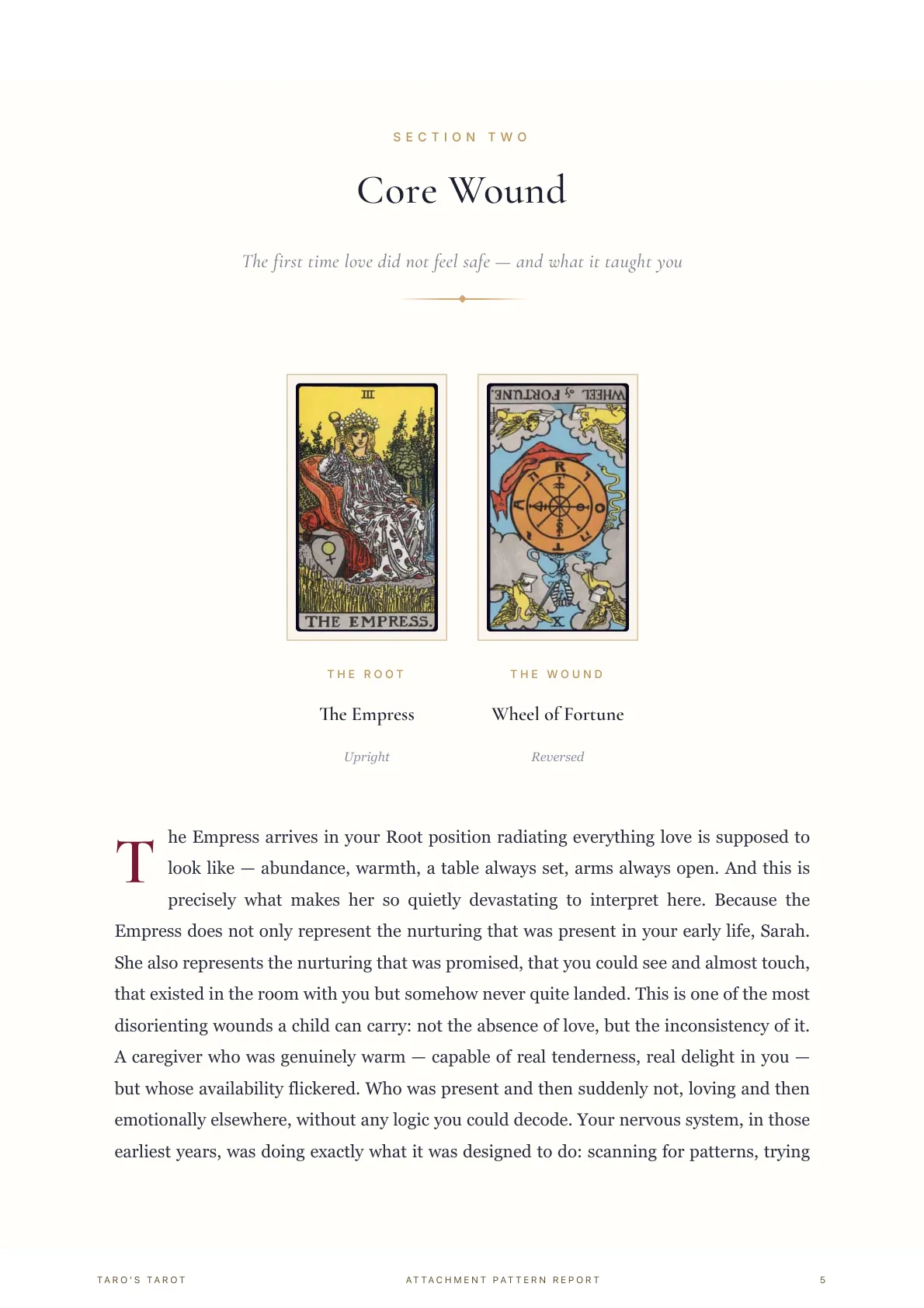
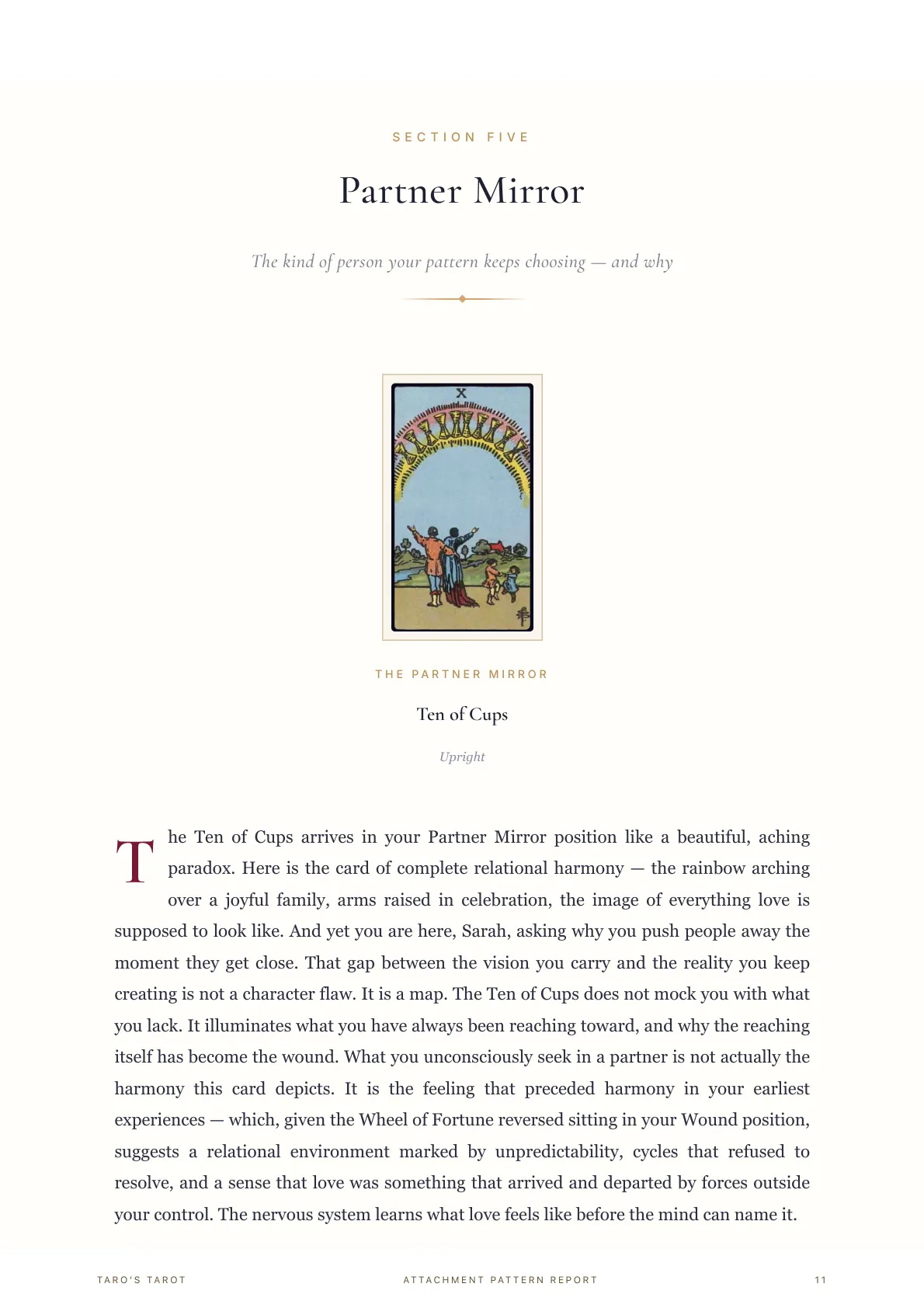
Sample pages from a real generated report — yours is written for you
$14.9930-day money-back guarantee — if your report doesn't feel genuinely specific to you, full refund, no questions asked.
Why Am I Still Single?
If you've typed this question into a search bar at 1am, here's the first thing worth knowing: the question itself is usually miscalibrated. It assumes there's a single flaw to find — too picky, too much, not enough — when almost nobody is single because of a defect. People are single because of patterns: repeatable, describable sequences in how they meet people, what they feel drawn to, and what happens when someone gets close.
Patterns are better news than flaws, for one simple reason: a flaw is something you are, but a pattern is something you do. What you do was learned somewhere — usually early, usually for good reasons — and what was learned can be retired. The person who keeps everyone at arm's length isn't defective; they're running twenty-year-old security software. The person who only wants people who half-want them back isn't broken; their nervous system just filed "uncertainty" under "love" a long time ago.
The quiz above identifies which of five patterns fits your history. Fair warning: one of the results is that nothing is wrong with you at all — some people are genuinely ready and simply fishing in an empty pond. That's a real result, not a consolation prize.
Is Something Wrong With Me — or Is It Dating Apps?
This is the honest fork in the road, and most quizzes dodge it. So let's not: dating apps really have made things harder. The paradox of choice is real — when the next option is one swipe away, people dismiss faster, invest less, and ghost more. Swipe fatigue flattens genuinely interesting people into 0.8-second verdicts. If your dating life runs entirely through three apps, some of your struggle is structural, not personal.
But here's the uncomfortable other half: the apps are the same for everyone, and the same person tends to have the same experience across every app, every city, every year. If your last five almosts all died the same death — you went cold, they were never available, it fizzled at week six on schedule — that's not the algorithm. That's a pattern wearing the algorithm as an alibi.
The useful move is separating the two, because the fixes are opposite. An environment problem needs new environments — new rooms, new routines, less app, more life. A pattern problem follows you into every new room until it's named. The quiz is designed to tell you which one you're actually dealing with.
The Patterns That Keep People Single
Five patterns cover most long-term singleness. Each is a strategy that once made sense — and each has a tarot archetype that captures its shape. Find the one that reads like your history.
Jump to a Pattern
The Guarded Heart
You're not single because nobody wants you. You're single because getting to you requires a security clearance most people give up on. Somewhere along the way, you learned that openness gets punished — so you built walls, and the walls work. That's the problem. They work on everyone, including the people you'd actually want inside.
You're warm once someone's in — genuinely, generously warm. But the road in is long. You deflect with humor, keep first dates at arm's length, and answer personal questions with impressive vagueness. People often describe you as "hard to read," which stings a little, because inside you're not cold at all. You're just careful. You've been burned before, and you decided — quietly, maybe without noticing — that the fire doesn't get a second chance.
Strengths
- You don't fall for love-bombing — your caution filters out the genuinely dangerous
- When you commit, you commit — your inner circle knows your loyalty is bedrock
- You know yourself well; the time alone hasn't been wasted
- Your walls prove you can protect yourself — that's a skill, not a flaw
Growth Edges
- The wall can't tell the difference between a threat and a good person being patient
- You test people without telling them they're being tested
- Vulnerability feels like losing, so you keep even great dates at a demo version of you
- You may mistake the absence of risk for peace
Tarot Archetype
Nine of Wands — the figure standing guard, bandaged but upright, gripping the last wand. This card honors what you've survived: you took hits and stayed standing. But look closer — the battle in the picture is over. The Nine of Wands asks the question you've been avoiding: are you defending yourself from something real, or from something that already ended?
Guidance
You don't need to demolish the wall — you need a gate. Practice graduated openness: share one true, slightly-vulnerable thing on a date and watch what they do with it. Their response is real data; your fear is old data. And notice the difference between standards and walls: standards filter for how someone treats you, walls filter out everyone before treatment can even begin. You've already proven you can survive being hurt. The remaining question is whether you'll let yourself be known.
The Self-Saboteur
You're not single because nothing ever starts. You're single because something in you ends it first. Things go well — genuinely well — and then you find the flaw, pick the fight, go quiet, or decide they're about to lose interest and beat them to the exit. It looks like pickiness from the outside. From the inside, it's protection: if you end it, it can't end you.
You're self-aware — painfully so. You can narrate your own sabotage in real time ("I know I'm doing the thing") and still not be able to stop the thing. Your mind is a brilliant prosecutor: it builds an airtight case against every promising person, usually around week six, right when things start feeling real. The crime they're charged with is never the real one. The real one is: they were getting close enough to matter.
Strengths
- Your self-awareness is genuinely rare — most people sabotage blind; you sabotage with commentary
- You feel things deeply, which is exactly why closeness rattles you
- The flaw-hunting brain, aimed at problems instead of partners, is a superpower
- You've never actually been proven unlovable — only untested
Growth Edges
- You reject preemptively so rejection can never surprise you
- Good treatment makes you suspicious — you go looking for the catch
- You start fights near milestones: meeting friends, saying feelings, making plans
- Insight without action has become its own hiding place
Tarot Archetype
Seven of Swords — the figure sneaking away from camp, arms full of swords. Traditionally the card of theft, but read it honestly: the thief and the victim are the same person. Every time you slip away from something good, you're stealing from your own camp — taking the connection, the possibility, the almost. The Seven of Swords asks a quiet, devastating question: what would happen if you just... stayed?
Guidance
The urge to bolt is not a verdict — it's a signal that something started to matter. So make one rule: no ending things inside the panic. When the exit-urge hits, wait 48 hours and tell one person (a friend, a journal, even the date) that you're scared, not done. Watch how often the "fatal flaw" dissolves once named. Your pattern was built to protect a younger you from an ending they couldn't control. You're allowed to thank it — and retire it.
The Too-Busy Builder
You're not single because you're undateable. You're single because love has been sitting in your someday pile — after the degree, the promotion, the move, the savings goal — for years. You built an impressive life with real foundations. You just never scheduled anyone into it, and the "right time" you've been waiting for keeps moving its own deadline.
You're the competent one. The friend with the plan, the career that's going somewhere, the apartment that's actually furnished. Dating, when it happens, gets the leftover hours — a app-swiping session at 11pm, a date squeezed between obligations, then a two-month gap when work heats up. It's not that you don't want love. It's that wanting it has never made it onto the calendar, and part of you finds that... convenient. Building is measurable. Love is not. You gravitate to the game you know you can win.
Strengths
- You bring a genuinely full life to the table — a partner would be an addition, not a rescue
- Follow-through is your native language; when you decide something matters, it happens
- You're not desperate, which makes you refreshingly honest to date
- Self-reliance this deep means you'd choose someone, never need-grab them
Growth Edges
- Busyness can be a socially applauded hiding place — no one questions "I'm focused on my career"
- You treat love as a reward for a finished life instead of an ingredient of one
- Efficiency thinking leaks into dating: three dates max, verdict rendered, next
- The someday pile assumes time is infinite; calendars disagree
Tarot Archetype
Eight of Pentacles — the craftsman at his bench, head down, carving the next pentacle. It's one of tarot's most honorable cards: mastery, diligence, work done well. But he's alone in the frame, and the town — where the people are — sits far in the background. The Eight of Pentacles doesn't tell you to put down the tools. It asks what the work is for, and who you're planning to show it to.
Guidance
Stop waiting for the season when things calm down; you and I both know that season is fictional. Instead, treat connection like you treat everything that actually happens in your life: give it structure. Two evenings a month, protected like a client meeting. And on those dates, resist the urge to audit for efficiency — connection compounds slowly, like the things you build. You don't have to earn love by finishing the scaffolding first. The building gets warmer with someone in it, even mid-construction.
Genuinely Ready (Wrong Pond)
Here's the plot twist: there's nothing to fix. You're open, you know yourself, your standards are reasonable, and you actually follow through. Your pattern isn't psychological — it's geographical. You're fishing in the wrong pond: the same three apps, the same routines, the same social circle that stopped producing new people around three years ago. The problem isn't the fisher. It's the water.
You've done the work — maybe therapy, maybe just honest years — and it shows. You can name your past patterns without flinching and you don't bring old ghosts to new dates. But your life has quietly ossified into a loop: same commute, same gym, same group chat. The apps show you the same recycled faces. Everyone tells you "it happens when you least expect it," which is both unhelpful and statistically dubious, because it mostly happens where new people actually are.
Strengths
- You're actually ready — a rarer condition than most people admit
- Your standards filter for character, not fantasy; that's exactly right
- You handle rejection like weather, not verdict — it passes
- You don't need someone; you want someone. That's the strongest position to date from
Growth Edges
- Routine has quietly shrunk your surface area for luck
- App fatigue may have made you swipe-numb — dismissing in 0.8 seconds what deserved 8
- Readiness can curdle into discouragement if you mistake a thin pond for proof about yourself
- You may under-broadcast interest — being composed can read as being uninterested
Tarot Archetype
Six of Swords — the boat crossing to a farther shore, swords packed, water calming ahead. This is tarot's card of deliberate passage: not fleeing, not drifting, but choosing new waters because the old ones have given what they had to give. The ferryman doesn't abandon the swords — the lessons come along. The Six of Swords says the work now isn't inner. It's directional. Row.
Guidance
Your assignment is exposure, not introspection. Change the water: one new recurring thing (a class, a club, a sport, a volunteer shift) where the same people show up weekly — repetition is how strangers become dates. Tell your friends, explicitly, that you're open to being set up; most people never actually say it. If you use apps, use them like a channel, not the channel. And keep your calibrated standards exactly where they are. You're not the problem to solve — you're the catch that's been circling a pond with no fish.
What to Do With Your Result
A named pattern is only useful if you do something with it, and each pattern has a different first move. If you got the Guarded Heart, your work is graduated openness — one true thing per date, then watch what they do with it. The Unavailable-Person Magnet's assignment is a genuine third date with someone "boring" — quiet spark is still spark. The Self-Saboteur gets one rule: no ending things inside the panic; wait 48 hours and say the fear out loud. The Too-Busy Builder puts love on the calendar with the same protection as a client meeting. And Genuinely Ready (Wrong Pond) skips the introspection entirely — the work is new rooms, new routines, and telling friends, explicitly, that you're open to being set up.
And if your result stirred something bigger — a suspicion that this pattern didn't start with dating — that instinct is usually right. Most single patterns are attachment patterns wearing a dating costume: they were learned in the first relationships you ever had, long before the apps existed. That's the layer the deep assessment and the personalised attachment pattern report are built to read.
Frequently Asked Questions
Why am I still single when I'm a decent person?
Because being single usually isn't about worth — it's about pattern. Most long-term single people are running one of a handful of identifiable patterns: walls that filter everyone out, chemistry that only fires for unavailable people, sabotage right as things get real, love deprioritized behind goals, or a social pond with no new people in it. None are defects. They're learned strategies, and learned strategies can be unlearned — once they're named.
Is something actually wrong with me, or is dating just harder now?
Both can be true, which is why the question is so confusing. Apps genuinely changed the landscape — endless perceived options and swipe fatigue are real. But the apps affect everyone, and some people still connect. The honest question is which part is environment and which part is pattern. One of the five results exists specifically for people whose problem is environmental, not psychological.
Is this quiz going to make fun of me for being single?
No. Every result is written to be dignifying, because the truth is dignifying: the patterns that keep people single are intelligent protective strategies that once made sense. Naming yours isn't an insult — it's the first step to retiring a strategy that's finished its job.
What should I do after getting my result?
Read your full pattern description, especially the guidance section — each pattern has a different next step. Walls need a gate, magnets need to re-test "boring" people, saboteurs need a 48-hour rule, builders need love on the calendar, and wrong-pond people need new water. If the result resonates deeply, the layer underneath is usually attachment-shaped — the attachment style quiz maps that next.
This quiz is for self-reflection purposes only. It is not a clinical diagnosis or substitute for professional help.
Explore More Quizzes
Discover more ways to explore your spiritual journey
Looking for more spiritual guidance?