A LITTLE MORE UNDERSTANDING
Abandonment Issues Quiz — Do You Have an Abandonment Wound?
Someone you care about hasn't replied for hours, with no explanation. What actually happens in you?
Choose the answer that feels most like you.
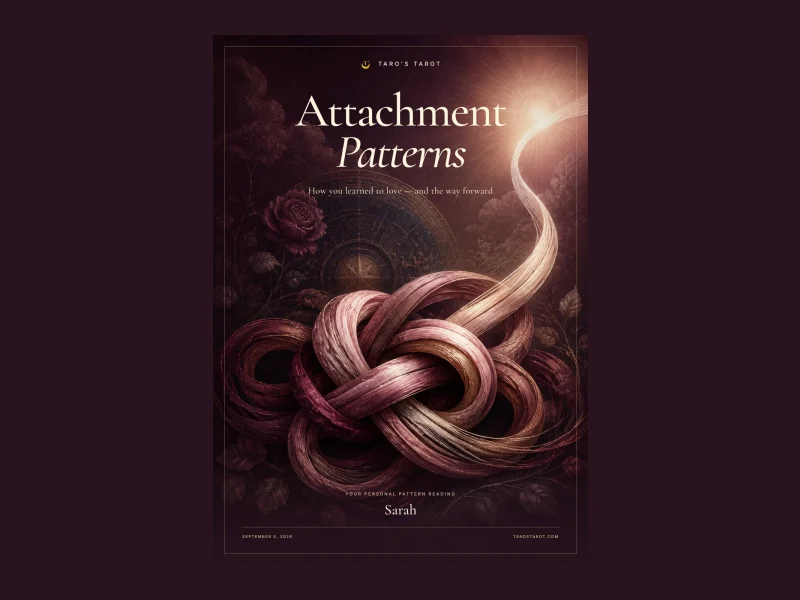
Inside the report: Your Defense System
Why do you love the way you do?
The Moon in the Mask position reveals something quietly devastating: the face you show the world when love gets close isn't cold — it's careful. You've learned to pre-empt abandonment by never fully arriving. The distance you create isn't indifference. It's a finely tuned survival mechanism built in a home where presence was punished...
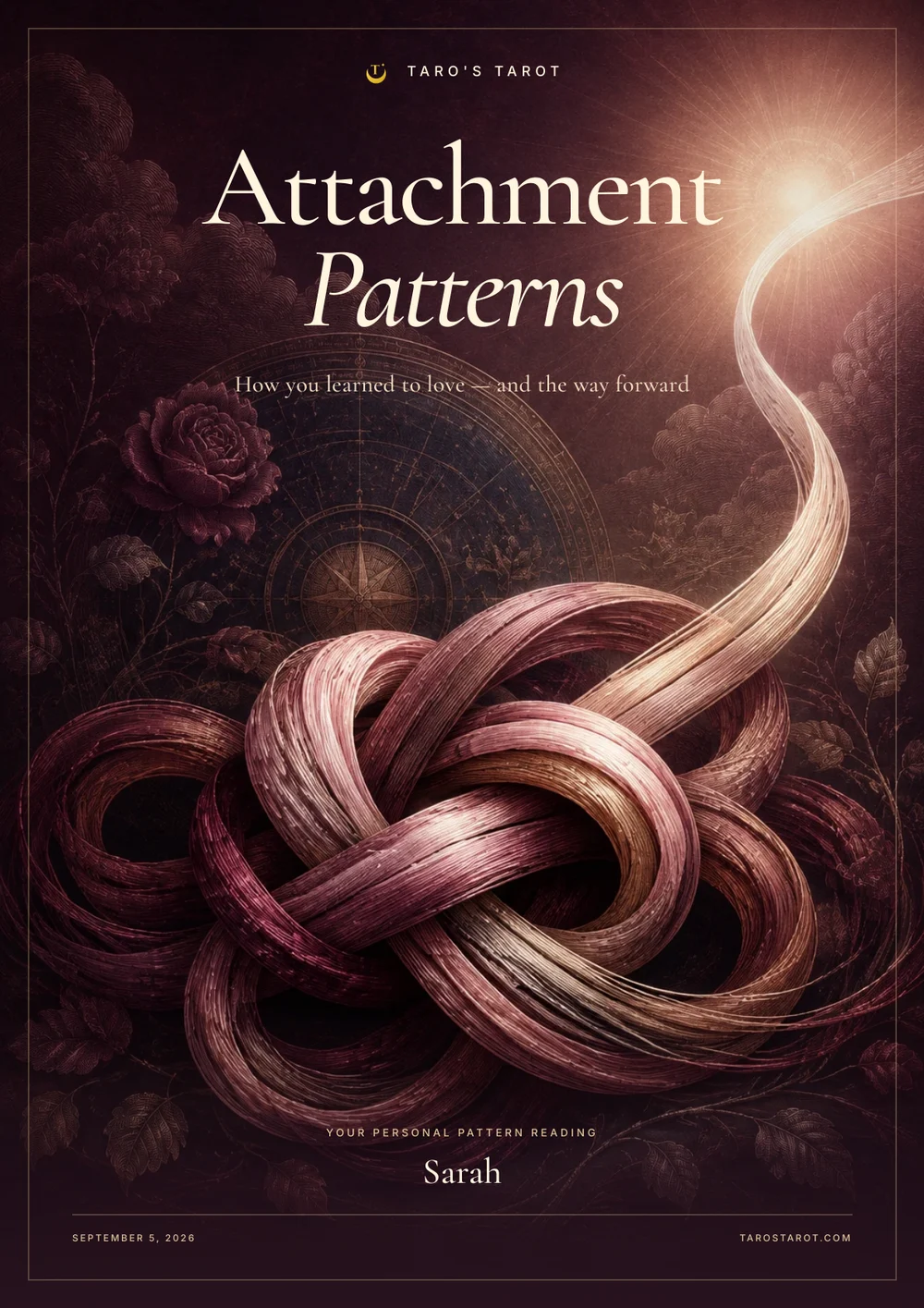
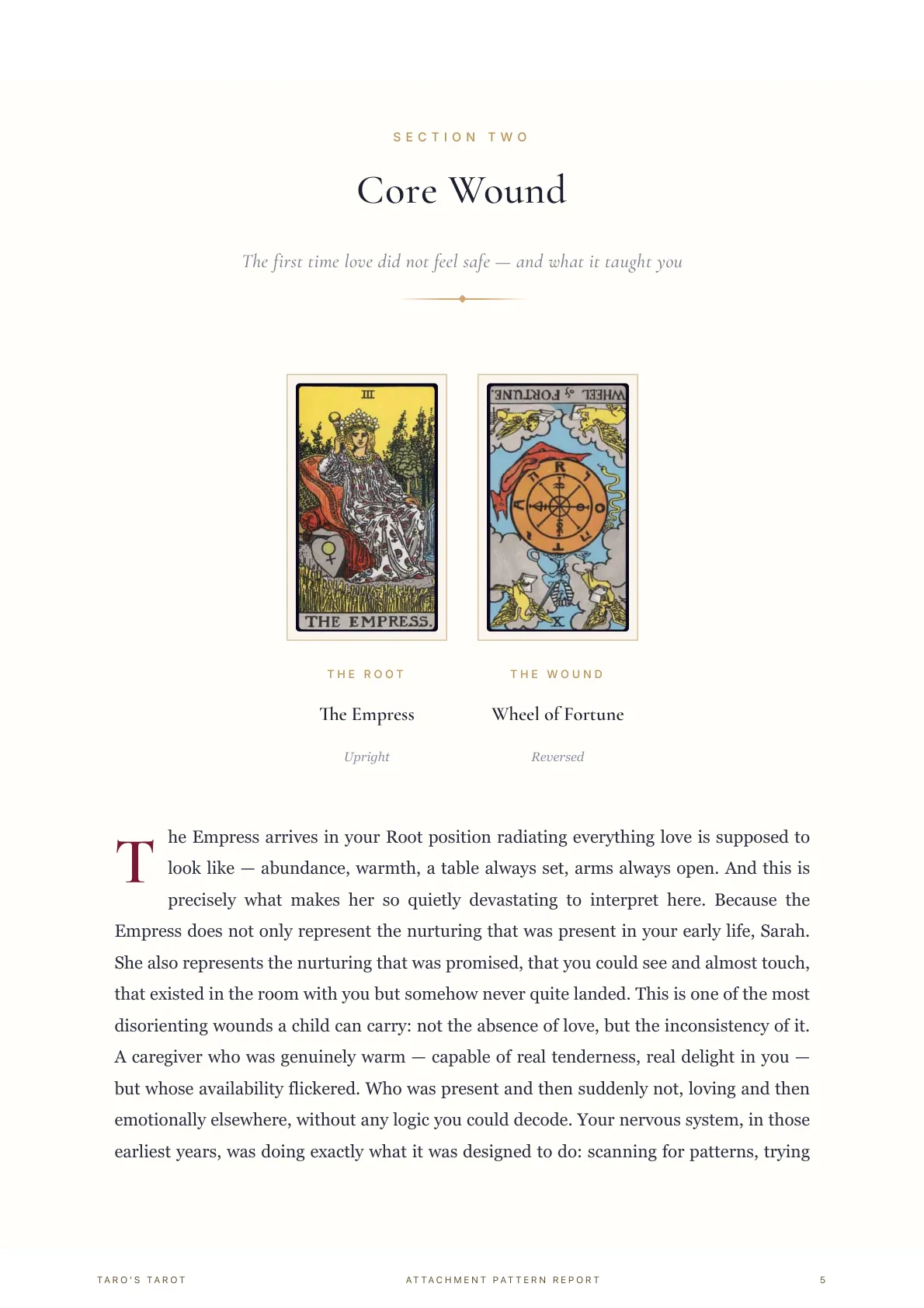
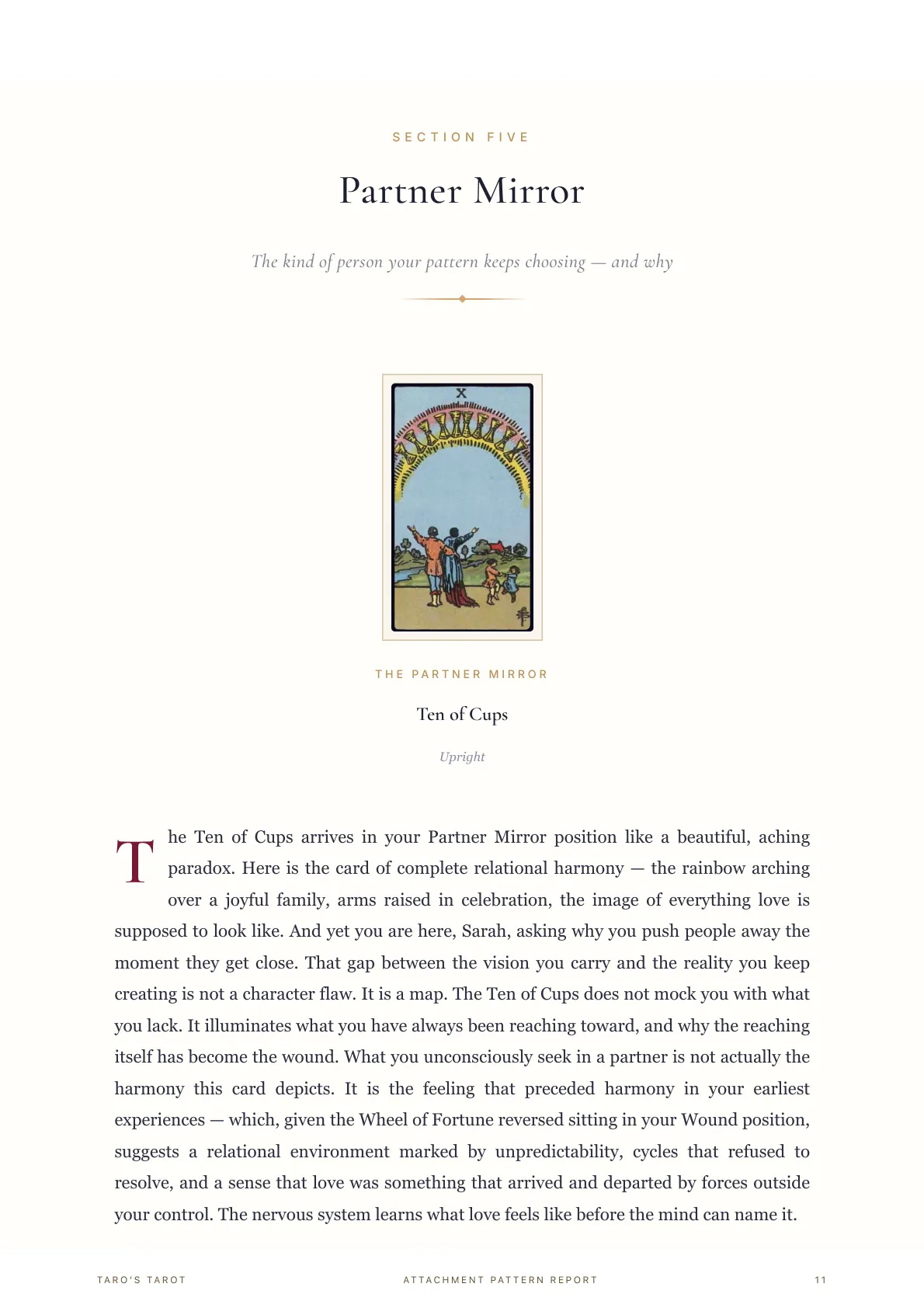
Sample pages from a real generated report — yours is written for you
$14.9930-day money-back guarantee — if your report doesn't feel genuinely specific to you, full refund, no questions asked.
Jump to an Abandonment Pattern
The Five Abandonment Patterns
An abandonment wound doesn't look the same in everyone. The same early leaving can produce someone who grips, someone who runs first, someone who tests, someone who walls off — or someone who has made real peace with the scar. Find the pattern that feels like yours.
The Holder-On
Your abandonment wound expresses itself by gripping. When someone matters to you, part of you is always watching for the first sign of them leaving — the slower reply, the flatter tone, the plans that don't include you. You hold on tighter when you feel distance, because letting go early once meant losing everything.
You love hard and you love loyally — nobody has to wonder whether you care. But closeness comes with a background hum of vigilance. You re-read messages. You notice micro-shifts in warmth that others miss entirely. When the fear spikes, you reach: a check-in text, a question that's really a test of "are we okay?", a need to hear it out loud one more time. The reassurance works — for about a day. Then the hum returns, because the wound was never about this person. It's about the leaving that came before them.
Strengths
- Your attentiveness is real emotional skill — you read people accurately, even if you interpret through fear
- You fight for your relationships instead of discarding them
- Your capacity for devotion is deep and rare
- You are honest about needing people — many spend their lives pretending they don't
Growth Edges
- Reassurance-seeking can exhaust a partner who has done nothing wrong
- Monitoring their warmth keeps you living in the future loss instead of the present love
- You may confuse anxiety with intuition — a racing heart isn't always evidence
- Holding tighter can create the very distance you fear
Tarot Archetype
The Moon — fear magnified in low light. Under the Moon, an ordinary path looks full of threats; the mind fills every shadow with the thing it dreads most. Your wound does the same with silence: it takes an unanswered message and projects an ending onto it. The Moon's teaching is not "your fear is false" — it's "wait for daylight before you believe what the dark is telling you."
Guidance
Your fear of being left is not neediness — it's a memory. Somewhere, leaving happened, and your nervous system learned to brace for it early. The work is not to stop caring; it's to learn the difference between a real signal and an old alarm. When the panic rises, try naming it before acting on it: "This is the wound talking, not this moment." Delay the checking text by twenty minutes and let your body settle first. And tell the people you love what the fear is — a named fear invites reassurance; an acted-out fear invites conflict. This is self-reflection, not a diagnosis — if the fear is running your daily life, a good therapist can help you trace it to its source.
The Pre-emptive Leaver
Your abandonment wound expresses itself by striking first. You learned that being left is the worst pain there is — so you make sure it never happens again by being the one who leaves. You end things at the first serious wobble, keep an exit half-planned even in good relationships, and feel safest when you care slightly less than the other person.
From the outside you look decisive, even cold — the one who "doesn't catch feelings," who ends things cleanly and moves on fast. Inside, it's not coldness; it's self-protection with excellent reflexes. You can feel the exact moment a relationship becomes dangerous — which is to say, the moment it starts to matter. That's when the flaws suddenly become dealbreakers, the restlessness kicks in, and part of you starts drafting the goodbye. Leaving first hurts too. But it's a pain you control, and control is the one thing being abandoned took from you.
Strengths
- You are genuinely self-protective — your instincts kept you safe when nothing else did
- You end things honestly rather than fading or betraying
- You recover quickly and rebuild your life with real competence
- Your independence is earned, not performed
Growth Edges
- You may be grading good relationships as threats simply because they matter
- Leaving first guarantees the ending you were trying to avoid
- The people you leave rarely know the real reason — so you carry it alone
- Control over the ending is not the same as safety within the relationship
Tarot Archetype
Eight of Cups — the figure walking away from eight carefully stacked cups under a dark moon. Upright, it's the courage to leave what no longer serves you. But lived as a pattern, it becomes the same mountain path over and over: build something, feel it start to matter, walk. The card's question for you is not "can you leave?" — you've proven that. It's "can you stay long enough to find out what would have happened?"
Guidance
Leaving first was intelligent once. Someone taught you that attachment ends in ambush, and you swore you'd never be ambushed again. But notice what the strategy costs: you never get to be fully known, because you're gone before knowing gets deep. The next time the urge to end things surges in a relationship that is actually good, try treating it as information instead of instruction: "Something just made me feel unsafe — what was it?" Often it's closeness itself. You don't have to stay in anything harmful. But a wobble is not an ambush, and mattering to someone is not a trap. This is self-reflection, not a diagnosis — if every relationship ends by your hand at the same depth, that pattern is worth exploring with a professional.
The Tester
Your abandonment wound expresses itself as trials. You don't quite believe anyone will stay, so you check — picking small fights to see if they'll weather them, pulling away to see if they'll follow, mentioning other options to see if they'll flinch. Every test they pass buys you a little peace. But no test result lasts, because the question isn't really about them.
You would never describe yourself as manipulative, and you're right — testing doesn't come from cruelty, it comes from terror. Some part of you is permanently gathering evidence on the question "will you leave me like they did?" So you engineer little experiments: going quiet to see who reaches out first, being difficult to see if they'll still choose you, watching how they talk about their exes for clues about your own future. When they pass, the relief is enormous and short-lived. When they fail — or get tired of being tested — the wound whispers, "See? Everyone leaves." It never mentions its own role in the ending.
Strengths
- Your tests come from taking love seriously — indifferent people don't check
- You are perceptive about inconsistency and false promises
- When someone earns your trust, you give it deeply
- You are capable of naming this pattern — which is the hardest step
Growth Edges
- Tests punish the innocent for the crimes of the person who left
- A partner can pass a hundred tests and still face test one-hundred-and-one
- Provoking distance to check for love eventually creates the distance
- The wound grades every ending as proof, even the endings the tests caused
Tarot Archetype
Justice — the scales and the sword. Justice weighs evidence and cuts cleanly, but your inner courtroom was rigged by the original leaving: the verdict "everyone abandons me" was entered before this person ever took the stand. Every test is an appeal that changes nothing, because the judge is your history, not your partner. Justice's invitation is to reopen the original case — the one where a child concluded the leaving was about their worth.
Guidance
Every test is a question you're afraid to ask out loud: "Are you going to leave me?" The brave version of testing is asking it directly — telling someone, "When you went quiet yesterday, an old fear woke up." That sentence gets you real reassurance; a staged fight only gets you evidence you can't trust, because you engineered the conditions. Start noticing the moment before a test: there's always a flicker of fear first. That flicker is the truth. Speak from there instead. And be gentle with yourself — you learned to test because someone failed you when you had no way to check. This is self-reflection, not a diagnosis — a therapist can help you retire the courtroom for good.
The Self-Sufficient Wall
Your abandonment wound expresses itself as fortress-building. Somewhere along the line you concluded: if I never fully need anyone, no one can ever fully leave me. So you became magnificently self-sufficient — the capable one, the low-maintenance one, the one who's "fine." People can't abandon what you never handed them. But they can't hold it either.
You are the person everyone relies on and no one worries about — which is exactly how you designed it. You handle your own crises, mourn your own losses privately, and feel a quiet discomfort when someone offers real care, as if they've found a door you meant to keep hidden. In relationships you're present but pre-armored: affectionate, but with your deepest needs filed under "handled." Partners often say they can't reach you, and they're right. The wall wasn't built against them. It was built decades ago against a leaving — and it doesn't know the war is over.
Strengths
- Your self-reliance is real — you can genuinely carry yourself through hard things
- You never weaponize need or drown a partner in demands
- You are steady in crisis; people trust your calm
- The wall proves you could build something to survive — imagine what you could build for connection
Growth Edges
- Needing no one reads as wanting no one — partners feel shut out, then leave, confirming the wound
- Your pain goes unwitnessed, which is its own slow abandonment
- Self-sufficiency can quietly become loneliness with good PR
- You may not notice how much you're carrying until your body tells you
Tarot Archetype
Nine of Pentacles — the elegant figure alone in a garden she built herself, a hooded falcon on her glove. It's tarot's card of earned self-sufficiency, and it's genuinely beautiful — but look again: the garden has walls, the falcon is hooded, and she is alone in paradise. The card honors what you built and asks the quiet question: was the garden meant to be a home, or a place no one could leave you from?
Guidance
Your independence is an achievement, not a flaw — do not let anyone shame you for the strength that carried you here. But notice the fine print of the deal you made: "no one can leave me" was purchased with "no one can truly find me." The wall doesn't come down all at once, and it shouldn't. Try one brick: let one safe person see one real need — say "this week was hard" instead of "I'm fine," or accept help you could technically manage alone. Notice that being witnessed doesn't collapse you. The goal isn't to become needy; it's to make need survivable again. This is self-reflection, not a diagnosis — if letting anyone in feels physically impossible, that's worth exploring gently with a professional.
Secure with Scars
You carry an abandonment wound — and you know it, name it, and mostly don't let it drive. The fear of being left still visits: in the pause before a hard conversation, in the flicker when someone's tone changes. But you've learned to feel the old alarm without obeying it. That's not the absence of a wound. That's a healed relationship with one.
You know your history and you've done real work with it — maybe therapy, maybe honest reflection, maybe just years of choosing differently. When the fear of abandonment rises, you can usually catch it: "That's the old story, not this moment." You ask for reassurance directly instead of testing for it, tolerate a partner's bad day without reading it as a departure, and stay through wobbles that once would have sent you gripping or running. On hard days the scar still aches — anniversaries, endings, someone going quiet too long. The difference is you now know it's a scar and not an open wound, and you treat it accordingly.
Strengths
- You can name your fear in real time — the rarest and most powerful relational skill
- Your empathy for other people's wounds is earned and genuine
- You reach for reassurance directly rather than through tests or grip
- You are living proof that abandonment wounds can heal without erasing the past
Growth Edges
- Old patterns can resurface under high stress — grief, illness, major loss
- You may grow impatient with partners still caught in their own wounds
- "Mostly healed" can become a reason to stop tending the scar
- You might minimize fresh hurts because "you've done the work"
Tarot Archetype
Temperance — the angel blending water between two cups, one foot on land and one in the stream. Temperance is the card of integration: not purity, not perfection, but the patient art of mixing what happened to you with who you chose to become. The scar is in the blend now. It gives your love its depth, the way a crack gives a bell its particular ring.
Guidance
Honor how far you've come — most people carrying this wound never get to name it, let alone loosen its grip. Your work now is maintenance and generosity: keep noticing the flicker when it comes, keep speaking your needs plainly, and stay humble about the days the scar aches. If you love someone still caught in their own abandonment pattern, remember what it took for you to change — patience, safety, and time — and offer that without appointing yourself their healer. And watch for the resurfacing seasons: major stress can wake old reflexes. That's not regression; it's weather. This is self-reflection, not a diagnosis — and even the well-healed deserve support when the weather turns.
Do I Have Abandonment Issues?
If you found this page by typing "do I have abandonment issues quiz" into a search bar at 1am, that question is probably already answering itself — not because searching proves anything, but because people without this wound rarely wonder about it. The fear of being left doesn't announce itself directly. It disguises itself as jealousy, as "high standards," as independence, as the mysterious urge to end good relationships.
Here is a more useful frame than "do I have it or not": abandonment sensitivity is a spectrum, not a switch. Almost everyone flinches at the thought of losing someone they love. The question is whether that flinch is proportionate to the moment — or whether it's wired to an older, bigger leaving, so that a slow text reply lands in your body like a door closing.
The quiz above maps where on that spectrum you sit and, more importantly, how your particular protection works — because the person who grips and the person who leaves first are often carrying the exact same wound with opposite armor. And a gentle reminder: this is self-reflection, not a diagnosis. No quiz can diagnose anything, and this one doesn't try.
Signs of Abandonment Issues in Adults
In adults, an abandonment wound rarely looks like sadness about the past. It looks like present-day relationship behavior that seems disproportionate — to your partner, and sometimes to you:
- Silence feels like a verdict. An unanswered message triggers hours of checking, re-reading, and catastrophizing.
- Reassurance has a short half-life. "We're fine" calms you for a day; then the question returns as if never answered.
- You test instead of ask. Going cold, picking fights, or threatening to leave — to see whether they'll fight for you.
- Good relationships trigger dread. The better it gets, the more you have to lose — so calm feels suspicious rather than safe.
- You leave first. Endings you control hurt less than ambushes, so you exit at the first serious wobble.
- Needing people feels dangerous. You're everyone's rock and no one's responsibility — self-sufficient to the point of unreachable.
- Jealousy arrives fast and hot. New friends, colleagues, even hobbies can register as early evidence of replacement.
Most people recognise themselves in two or three of these, expressed through one dominant style — which is exactly what the quiz identifies.
Where Abandonment Wounds Come From
Abandonment wounds are learned, not innate — and they are almost always learned early, when losing a caregiver genuinely was a survival threat. The classic origins: a parent who left through divorce, death, addiction, or work; a childhood of instability where homes, schools, and adults kept changing; or the subtler version — emotional abandonment by someone who stayed physically present but was never truly reachable.
What turns a loss into a wound is the meaning a child makes of it. Children are wired to assume they cause everything, so "they left" quietly becomes "I wasn't enough to make them stay." That belief then runs silently for decades, selecting partners, interpreting silences, and writing endings — until it's dragged into the light and questioned.
Sometimes the wound begins later: a first love who vanished, a spouse's affair, a sudden divorce. Adult abandonment can absolutely create the pattern — though it most often lands hardest on people whose childhood had already primed the soil. If you want to explore the childhood layer specifically, our inner child quiz maps those early wounds directly.
Abandonment Issues in Relationships
The cruellest thing about an abandonment wound is that it tends to manufacture the outcome it fears. The Holder-On grips until a partner feels suffocated and pulls away. The Tester runs trials until an innocent partner fails one — or tires of the courtroom. The Pre-emptive Leaver ends good relationships to avoid endings. The Wall keeps partners at arm's length until they conclude they're not wanted. In each case the wound whispers, "See? Everyone leaves" — without ever admitting its own role in the leaving.
If you love someone with an abandonment wound, the most powerful thing you can offer is predictability: say what you'll do, do it, and name your departures — "I need an hour to decompress, and then I'm coming back" lands completely differently than an unexplained silence. If the wound is yours, the equivalent work is translation: learning to say "an old fear just woke up" instead of acting the fear out as a grip, a test, or a goodbye.
And a validating truth to hold onto: every one of these patterns began as intelligence. Gripping, running, testing, and walling off were each the smartest available response to a real leaving. The work isn't to shame the pattern away — it's to thank it, and then gently retire it.
Frequently Asked Questions
What causes abandonment issues?
Usually an early experience of losing someone you depended on — a parent leaving through divorce, death, addiction, or emotional absence, or a childhood of chronic instability. The nervous system learned "people I need can disappear" at an age when that felt like a survival threat, and kept applying the lesson long after childhood ended.
Can you have abandonment issues even if nobody physically left?
Yes. Emotional abandonment — a caregiver who was in the room but consistently unavailable or dismissive — creates the same wound as physical leaving. Because nothing dramatic "happened," this version often goes unnamed for decades.
Are abandonment issues the same as an anxious attachment style?
They overlap but aren't identical. Anxious attachment is one expression of the wound — the holding-on, reassurance-seeking pattern. But the same wound can also produce leaving-first, testing, or walled-off self-sufficiency, which is why this quiz maps five patterns. Our attachment style quiz covers the same territory through the attachment-theory lens.
Can abandonment issues be healed?
Yes. Healing rarely means the fear vanishes; it means the old alarm stops making your decisions — what this quiz calls "Secure with Scars." Naming the pattern is the first step; a therapist experienced in attachment work can guide the deeper repair.
This quiz is for self-reflection purposes only. It is not a clinical assessment, diagnosis, or substitute for professional mental health support. If fear of abandonment is significantly affecting your daily life, please consider speaking with a qualified therapist.
Explore More Quizzes
Discover more ways to explore your spiritual journey
Looking for more spiritual guidance?