You don’t need his diagnosis to trust what happened to you.
A recovery workbook after a controlling, devaluing relationship. It audits behaviours and their effects — the corrected memories, the rules that only applied to you, the warmth that returned at the door — and never plays psychiatrist with someone who isn’t in the room.

$13.99 once · 71 pages · print-first, yours to keep.
Instant PDF download. Pay by card via Stripe — no account needed.
Not sure yet? See inside first ↓A look inside
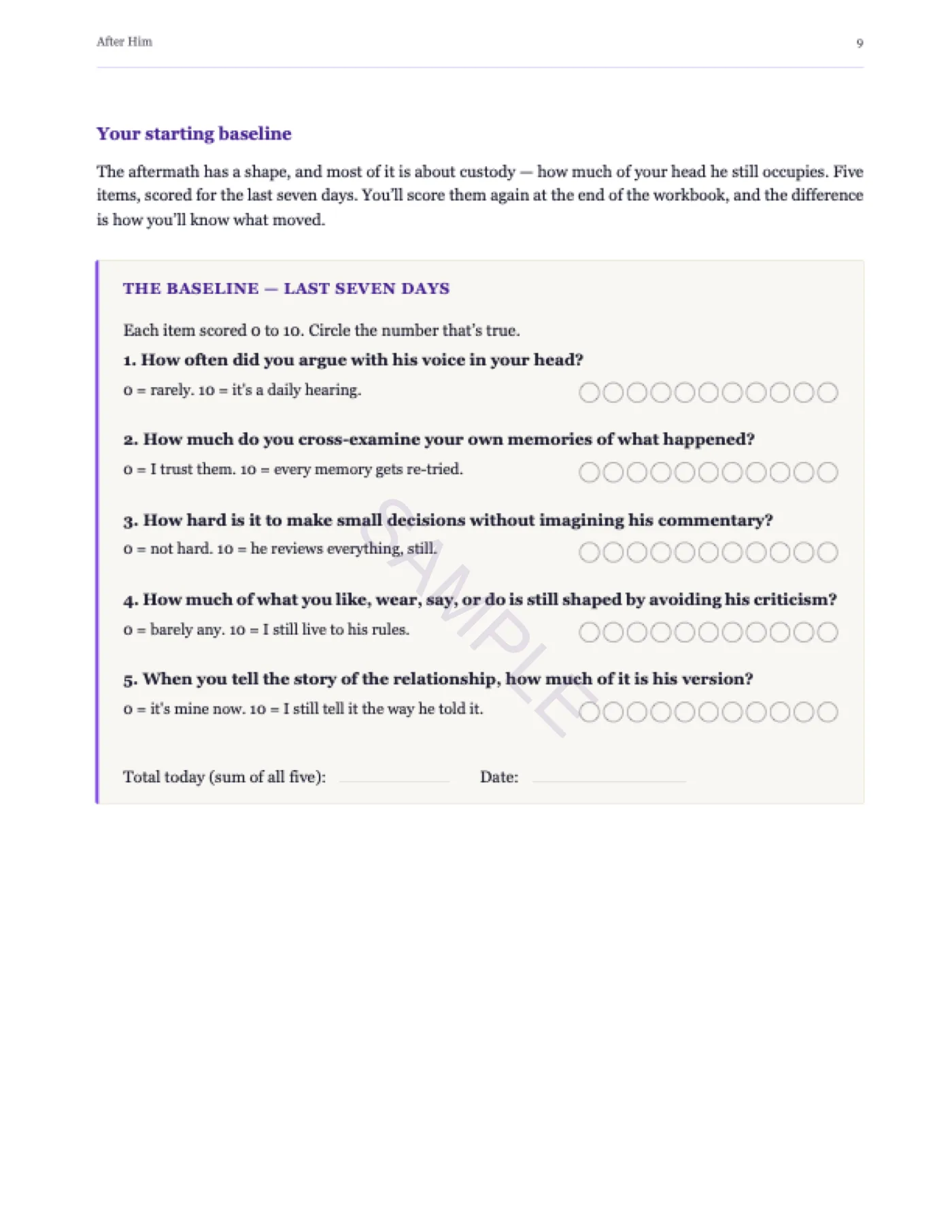
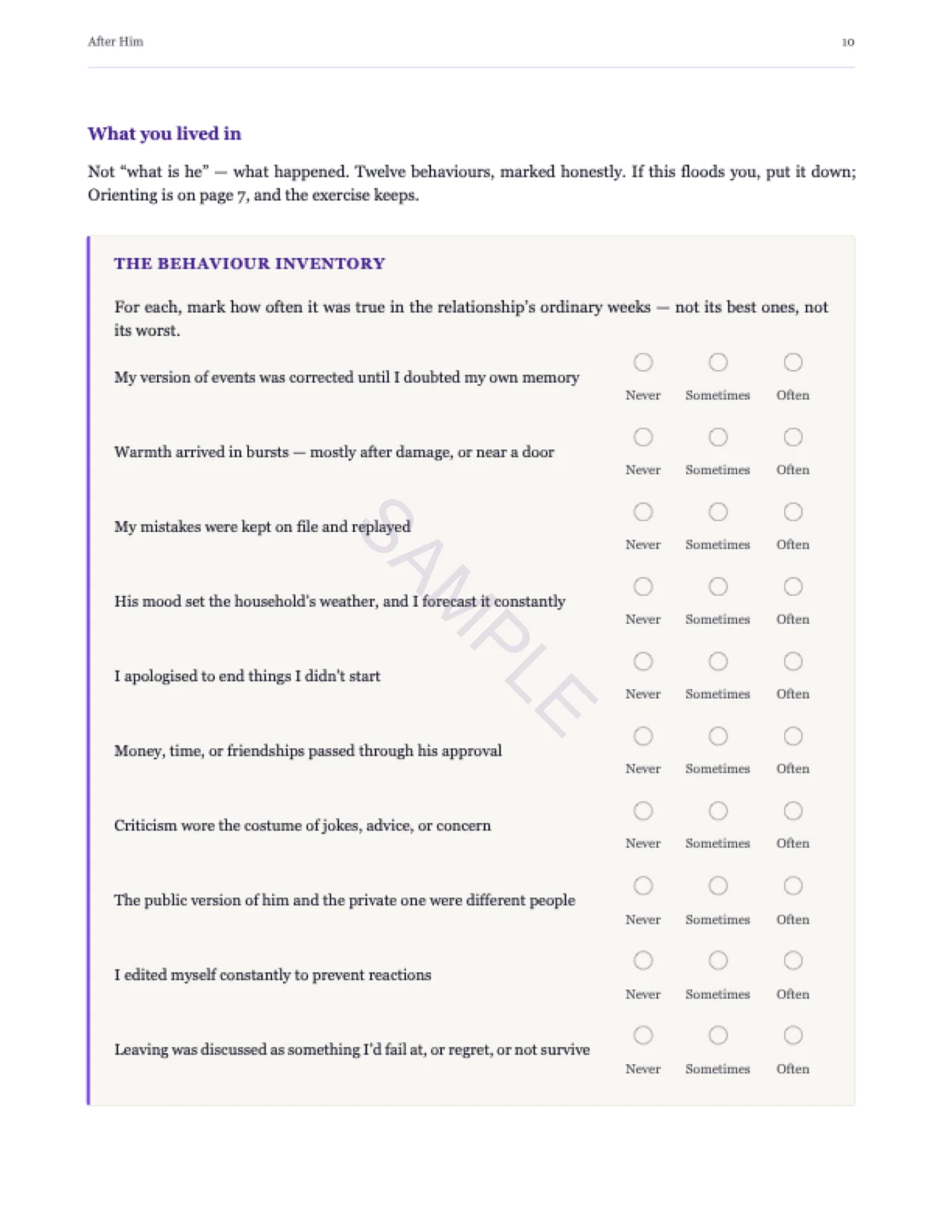
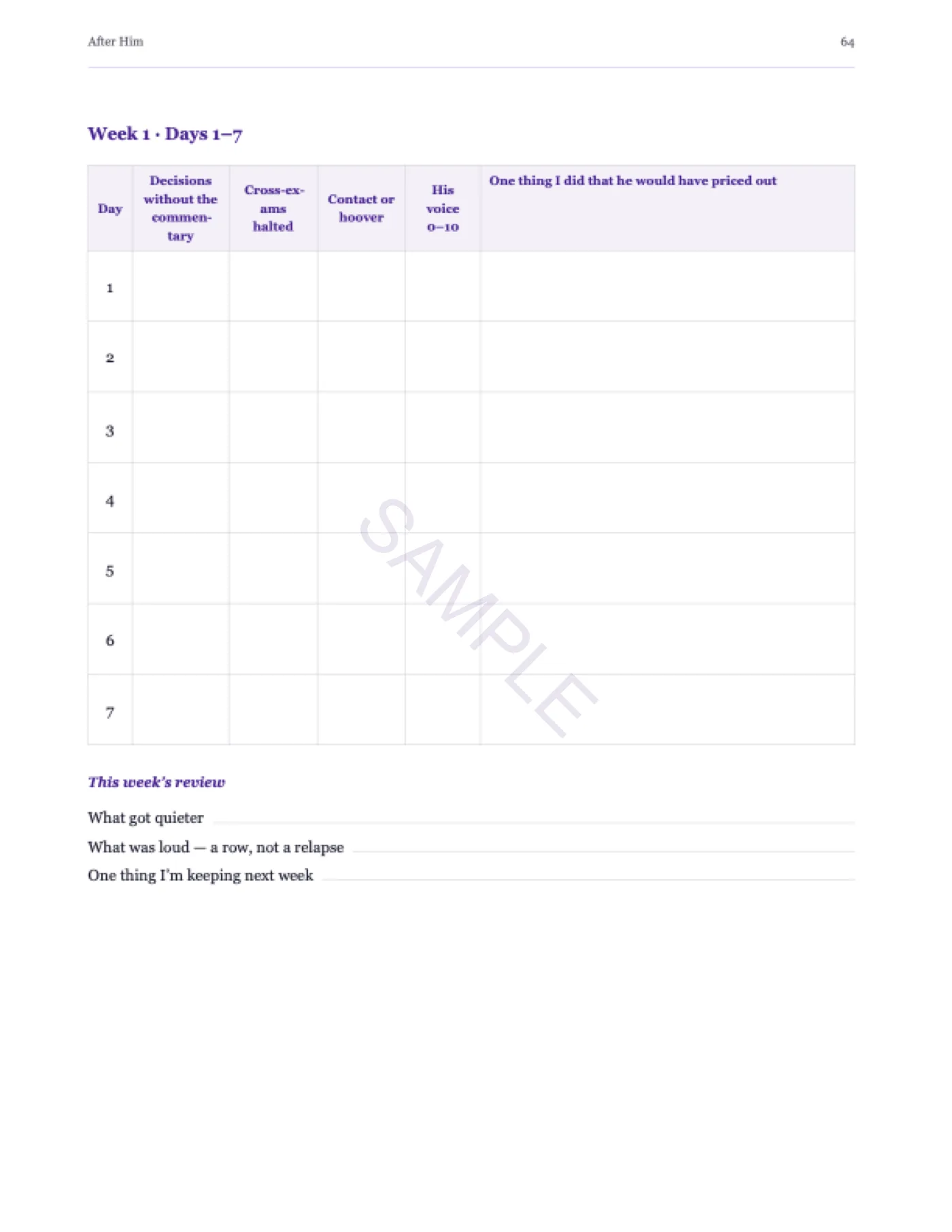
The baseline, the Behaviour Inventory, and the 21-Day Self-Trust Tracker. Watermarked previews.
The stance the whole workbook stands on
You may have spent long nights researching what he "is". That research promised validation, and some of it helped you see the pattern — but a diagnosis belongs to clinicians who have him in the room, and your recovery cannot be built on a verdict that will never arrive. So this workbook stands somewhere sturdier: what happened to you is established by what happened — not by what he is.
And it takes safety more seriously than anything else in our catalogue: a gate on page one (this workbook is for after — if you’re still in it or in danger, the help pages come first, and the DV lines are printed right there), two Stop-Go gated chapters, a two-page cap on every exercise, and no re-living prompts anywhere.
From Chapter 1 — What This Workbook Believes
The corrected memories happened. So did the rules that only applied to you, and the warmth that returned exactly when you reached the door. Behaviours and their effects can be written down and dated by you, without anyone’s cooperation — and a record like that is worth more than his file at a clinic you’ll never see.
Who is this for?
What's inside
Chapter 1.Where You Are
The gate, the stance, the baseline, and the Behaviour Inventory — what you lived in, not what he is
Chapter 2.The Record
Stop-Go gated — the pattern ledger across eight domains (Stark), the corrections log, the two versions
Chapter 3.The Bond
The trauma bond translated (Carnes) — why leaving took more than anyone knows
Chapter 4.The Openings
Stop-Go gated and wound-optional — "I met a skilled one" is a complete answer
Chapter 5.The Costs
The effects inventory, the self-trust audit, and what survived
Chapter 6.The Untangling
His voice vs your judgement, the cross-examination halt, and the diagnosis hunt — retired
Chapter 7.The Rebuild
The reclaimed list, the boundary kit (the no-response default, grey rock for forced contact), the story in your version
Chapter 8.The Grief Underneath & Forward
Ambiguous loss (Boss), the post-assessment delta, and the dashboard that expects the hoover at your strongest moments
Also inside
- The 21-Day Self-Trust Tracker — decisions made without the commentary
- Getting Help — trauma-focused CBT and EMDR, what to say in a first session
- The Lines — crisis, domestic violence and stalking resources, prominent
Where you’ll be when the work is done
- The record in your custody: what happened, dated, in your own hands — the file he can’t argue with.
- The bond explained without shame: why staying was survival logic, and why leaving took what it took.
- His phrases identified by their fingerprints — and the cross-examination of your own memories, closed.
- Permission to stop researching him, framed as the last door of his house you walk out of.
- A boundary kit for what’s ahead: the no-response default, grey rock for forced contact, one sentence for the mutual friends.
- A number: your baseline against the post-assessment — custody of your own head, measured.
Also included: the relief ledger, what survived, the story in your version, the new-person protocol built on behaviour rather than suspect lists, and the single most protective sentence in the book — the hoover arrives at your strongest moments, because it tracks your recovery, not your availability.
Get the debrief.
71 pages. The record, the bond, the untangling, the rebuild. Behaviours and effects — never armchair psychiatry.
Instant PDF download. Secure payment via Stripe.
See the sample pages above before you pay. If it's not the tool you need, don't buy it.
At checkout you can add a personalised reading for $9.99 instead of the usual $14.99 — skip it if you just want the workbook.
Common questions
I’m still in the relationship — will this help?
This workbook is for after, and its first page says so in a gate you can’t miss. If you are still in it, afraid of what he’d do if he found it, or he won’t stop contacting you, the help pages come first — they’re written for exactly that, and the domestic violence lines are printed in the gate itself.
Will it tell me what he is?
No — and that’s the point. A diagnosis belongs to clinicians who have him in the room, and your recovery can’t wait on a verdict that will never arrive. The workbook audits behaviours and their effects, which you can establish yourself, with dates, in your own handwriting.
Is it safe to work through alone?
It has the strictest containment in our catalogue: a grounding tool (Orienting) every chapter routes to, two Stop-Go gates, a two-page cap on every exercise, inline "put this down if flooded" instructions, and no prompts that ask you to relive anything at length. And it says plainly that this recovery in particular benefits from a trauma-trained professional — with what to ask for.
What if my childhood wasn’t the problem?
Chapter 4’s skip permission is real: many readers’ complete answer is "I met a skilled one." The tactics select for empathy and hope, not damage — the chapter says so explicitly, and no childhood wound is required for the workbook to work.
What about when he tries to come back?
Chapter 7 gives you the hoover protocol — the no-response default, grey rock defined plainly for forced contact like kids or court, and a pre-written sentence for mutual friends carrying messages. Chapter 8’s dashboard tells you when to expect it: at your strongest moments, not your weakest.
How does the assessment work?
Five items about custody of your own head — how often you argue with his voice, how much you cross-examine your memories — scored at the start and again at the end. This recovery is measured in months; the delta is a waypoint, and it’s yours.
Digital or print?
Print-first PDF, US Letter, 71 pages. Keep it somewhere genuinely private — the how-to-use page says the same. Instant download after purchase.
If the caretaking pattern outlived the relationship: Codependency: The Honest Workbook
If the breakup is fresh and the days need shape: The First Thirty Days