You don’t have to feel better today. You have to know what today is for.
Thirty days, one page a day, ten minutes each — deliberately small, because you are not currently a person with spare capacity, and a programme that pretends otherwise gets abandoned by Thursday.
$12.99 once · 52 pages · one day, one stone.
Instant PDF download. Pay by card via Stripe — no account needed.
Not sure yet? See inside first ↓A look inside
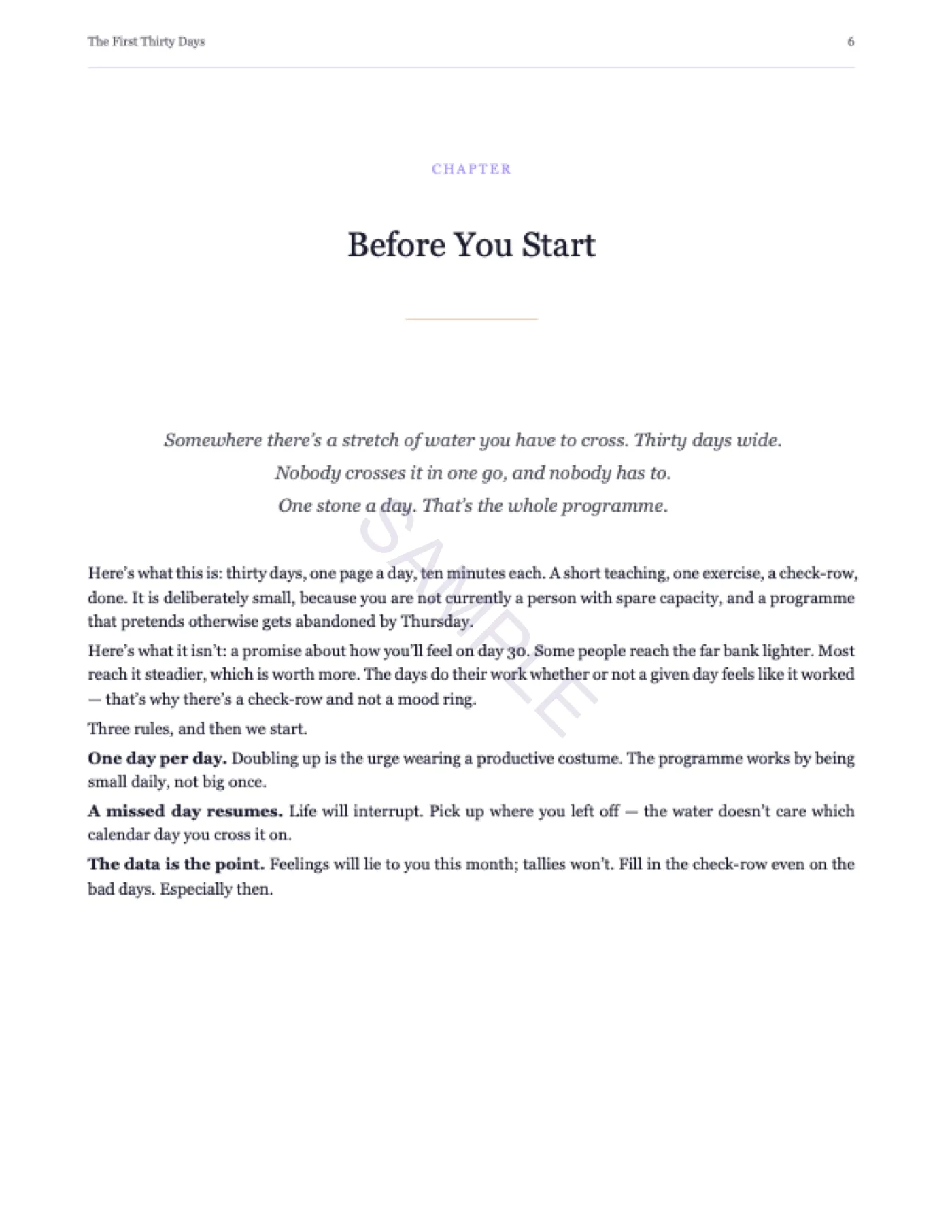
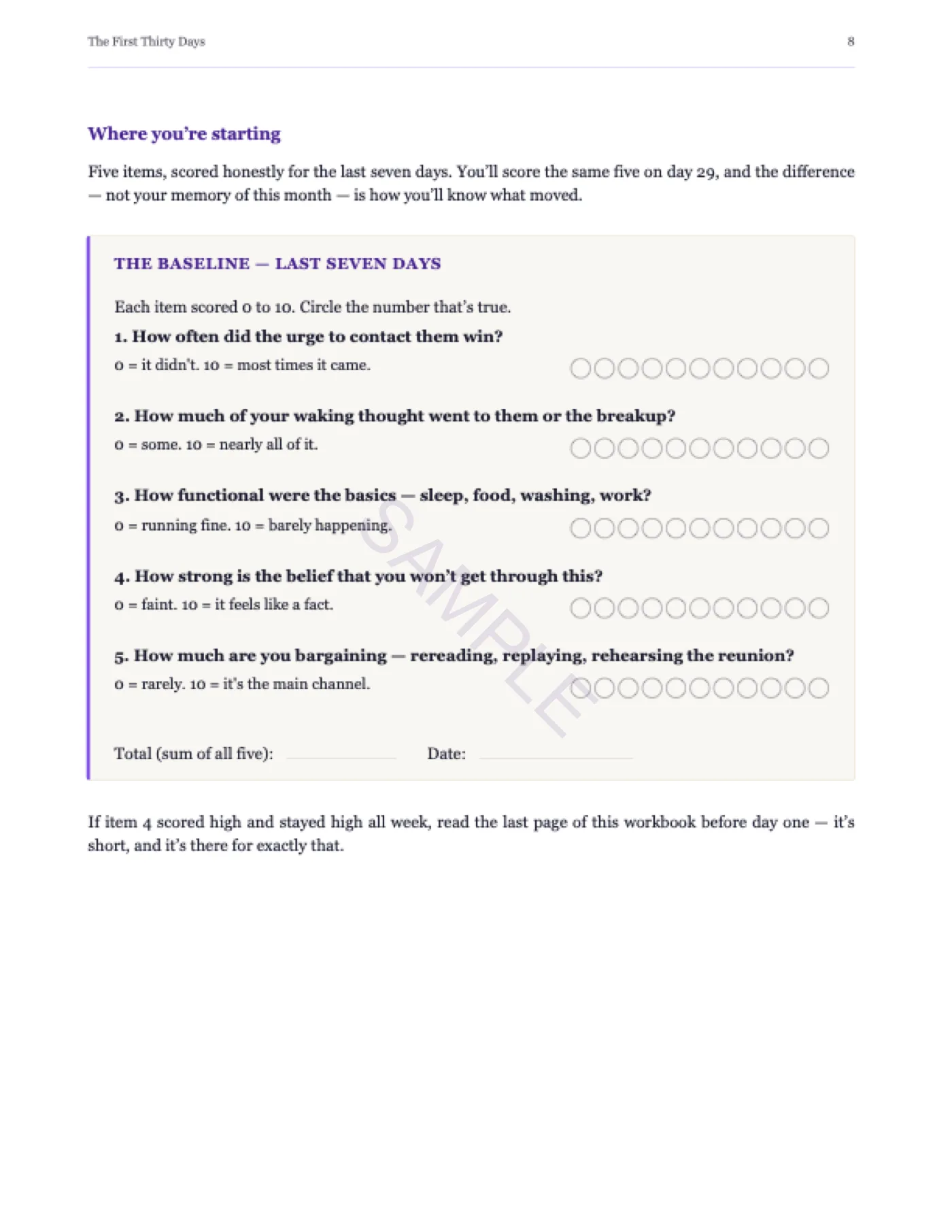
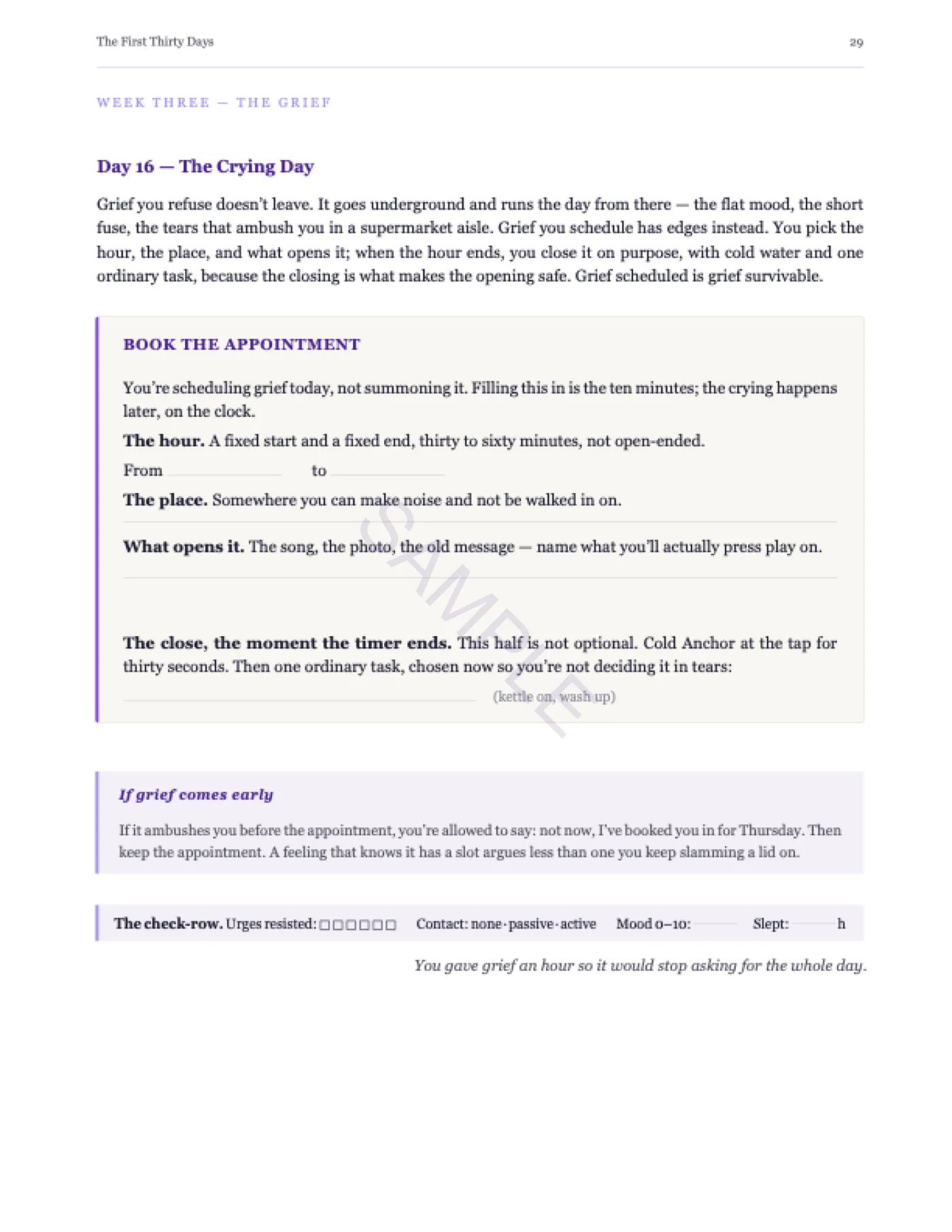
The baseline, Day 1’s signed no-contact terms, and a Week Three day. Watermarked previews.
The check-row — a month of pain, turned into data
Every day ends the same way: urges resisted (tallied), contact (none, passive, active — and checking their stories counts), mood, sleep. Feelings will lie to you this month; tallies won’t. By day 7 you review the week from the rows, not from memory — and by day 29 the re-assessment gives you a number against your day-one baseline.
The rules that make it survivable: one day per day (doubling up is the urge wearing a productive costume). A missed day resumes, never restarts. And a slip is a row of data, not a failed programme — the workbook says that once, on day one, and never moralises about it again.
From Before You Start
Here’s what it isn’t: a promise about how you’ll feel on day 30. Some people reach the far bank lighter. Most reach it steadier, which is worth more. The days do their work whether or not a given day feels like it worked — that’s why there’s a check-row and not a mood ring.
Who is this for?
What's inside
Start.Before You Start
The Cold Anchor, the baseline, and the three rules
Week 1.Stand Up
The no-contact terms signed with your own definitions, the blocks, urge surfing (Marlatt), the first weekend planned
Week 2.The Story
The real timeline, what you miss vs what you had, the relief list, the rereading fast
Week 3.The Grief
The losses list, the crying day (scheduled, contained), the anger day, the bargaining audit
Week 4.The Return
The reclaimed hours, the re-entry, the places, the future tense, the watch-signs
Days 29–30.The Far Bank
The re-assessment delta, the letter to day-one you, and no-contact decided — not drifted
Also inside
- When Thirty Days Isn’t the Tool — grief vs depression, plainly; crisis and DV lines
Where you’ll be on the far bank
- Thirty check-rows of real data: how many urges you actually resisted, how contact actually held.
- No-contact terms you wrote and signed yourself — including what counts as contact at 2am.
- A grief that got its scheduled hour with a door on it, instead of running your whole month from underground.
- The real timeline and the honest columns: what you miss versus what you actually had.
- A relapse map for the moments that break people: the hoover text, the anniversary, the drunk night.
- A number: day 29 against day 1. Steadier, measured.
Also included: the basics floor, the first-weekend plan grid, the halfway letter, the reclaimed hours, and a final page that makes no-contact a decision rather than a drift.
Start day one tonight.
Thirty days, each one small enough to finish on the days you can’t do anything.
Instant PDF download. Secure payment via Stripe.
See the sample pages above before you pay. If it's not the tool you need, don't buy it.
At checkout you can add a personalised reading for $9.99 instead of the usual $14.99 — skip it if you just want the programme.
Common questions
What if I slip and text them?
A slip is a row of data, not a failed programme. You record it in the check-row like weather and carry on from the same stone. Day 1 says that once — and then the workbook never moralises about it again, because dwelling on slips is its own kind of bargaining.
Is 30 days enough to get over someone?
No, and the workbook doesn’t claim it. Thirty days is a crossing, not a cure — day 29’s framing is honest about the second month being quieter but not silent. What thirty days does is get you standing, with data, on the far side of the acute phase.
What if I miss a day?
You resume where you left off. The water doesn’t care which calendar day you cross it on. Doubling up to catch up is explicitly against the rules — the programme works by being small daily, not big once.
Do I have to go no contact?
Day 1 is the no-contact decision, signed with terms you define — including a narrowly defined exception if you share children, work or a home. The programme is built on it; if you’re not ready to sign thirty days, you’re not ready for this workbook yet, and that’s useful to know for free.
Is the crying day serious?
Completely. Grief you refuse goes underground and runs the day from there. Day 16 schedules it: a fixed hour, a chosen place, what opens it, and a non-optional close — cold water and one ordinary task. Grief scheduled is grief survivable.
Is it safe to do alone?
It’s built for alone, and it fails safe: the Cold Anchor for the bad ten minutes, containment lines daily, and a back page that distinguishes grief from depression plainly — with crisis and DV lines if the ex is the danger.
Digital or print?
Print-first PDF, US Letter, 52 pages. One page a day with a pen. Instant download after purchase.
Stuck on whether they’re coming back? Will They Come Back? — the honest book
If it’s been months and the thoughts won’t stop: Limerence: The Honest Workbook