The limerence workbook that measures the change you make.
Companion to the Limerence book. The book explains the loop — the uncertainty engine, the crystallised image, the withdrawal. This is where you break it, exercise by exercise, with a score at each end to prove what moved.
$12.99 once · 86 pages · print-first, yours to keep.
Instant PDF download. Pay by card via Stripe — no account needed.
Not sure yet? See inside first ↓A look inside
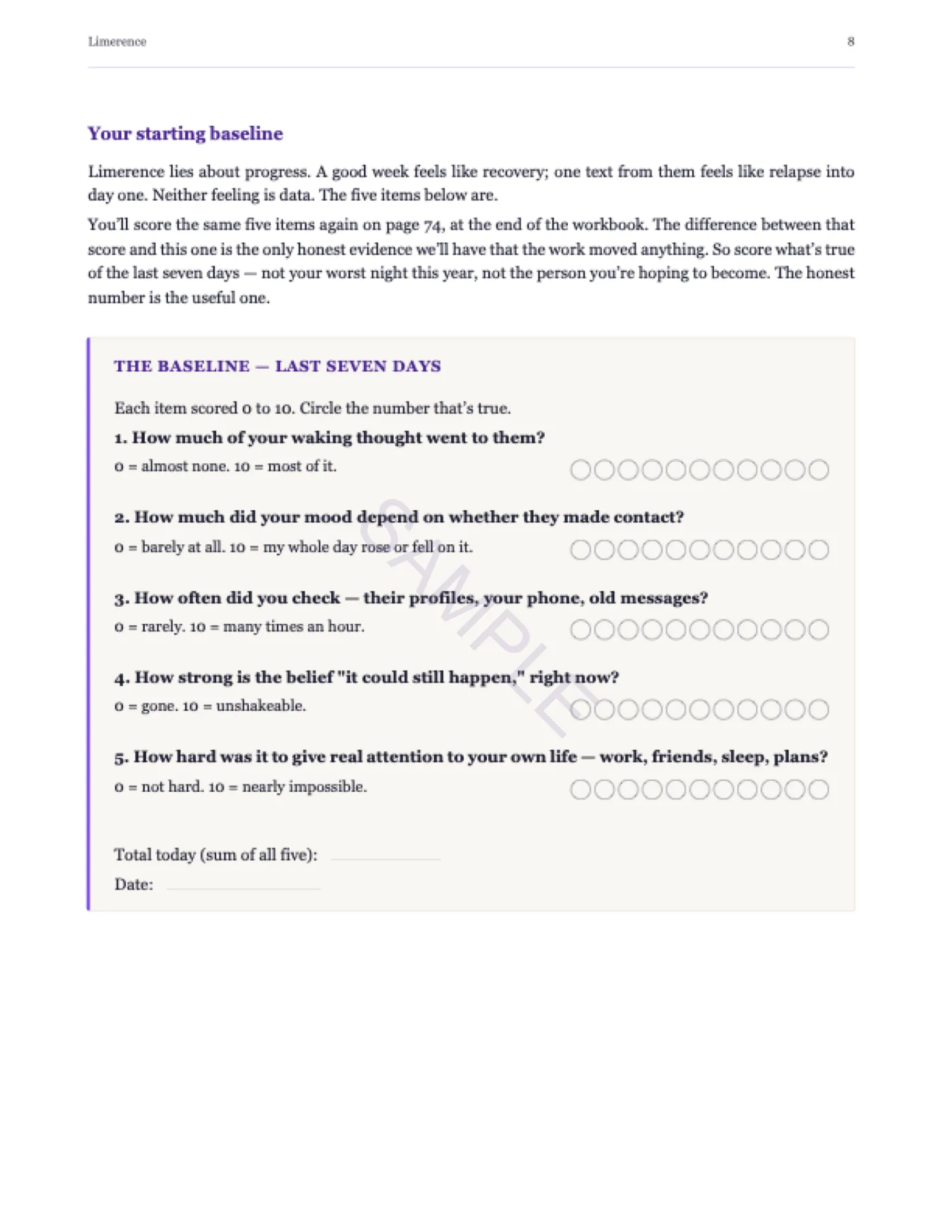
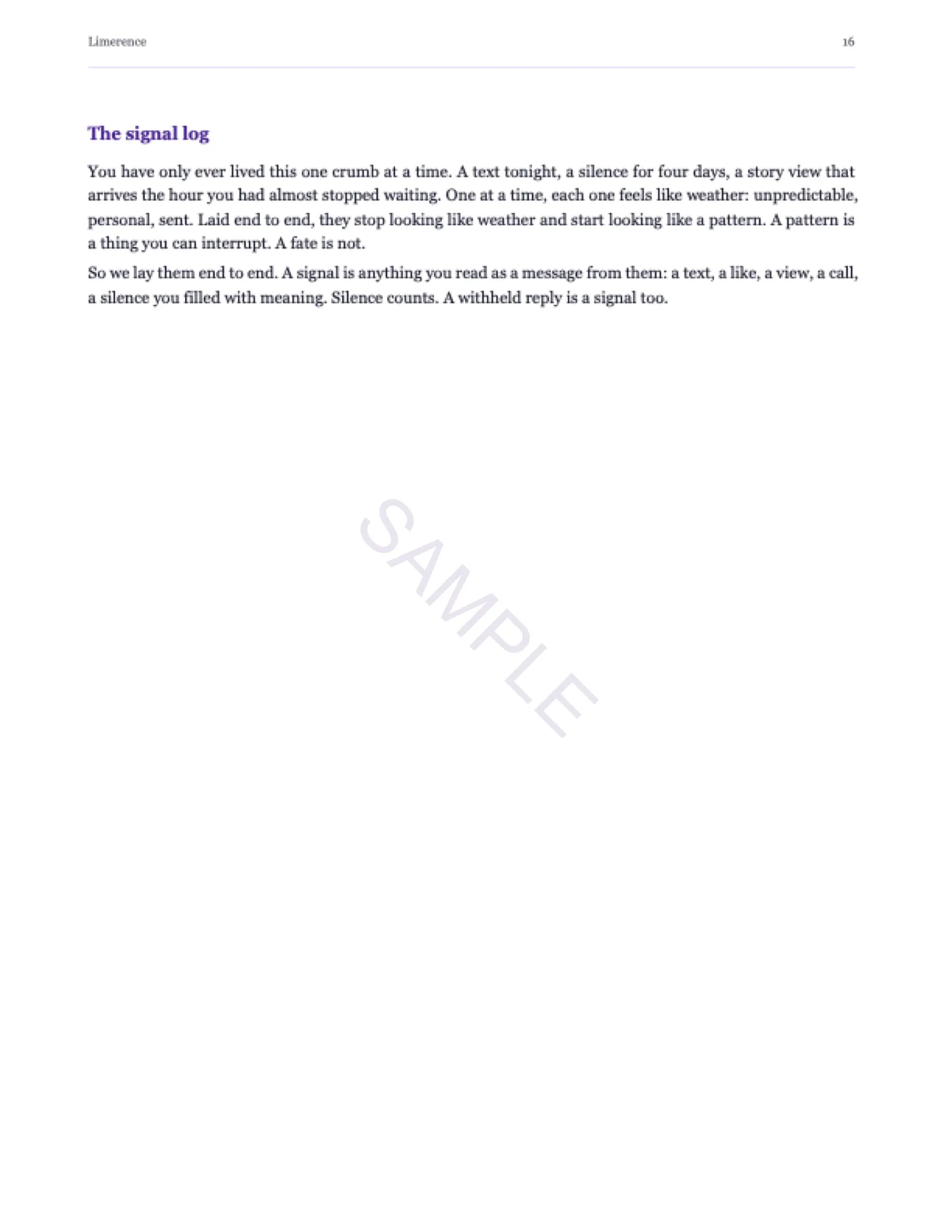
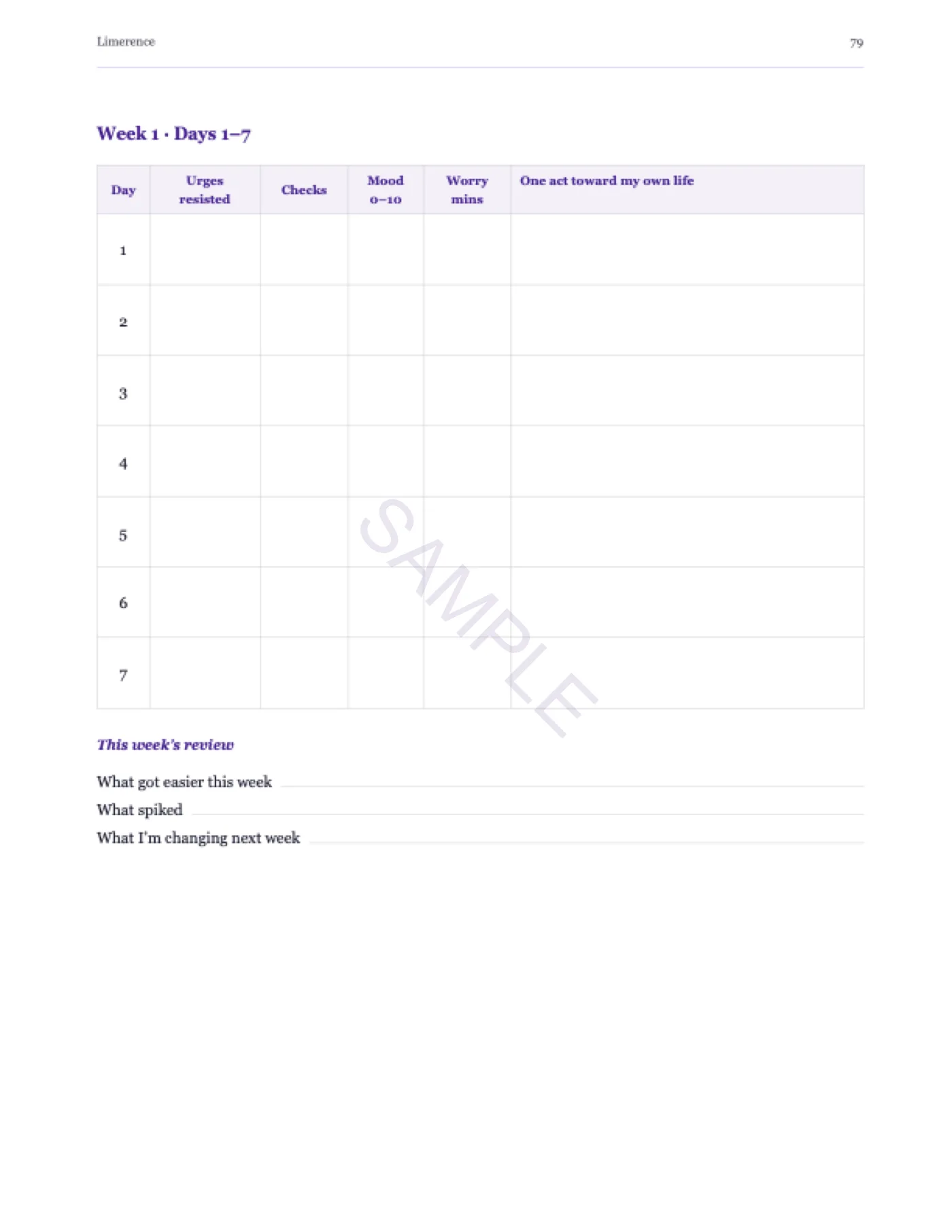
The baseline assessment, the Signal Log, and the 21-Day Loop Tracker. Watermarked previews.
The uncertainty test, made into an instrument
One question separates limerence from love: would certainty reduce the intensity of what you feel? You don’t answer it with opinions — your opinions are limerent too. Chapter 1 turns it into a written instrument you run on your own last three activations, in your own handwriting.
Then the same five baseline items you score on page 8 return at the end of the workbook. The difference between the two numbers is the only honest evidence that the work moved anything. Most resources about limerence make you feel understood. This one measures whether you’re getting out.
From Chapter 1 — Where You Are
Love runs on certainty. Knowing someone is yours doesn’t flatten the feeling; it settles it. Limerence runs on the opposite fuel. On the rare occasions the wanted person turned fully, unambiguously toward the limerent one, the feeling didn’t arrive at its destination. It thinned. A feeling that collapses when it gets a yes was never pointed at the person. It was pointed at the question.
Who is this for?
What's inside
Chapter 1.Where You Are
Baseline assessment + the uncertainty test as a scored instrument
Chapter 2.The Maybe Ledger
Your reinforcement schedule on paper — the Signal Log, the evidence machine, the closure trap
Chapter 3.The Crystallisation Audit
The case file vs the image (Tennov) + your first decrystallisation rep
Chapter 4.Why You
Stop-Go gated origins chapter — the LO line-up, the childhood blueprint, the reframe
Chapter 5.The Cost Accounting
Thinking vs ruminating, the hour audit, the mood satellite — the honest bill
Chapter 6.The Decision
The honest litmus + the no-contact design — person AND fantasy
Chapter 7.Starving the Loop
The toolkit: defusion (Hayes), the worry window (Borkovec), attention training (Wells), decrystallisation (Langeslag)
Chapter 8.The Grief Underneath & Forward
Disenfranchised grief (Doka), the post-assessment delta, the early-warning dashboard
Also inside
- The 21-Day Loop Tracker — daily rows for the withdrawal weeks
- When to Seek Help — when limerence is more than limerence
- Resources & Crisis Lines — international helplines, therapist directories
Where you’ll be when the work is done
- A written answer to the only question that matters — limerence or love — produced by your own body, not your hopes.
- Your personal reinforcement schedule on one page: the crumbs, the crashes, and the exact ratio that’s been running your weeks.
- The image and the person, finally separated — with the resistance you felt while writing marked down as evidence.
- A no-contact design with terms you wrote yourself, covering the person and the fantasy, with your three highest-risk moments pre-planned.
- A toolkit you’ll reopen for months: the worry window, the defusion drill, the decrystallisation protocol, each cited to the clinician who tested it.
- A number. Your score on page 8 against your score at the end — the delta that proves the loop is starving.
Also included: the withdrawal map for weeks 1–12, the mood satellite, containment closes on every chapter, a Stop-Go signpost before the origins work, and the 21-Day Loop Tracker.
Get the workbook.
86 pages. Eight chapters. The pre- and post-assessment that proves the loop is starving.
Instant PDF download. Secure payment via Stripe.
See the sample pages above before you pay. If it's not the tool you need, don't buy it.
At checkout you can add a personalised reading for $9.99 instead of the usual $14.99 — skip it if you just want the workbook.
Common questions
Who’s behind this, and why should I trust it with something this raw?
Taro’s Tarot — the same people behind the Limerence book and the limerence quiz you may have just taken. Every exercise holds the line we hold everywhere: psychology first, no spiritual bypassing, your safety over any framework. The origins chapter opens with a mandatory pause, heavy prompts carry time containers, and the "When to Seek Help" page names exactly when this needs a clinician instead of a workbook.
Do I need to read the book first?
No. The workbook stands alone — each chapter introduces the framework it needs in a few hundred words before the exercises. The book and workbook read as a set, but neither requires the other.
Is this just journaling prompts?
No. It’s structured instruments: scored inventories, two-column audits, a reinforcement ledger, a decision litmus, rep logs with grids. There’s writing space, but every prompt has a defined purpose and a named clinical source — Tennov, Hayes, Wells, Borkovec, Nolen-Hoeksema, Langeslag.
How does the assessment work?
Five items scored 0–10 in Chapter 1, the same five at the end. The delta is the evidence. Any movement counts — and a flat line means you re-run the workbook in a month, not that you failed it.
Will it tell me to go no contact?
It will hand you the decision properly: the honest litmus (observable criteria, scored) and then a no-contact design you write yourself — including the harder half, no contact with the fantasy. The workbook never decides for you.
Is it safe to do alone?
Mostly, and it’s built to fail safe: a grounding exercise on page 7 that every chapter routes back to, a Stop-Go gate before the childhood material, containment closes throughout, and crisis lines printed in the back. If limerence is riding on something bigger — OCD, depression, trauma — the "When to Seek Help" page says so plainly.
Digital or print?
Print-first PDF, US Letter, 86 pages. You can work on a tablet, but it’s designed for a pen. Instant download after purchase.
Want the full mechanism first? Start with the Limerence book — the workbook is its practice arena.
Not sure it’s limerence? The Psychology Behind Your Love Patterns covers the wider pattern.