You run everyone’s life but yours. This is the map back.
An 85-page workbook for the over-functioner — the strong one, the manager, the one who knows everyone’s needs in detail and goes blank on her own. Grounded in the clinical literature: Cermak, Mellody, Beattie, Lerner.
$11.99 once · 85 pages · print-first, yours to keep.
Instant PDF download. Pay by card via Stripe — no account needed.
Not sure yet? See inside first ↓A look inside
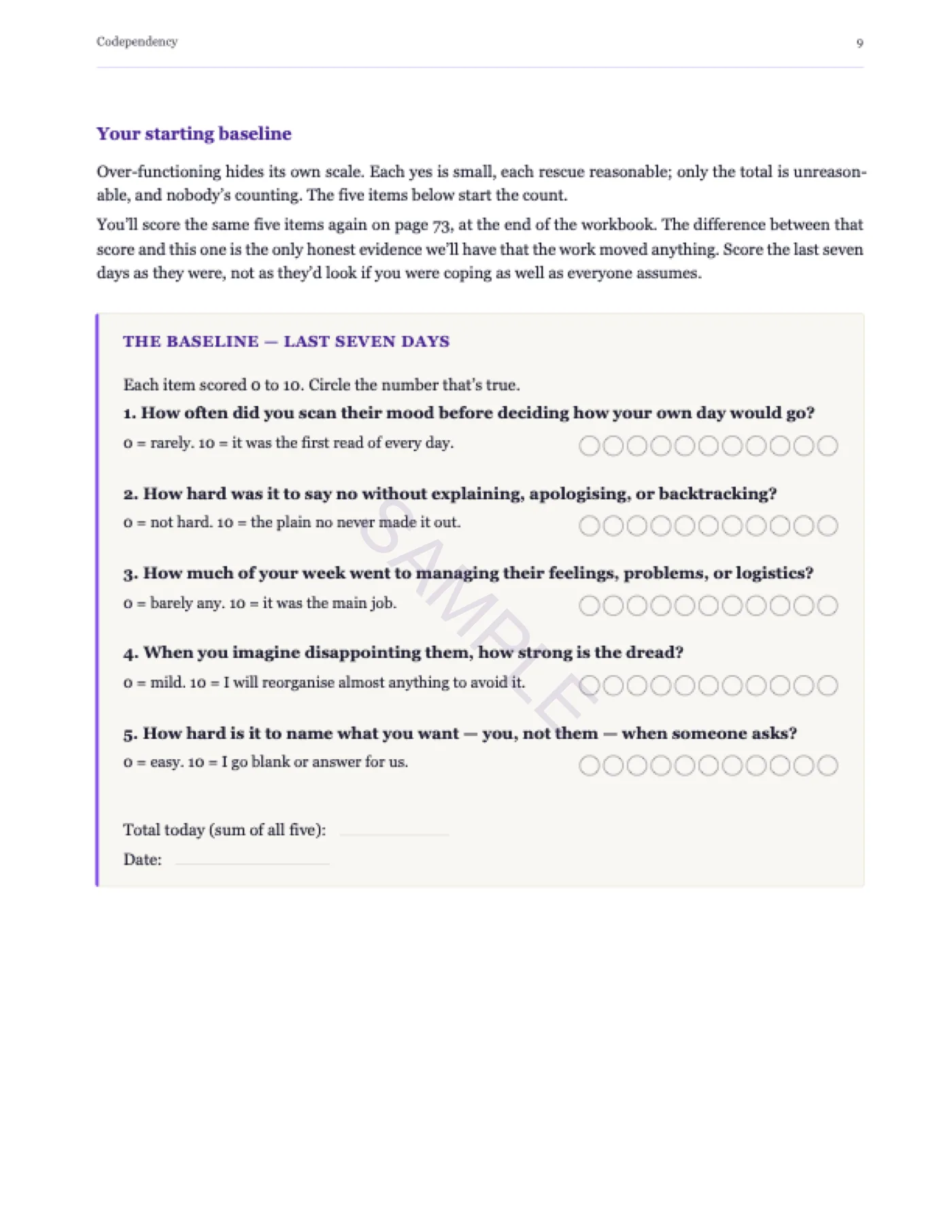
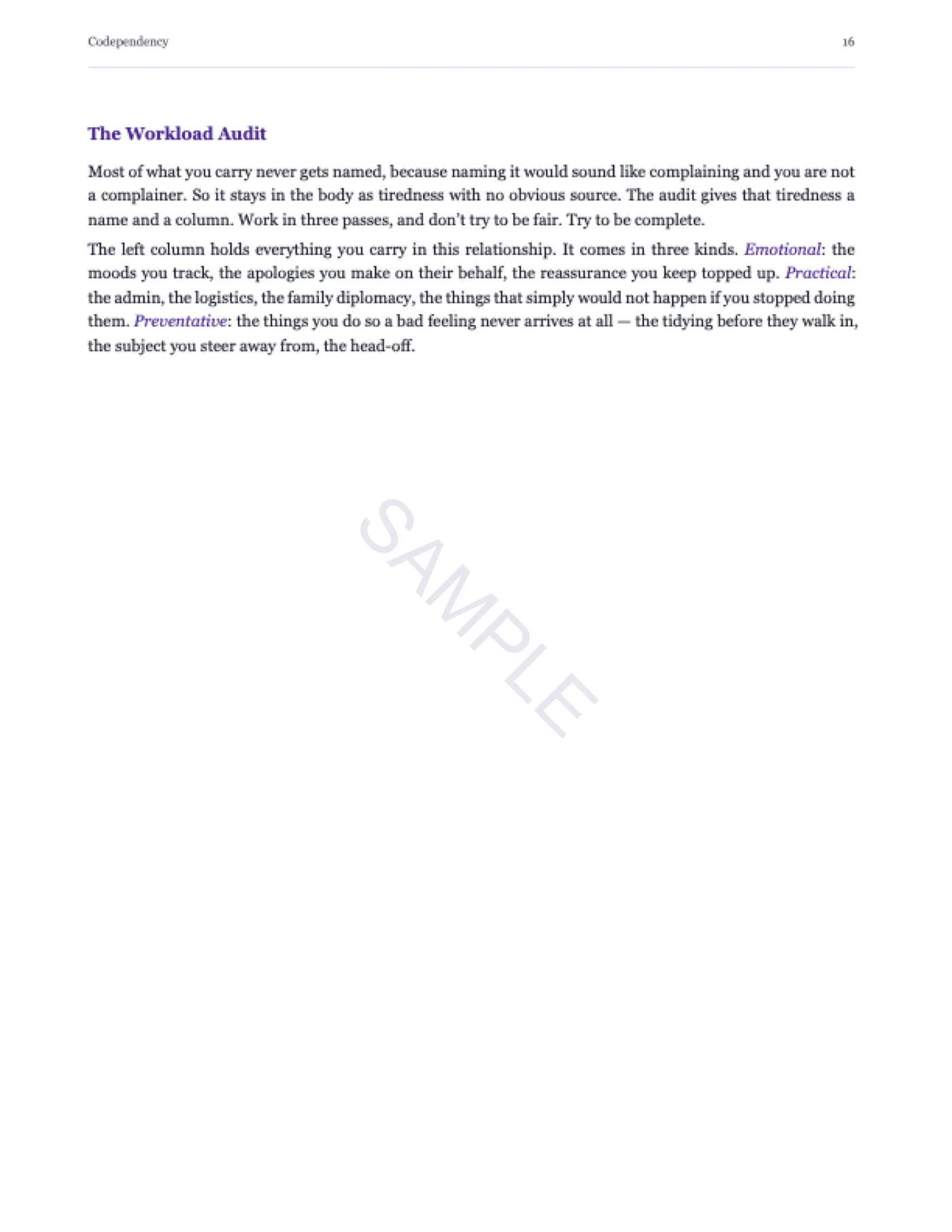
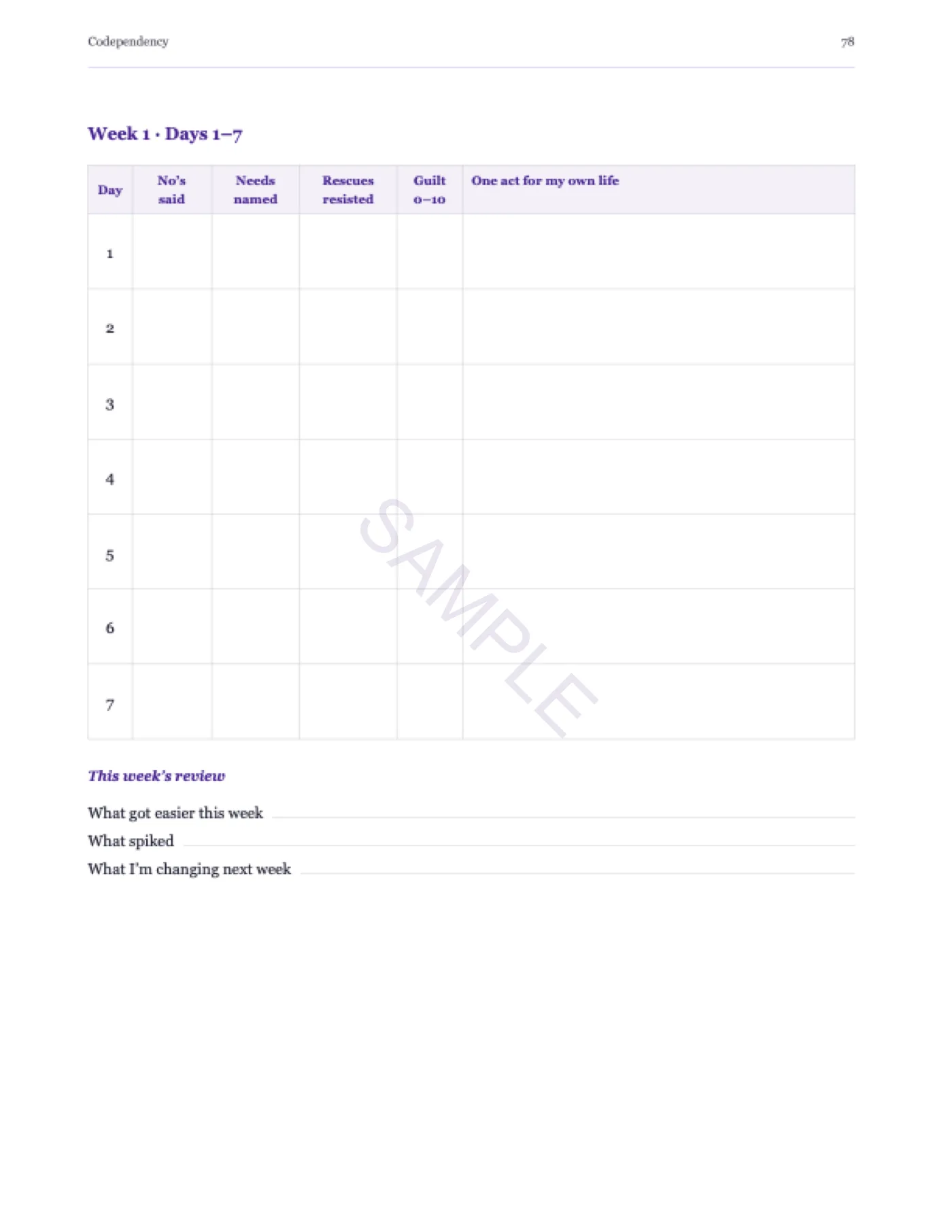
The baseline assessment, the Workload Audit, and the 21-Day Rebalancing Tracker. Watermarked previews.
The misread this workbook corrects first
You probably half-rejected the word codependency, because the internet version means clingy — and you need almost nothing. That misread is where Chapter 1 starts: in the clinical description (Cermak), needing nothing isn’t the opposite of the pattern. It is the pattern. Codependency is need expressed through being needed.
Then the work is made countable: five baseline items scored on page 8, the same five re-scored at the end. The delta — not how the month felt — is your evidence that the rebalancing took.
From Chapter 1 — The Word You Half-Rejected
You are the one people lean on, the one who copes, the strong one. So you filed the word under "other people" and kept managing everyone’s life but your own. Needing nothing isn’t the opposite of the pattern. It is the pattern. The need is still there — it has just been trained to arrive in uniform, doing something useful for somebody else.
Who is this for?
What's inside
Chapter 1.Where You Are
Baseline assessment + the One Question: whose feeling is in your body right now?
Chapter 2.The Invisible Workload
The Workload Audit (who asked?), the Rescue Log, and the Job Description you never applied for
Chapter 3.The Radar
The scan log, the eggshell map, and re-aiming a hypervigilance that works brilliantly
Chapter 4.Why You
Stop-Go gated origins chapter — the trained caretaker, the love recipe, the partner line-up
Chapter 5.The Cost Accounting
De-selfing (Lerner), the swallowed no’s, and the Restaurant Test
Chapter 6.The Boundary Workshop
The No Experiment with a guilt forecast + the Change-Back Forecast (Lerner)
Chapter 7.The Rebalancing
The deliberate drop, the discomfort rep, needs-naming, receiving — the practice toolkit
Chapter 8.The Grief Underneath & Forward
Grieving the indispensable self, the post-assessment delta, the early-warning dashboard
Also inside
- The 21-Day Rebalancing Tracker — no’s said, needs named, rescues resisted
- When to Seek Help — abuse named plainly, carer resources, CoDA
- Resources & Crisis Lines — including domestic abuse lines
Where you’ll be when the work is done
- The invisible workload on one page, coded by who actually asked for each item — with the pre-emptions counted.
- The job description you’ve been working to, written as the ad it always was — and an honest answer to who wrote it.
- One small no, designed and delivered, with the guilt forecast that reframes guilt as a withdrawal symptom, not a moral signal.
- A forecast of exactly how they’ll push back when you change (Lerner’s change-back), with your response chosen in advance.
- Eight answers to the Restaurant Test that arrive without checking anyone’s face first.
- A number: your baseline against your post-assessment — the delta that proves the rebalancing took.
Also included: the boundary-or-control discrimination drill, the receiving rep, self-compassion as replacement (Neff), containment closes on every chapter, and the 21-Day Rebalancing Tracker.
Get the workbook.
85 pages. Eight chapters. The pre- and post-assessment that proves the rebalancing took.
Instant PDF download. Secure payment via Stripe.
See the sample pages above before you pay. If it's not the tool you need, don't buy it.
At checkout you can add a personalised reading for $9.99 instead of the usual $14.99 — skip it if you just want the workbook.
Common questions
Who’s behind this, and why should I trust it with something this raw?
Taro’s Tarot — the same people behind the codependency quiz you may have just taken. Every exercise holds the line we hold everywhere: psychology first, named clinical sources (Cermak, Mellody, Beattie, Lerner, Gibson, Neff), your safety over any framework. The origins chapter opens with a mandatory pause, and the back page names plainly when the pattern is actually a controlling relationship and deserves more than a workbook.
I’m not clingy — is this really about me?
That’s the misread Chapter 1 corrects. The clinical picture isn’t neediness; it’s worth built on being needed — the over-functioner who manages everyone’s life and goes blank on her own. If their being fine for a while leaves you feeling oddly unmoored, this workbook was written for you.
Is this just journaling prompts?
No. Structured instruments: the Workload Audit with a who-asked coding pass, a rescue log, an eight-domain boundary inventory, discrimination drills, rep grids. Every prompt has a defined purpose and a named source.
How does the assessment work?
Five items scored 0–10 in Chapter 1, the same five at the end. The delta is the evidence. A flat line means you re-run the workbook in a month — not that you failed it.
Will it tell me to leave my relationship?
No. The workbook rebalances you; what that does to the relationship is yours to read. It never hands down verdicts about your partner — and it never calls anyone toxic.
Is it safe to do alone?
Mostly, and it fails safe: a grounding exercise every chapter routes back to, a Stop-Go gate before the childhood material, time containers on heavy prompts, and a help page that distinguishes the pattern from abuse — with the DV lines printed.
Digital or print?
Print-first PDF, US Letter, 85 pages. Built for a pen. Instant download after purchase.
If the anxiety side is louder than the caretaking side: Anxious Attachment: The Honest Workbook
Want the full theory of your pattern first? The Psychology Behind Your Love Patterns