You already know your attachment style. This is the training.
Knowing has never once helped at 11pm. This is an 85-page training programme for a nervous system that loves on high alert — your trigger map, your protest patterns translated into the needs underneath, and the daily reps that build earned security.
$14.99 once · 85 pages · print-first, yours to keep.
Instant PDF download. Pay by card via Stripe — no account needed.
Not sure yet? See inside first ↓A look inside
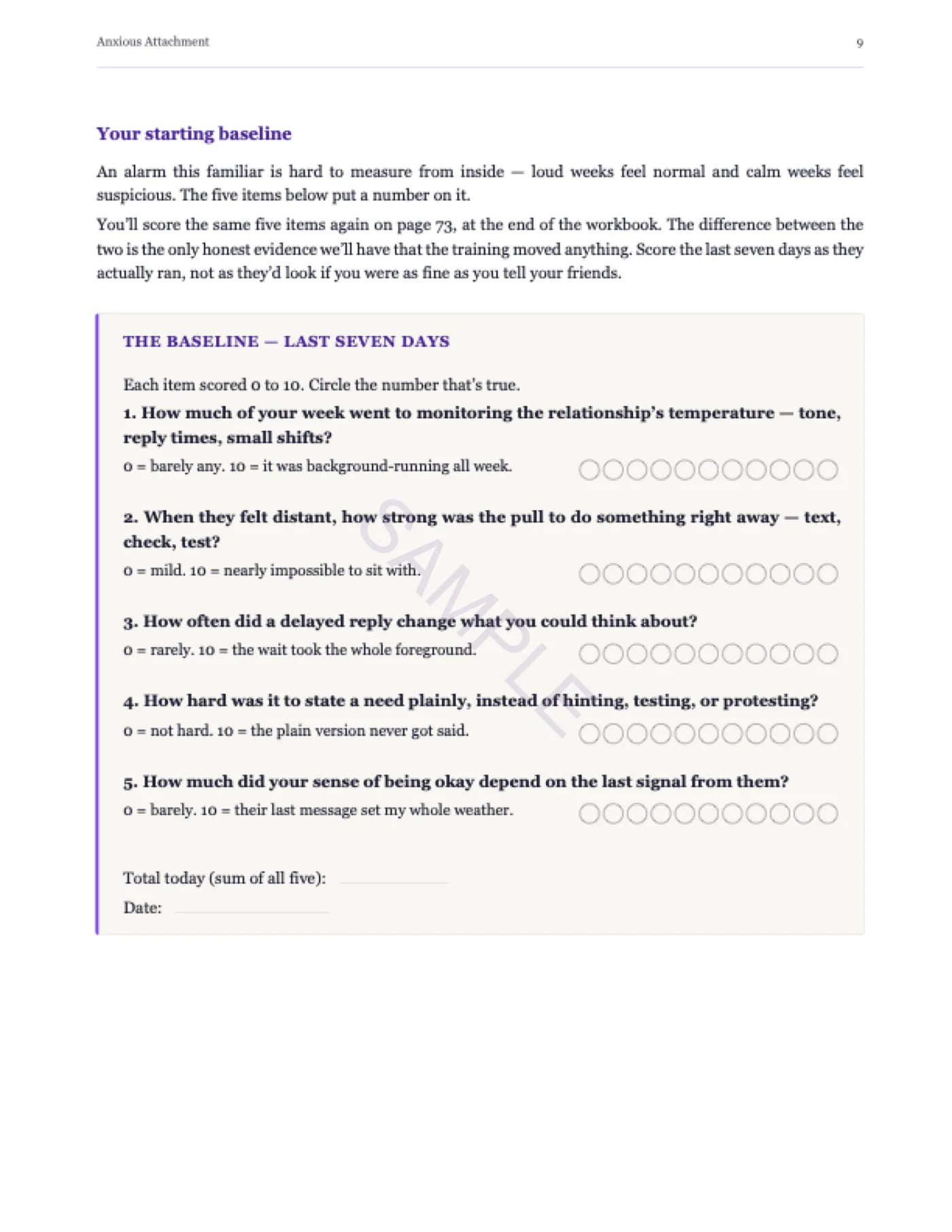
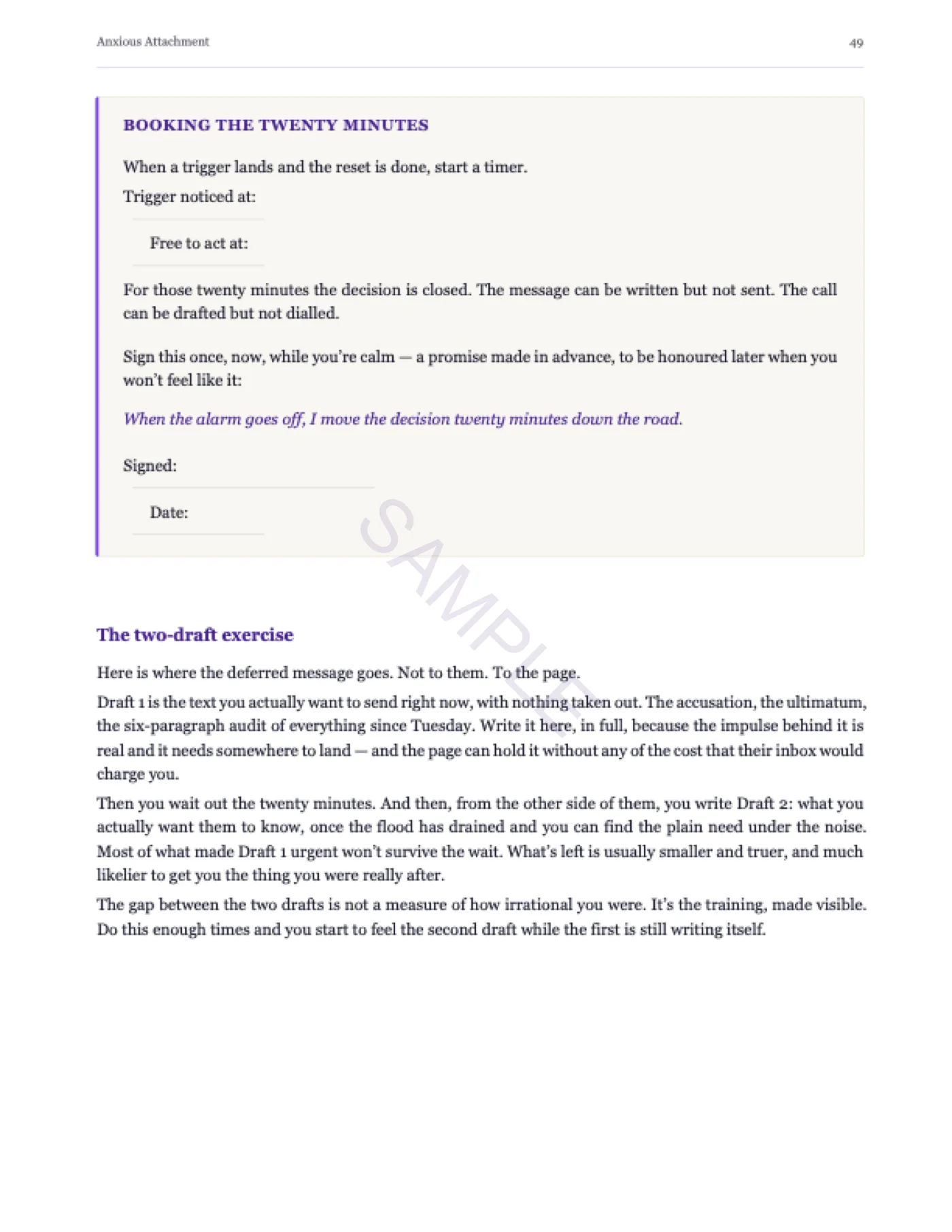
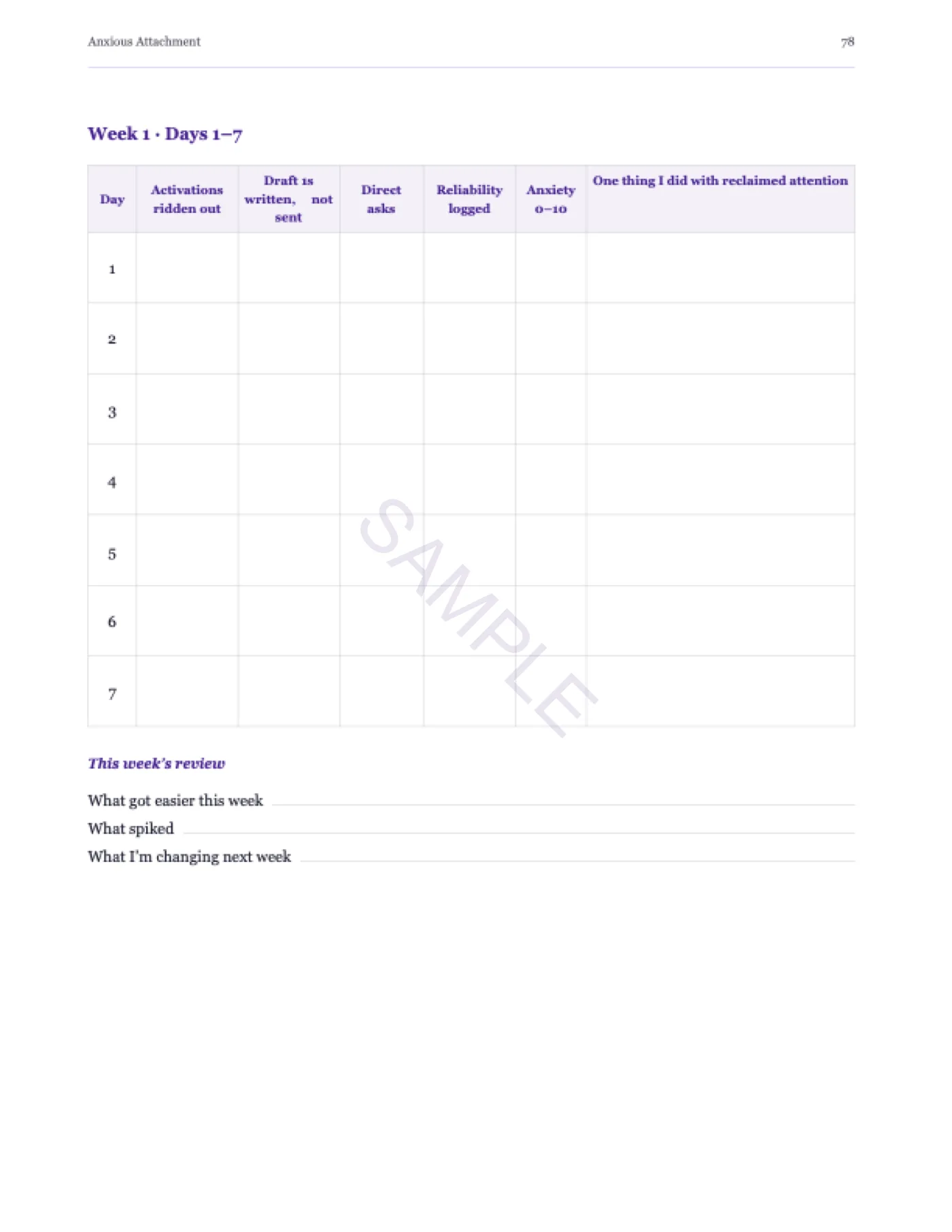
The baseline assessment, the Two-Draft Exercise, and the 21-Day Steadiness Tracker. Watermarked previews.
Description was never going to do it. Reps might.
Every attachment resource describes you perfectly and then says "communicate your needs" — as if you could. This workbook is built differently: the alarm is treated as an instrument that can be recalibrated, and recalibration is reps. The 20-minute rule. The two-draft exercise. One direct ask a day, smallest possible. An evidence ledger that teaches the instrument to register safety data, not just threat.
And it’s measured: five baseline items at the start, the same five at the end. The delta — not your memory of the month — is the proof the retraining took.
From Chapter 1 — The System, Not the Self
Attachment is not a personality trait. It’s older machinery than that — a proximity alarm, wired in before you could talk, whose one job is to notice when someone you depend on moves away and to raise whatever alarm brings them back. Everyone has it. Yours is calibrated loud. That child wasn’t wrong. She was paying attention.
Who is this for?
What's inside
Chapter 1.Where You Are
Baseline assessment + the Volume Knob: signal vs siren, with the evidence test
Chapter 2.The Trigger Map
The trigger census, the chain (trigger → story → body → urge), and the close-then-far pattern
Chapter 3.The Protest Chapter
Protest behaviours named without shame, translated into direct asks (Levine & Heller, Johnson)
Chapter 4.Why You
Stop-Go gated — the calibration history, the relationship echo, and earned security (Main)
Chapter 5.The Cost Accounting
The attention bill, the relationship toll, and what the vigilance pays
Chapter 6.The Activation Protocol
The window of tolerance (Siegel), the 20-minute rule, and the Two-Draft Exercise
Chapter 7.Earned Security Practice
The direct ask drill, the repair rep, the evidence ledger, the secure-signal reader
Chapter 8.The Grief Underneath & Forward
The child who kept watch, the post-assessment delta, the early-warning dashboard
Also inside
- The 21-Day Steadiness Tracker — activations ridden out, draft 1s not sent, direct asks
- When to Seek Help — when the alarm predates any relationship
- Resources & Crisis Lines — international helplines, therapist directories
Where you’ll be when the work is done
- Your three loudest triggers mapped as chains with joints — and the joint where you can actually get a hand in.
- Your protest patterns translated: what each one looks like from their side, and what asking directly would sound like instead.
- The two-draft habit installed: the activated text written in full — here, not to them — and the second draft that says what you actually mean.
- An evidence ledger with ten entries of ordinary reliability your alarm would previously have discounted.
- A secure-signal reader that scores partners on behaviour over intensity — because the stomach-drop is the alarm recognising its home conditions, not your heart recognising your person.
- A number: baseline against post-assessment. The score follows the reps.
Also included: the demand-withdraw loop mapped without villains, self-soothing vs reassurance-seeking distinguished, the calm-alarm rep for good stretches, containment closes throughout, and the 21-Day Steadiness Tracker.
Get the workbook.
85 pages. Eight chapters. The retraining, measured — because knowing was never going to be enough.
Instant PDF download. Secure payment via Stripe.
See the sample pages above before you pay. If it's not the tool you need, don't buy it.
At checkout you can add a personalised reading for $9.99 instead of the usual $14.99 — skip it if you just want the workbook.
Common questions
Who’s behind this, and why should I trust it with something this raw?
Taro’s Tarot — the same people behind the attachment-style quiz you may have just taken. Every exercise holds our line: psychology first, named clinical sources (Levine & Heller, Sue Johnson, Mikulincer & Shaver, Mary Main, Dan Siegel), your safety over any framework. The origins chapter is Stop-Go gated and the alarm is never mocked — sometimes it’s right, and the goal is an instrument you can trust, not one you’ve learned to ignore.
I’ve already read Attached — what does this add?
The training. Books describe the pattern; this makes you run reps against your own material: your triggers, your protests, your drafts, your evidence ledger. If description were enough, 11pm would already feel different.
Is this for avoidant attachment too?
No — it’s built for the anxious side specifically. The avoidant partner appears where he actually appears in your life: in the demand-withdraw loop, described mechanically and without villains. An avoidant-side workbook would be a different book.
How does the assessment work?
Five items scored 0–10 in Chapter 1, the same five at the end. Any movement counts, and attachment work compounds with corrective experience — the score follows the reps.
Does it just tell me to communicate my needs?
It trains the thing under that advice. The protest translation table shows what you’re actually asking; the direct-ask drill starts with needs small enough to survive asking; the 20-minute rule and two-draft exercise handle the moments when communicating is the last thing your body wants to do well.
Is it safe to do alone?
Mostly, and it fails safe: the Long Exhale grounding every chapter routes to, a Stop-Go gate before the childhood material, and a help page that says plainly when the alarm predates any relationship and deserves a trauma-trained clinician.
Digital or print?
Print-first PDF, US Letter, 85 pages. Built for a pen. Instant download after purchase.
Want to see the pattern across your last three relationships first? The Pattern Audit workbook
Prefer to start with the theory? The Psychology Behind Your Love Patterns