The book named your pattern. The audit finds it in your own handwriting.
Three page-identical structured audits — one per relationship — then a synthesis that reads across all three columns and names the repeating element. Companion to Love Patterns. Evidence over vibes, tables over journalling.
$13.99 once · 53 pages · print-first, yours to keep.
Instant PDF download. Pay by card via Stripe — no account needed.
Not sure yet? See inside first ↓A look inside
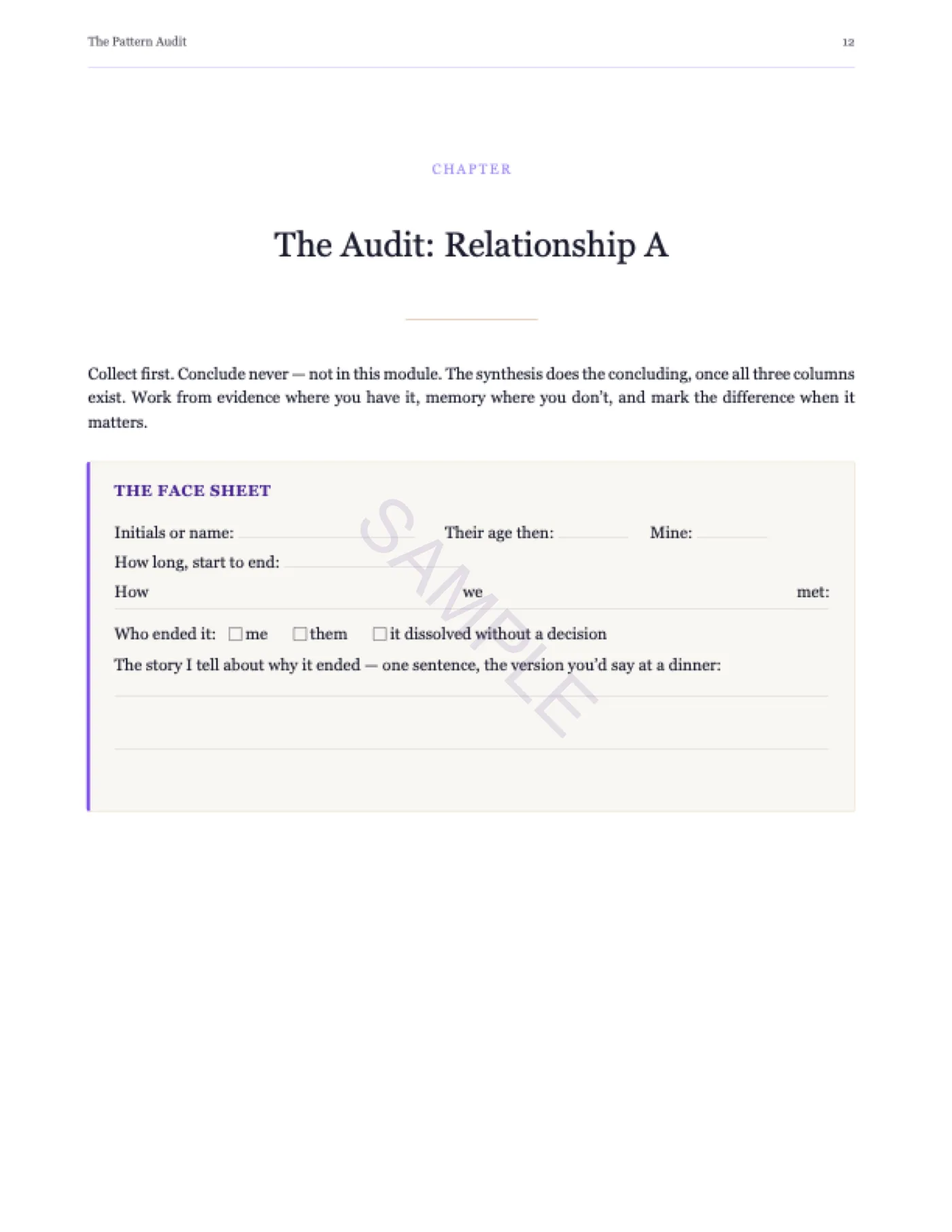
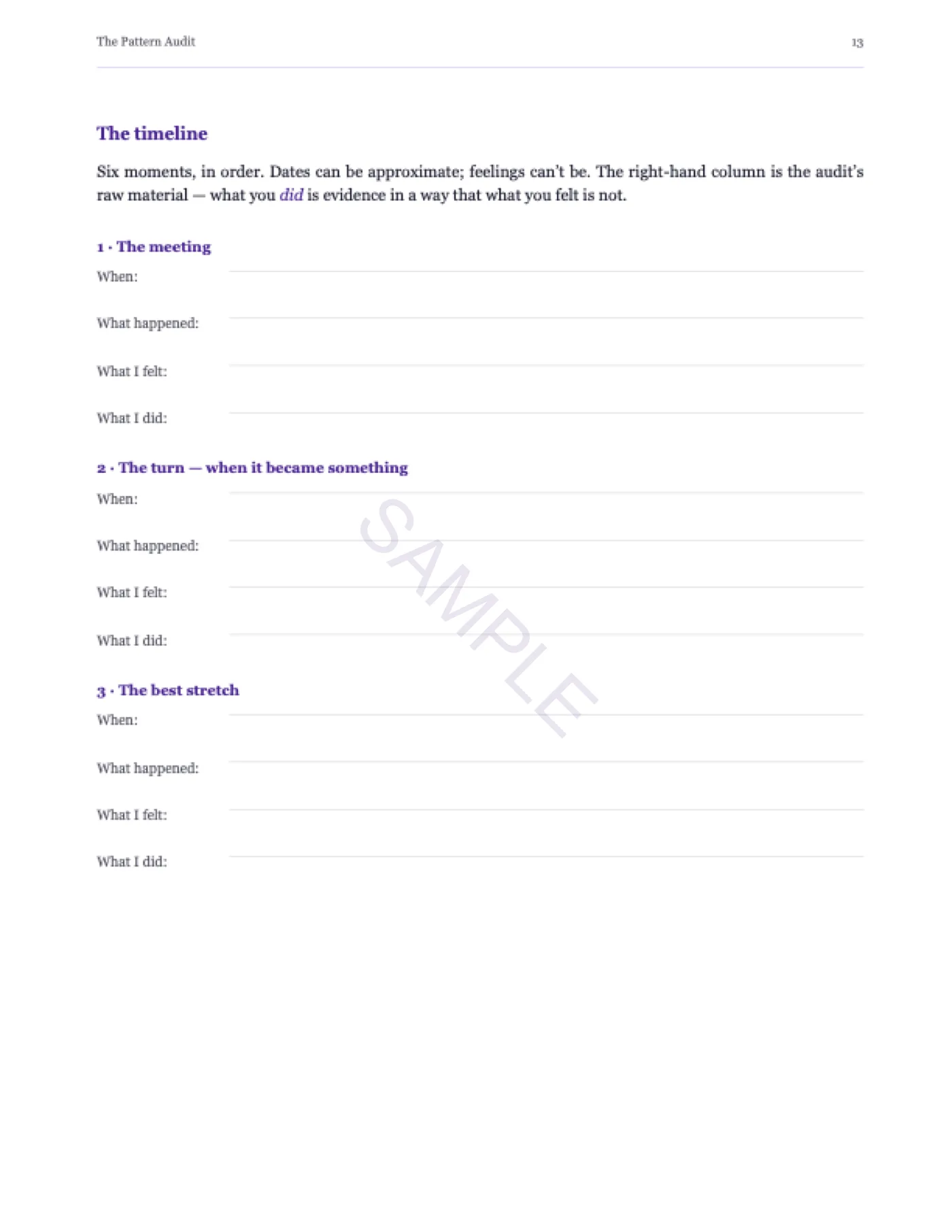
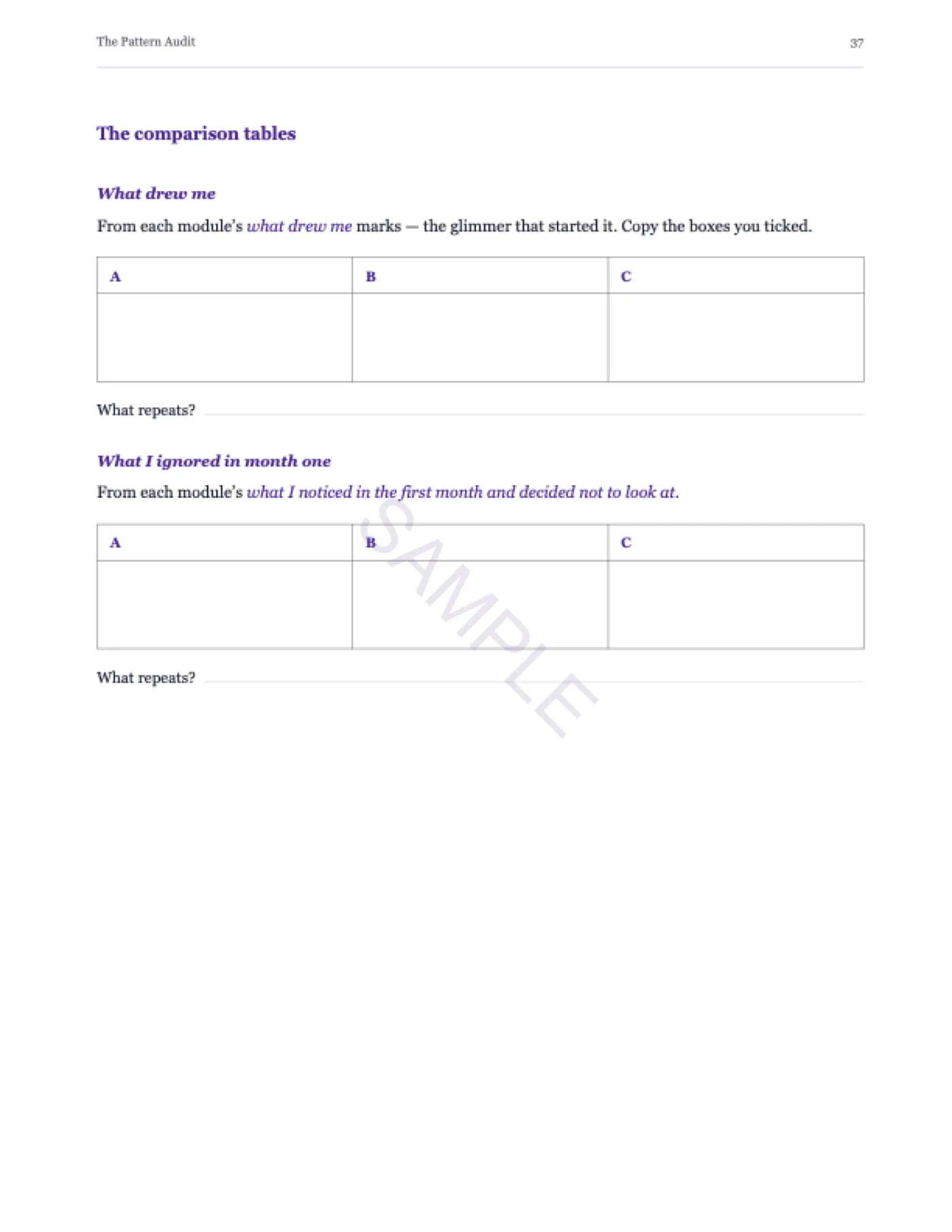
The face sheet, the timeline, and the synthesis comparison tables. Watermarked previews.
Why the three audits are page-identical on purpose
One relationship is an event. Two is a coincidence. Three is a sample — and identical questions asked of three different people are what make the repeat visible. The modules collect and never conclude; every verdict is withheld until the synthesis, where your three answer-columns sit side by side and interrupt each other’s stories.
And the rule that makes it safe to start tonight: no ex-contact, ever. The audit runs entirely on your records and your memory — and memory’s point of view is worked into the design, because the pattern lives in the telling too.
From Part One — The Method
The dinner-party version of an ex is compressed for delivery. It has a moral, a villain or a fool, and a running time of under two minutes. The audit runs the opposite operation. It takes the smoothed story and slows it back down into its parts: dates, acts, the things you actually did on ordinary Tuesdays. You are the scientist here, not the specimen.
Who is this for?
What’s inside
Part 1.The Method
Picking your three, the ground rules, and why memory’s bias is part of the design
Part 2.The Three Audits
Page-identical modules: the timeline, what drew you, the loop you ran, seeking vs creating, the withheld verdict
Part 3.The Synthesis
Seven comparison tables, the repeating element, the common denominator handled without self-blame, the one variable you control
Part 4.Forward
The watchlist, a light protocol for a current relationship, and when to stop auditing
Also inside
- When the Audit Isn’t the Right Tool — the abuse route-out, stated plainly, with the lines
Where you’ll be when the work is done
- Three relationships on paper as data — dates, acts and loops — instead of three well-worn stories.
- Seven tables read across, with the repeats circled in your own handwriting.
- The type you call chemistry, named: what all three shared that your friends couldn’t see the appeal of.
- The loop that appears in all three — when I ___, they ___, so I ___ — compared side by side.
- The common denominator handled honestly: you own the selection and the loop, not other people’s behaviour.
- A watchlist that buys you the pause between the next glimmer and the next commitment.
Also included: the almost-didn’t-write-it line (the censored answer is usually the pattern’s home address), the current-relationship light protocol, and a clear rule for when auditing becomes avoidance.
Get the audit.
53 pages. Three identical audits, one synthesis, one watchlist. The pattern is the data, not the verdict.
Instant PDF download. Secure payment via Stripe.
See the sample pages above before you pay. If it's not the tool you need, don't buy it.
At checkout you can add a personalised reading for $9.99 instead of the usual $14.99 — skip it if you just want the workbook.
Common questions
Who’s behind this, and why should I trust it with something this raw?
Taro’s Tarot — the authors of Love Patterns, the book this workbook is the practice arena for. Same line we hold everywhere: psychology first, no diagnosis of you or your exes, your safety over any framework. The ground rules include an explicit route-out: a relationship that included control or fear is a different exercise, and "what was my part" is the wrong question for abuse.
Do I need to read Love Patterns first?
No. The audit stands alone — the few concepts it uses are explained in a line each where they appear. The book gives you the theory of why patterns form; the audit finds yours.
Do I need to contact my exes?
Never. The audit runs on your records and your memory. Old messages and photos help with dates but aren’t required — and the workbook is honest about memory being a witness with a point of view.
What if I’ve only had two real relationships?
Two columns still work — the synthesis says exactly how to read across two. A situationship counts as a third if it ran deep; the rule is the three that mattered, not the three most official.
Is this going to tell me I’m the problem?
No, and it addresses that dread head-on. You are the common denominator of the selection and the loop — which is the good news, because those are the two things you can actually work with. Nothing in the audit both-sides genuinely bad treatment.
I’m in a relationship now — can I audit it?
The current relationship stays out of the modules by design. Part 4 gives it a light protocol instead: the loop check, with evidence both ways — because the pattern-radar can false-positive on a decent person.
Digital or print?
Print-first PDF, US Letter, 53 pages. One audit module per sitting, at least a day apart. Instant download after purchase.
Want the theory of why patterns form? The Psychology Behind Your Love Patterns — the book this audit is built for.
If one ex is still taking up the whole table: Limerence: The Honest Workbook