THE WAY YOU CONNECT
Am I In Love? Find Out What You Actually Feel
How often do you think about this person — and what are the thoughts like?
Choose the answer that feels most like you.
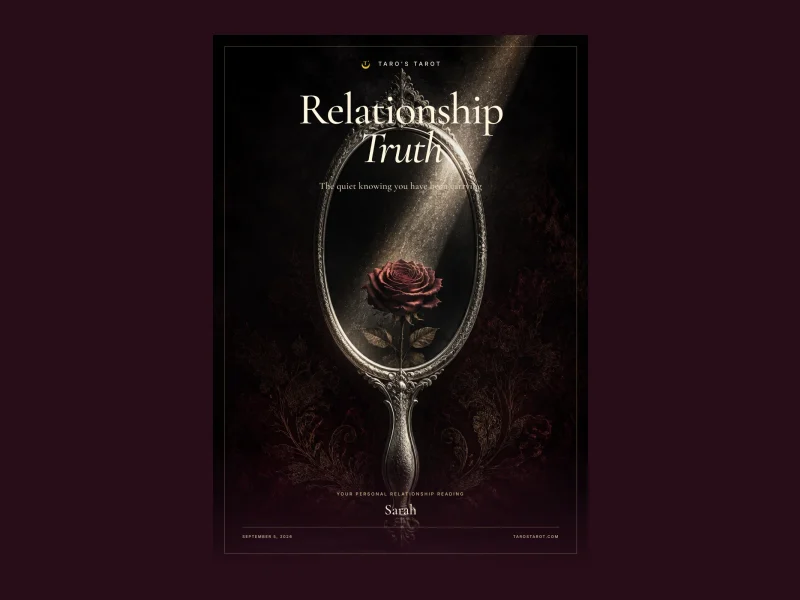
Inside the report: His True Feelings vs What He Shows
What isn't he telling you?
The Knight of Cups in the True Feelings position paired with the Seven of Swords in the Facade position reveals a painful disconnect: he does feel something real — but what he's showing you is a carefully edited version of it. This isn't indifference. It's strategy. The question isn't whether he cares. It's why he's decided you can't see it...
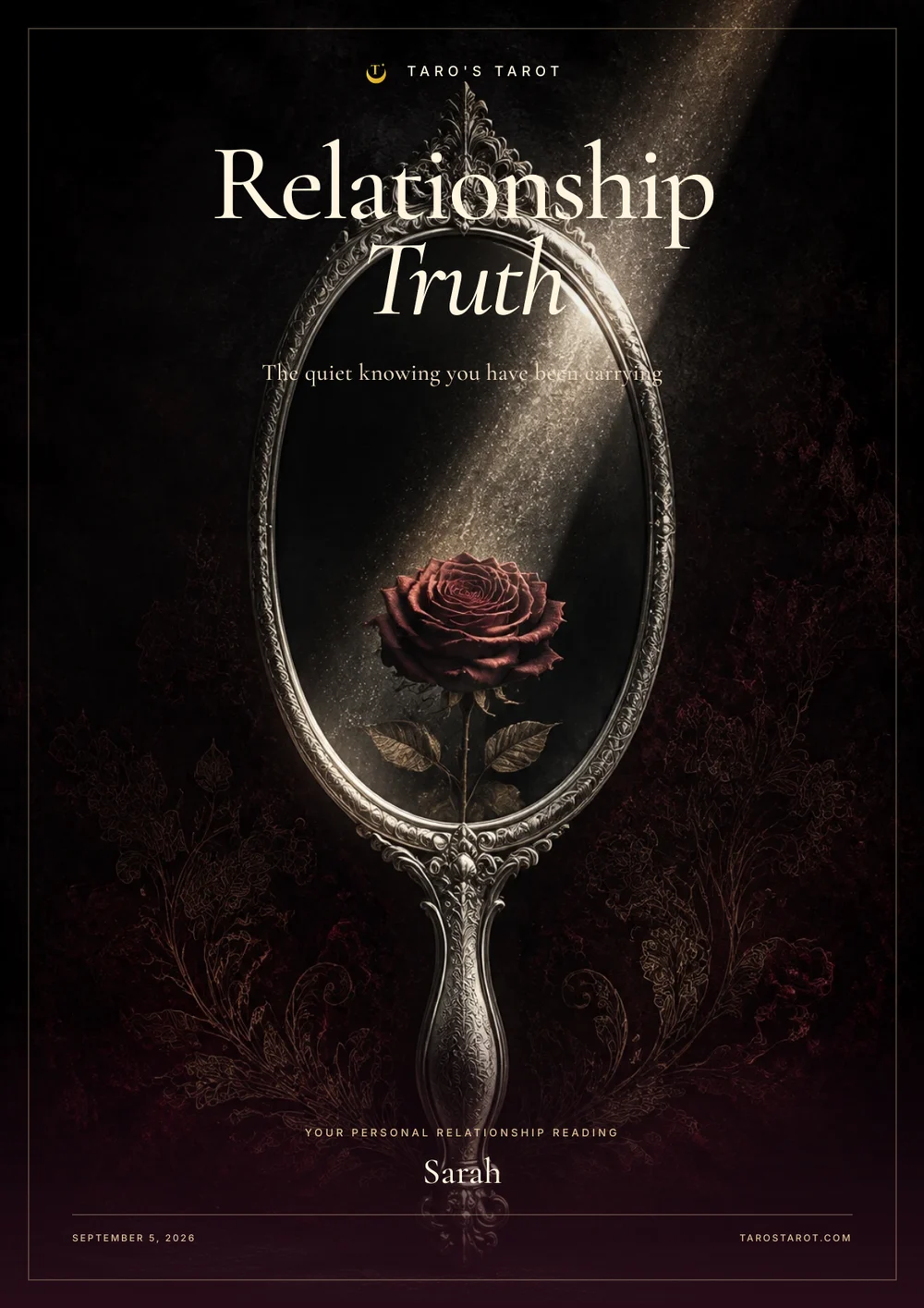
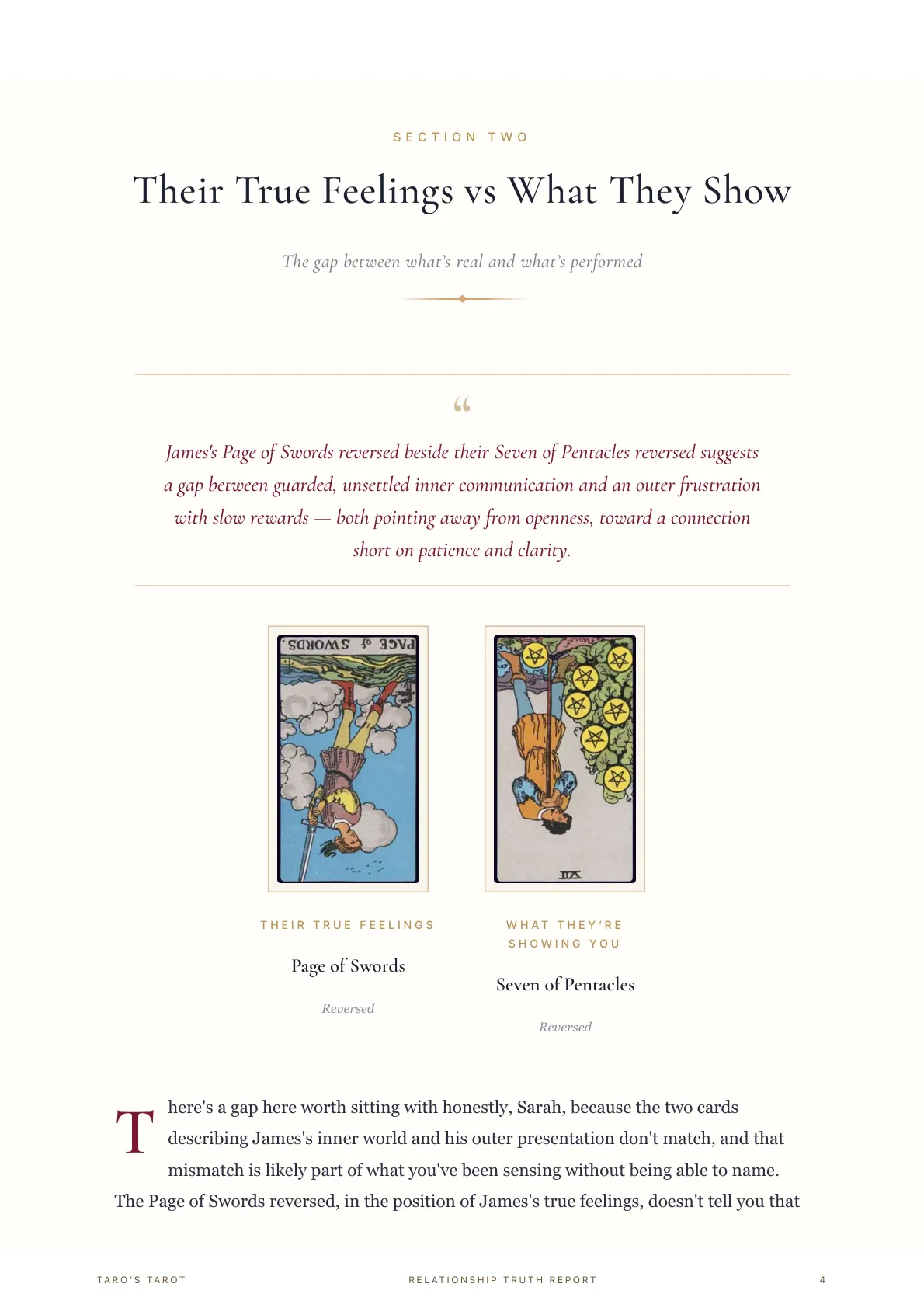
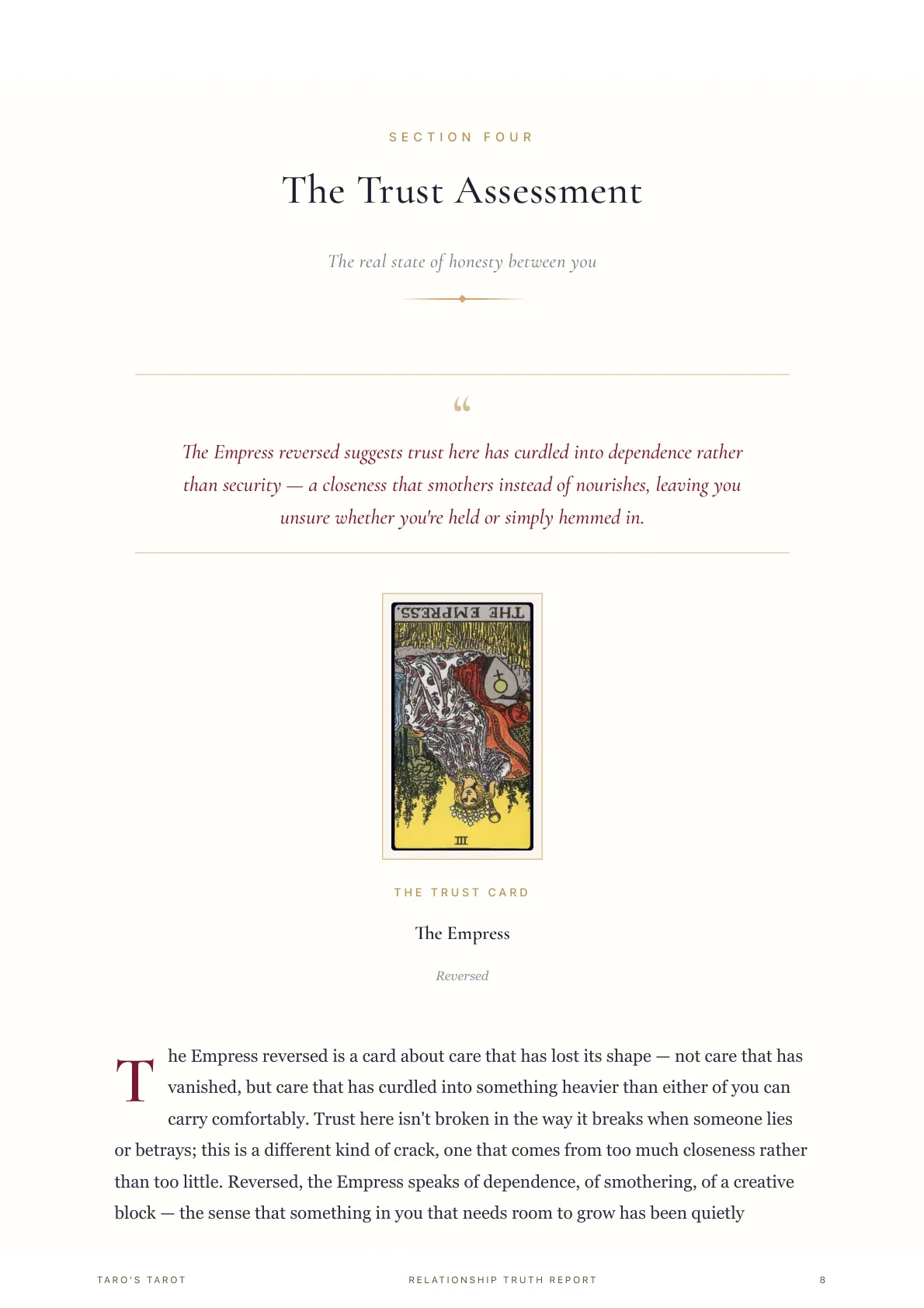
Sample pages from a real generated report — yours is written for you
$14.9930-day money-back guarantee — if your report doesn't feel genuinely specific to you, full refund, no questions asked.
“The question is never just 'am I in love?' — it's 'can I trust what I feel?' Love, limerence, and longing all wear the same face at first. The difference shows in how each one behaves when the person becomes real.”
Jump to a Feeling
The Five Feelings People Call "In Love"
"In love" isn't one feeling — it's at least five, and they behave very differently under distance, conflict, and time. Each has a distinct tarot archetype that captures its shape. Find the one that feels like where you are right now.
Deeply in Love
What you're feeling has the signature of real, established love: it's calm rather than frantic, it survives ordinary days, and it includes the person's flaws instead of editing them out. You're not wondering whether they exist when they don't text back. You're not performing a better version of yourself around them. This is the feeling most people are asking about when they type "am I in love" — and yours has the depth to match.
Around this person, you're more yourself, not less. Conflict is uncomfortable but not existential — you fight and you're still an "us" afterwards. When you imagine the future, they're in it as a real person with their real habits, not as a montage. The thought of them brings a settledness in your chest rather than a spike. You know things about them that aren't flattering, and it hasn't changed your answer.
Strengths
- You see the actual person clearly — flaws included — and choose them anyway
- Your feeling is stable under distance, silence, and bad days
- You can be fully yourself around them, which is where real intimacy lives
- Your love includes their reality, not just your idea of them
Watch Out For
- Deep love can feel "too quiet" if you learned that love should feel like anxiety
- You may undervalue what you have because it lacks dramatic highs
- Comfort can drift into taking each other for granted without deliberate attention
- Being this open means the stakes are genuinely high — and that vulnerability is real
Tarot Archetype
Two of Cups — two people meeting as equals, each holding their own cup. This is tarot's card of mutual, clear-eyed love: not the intoxication of the Knight of Cups or the fantasy of the Seven, but a real exchange between two whole people. What flows between the cups is offered freely and returned in kind.
What This Feeling Needs Next
Trust it. The quiet you feel isn't the absence of passion — it's the absence of fear, and that's what secure love feels like from the inside. What this feeling needs next is expression and tending: say the thing out loud if you haven't, invest in the relationship deliberately rather than coasting on the comfort, and protect the small rituals that built this closeness. If you've been waiting for a lightning bolt to confirm it's love — this steadiness IS the confirmation. Lightning is for beginnings. This is the thing beginnings are trying to become.
Falling (Early Love)
You're in the early, unfolding stage of love: past infatuation's pure fantasy, not yet in the settled depth of established love. The feeling is real and it's growing roots — you're starting to know the actual person, and what you're learning is deepening the pull rather than breaking the spell. This is the stage where "am I in love?" is the most honest question to ask, because the answer is genuinely becoming.
You think about them often, but the thoughts are curious rather than obsessive — you want to know what they'd say, not just how they'd make you feel. Their texts light you up, but silence doesn't destroy you. You've seen a flaw or two and found, slightly to your surprise, that it made them more real rather than less appealing. You're nervous around them sometimes, but it's the nervousness of something mattering, not of performing.
Strengths
- Your feeling is growing through real knowledge of them, not around it
- You can hold excitement and clear sight at the same time
- The openness you feel right now is the raw material of deep love
- You're still yourself around them — enchanted, but not erased
Watch Out For
- Early love is fragile to rushing — declaring or demanding too much too fast
- The intensity can tempt you to skip the slow verification that this person is who they seem
- Vulnerability hangovers are real: big openness, then the urge to retreat
- You may mistake the natural cooling of novelty for the feeling dying, when it's actually deepening
Tarot Archetype
Ace of Cups — the first overflowing of genuine feeling. The cup is offered from a cloud because you didn't manufacture this; it arrived. But an Ace is a seed, not a harvest. Everything depends on what you plant it in: real conversations, real time, real knowledge of each other.
What This Feeling Needs Next
Let it unfold at its own speed. What this feeling needs next is time and truth: keep learning who they actually are, let them learn who you actually are, and resist the urge to force a definition before the feeling has finished forming. Don't compare your beginning to other people's middles — early love is supposed to feel uncertain, because it's honest about not knowing yet. The single best thing you can do is stay curious: ask real questions, share real answers, and watch whether the feeling keeps deepening as the person gets more real. If it does, you'll know — and you won't need a quiz to tell you.
Infatuation / Limerence
What you're feeling is intense — maybe the most intense thing you've felt — but its engine is fantasy and uncertainty rather than knowledge of the actual person. This is infatuation, or in its stronger form, limerence: involuntary obsessive attraction that feeds on "maybe." The thoughts are intrusive rather than chosen, the highs depend entirely on signs of reciprocation, and the person in your head is doing a lot more of the work than the person in your life.
You check their name compulsively — messages, stories, whether they've been online. A single warm interaction fuels days of replaying; a lukewarm one can wreck an afternoon. You rehearse conversations you'll probably never have. The imagined future is vivid and cinematic, while your actual shared history is thinner than the feeling suggests it should be. Around them you're careful, curated, performing the version of you that might win them — which is exhausting, and nothing like peace.
Strengths
- Your capacity for intensity is real — the same depth, pointed at a real relationship, is a gift
- Limerence is involuntary; feeling it doesn't mean you're foolish or broken
- The fantasy is precise data about what you're starving for — that information is useful
- Naming it limerence is the single biggest step toward loosening its grip, and you just did
Watch Out For
- The feeling needs uncertainty to survive — it spikes on mixed signals and starves on clarity
- You're attached to an idealized version who doesn't fully exist, which blocks real intimacy
- The checking and replaying consume hours and crowd out your actual life
- Mistaking this for love can keep you orbiting someone unavailable for years
Tarot Archetype
Seven of Cups — a figure staring at cups full of visions floating in cloud: castles, jewels, a laurel wreath, a face. Every prize is imagined; none can be touched. This is tarot's card of enchantment by possibility — the feeling that the dream is so vivid it must be real. The card's question is the one you're asking: which of these cups holds something solid?
What This Feeling Needs Next
Be gentle with yourself — limerence is a nervous-system event, not a character flaw. What this feeling needs next is reality-testing, not more fuel: measure your actual interactions against the time spent imagining them, notice that the feeling spikes on uncertainty rather than closeness, and cut the checking rituals that keep the fire fed. Ask the hard question: if they clearly, warmly, boringly wanted you — would the feeling survive? If the honest answer is "it might die," that's your answer about what this is. The wanting is real. But it's pointed at a projection, and you deserve something that can actually hold you back.
Attachment & Comfort
What you're feeling is real attachment — deep familiarity, comfort, a life genuinely interwoven with theirs — but the question you're asking suggests the "in love" feeling has gone quiet or was never quite there. This isn't nothing: attachment is one of love's essential ingredients, and long relationships run on it. But comfort alone can also keep people in place out of habit, history, and the fear of the empty space where the person used to be.
Life with them works. The routines are smooth, the history is long, and imagining leaving feels less like freedom and more like amputation. But when you're honest, you're not sure whether you miss them or just notice their absence. Conflict feels less like fighting for the relationship and more like managing a household. You may catch yourself wondering whether this is what mature love is supposed to feel like — or whether you've mistaken the nest for the bird.
Strengths
- You've built something real — trust, history, and interwoven lives are not small things
- Attachment is the foundation long-term love actually stands on
- You're asking an honest question instead of sleepwalking, which takes courage
- Comfort with a person is rare — many people never feel safe enough to get bored
Watch Out For
- Comfort can anesthetize you to the difference between contentment and resignation
- Habit makes it hard to tell whether you'd choose this person again or you're just already here
- The fear of loss can masquerade as love — missing the structure isn't missing the person
- Unasked questions tend to leak out sideways as irritation, distance, or wandering attention
Tarot Archetype
Ten of Pentacles — the established house: family, dogs, archways, generations of security. It's tarot's card of everything built and banked. But the figures in the card barely look at each other; the wealth is structural, not felt. The Ten asks whether the fortress you've built still has a heart beating inside it — or whether the walls became the point.
What This Feeling Needs Next
Don't panic, and don't torch anything — the quiet you feel is not automatically a verdict. What this feeling needs next is deliberate re-choosing: attachment goes dormant when a relationship runs on autopilot, and it often reawakens under real attention — novelty, honest conversation, actually seeing the person instead of the routine. Try genuinely dating them again for a month and watch what your heart does. If warmth answers back, you've found the bird still in the nest. If honesty keeps returning the same flat answer, that's information too — and you deserve to know it while you still have the kindness to act on it well.
Love Confused with Longing
What you're feeling is real — but it may be pointed at the wrong target. This pattern is longing: a deep ache to love and be loved that has draped itself over a particular person, often one who is distant, unavailable, or mostly known through imagination. The feeling swells in their absence and gets strangely quiet in their presence, because it was never really about the person in front of you — it's about the space in you that wants filling.
The feeling is strongest late at night, in music, in the missing — less so in their actual company. You may barely know them, or know them well but connect mostly through fantasy versions of what you could be together. Loneliness and the feeling are hard to tell apart: when your life feels full, they fade; when it empties, they return like a tide. You've possibly done this before with someone else — the faces change, but the ache stays the same shape.
Strengths
- Your longing is proof of a real, unmet capacity for love — the well is deep, not broken
- You feel things fully; numbness is not your problem
- Recognizing the pattern (the ache outliving the specific person) is genuine self-awareness
- The energy you spend yearning, redirected, is exactly the energy that builds a real life and real love
Watch Out For
- Longing prefers distance — it can quietly sabotage real availability because closeness kills the ache it feeds on
- You may be casting ordinary people as the answer to a question they never agreed to hold
- The fantasy of being loved can substitute for the risks of actually being known
- Mistaking longing for love leads to chasing ghosts while real possibilities pass by
Tarot Archetype
The Moon — a landscape lit by reflected light, where every shape is suggestion and the path runs between two towers into the unknown. Tarot's card of projection: what you see by moonlight is half real and half your own mind. The Moon doesn't call you a fool — it says the night is genuinely beautiful. It just asks you to wait for daylight before you decide what you're looking at.
What This Feeling Needs Next
Be honest about the shape of the ache. What this feeling needs next is redirection, not suppression: the longing is a real signal about real hunger — for intimacy, for being chosen, for a witness to your life — and the specific person is mostly the screen it's projected on. Test it: does the feeling live in your actual moments with them, or in the missing? Does it have a history of moving from face to face? Then tend the hunger directly — deepen friendships, build the life that makes you feel chosen by yourself, and practice letting available people get close. Love that starts from fullness feels completely different from love that starts from ache. You're allowed to find out.
Am I in Love With Him? How to Tell With a Specific Person
When the question has a name attached — am I in love with him, with her, with them — the answer lives in how the feeling behaves around the real person, not in how strong it is. Intensity is the least reliable signal there is: anxiety, infatuation, and genuine love can all hit hard. What separates them is direction over time.
Ask three questions. First: do you like who you are around him? Love makes you more yourself; performing a curated version of you to keep his interest is a different feeling wearing love's clothes. Second: has knowing him better deepened the feeling or strained it? Love grows on real information — his moods, his flaws, his boring Tuesdays. Infatuation needs the gaps to stay unfilled. Third: what does a fight do? If conflict is painful but the wanting never actually wavers, that steadiness underneath is love's most distinctive fingerprint.
The quiz above measures exactly these signals — thought quality, conflict response, who you become around him, and the ratio of real time to imagined time — and names what the pattern adds up to.
Am I in Love or Is It a Crush?
A crush and early love can feel identical for the first stretch: the flutter, the frequent thoughts, the lit-up feeling when they appear. The difference emerges when reality arrives. A crush is powered by surface and possibility — it runs on the highlight reel and tends to deflate when the person becomes ordinary, familiar, or clearly available. Love is powered by the actual person, so familiarity feeds it instead of starving it.
Two practical tests. The flaw test: when you discover something genuinely unflattering about them, does the feeling wobble and dim (crush), or does it absorb the information and keep going — sometimes even deepen (love)? The boredom test: imagine a completely mundane evening with them, errands and dishes and nothing cinematic. If that picture is quietly appealing, the feeling has roots. If the appeal evaporates without the sparkle, you're likely holding a crush — which is a perfectly good thing to hold, as long as you know what it is.
And crushes matter: they're how many real loves begin. The quiz's "Falling (Early Love)" result exists precisely for the honest middle ground — past a crush, not yet certain.
Love vs Limerence vs Attachment: Three Feelings That Wear the Same Face
Most "am I in love?" confusion comes down to three feelings that overlap at the surface and diverge underneath. Love is knowledge plus devotion: it sees the real person clearly, brings more peace than anxiety, and holds steady under distance and conflict. Limerence is involuntary obsession: intrusive thoughts, compulsive checking, euphoric highs and crushing lows keyed entirely to signs of reciprocation — a feeling that needs uncertainty to survive. Attachment is bonded familiarity: the deep comfort of interwoven lives, which is a core ingredient of lasting love but can also outlive the love itself.
The cleanest way to tell them apart is to watch what each does under pressure. Under distance, love stays steady, limerence spikes into monitoring, attachment barely registers until the routine breaks. Under certainty — the person clearly and fully wanting you — love deepens, limerence often deflates without the chase, and attachment feels relief rather than joy. Under real knowledge of the person, love grows, limerence dims as the fantasy loses room to operate, and attachment simply continues.
None of these feelings is a character flaw — but they call for very different next moves, which is why the quiz names which one is actually driving. If limerence sounds uncomfortably familiar, the dedicated limerence quiz goes deeper into that pattern specifically.
Am I in Love With My Best Friend?
Falling for a best friend is one of the most disorienting versions of this question, because the usual signals are scrambled. You already have the intimacy, the inside jokes, the person you call first — so the ordinary markers of love are present whether or not you're in love. What changes is usually smaller and stranger: a jealousy that surprises you when they date someone, a new awareness of their physical presence, the realization that your imagined future quietly assumes them in it.
The honest test is specificity: is the feeling about them, or about the closeness itself? Losing a best friend to a new partner produces real grief either way — but grief over losing your place in their life is attachment, while wanting to be the one across the table, chosen romantically, with everything that entails, is something more. Notice also whether the feeling arrived on its own or only appeared when their attention moved elsewhere; longing triggered purely by potential loss deserves extra scrutiny before you act on it.
There's no answer that makes this risk-free — but there is a clearer view of what you're actually feeling, which is what the quiz above is built to give you before any conversation happens.
Frequently Asked Questions
How do I know if I'm really in love?
Real love tends to be calm rather than frantic: you can be yourself around the person, the feeling survives distance and ordinary days, and it includes their actual flaws instead of editing them out. If your feeling grows the more you genuinely know them, that's love's signature. If it feeds on uncertainty and fantasy, it's likely infatuation.
What is the difference between love and limerence?
Limerence is involuntary obsessive attraction that feeds on uncertainty — intrusive thoughts, compulsive checking, and highs and lows tied entirely to signs of reciprocation. Love is grounded in knowledge of the actual person and brings peace rather than anxiety. The sharpest test: limerence often deflates when the person becomes clearly available — love deepens.
Can you be in love with someone you barely know?
You can feel something overwhelming for a near-stranger, but by most definitions it isn't yet love — love requires knowing the real person, flaws included. Intense feelings without knowledge are usually infatuation or projection. That doesn't make the feeling fake; it makes it a beginning that still needs reality to confirm it.
Is it love or just attachment and comfort?
Attachment is a real ingredient of love, not its opposite — the question is whether warmth still answers when you pay genuine attention to the person, or whether only the routine remains. Try deliberately re-choosing them for a month: real dates, real curiosity. Dormant love usually reawakens under attention; resignation stays flat.
This quiz is for self-reflection purposes only. It is not a clinical assessment or a substitute for professional advice.
Explore More Quizzes
Discover more ways to explore your spiritual journey
Looking for more spiritual guidance?