A LITTLE MORE UNDERSTANDING
Am I Codependent?
Your partner is having a bad day. What happens to your mood?
Choose the answer that feels most like you.

Inside the report: Their Energy
What aren't they telling you?
There's a clear pattern in how they hold back emotionally — not because they don't care, but because past experiences have taught them to guard their vulnerability. There's a deep well of feeling here, buried under layers of self-protection...

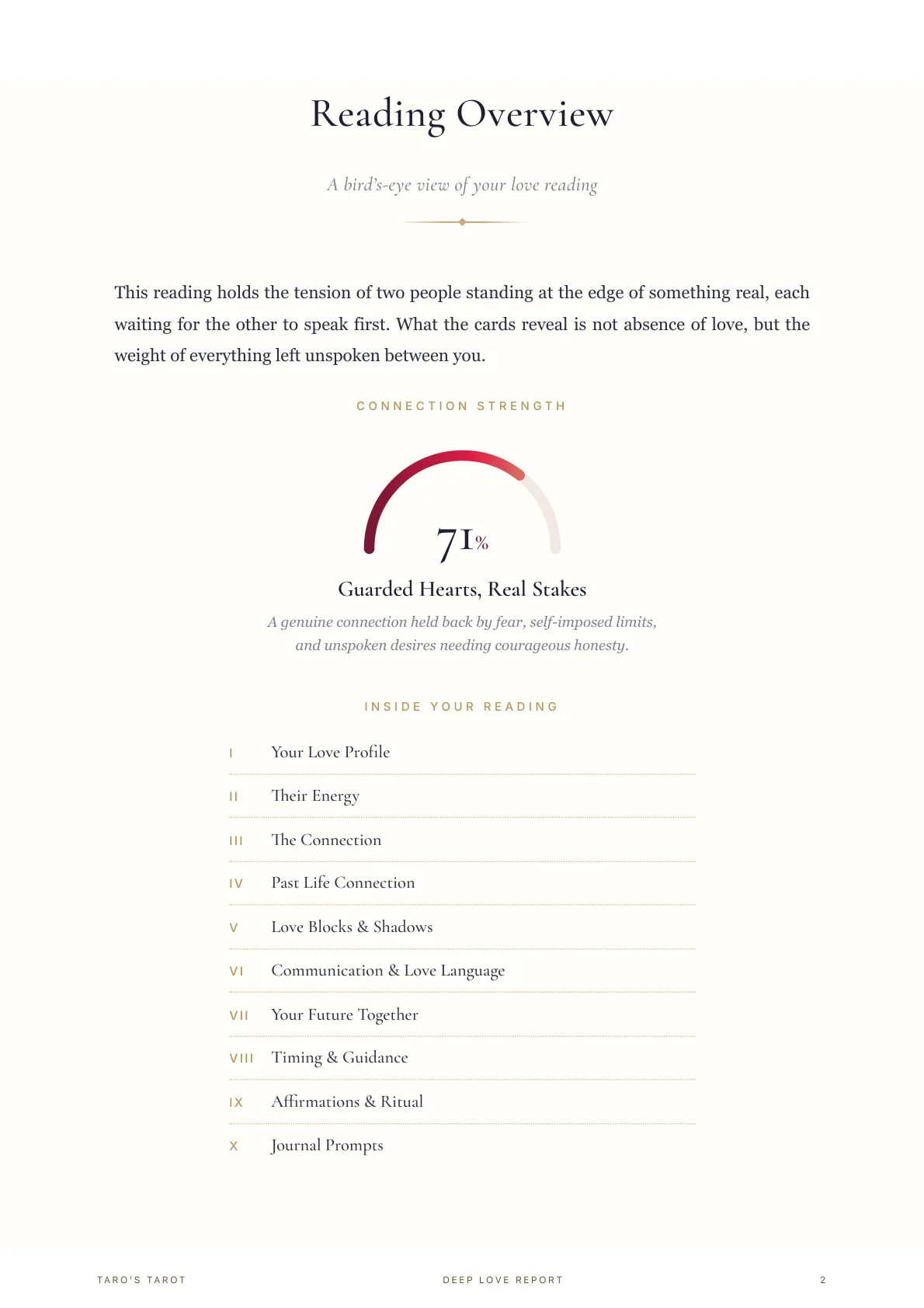
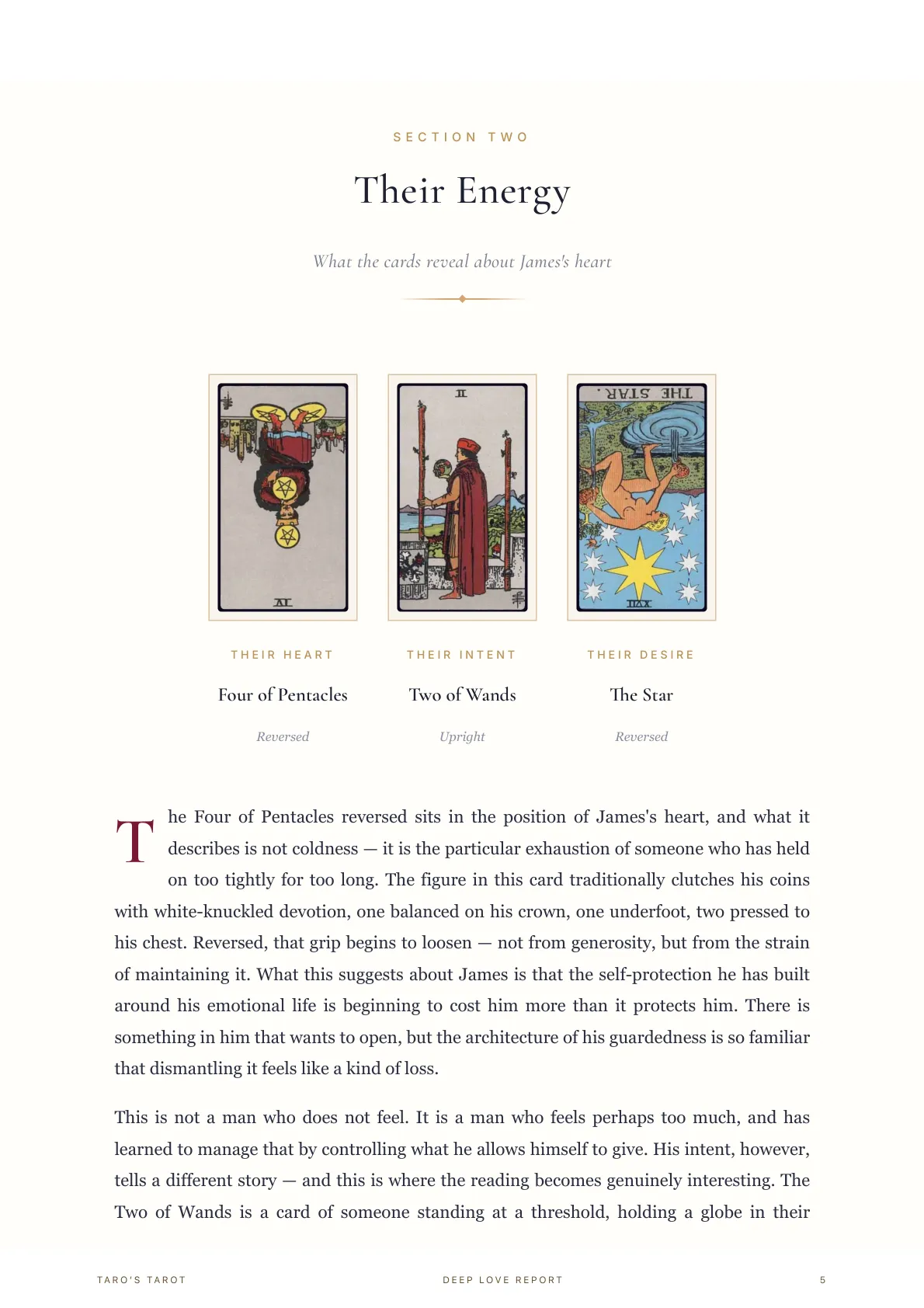
Sample pages from a real generated report — yours is written for you
$14.9930-day money-back guarantee — if your report doesn't feel genuinely specific to you, full refund, no questions asked.

Book
Twin Flames: The Honest Guide
The 8 stages, attachment theory, false twins, trauma bonds, and shadow work. Both frameworks, no fluff.
Get the Book — $14.99Understanding Codependency
Codependency was originally identified in partners and families of people with addiction, but the pattern extends far beyond that context. At its core, codependency is chronic self-abandonment — the habit of prioritizing others' needs so consistently that you lose track of your own.
Codependency isn't the same as being caring, generous, or empathetic. The difference is choice: healthy giving comes from genuine desire; codependent giving comes from the terror of what happens if you stop. When your value as a person depends on being needed, "selflessness" becomes a survival strategy rather than a virtue.
“Codependency disguises itself as love, but love doesn't require you to disappear. The moment you start confusing self-sacrifice with devotion, you've stopped giving and started surviving.”
Jump to a Relational Pattern
The Four Relational Patterns
Codependency sits on a spectrum between two healthy poles (independence and interdependence) and two defended extremes (codependency and counter-dependency). Each pattern has a distinct tarot archetype that captures its shape — find the one that feels like home.
Healthy Independence
You maintain a healthy sense of self within your relationships. You can love deeply without losing yourself, care for others without abandoning your own needs, and say no without guilt. This isn't emotional distance — it's emotional maturity.
You know where you end and others begin. When someone you love is struggling, you empathize without absorbing their pain. When conflict arises, you can hold your ground without aggression. You give from overflow rather than from depletion — and you know the difference.
Strengths
- Clear boundaries that protect both yourself and the relationship
- Ability to be fully present without becoming enmeshed
- Self-awareness about your own emotional patterns
- Gives generously from a place of genuine choice, not obligation
Growth Edges
- May sometimes come across as detached to more emotionally expressive partners
- Independence doesn't guarantee choosing the right people
- Can underestimate how much others struggle with the same balance
Tarot Archetype
The Emperor — grounded authority and self-governance. The Emperor sits on a solid throne not because he controls others, but because he governs himself. His boundaries create safety for everyone in his realm.
Guidance
You have a healthy foundation. Continue nurturing it by staying connected to your own needs, maintaining friendships outside your relationship, and modeling healthy boundaries for those around you. Your independence is a gift — both to yourself and to anyone who loves you.
Healthy Interdependence
You've found the sweet spot: genuine closeness without losing yourself. Interdependence means two complete people choosing to share their lives — leaning on each other without collapsing into each other. This is the healthiest relational pattern, and it takes real emotional skill to maintain.
You give and receive with equal grace. You can ask for help without shame and offer it without losing yourself. Your relationship feels like a partnership — not a rescue mission, not a merger, but two people building something together while maintaining who they are as individuals.
Strengths
- Balanced reciprocity — giving and receiving feel natural
- Comfortable with both closeness and healthy space
- Conflict is productive because both voices are heard
- Strong sense of "we" without sacrificing "I"
Growth Edges
- Interdependence requires both partners to participate — you can't do it alone
- May feel destabilized if a partner shifts toward codependent or avoidant patterns
- Maintaining balance requires ongoing conscious effort
Tarot Archetype
The Lovers — not the Hollywood version of passion, but the deeper meaning: conscious, mutual choice. The Lovers card depicts two people facing each other as equals, with an angel above them representing the higher love that flows when both people show up whole.
Guidance
What you have is rare and worth celebrating. Interdependence is often described as the goal of relationship therapy — the ability to be fully yourself while being deeply connected. Keep practicing: express needs clearly, receive support gracefully, maintain your individual interests, and stay curious about your partner's inner world.
Codependent Pattern
Your relationship patterns show significant codependency — a dynamic where your sense of identity, worth, and emotional stability depends on another person. You give compulsively, absorb others' emotions, and struggle to distinguish between caring for someone and losing yourself in them.
You are the one everyone relies on. You anticipate needs before they're spoken, smooth over conflicts before they happen, and carry the emotional weight of every relationship you're in. Others describe you as selfless and caring. Privately, you're exhausted, resentful, and unable to identify what you actually want. The cruel irony of codependency is that the giving that looks like love is actually a survival strategy designed to ensure you won't be abandoned.
Strengths
- Extraordinary empathy and emotional awareness
- Fierce loyalty and dedication to loved ones
- Ability to hold space for others' pain
- Deep desire for genuine connection (it's the method that needs adjusting, not the desire)
Growth Edges
- Self-abandonment has become so automatic you don't notice it happening
- Confuse being needed with being loved
- Resentment builds silently and eventually erupts or drives withdrawal
- May unconsciously choose partners who need rescuing
Tarot Archetype
The Empress reversed — the great mother depleted. The upright Empress nurtures from abundance; reversed, she gives from a well that has run dry. The garden she tends is everyone else's while her own withers from neglect.
Guidance
Codependency isn't a character flaw — it's a learned pattern, usually rooted in childhood experiences where love was conditional on being useful, quiet, or accommodating. Recovery starts with the smallest acts of self-reclamation: eating what you want for dinner, saying "I need to think about it" instead of automatic yes, spending time alone without filling it with productivity. Read our guide on codependent relationship signs for deeper understanding. Consider exploring CoDA (Co-Dependents Anonymous) meetings or therapy with a codependency specialist.
Counter-Dependent Pattern
Counter-dependency is the other side of the codependency coin: instead of over-giving, you've walled yourself off. You've decided that needing anyone is dangerous, so you built a life of radical self-sufficiency. Independence isn't your strength — it's your armor.
You are proud of not needing anyone. You handle your own problems, manage your own emotions, and rarely ask for help. From the outside, you look strong and self-contained. But the truth is that your hyper-independence isn't freedom — it's a defense mechanism built on the belief that depending on others leads to disappointment, betrayal, or loss.
Strengths
- Genuine self-sufficiency and resilience
- Ability to function under pressure without falling apart
- Clear sense of personal identity
- Doesn't lose themselves in relationships
Growth Edges
- Walls that protect also isolate
- Partners feel kept at a distance and eventually give up trying
- May secretly long for closeness but have no idea how to create it
- Confuses vulnerability with weakness
Tarot Archetype
The Hermit — retreating to the mountaintop with a lantern of self-knowledge. The Hermit's wisdom is genuine, but carried too far, the retreat becomes a prison. The lantern illuminates the path for one, but a life shared requires bringing that light back down to the valley.
Guidance
Your independence was built for good reason — at some point, depending on others hurt you badly enough that you decided never again. But walls that keep pain out also keep love out. The challenge isn't becoming dependent — it's learning that interdependence exists as a safe middle ground. Start by allowing someone to help you with something small. Notice that accepting help doesn't make you weak. Notice that vulnerability doesn't always lead to pain. If this pattern is deeply entrenched, attachment-focused therapy can help you slowly, safely lower the drawbridge.
The Complete Codependency Guide
Go deeper into the roots of codependent patterns, the childhood origins, the warning signs in your relationships, and the recovery path — including CoDA, therapy, and daily self-reclamation practices.
Read the full guide →Frequently Asked Questions
Is codependency a mental health diagnosis?
Codependency is not a formal DSM-5 diagnosis, but it is widely recognized by mental health professionals as a significant relational pattern that often co-occurs with anxiety, depression, and CPTSD. Many therapists specialize in codependency recovery.
What causes codependency?
Codependency typically develops in childhood when love was conditional on being useful, quiet, or accommodating. Children who learn that their worth depends on managing others' emotions carry this pattern into adult relationships. It's an adaptation, not a defect.
This quiz is for self-reflection purposes only. It is not a clinical diagnosis or substitute for professional help.
Inner Child Quiz
Discover the childhood wound beneath your codependent pattern.
Attachment Style Quiz
How codependency shapes your attachment pattern.
Shadow Work Quiz
Meet the shadow archetype driving your relational patterns.
Explore More Quizzes
Discover more ways to explore your spiritual journey
Looking for more spiritual guidance?