A LITTLE MORE UNDERSTANDING
Is He Manipulating Me?
When you bring up something he did that hurt you, how does the conversation usually end?
Choose the answer that feels most like you.
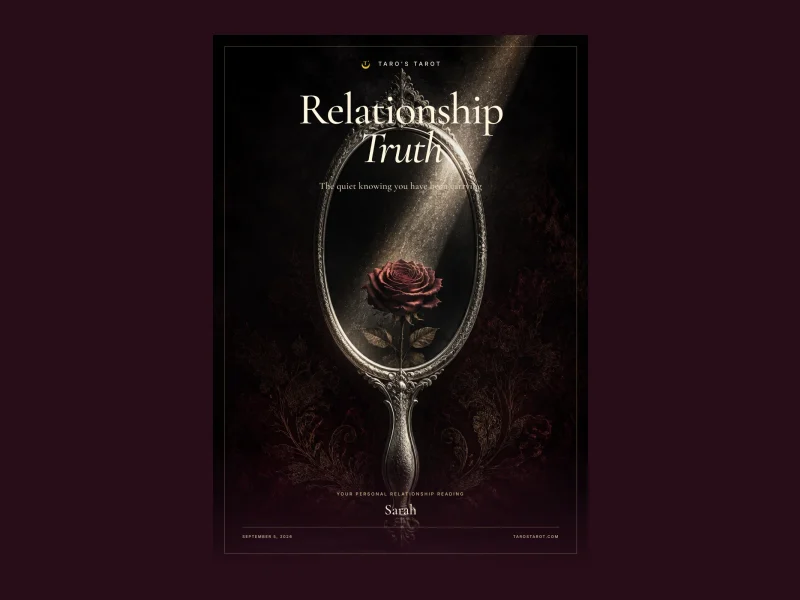
Inside the report: His True Feelings vs What He Shows
What isn't he telling you?
The Knight of Cups in the True Feelings position paired with the Seven of Swords in the Facade position reveals a painful disconnect: he does feel something real — but what he's showing you is a carefully edited version of it. This isn't indifference. It's strategy. The question isn't whether he cares. It's why he's decided you can't see it...
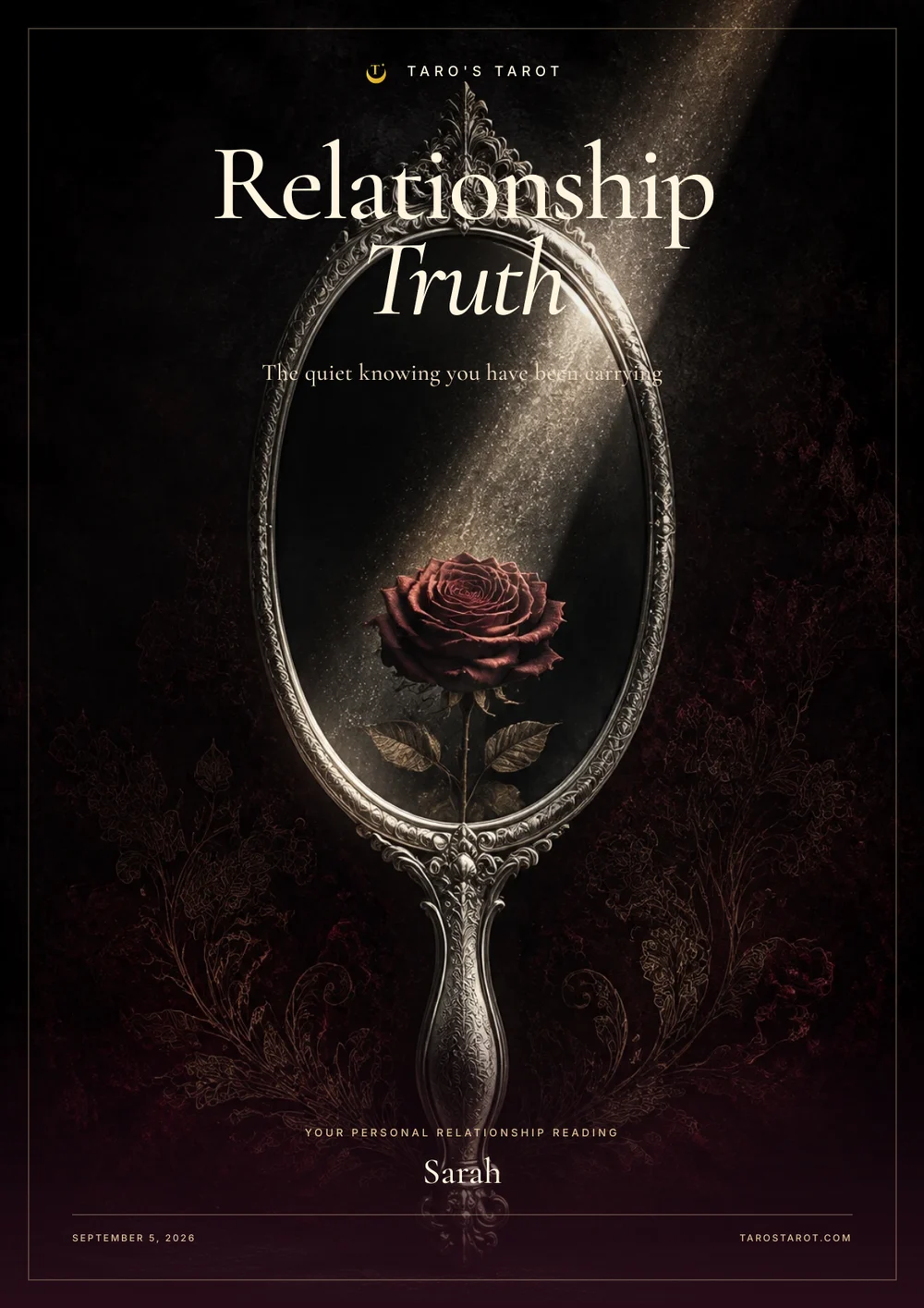
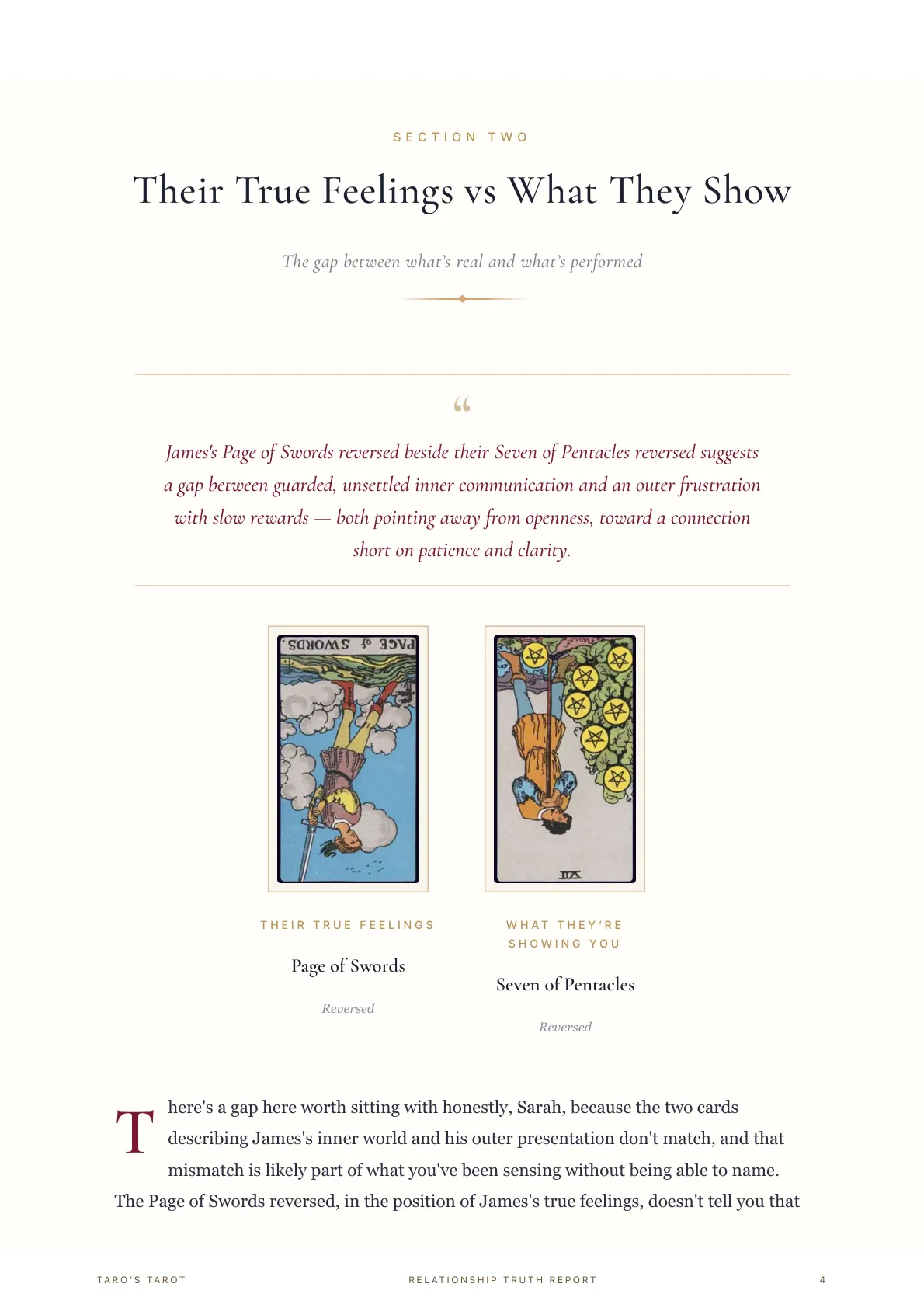
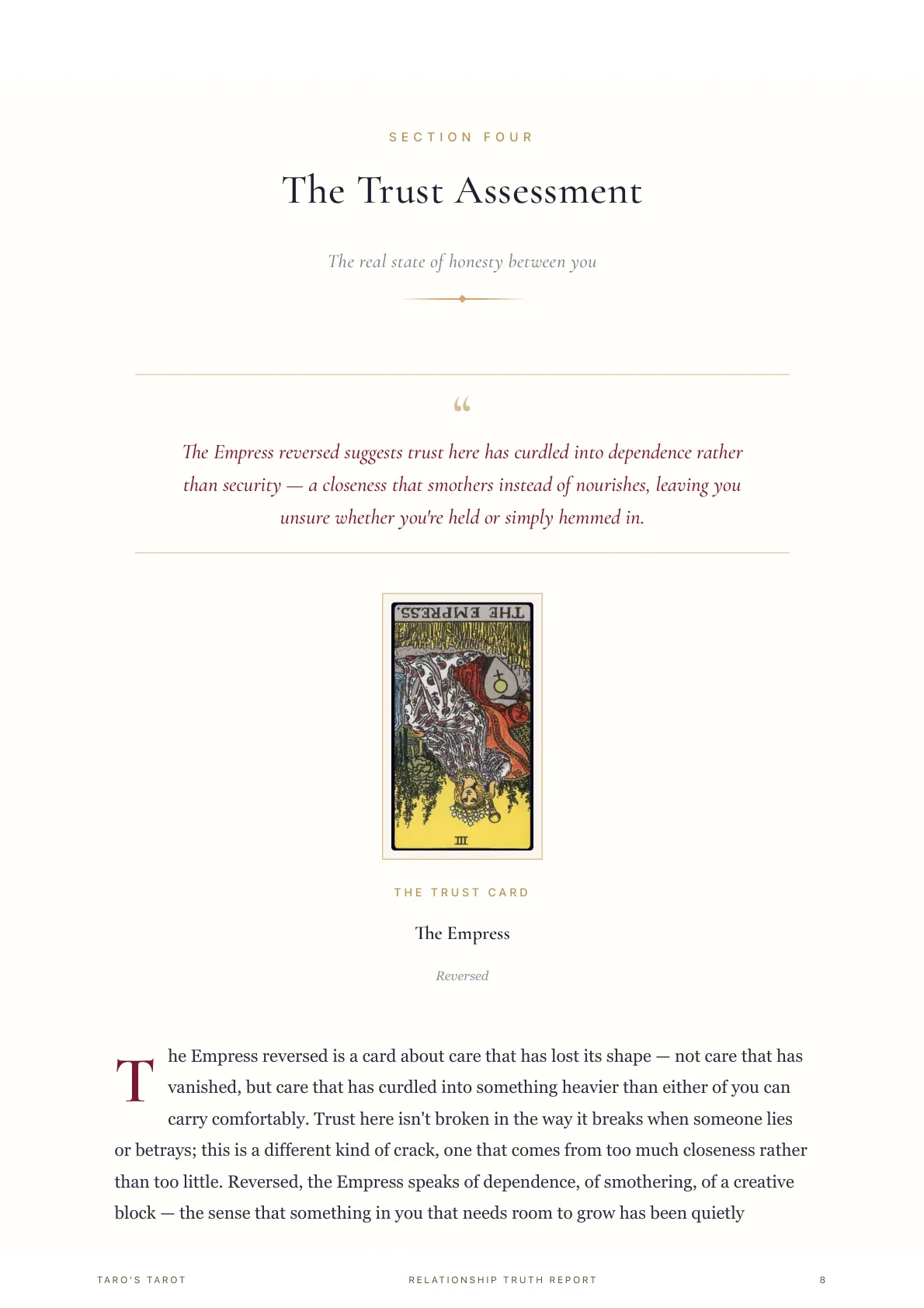
Sample pages from a real generated report — yours is written for you
$14.9930-day money-back guarantee — if your report doesn't feel genuinely specific to you, full refund, no questions asked.
Before You Start: A Note on What This Quiz Is
This quiz names behavior patterns and their effect on you. It is not a diagnosis of him — no quiz can tell you what's in another person's mind or whether he has a personality disorder. Patterns are about what keeps happening, not verdicts on who someone is. And nothing here is a verdict on you: being on the receiving end of manipulation is never your fault. If you feel unsafe in your relationship, support is available 24/7:
- National Domestic Violence Hotline: 1-800-799-7233
- Crisis Text Line: Text HOME to 741741
- Emergency: Call 911
“Manipulation is hardest to see from inside it — that's the design. The way out isn't deciding what he is. It's naming what keeps happening, and noticing what it's been costing you.”
The Five Patterns This Quiz Can Name
Not every uneasy relationship is manipulation — and pretending otherwise would help no one. This quiz sorts what you're living into one of five honest patterns, including the possibility that what you have is fixable friction, and the possibility that you're too close to see it clearly yet.
Clear Manipulation Patterns
Your answers describe behavior that follows a recognizable manipulation playbook: your concerns get turned back on you, standards move the moment you meet them, and conversations about his behavior reliably end with you apologizing. This is not about labeling him — it's about naming what keeps happening to you. And what keeps happening to you has a pattern.
You already know more than you let yourself admit. You can predict how a conversation will go before it starts — you know which topics are "safe," which sentences will set off a three-day storm, and exactly how it will end: with your original point lost and your character on trial. That predictive ability isn't anxiety. It's pattern recognition. Your nervous system has been collecting data for a long time, and the data is consistent.
Tarot Archetype
The Moon reversed — illusion beginning to lift. Upright, The Moon is the card of distortion, of not being able to trust what you see by half-light. Reversed, the dawn arrives: what was hidden becomes visible, and the fears that were engineered start to lose their grip. You are at the moment where the shapes in the dark resolve into what they actually are.
Guidance
You don't have to decide anything today. Naming the pattern is the work right now — decisions come later, on your timeline, ideally with support. Start rebuilding outside perspective: one trusted friend, a therapist, or a support line, told the unedited version. Keep your reality-checking (journal, screenshots) somewhere private and safe. Remember: this quiz describes behavior patterns, not a diagnosis of him — and none of it is a verdict on you. If you ever feel unsafe, contact the National Domestic Violence Hotline (1-800-799-7233) — you deserve support regardless of whether you think it's "bad enough."
Control Dressed as Care
The behavior you're describing doesn't look like cruelty — it looks like devotion. He worries. He checks in. He has opinions about your friends "because he loves you." But your answers show the tell: the care only flows in directions that shrink your world and expand his access to it. Concern that costs you friendships, autonomy, and privacy isn't protection. It's control wearing protection's clothes.
You feel guilty for even taking this quiz, because he's not a monster — he's attentive, sometimes wonderful, and everyone says you're lucky. But you've noticed your world getting smaller: plans you don't make anymore, people you see less, opinions you pre-screen before saying out loud. When you do something purely for yourself, there's a tax — sulking, worry framed as hurt, a debt you somehow owe. You keep paying it because the alternative conversation is exhausting.
Tarot Archetype
The Emperor reversed — structure that has hardened into a cage. Upright, The Emperor offers protective order; reversed, the protection becomes possession, and rules that claimed to keep you safe mostly keep you contained. The question the reversed Emperor asks is simple: does this structure serve your growth, or your containment?
Guidance
Run the direction test: healthy care expands your life (encourages your people, your goals, your privacy); control contracts it. Try one small act of ordinary autonomy — an evening with a friend, a decision made without pre-clearing it — and observe what it costs you afterward. That cost is your data. Reconnect quietly with one person you've drifted from; isolation is the soil this pattern grows in. This is about his behavior's effect on your life, not a diagnosis of his heart — and if asserting normal freedom ever feels unsafe, that's the moment to reach for outside support (1-800-799-7233 in the US).
Emotional Whiplash (Intermittent)
Your answers describe a relationship that runs on unpredictability: punishing cold followed by dazzling warmth, with no reliable way to know which version of him you'll get. This on-off pattern — intermittent reinforcement — is the most binding dynamic psychology knows. The good moments aren't proof the bad ones don't matter. The alternation itself is the pattern.
You live at two speeds: bracing and basking. When he's cold, you audit everything you said and did, hunting for the crime. When the warmth returns — and it returns gloriously — the relief is so intense it feels like love multiplied. You've started managing him like weather: reading micro-signals, adjusting yourself, celebrating sunny days you did nothing to cause and dreading storms you did nothing to earn. The exhaustion is constant, but so is the hope.
Tarot Archetype
The Wheel of Fortune — but you're strapped to it. The Wheel's lesson is that fortune turns and no one controls it. In this dynamic, that cosmic truth has been shrunk into a relationship: euphoria, then the drop, then euphoria again, on a schedule you can't read. The way off the wheel is not predicting the next turn. It's noticing you were never the one turning it.
Guidance
Track the cycle in writing for two weeks — cold spells, what preceded them (often nothing you did), the reunion warmth. Patterns you can see are patterns that lose power. Notice the difference between peace and a good day inside a bad pattern: peace doesn't require earning. Tell one outside person the whole shape of it, including the lows you usually edit out. This describes a dynamic, not a diagnosis of him — but a dynamic that keeps you bracing is already costing you, whatever its cause. If the cold phases ever include threats, intimidation, or fear for your safety, treat that as the headline and reach for support (1-800-799-7233).
Miscommunication, Not Manipulation
Here's some honest good news: your answers don't describe a manipulation pattern. They describe two people who fight clumsily but in good faith — your reality gets respected even when it's disagreed with, apologies actually change behavior, rules apply in both directions, and your world isn't shrinking. What you're feeling looks like the friction of mismatched communication styles, not the machinery of control.
You googled "is he manipulating me" — that matters, and it deserved a straight answer, not a scare. Something has felt off: fights that go sideways, moments of feeling unheard, maybe a phrase of his that stung. But when you look at the structure — how disagreements end, whether repair happens, whether you're free to be fully yourself elsewhere — the machinery of manipulation isn't there. You feel frustrated after arguments, not erased by them. That distinction is everything.
Tarot Archetype
Two of Cups slightly tilted — a genuine exchange with the cups misaligned. The Two of Cups is tarot's card of mutual, reciprocal connection. Yours isn't broken; it's pouring at slightly different angles, so some of what you offer each other spills. The repair isn't to find a new cup. It's to adjust the pour.
Guidance
Name the actual problem with him — not "are you manipulating me" but "our fights follow a pattern that leaves me feeling unheard; I want us to fix the pattern." Try structural changes: time-outs with a promised return time, one issue per conversation, repair check-ins after conflict. If the same fight keeps looping, a few sessions of couples counseling is maintenance, not crisis. And keep the self-trust that brought you here: if the structure ever changes — if apologies stop changing anything, if your world starts shrinking, if disagreeing starts costing you — you now know exactly what to look for.
The Fog (Too Close to See)
Your answers don't settle into one clear picture — and that isn't a failure of the quiz or of you. It's a finding in itself. You oscillate: some days you're sure something is deeply wrong, other days you're sure you're overreacting, and you can argue both cases convincingly. Chronic uncertainty about your own experience — especially when clarity keeps arriving and then getting talked away — is worth taking seriously.
You are the lawyer for both sides. You keep evidence, then cross-examine yourself about whether the evidence means anything. You rehearse describing your relationship to a friend and edit it until it sounds fine. The moments of clarity come — usually late at night, or right after an incident — and then his explanation, or your own empathy, dissolves them by morning. You came to a quiz because you've stopped trusting your own verdict. Read that sentence again.
Tarot Archetype
The Moon — tarot's card of the half-lit path. Under moonlight, real things cast strange shadows and strange things look real; the dog and the wolf howl side by side and you can't tell which is which. The Moon's counsel is not to pretend it's daytime. It's to keep walking toward dawn — and to stop navigating by lights someone else may be moving.
Guidance
Stop trying to reach a verdict alone; fog doesn't clear from inside fog. Do one thing this week: tell one safe person the unedited version — including the parts you usually soften — and watch their face. Start a private log of moments, written the same day, before the reinterpretation arrives; in a month, read it as if a friend wrote it. Ask the structural questions: Do apologies change behavior? Do the rules apply to him? Is your world shrinking? Behavior answers what arguments can't. This is about naming patterns, not diagnosing him — and if any part of the fog involves fear of him, that part is already your answer: support is at 1-800-799-7233, no certainty required.
Signs of Manipulation in a Relationship
Manipulation rarely announces itself. It arrives as ordinary moments that follow an extraordinary pattern. The most reliable signs are structural — things that keep happening, in the same direction, no matter what the argument was originally about:
- Guilt reversal: you raise a hurt, and within minutes you're the one apologizing. Your complaint becomes the offense.
- DARVO moments: Deny, Attack, Reverse Victim and Offender — he denies it happened, attacks your character for raising it, and ends the conversation as the wounded party.
- Moving goalposts: you meet the standard he set, and a new condition appears. The finish line exists to keep you running.
- Conditional apologies: "I'm sorry you feel that way" and "I'm sorry, but you have to understand why" — apologies that assign you the cause and change nothing.
- A shrinking world: friends who became "drama," family who became "toxic," a social life that quietly narrowed to him.
- Reality-checking yourself: screenshots, journals, re-reading old texts to confirm your own memory — because his retellings keep differing from what you lived.
Any one of these can happen once in a stressed, imperfect relationship. The signal isn't the incident — it's the repetition, the direction (it always resolves against you), and what it does to your trust in your own perception.
Manipulation vs Miscommunication
This is the question underneath the question — and it deserves an honest answer, because plenty of loving relationships fight badly. The difference isn't how a conflict feels in the middle. It's the structure of how it ends.
Miscommunication looks like
- "I remember it differently" — your memory is disputed, not erased
- Apologies that actually change behavior
- Fault that lands on both sides over time
- Rules and standards that apply to both of you
- Feeling frustrated or unheard afterward
Manipulation looks like
- "That never happened" — your memory itself is contested
- Apologies that come with lessons about your role in causing it
- Every conflict resolving in the same direction: against you
- Strict rules for you, exemptions for him
- Feeling scrambled, guilty, or unsure what's real afterward
One honest test: after your hardest conversations, do you doubt his choices — or your own sanity? Clumsy communication erodes patience. Manipulation erodes perception. If your quiz result comes back "Miscommunication, Not Manipulation," take it seriously in both directions: the machinery of control isn't there, and the friction is still worth fixing.
Is My Partner a Narcissist or Just Difficult?
If you've searched "is my partner a narcissist test," here is the honest answer: no online test can diagnose narcissistic personality disorder, because NPD is a clinical diagnosis that requires a professional who has actually assessed him. Anyone promising you that verdict from ten checkboxes is selling certainty they don't have.
But here's what matters more: you don't need his diagnosis to trust your own experience. Whether the behavior comes from narcissism, learned habits, or something else entirely, the questions that decide what you do next are behavioral — Does he take accountability, ever? Do apologies change anything? Does your reality get respected or rewritten? Is your world growing or shrinking? A difficult partner exhausts you and knows it. A manipulation pattern exhausts you and calls it your fault.
This quiz deliberately measures the pattern, not the person. If narcissistic dynamics specifically are what you're trying to understand, our narcissist partner quiz looks at those patterns in the same behavior-first, diagnosis-free way.
What to Do If the Answer Scares You
Sometimes naming a pattern is a relief. Sometimes it lands like a stone — because if it's true, everything seems to demand something of you. So let's be clear about what naming it actually requires today: nothing. Clarity and action are separate steps, and you're allowed to stand in the first one for as long as you need.
- Break the isolation first. Tell one safe person the unedited version — including the parts you usually soften. Manipulation loses power in outside air.
- Keep a private, same-day record. Write incidents down before the reinterpretation arrives. In a month, read it as if a friend wrote it.
- Find a therapist who understands coercive control. Not every counselor does; ask directly. If couples counseling has made things worse before, individual support first is a valid choice.
- Don't wait for "bad enough." If any part of you is afraid of him — of his anger, his retaliation, what he'd do if you left — that fear is already information. The National Domestic Violence Hotline (1-800-799-7233) exists for uncertainty too, not just emergencies.
And one thing to put down: the question of what you did to deserve this. You didn't. Manipulation patterns are about the behavior of the person running them — staying, hoping, and loving someone are not causes.
Frequently Asked Questions
What are the signs of manipulation in a relationship?
The most reliable signs are structural, not dramatic: conversations about his behavior end with you apologizing, standards move once you meet them, apologies come with lessons about what you did to cause it, the rules don't apply to him, and your circle keeps shrinking. Manipulation is a repeating pattern with a predictable shape — not a single bad moment.
How can I tell manipulation from miscommunication?
Look at how disagreements resolve. Miscommunication is mutual and repairable: your version of events is respected even when disagreed with, and apologies change behavior. Manipulation is directional: the same person always ends up wrong, memory itself gets contested, and repair never arrives. Clumsy fights leave you frustrated; manipulation leaves you doubting your own perception.
Is my partner a narcissist or just difficult?
No quiz can answer that — narcissistic personality disorder is a clinical diagnosis only a professional who has assessed him can make. The more useful question is behavioral: does his behavior follow a manipulation pattern, and what is it doing to you? You don't need a diagnosis to take a pattern seriously.
What should I do if my result scares me?
Naming a pattern doesn't obligate you to act on it today — clarity first, decisions later, ideally with support. Tell one trusted person the unedited version, keep a private same-day record of incidents, and consider a therapist who understands coercive control. If you ever feel unsafe, contact the National Domestic Violence Hotline at 1-800-799-7233 — you don't have to be certain it's "bad enough."
This quiz is for self-reflection purposes only. It names behavior patterns — it is not a clinical diagnosis of any person and not a substitute for professional help. If you are in danger, please contact emergency services or the National Domestic Violence Hotline at 1-800-799-7233.

Book
Twin Flames: The Honest Guide
The 8 stages, attachment theory, false twins, trauma bonds, and shadow work. Both frameworks, no fluff.
Get the Book — $14.99Explore More Quizzes
Discover more ways to explore your spiritual journey
Looking for more spiritual guidance?