The parts of you that got exiled are choosing your partners.
Shadow work without the candles: the psychology of the disowned, applied to how you love. Every prompt in this workbook tells you what it stands on — no mysticism, no monster theatrics, and a plain page at the back for when it isn’t shadow work but therapy terrain.
$12.99 once · 61 pages · print-first, yours to keep.
Instant PDF download. Pay by card via Stripe — no account needed.
Not sure yet? See inside first ↓A look inside
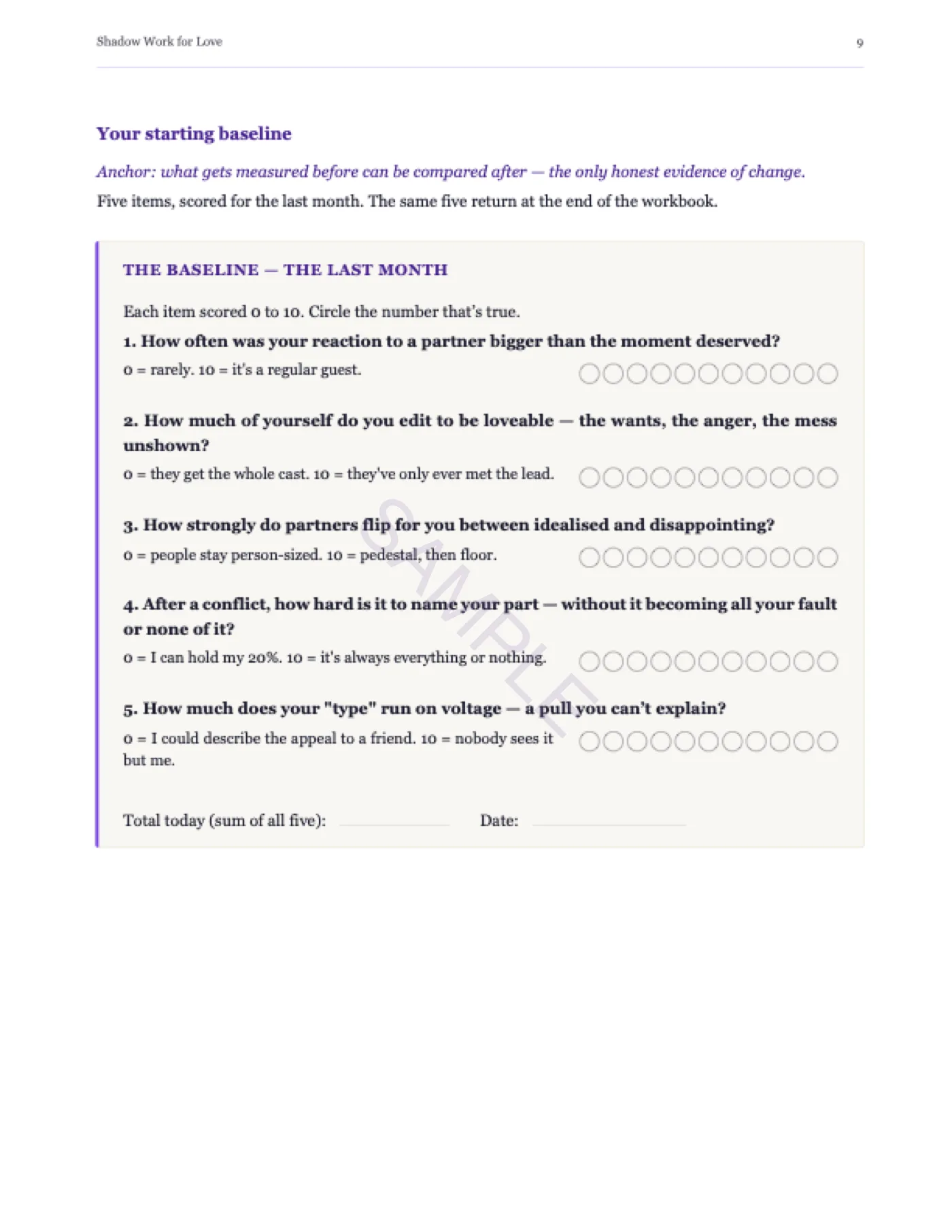
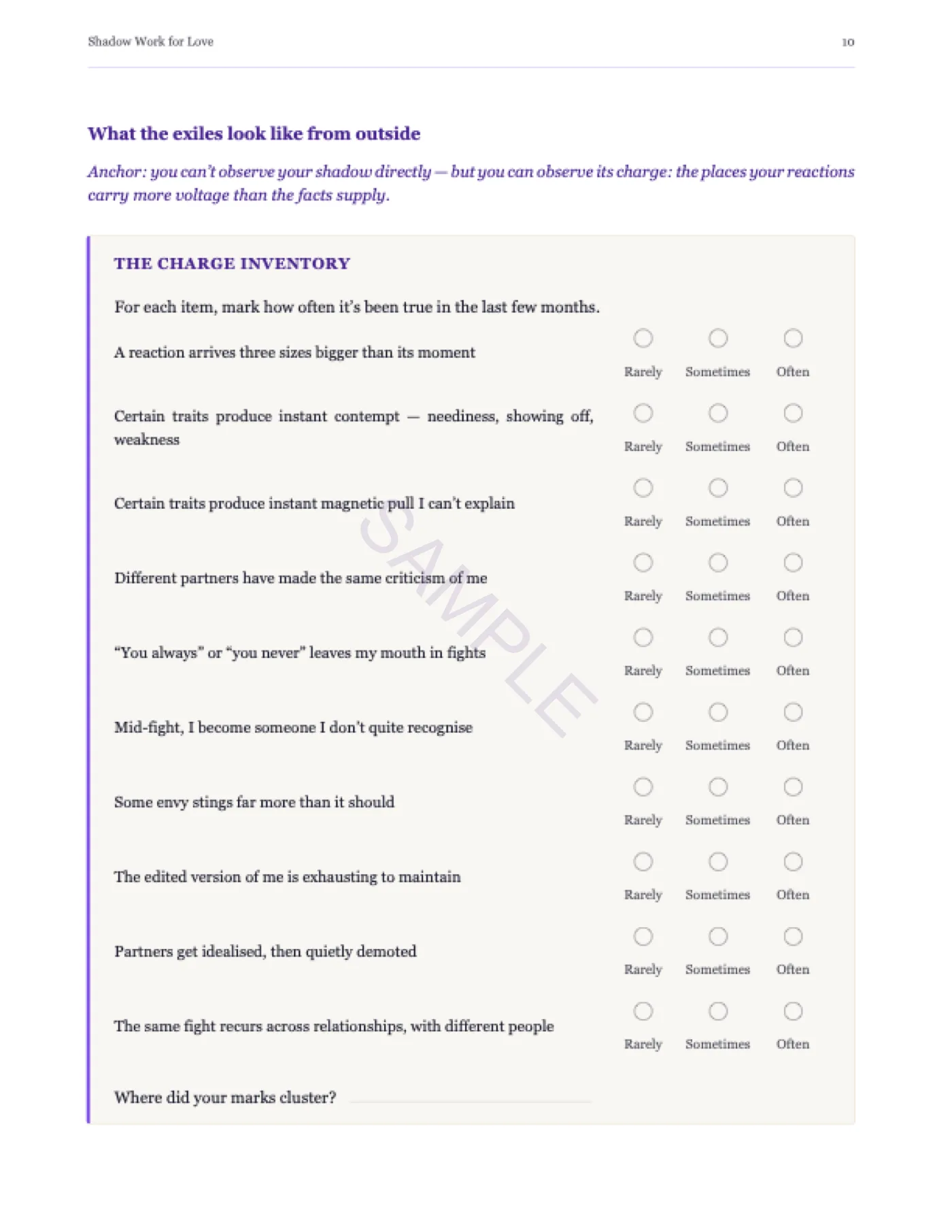
The baseline assessment and the Charge Inventory. Watermarked previews.
The voltage test — the diagnostic under everything here
A proportionate reaction is information about the moment; a disproportionate one is usually carrying freight from somewhere else. The workbook starts by measuring your gaps — the size a moment deserved against the size that arrived — and then traces the freight: what you can’t stand in partners, what you can’t resist, and the same "type" your off-stage parts keep casting.
Its signature is a convention you can argue with: every exercise opens with one plain line naming the psychology it stands on. If a prompt ever seems to ask for faith, the anchor line is right there to be checked.
From Chapter 1 — What a Shadow Actually Is
Children arrive whole, and then edit. Every family, however loving, makes some traits expensive — the anger that got you sent out, the neediness that got sighed at, the loudness, the pride, the wanting. A child can’t afford disapproval, so the expensive traits get exiled: not deleted, just moved off-stage, out of the performed self. No mysticism required — it’s an inventory of what you cut to stay loveable.
Who is this for?
What's inside
Chapter 1.Where You Are
The honest Jung, the baseline, the Charge Inventory, and the voltage test
Chapter 2.The Projection Map
Both polarities — the can’t-stand list, the can’t-resist list, the repeat criticism, the casting office
Chapter 3.The Persona in Love
The edit list, the costume fitting, the cost sheet, and the leak log
Chapter 4.The Exile
Stop-Go gated — where the traits got banned, the approval recipe, the reframe
Chapter 5.The Golden Shadow
Admiration and envy as disowned capacity (Robert A. Johnson) — and the first reclaim
Chapter 6.The Integration Reps
The 90-second reclaim, the always/never translation drill, conflict with the cast on-stage
Chapter 7.The Grief Underneath & Forward
The unperformed years, the post-assessment delta, and the letter to the exiled one
Also inside
- The 21-Day Charge Journal — one charge a day, size deserved vs size arrived
- When It Isn’t Shadow Work — the plain page about therapy terrain
Where you’ll be when the work is done
- Your three biggest voltage gaps measured — the size deserved against the size that arrived.
- The contempt list and the magnetism list read as mail addressed to you, with the turn made gently.
- The criticism two partners made independently, split honestly into the kernel and their projection.
- The partner-persona’s cost sheet — and where the cut material has been leaking out sideways.
- One golden trait reclaimed in a small dated act this week, instead of admired in someone else.
- The 90-second reclaim installed: charge noticed, freight named, and the actual moment answered at its actual size.
Also included: the exile chapter with real skip permission, the "you always/never" translation drill, the shadow-aware fight menu with the owned 20%, and the 21-Day Charge Journal.
Get the workbook.
61 pages. Anchored prompts, both polarities, the reps that take the freight back. No candles required.
Instant PDF download. Secure payment via Stripe.
See the sample pages above before you pay. If it's not the tool you need, don't buy it.
At checkout you can add a personalised reading for $9.99 instead of the usual $14.99 — skip it if you just want the workbook.
Common questions
Is this the TikTok shadow work?
No. There are no candles, no midnight confrontations with your darkness, and no prompts that open doors they can’t close. Every exercise cites the psychology it stands on, heavy chapters are gated, and the back page says plainly when what’s surfacing is trauma — which is therapy terrain, not journaling terrain.
Is it woo? Is it anti-woo?
Neither. It uses Jung’s shadow and persona as what they are — a working psychology of the disowned — with respect and without mysticism. The anchor lines keep everything honest: they say "usually" and "often", never "everything that irritates you is a mirror".
Why is it about love specifically?
Because that’s where the exiles do their loudest work: the too-big reaction in a fight, the type you can’t explain, the same criticism from different partners, the performed self a partner falls for instead of you. General shadow work is a sea; this is the harbour where your pattern actually docks.
What’s the golden shadow?
The half most workbooks skip: admiration and envy carry disowned capacity the same way irritation carries disowned faults (Robert A. Johnson’s "gold"). Chapter 5 traces what you’ve loved partners for that you refuse in yourself — and has you wear one piece of it, dated, this week.
How does the assessment work?
Five items scored 0–10 at the start and again at the end — reaction size, self-editing, pedestal-to-floor flips, owning your part without collapse, and how much your type runs on voltage. The delta is the evidence.
Is it safe to do alone?
It’s built to be: exercises have endpoints and time containers, the exile chapter opens with a Stop-Go gate and genuine skip permission, an ordinary-object grounding tool re-tethers you when the work floats, and the back page routes trauma to the right door without shame.
Digital or print?
Print-first PDF, US Letter, 61 pages. Built for a pen. Instant download after purchase.
Want to see the pattern in your actual relationship history? The Pattern Audit workbook
If the projection has one specific face lately: The Limerence book