Month-to-month love. This is where you read the lease.
Every situationship has terms — you live under them weekly; they’re just unwritten, and unwritten terms favour whoever wants less. This 80-page workbook writes them down, prices them, and puts three doors in front of you. It never picks one for you.
$11.99 once · 80 pages · print-first, yours to keep.
Instant PDF download. Pay by card via Stripe — no account needed.
Not sure yet? See inside first ↓A look inside
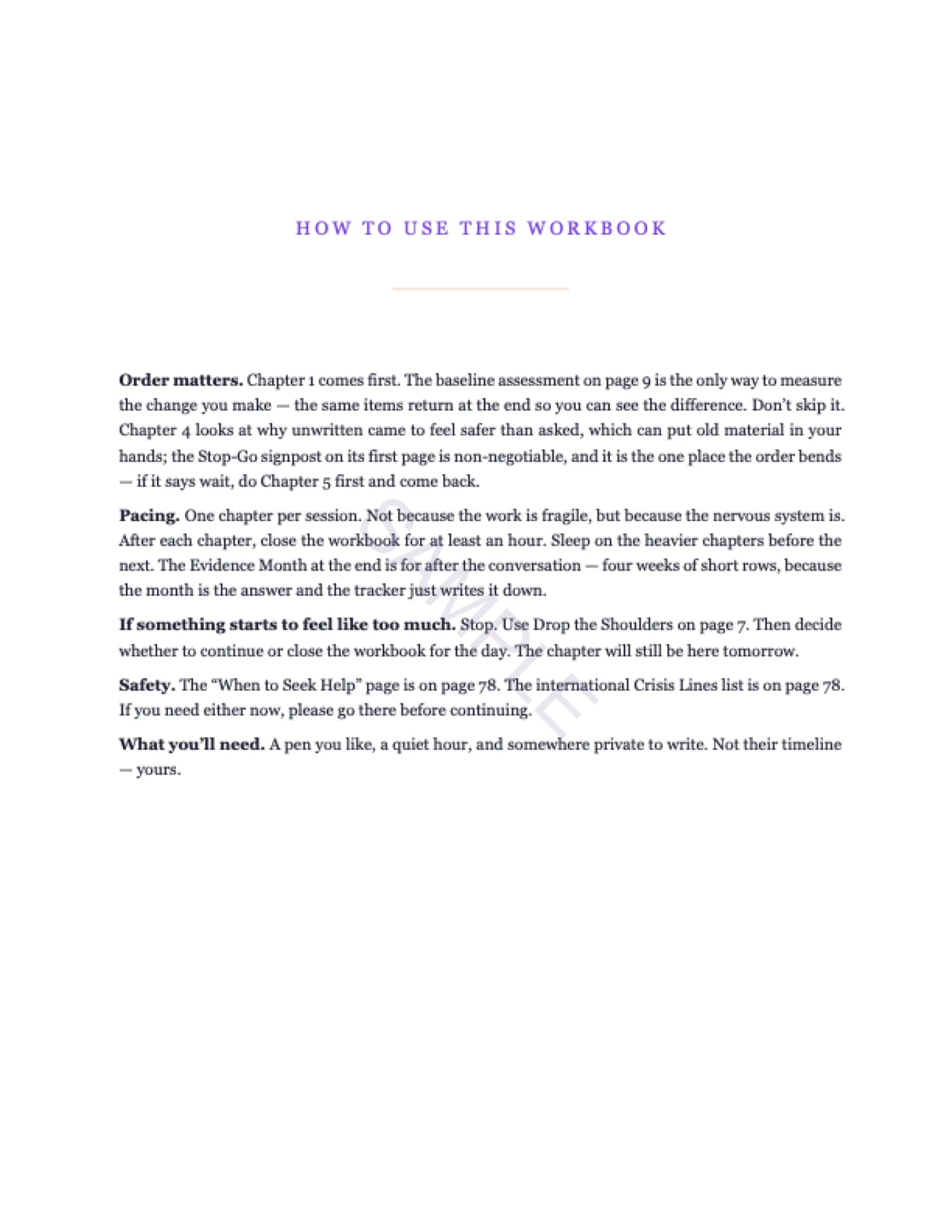
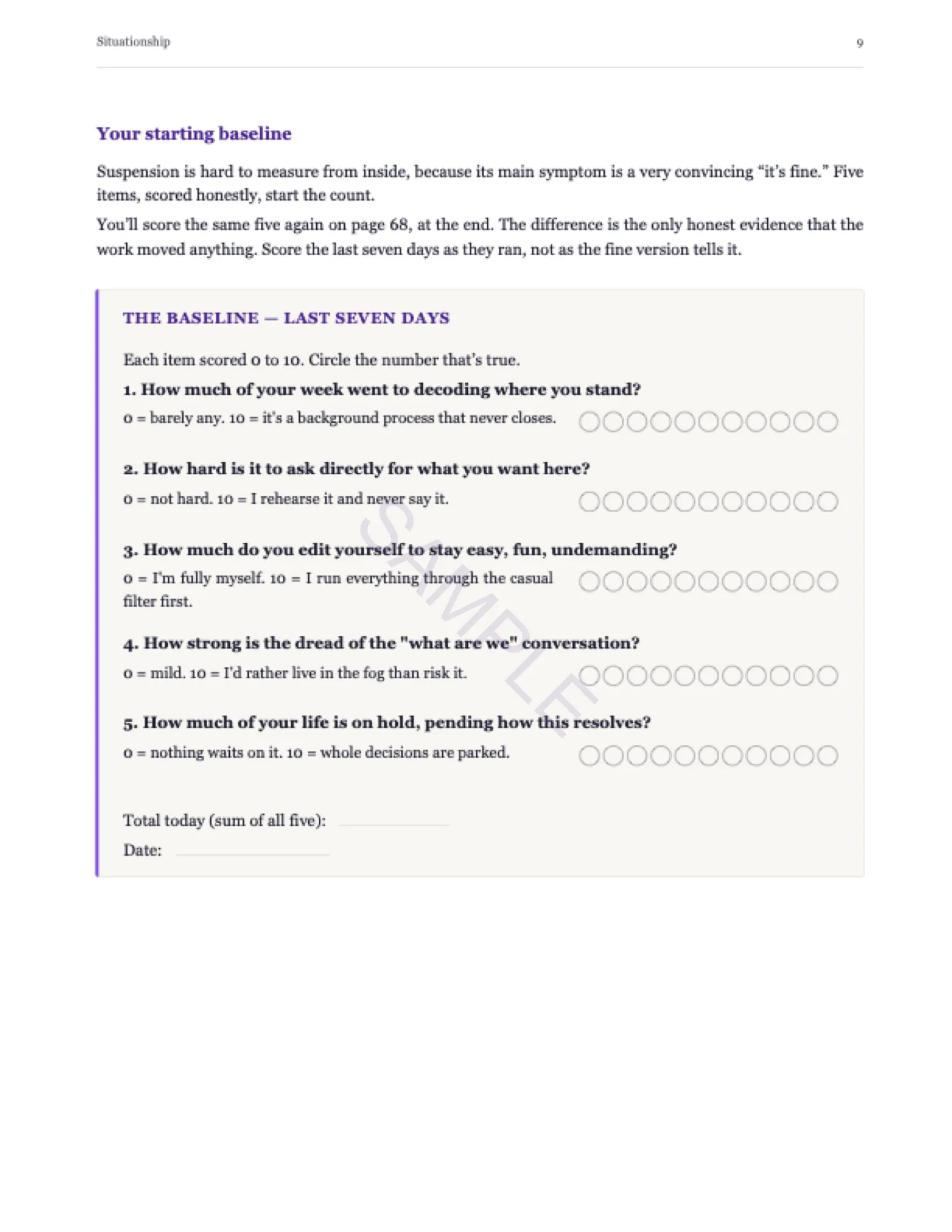
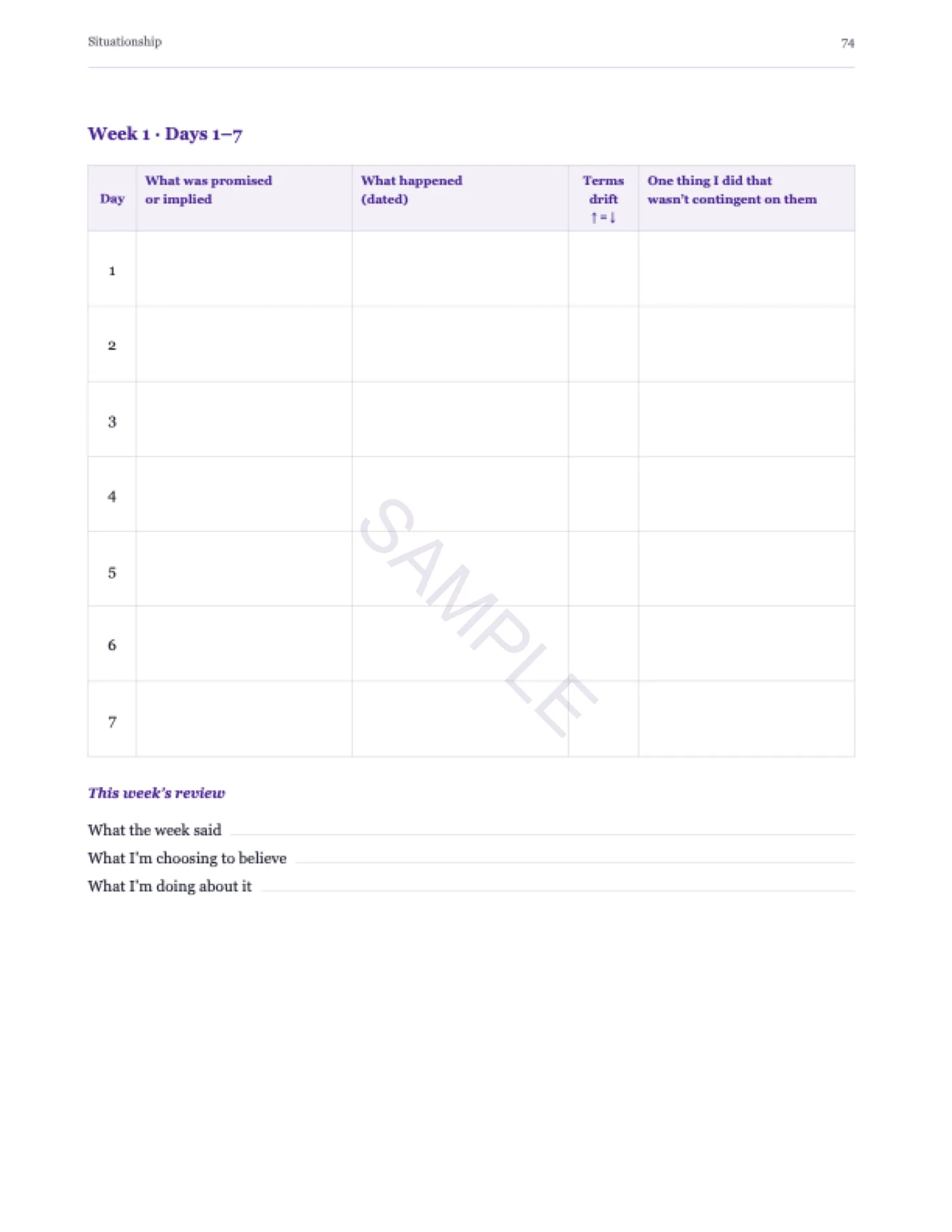
Inside pages, the baseline assessment, and the Evidence Month grids. Watermarked previews.
The terms test — the question under the whole workbook
If you asked for the terms in writing — what this is, where it’s going, what you can count on — what would happen? Not what you hope would happen: what the last six months of observable behaviour says. Chapter 1 turns that into a written instrument, and here’s its tell: terms you’re afraid to request are terms you’ve already accepted. Unsigned, but paid monthly.
From there the workbook prices everything — the suspension, the self-editing, the doors quietly closed — and ends at three doors, not two: sign the terms on purpose, renegotiate them, or hand back the keys. Staying undefined is legitimate, if it survives being chosen out loud.
From Chapter 1 — The Lease That Was Never Written
You’re not confused about what this is. You’ve read the terms already — you read them every time plans lapse, every time the future tense goes foggy, every time you edit "we" out of a sentence. What you haven’t done is read them out loud to yourself, in one place, priced.
Who is this for?
What's inside
Chapter 1.Where You Are
Baseline assessment + the Terms Test
Chapter 2.The Unwritten Terms
The Actual Lease — what you provide vs what you can count on — and the renewal log
Chapter 3.Who Keeps It Vague
Their maintenance moves, your half of the rent (Waller’s least-interest principle)
Chapter 4.Why Unwritten Feels Safer
Stop-Go gated — the no history, the half-loaf ledger, the reframe
Chapter 5.The Cost of Month-to-Month
The suspension audit, the door cost, the editing bill, the hours
Chapter 6.The Decision
The criteria matrix + the three doors, priced — and your minimum, found
Chapter 7.The Naming
The conversation with every outcome pre-planned: yes, no, the vague answer, the warmth surge
Chapter 8.After the Answer
The unsuspension, the terms you keep, the post-assessment delta
Also inside
- The Evidence Month — four weekly grids: believe the month, not the evening
- When the Vagueness Isn’t the Problem — fear of their reaction is control, not ambiguity
Where you’ll be when the work is done
- The unwritten terms of your arrangement on one page, in your own handwriting — what you provide, what you can actually count on.
- An honest count of what month-to-month costs: the parked decisions, the closed doors, the edits that became automatic.
- Your genuine minimum — the three terms without which this costs more than it gives — found before any conversation.
- Three doors priced, with the workbook’s hands visibly off the choice.
- A conversation plan for every outcome, including the one where "I need time" is the answer — because vague, in response to a direct question, is the terms restated.
- A month of evidence rows that outweigh any single warm evening.
Also included: the almost-conversations audit, the collusion audit (de-shamed — you’ve been paying half the rent), branch sidebars for long-distance and just-out-of-something, and the Evidence Month.
Get the workbook.
80 pages. The terms, the bill, the three doors, the conversation. Priced honestly, chosen by you.
Instant PDF download. Secure payment via Stripe.
See the sample pages above before you pay. If it's not the tool you need, don't buy it.
At checkout you can add a personalised reading for $9.99 instead of the usual $14.99 — skip it if you just want the workbook.
Common questions
Will it tell me to leave?
No. Three doors, not two — and staying undefined on purpose is one of them, if it would survive being chosen out loud. The workbook prices the doors; you walk through one.
How is this different from the $4.99 checklist?
The checklist assembles the evidence in ten minutes. This is the full programme: the terms written out, who maintains the vagueness, why asking feels dangerous, the complete bill, the decision framework, and the conversation planned for every outcome. If you’ve done the checklist, Chapter 1 will feel like coming home.
What if they give me a vague answer?
Chapter 7 treats the vague answer as a first-class outcome: "I need time" in response to a direct question is the terms, restated. You set the countdown — how long "time" is — and you date it. The warmth surge that often follows gets named too, so you recognise the renewal move when it arrives.
Is this just journaling?
No — audits, ledgers, a scored criteria matrix, a renewal log, decision pages with fields, and four weeks of evidence grids. Writing space exists, but every prompt has a job.
What if I’m scared of how they’ll react to the question?
Then the workbook says something important plainly: fear of their reaction — anger, punishment, disappearing as retaliation — is not ambiguity, it’s control, and the back page routes you to real support rather than a conversation script.
Who’s behind this?
Taro’s Tarot — same line we hold everywhere: behaviour over vibes, menus not scripts, no mind-reading, and the other person never made a villain. Vagueness is usually convenience plus conflict-avoidance, not a scheme — the workbook says so.
Digital or print?
Print-first PDF, US Letter, 80 pages. Built for a pen. Instant download after purchase.
Want the ten-minute version first? The Red-Flag Checklist ($4.99)
If the waiting itself has become the obsession: Limerence: The Honest Workbook