💕
A Weekly Card for Your Love Life
One card each Sunday — a quiet read on your heart and the week ahead.

Inside the report: The Runner-Chaser Dynamic
Why do they keep pulling away?
The Tower card in the Runner position is a powerful indicator that Jordan's separation isn't rejection — it's a spiritual crisis. They're not running from you; they're running from the intensity of a connection that demands they dismantle every wall they've ever built...

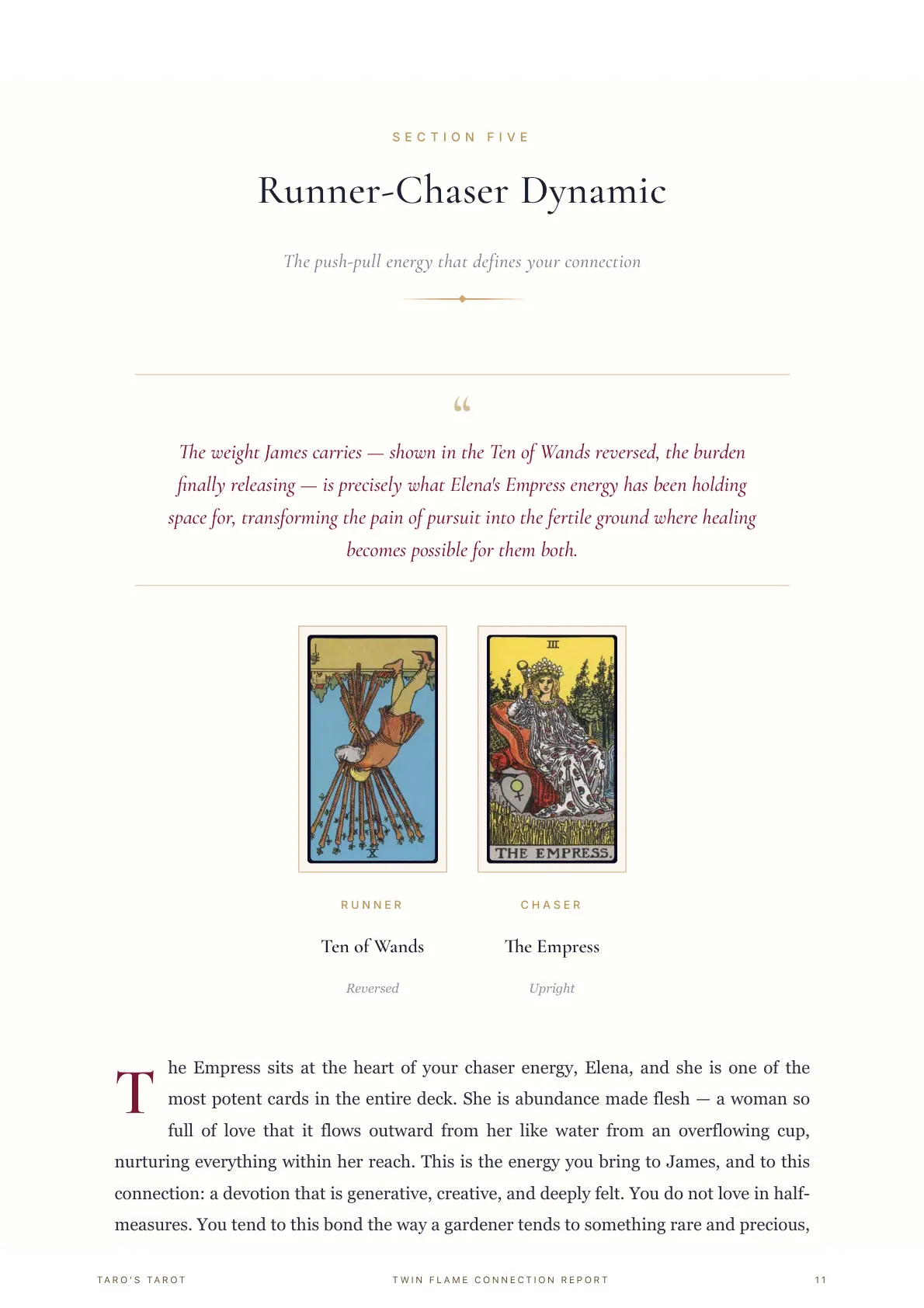
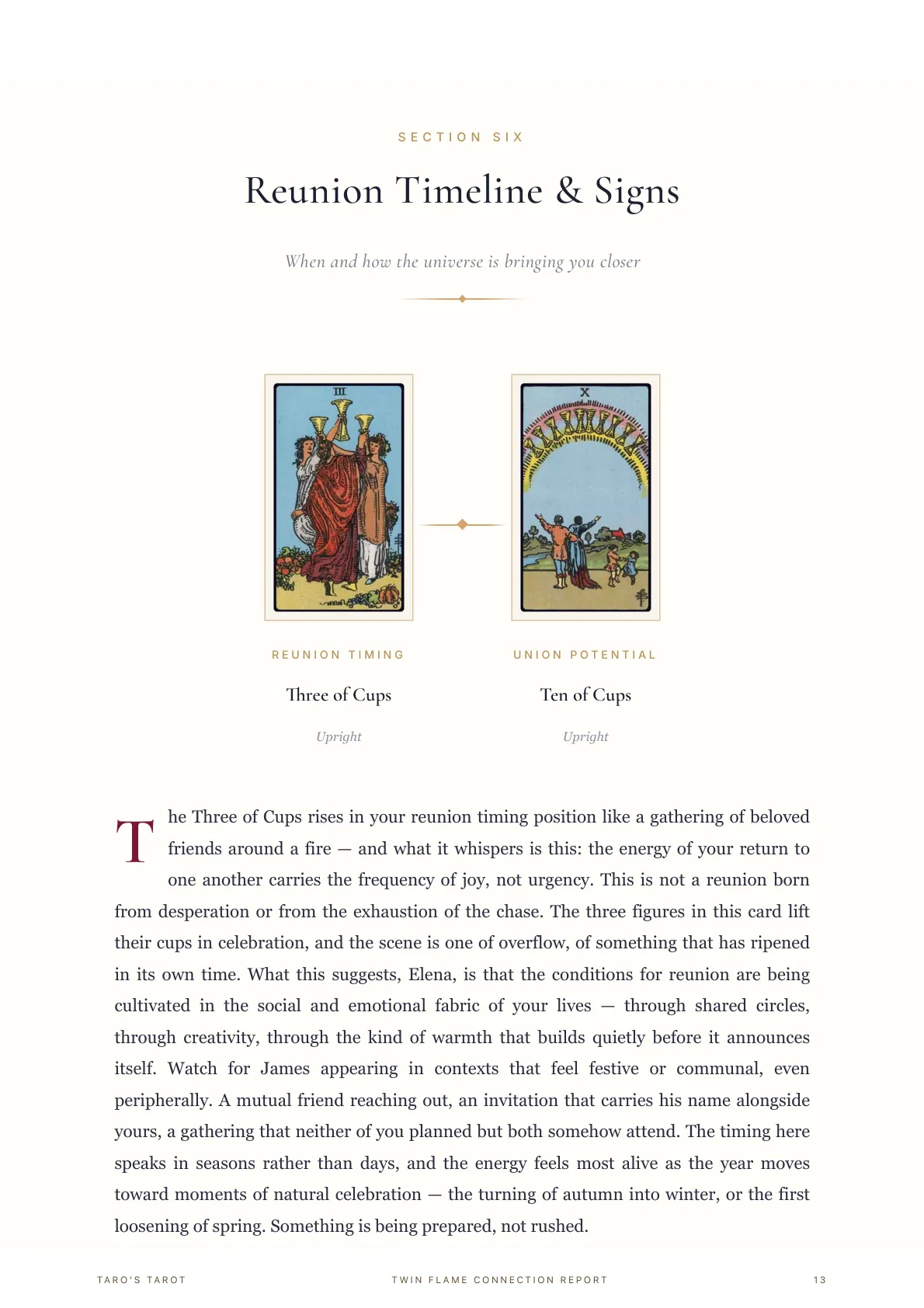
Sample pages from a real generated report — yours is written for you
$14.9930-day money-back guarantee — if your report doesn't feel genuinely specific to you, full refund, no questions asked.

Book
Twin Flames: The Honest Guide
The 8 stages, attachment theory, false twins, trauma bonds, and shadow work. Both frameworks, no fluff.
Get the Book — $14.99The Split Soul vs. Kindred Spirits
Two ancient concepts, often confused in modern spirituality
The confusion between twin flames and soulmates stems from their different philosophical origins. Understanding where each concept comes from illuminates why they describe fundamentally different experiences.
New to the concept? Start with our guide to what a twin flame is.
The Twin Flame Origin: Plato's Symposium
The twin flame concept traces back to Aristophanes' speech in Plato's Symposium (385 BCE), where he describes humans as originally spherical beings with four arms, four legs, and two faces. These powerful beings threatened the gods, who split them in half-condemning each half to wander the earth seeking their other half.
This is the foundational myth: one soul, divided, seeking reunion. The modern twin flame concept, codified by Elizabeth Clare Prophet in her 1984 book Soul Mates and Twin Flames, builds on this Platonic foundation, adding concepts like the "I AM Presence" and "Violet Flame" for transmuting karma that keeps twins apart.
The Soulmate Origin: Sympathetic Resonance
The soulmate concept is older and more widespread, appearing across cultures from ancient India to Celtic traditions. Rather than split souls, soulmates are understood as separate souls vibrating at similar frequencies-like tuning forks that resonate together.
This is why you can have many soulmates: your mother, best friend, mentor, or spouse can all be soulmates if your souls "harmonize." Soulmates don't complete you; they complement you. They're kindred spirits who've chosen to walk alongside you, not missing halves you need to survive.
The Core Distinction
At its simplest: twin flames share the same soul frequency (they ARE you). Soulmates share a compatible soul frequency (they MATCH you).
Twin Flame
The Same Soul, Split in Two
Twin flames are believed to be one soul in two bodies-a single consciousness experiencing itself through two perspectives. The connection is intense, transformative, and often turbulent because you're essentially confronting yourself.
•Only one per existence - Mathematics of the split soul allows for only one other half
•Triggers deep wounds - They mirror your shadow, forcing you to see what you've hidden from yourself
•Often involves separation - The intensity requires periods of individual healing
•Destabilizing at first - Your identity shifts when you meet yourself in another body
Soulmate
Kindred Spirits, Similar Frequency
Soulmates vibrate at a similar frequency and offer comfort. They're separate souls who resonate together-like instruments in harmony. The connection is supportive, stabilizing, and builds steadily over time.
•Multiple throughout life - Friends, lovers, family members can all be soulmates
•Soothes and supports - They accept you as you are while gently encouraging growth
•Can work through challenges together - Conflicts don't require separation to resolve
•Feels comfortable from start - Recognition comes as relief, not destabilization
The Attachment Theory Lens
What psychology reveals about these connection patterns
From a psychological perspective, the twin flame vs. soulmate distinction often maps onto attachment styles. This isn't to dismiss the spiritual reality-but understanding the psychology can help you navigate either connection more wisely.
Twin Flame Dynamic
Often mirrors the Anxious-Avoidant trap: one partner (the Chaser) has anxious attachment and pursues connection, while the other (the Runner) has avoidant attachment and withdraws from intensity.
This creates a self-perpetuating cycle where pursuit triggers withdrawal, and withdrawal triggers pursuit. The spiritual framework reframes this as "mirroring" and "soul growth."
Soulmate Dynamic
More likely to involve secure attachment or two people with compatible insecure styles that don't trigger each other's core wounds as intensely.
The stability of soulmate connections allows for what psychologists call a "secure base"-a relationship foundation from which both partners can explore, grow, and return to safety.
The Integration Point
Whether you view your connection through spiritual or psychological lenses, the goal is the same: earned secure attachment. Twin flames must heal their attachment wounds to reach harmonious union. Soulmates must maintain their secure foundation through life's challenges. Both paths lead to the same destination-two whole people choosing each other.
Detailed Comparison
Click each row to understand the deeper significance of these differences
Purpose
Twin Flame: Spiritual awakening, shedding ego, shared mission
Soulmate: Companionship, stability, mutual support
The fundamental difference lies in what each connection is "for." Twin flames exist to catalyze rapid spiritual growth through intensity and mirroring. Soulmates exist to provide the stable container within which you can build a life. Neither is superior-they serve different functions in the soul's journey.
How It Feels
Twin Flame: "I AM you" - intensity, terror, ecstasy
Soulmate: "I love you" - comfort, ease, friendship
The feeling signature is distinct. Twin flame recognition often comes with disorientation-like looking in a mirror you didn't know existed. Soulmate recognition feels like relief-finally finding someone who "gets" you. One destabilizes your identity; the other confirms it.
Conflict Style
Twin Flame: Existential triggering, reveals deep shadows
Soulmate: Normal disagreements, resolution strengthens bond
Twin flame conflicts cut to the bone because they mirror your own unhealed wounds. Fighting with your twin flame often feels like fighting with yourself. Soulmate conflicts, while painful, remain bounded-you're two separate people disagreeing, not one soul at war with itself.
How Many?
Twin Flame: Only one (according to most theories)
Soulmate: Many - friends, lovers, family members
If twin flames are "one soul split in two," mathematically there can only be one. Soulmates are souls who resonate at similar frequencies-you'll encounter many throughout your life. Your mother, best friend, or colleague could all be soulmates.
Outcome
Twin Flame: "Happily Ever Now" (after turmoil)
Soulmate: "Happily Ever After" (steady progression)
The twin flame journey is non-linear-expect cycles of union, separation, and reunion. The soulmate journey follows a more traditional arc of deepening connection over time. Twin flames must learn to be "present" in chaotic Now; soulmates can plan for a peaceful "After."
Recognition
Twin Flame: Soul remembering - you've known them before
Soulmate: Deep compatibility - you fit well together
Twin flame recognition often feels like "remembering" rather than meeting-an uncanny sense of having always known this person. Soulmate recognition is more about "fit"-discovering you share values, humor, life goals. One bypasses the mind; the other engages it.
Growth Pattern
Twin Flame: Rapid, intense, through crisis and mirroring
Soulmate: Gradual, supportive, through partnership
The twin flame path accelerates growth by forcing you to confront everything you've avoided. It's spiritual boot camp. The soulmate path supports steady growth through consistent love and acceptance. One grows you through fire; the other through nurture.
Separation
Twin Flame: Common - often necessary for individual growth
Soulmate: Less common - typically can work through issues together
Separation is almost structurally built into the twin flame journey-the intensity requires "cooling off" periods for individual healing. Soulmate separations, when they occur, are usually due to external circumstances rather than the nature of the connection itself.
Which Have You Met?
Answer these questions honestly about your connection. Notice which column resonates more deeply-not which you want to be true, but which actually describes your experience.
When you met, did it feel like...
Twin Flame: Remembering someone you've always known-recognition that bypassed logic
Soulmate: Finding someone who really understands you-relief at being truly seen
Twin flame recognition is often described as "impossible to explain." Soulmate recognition makes sense to you and others.
Does being with them make you...
Twin Flame: Confront your deepest wounds and shadows-they mirror what you've hidden
Soulmate: Feel safe, supported, and accepted-they create space for you to be yourself
Twin flames trigger growth through discomfort. Soulmates support growth through security.
Has the connection...
Twin Flame: Triggered a spiritual awakening or complete life upheaval
Soulmate: Added stability, happiness, and support to your existing life
Twin flames often appear at inflection points, forcing change. Soulmates often stabilize periods of growth.
During conflict, do you feel...
Twin Flame: Like your entire identity is being challenged-existential anxiety
Soulmate: Like you can work it out with communication-problems feel solvable
Twin flame conflicts feel "life or death" because identity is at stake. Soulmate conflicts remain bounded.
When the Labels Become Harmful
Important distinctions for your emotional safety
The Limerence Trap
Limerence is obsessive infatuation characterized by intrusive thoughts, emotional dependency on reciprocation, and anxiety when uncertain of the other person's feelings. It's often mistaken for twin flame connection.
The test: True twin flame energy, while intense, should ultimately lead to expansion-creativity, self-improvement, spiritual growth. Limerence leads to contraction-anxiety, obsession, loss of self. If you can't function, constantly check their social media, and are losing yourself entirely-that's likely limerence, not divine connection.
Justifying Toxic Behavior
The "twin flame" label is sometimes used to justify staying in relationships that are abusive, neglectful, or simply incompatible. "They're triggering my shadow" becomes an excuse for tolerating disrespect.
The reality check: Spiritual connection doesn't excuse 3D bad behavior. A true twin flame may trigger your wounds, but they don't create new ones through abuse. If someone consistently makes you feel worthless, that's not mirroring-that's harm.
Cult Group Warning
Some groups, like the controversial "Twin Flames Universe," have been accused of using the twin flame concept to control members-pressuring them to pursue specific individuals, change their gender identity to "fit" the dynamic, or cut ties with family. This is spiritual abuse.
Red flags: Any group that demands payment for "reunion," tells you exactly who your twin flame is, or suggests you must do specific things (like transitioning gender) to achieve union is exploiting the concept. True spiritual guidance empowers your discernment-it doesn't override it.
Can You Have Both?
Yes. And many spiritual teachers suggest this is common-even ideal.
A soulmate is often described as the "reward" for a life well-lived-offering a peaceful, stable partnership that supports your daily existence. A twin flame is a specific "assignment" for rapid soul evolution through intensity and mirroring.
Many people choose a soulmate partner for marriage and family while maintaining a spiritual (sometimes only energetic/5D) connection to their twin flame. This isn't "settling"-it's wisdom. The person who helps you build a life may not be the person who catalyzes your spiritual awakening, and that's okay.
The key insight: Don't reject a beautiful soulmate relationship while chasing an unavailable twin flame. A present, loving partner who supports your growth can be far more valuable than a destined connection that causes endless suffering. The goal is growth and love-not a specific person or label.
Scenario 1
You meet your twin flame, do the work, reach union, and build a life together. The twin flame becomes your soulmate-like partner after the intensity stabilizes.
Scenario 2
You meet your twin flame, catalyze each other's growth, but remain apart. You marry a soulmate and maintain a spiritual connection to your twin on the energetic plane.
Scenario 3
You never meet your twin flame (or they're not incarnated). You build a beautiful life with soulmate partners and experience profound growth through those connections.
“A soulmate teaches you that love can be safe. A twin flame teaches you that growth can be uncomfortable. Both are real, both are valid, but confusing one for the other leads to either settling for less or enduring more pain than any connection should require.”
Twin Flame vs Soulmate FAQ
Common questions about these soul connections
Can someone be both my twin flame and soulmate?
They're distinct concepts in spiritual literature. Twin flames are believed to be the same soul split in two-there's only one. Soulmates are kindred spirits who share similar vibrations-you can have many. However, a twin flame in harmonious union might FEEL like the ultimate soulmate because you've done the work to achieve ease. The relationship can evolve from turbulent twin flame dynamics into peaceful soulmate-like partnership once both individuals have healed their core wounds. Learn more about the 8 stages of twin flame union.
Which is better: twin flame or soulmate?
Neither is "better"-they serve different purposes in your soul's evolution. Soulmates offer stability, comfort, and partnership that supports a happy life. Twin flames offer intense growth and spiritual transformation that accelerates your evolution. Many people choose soulmates for marriage and family while maintaining a spiritual connection to their twin flame. A peaceful soulmate relationship can be more fulfilling than a chaotic twin flame dynamic. The "better" connection is whichever supports your growth without destroying your peace.
How do I know which one I've met?
Ask yourself: Does this person CHALLENGE me to grow through discomfort (twin flame) or SUPPORT me through companionship (soulmate)? Twin flame meetings are destabilizing and intense-your life shifts on its axis. Soulmate meetings feel like relief and comfort-you've found your person. Twin flames trigger your wounds; soulmates soothe them. Review our guide to twin flame signs for detailed recognition patterns.
Can I marry my twin flame?
Yes, if you reach harmonious union (Stage 8). But many twin flame connections involve significant separation, and union isn't guaranteed in this lifetime. Some people marry soulmates while their twin flame remains a spiritual connection. There's no "should"-it depends on both twins' growth and choices. Marriage to a twin flame requires both partners to have completed substantial shadow work; otherwise, the intensity that once felt magical becomes unbearable in daily life.
What if my twin flame is with someone else?
This is common during the runner/chaser phase. Twin flames often enter "karmic" relationships during separation-relationships that teach lessons needed before union is possible. Your twin being with someone else doesn't negate the connection, but it does mean union isn't available right now. Focus on your own growth rather than waiting. Warning: Don't use "they're my twin flame" to justify pursuing someone in a committed relationship. Free will is paramount.
Do I need to find my twin flame to be happy?
Absolutely not. Many people live fulfilling, spiritually rich lives with soulmate partners or alone. The twin flame narrative can become toxic if it makes you reject good relationships while waiting for "the one." A loving soulmate who's present and committed is often more valuable than an unavailable twin flame. Beware of using the twin flame concept to avoid intimacy or reject partners who could make you happy. The goal is growth and love-not a specific person.
What's the difference between twin flame and limerence?
This is crucial to understand. Limerence is obsessive infatuation fueled by uncertainty and intermittent reinforcement-the classic "hot and cold" dynamic. A true twin flame connection, while intense, should lead to expansion: creativity, self-improvement, spiritual growth. Limerence leads to contraction: anxiety, obsession, loss of self. If you're unable to function, constantly checking their social media, and losing yourself entirely-that's likely limerence, not divine connection. See false twin flame signs.
Can soulmates become romantic partners?
Yes-most happy marriages are likely between soulmates, not twin flames. Soulmate romantic partnerships offer what many people actually want from love: companionship, shared values, mutual support, and growing old together. The soulmate romantic relationship doesn't have the dramatic intensity of twin flames, but it has something perhaps more valuable: sustainability. Many spiritual teachers suggest soulmate partnerships are the "reward" for lives well-lived.
Still have questions? We're here to help!
Contact Support →Try Our Free Spiritual Calculators
Get deeper insights with our interactive tools