The Origins of the Twin Flame Concept
The contemporary twin flame narrative isn't a spontaneous invention of the internet age-it's a resurgence of ancient ideas, reframed for modern seekers. The foundational myth traces back to Plato's Symposium (circa 385 BCE), in which the character Aristophanes suggests that humans were originally spherical beings with two faces and four limbs. The gods, threatened by human power, split these beings in half, condemning them to roam the earth searching for their other half.
This "split soul" theory was adopted and refined by 19th and 20th-century esoteric movements, particularly Theosophy. The modern understanding was largely codified by Elizabeth Clare Prophet in her 1999 book Soul Mates and Twin Flames, which introduced concepts like the "I AM Presence" and the "Violet Flame" as tools for transmuting the karma that keeps twins apart. Prophet shifted the narrative from mere romance to a high-stakes spiritual mission.
Today, the twin flame concept has exploded via social media, particularly TikTok and YouTube, where "Pick a Card" tarot readings generate massive engagement. The narrative appeals to a collective longing for destined love in an era of dating app fatigue. However, this democratization has fragmented definitions-"twin flame" is sometimes used interchangeably with "intense ex" or "obsessive crush," necessitating the rigorous framework below.
New to the concept? Start with our guide to what a twin flame is.
Understanding the Twin Flame Journey
Unlike the concept of a "soulmate," which implies compatibility and ease, the twin flame model is predicated on spiritual evolution through turmoil. The path is often described as non-linear or spiral-meaning couples may revisit stages at higher octaves of consciousness as they peel back successive layers of ego.
The Eight Stage Model presented here is the most widely cited framework, appearing in various iterations across major spiritual publishers and ranking content. While individual experiences vary, the stages represent archetypal patterns that most twin flame connections navigate.
A Critical Distinction
If a connection leaves you depleted, isolated, or tolerating abuse, it may be a false twin flame or karmic relationship. True twin flames challenge you to grow-they don't destroy you. The "twin flame" label should never justify staying in harmful dynamics. Be especially wary of groups or teachings that demand money, isolation, or extreme measures to achieve "Union."
🔥
A Weekly Card for Your Journey
One card each Sunday to guide your path and the week ahead.
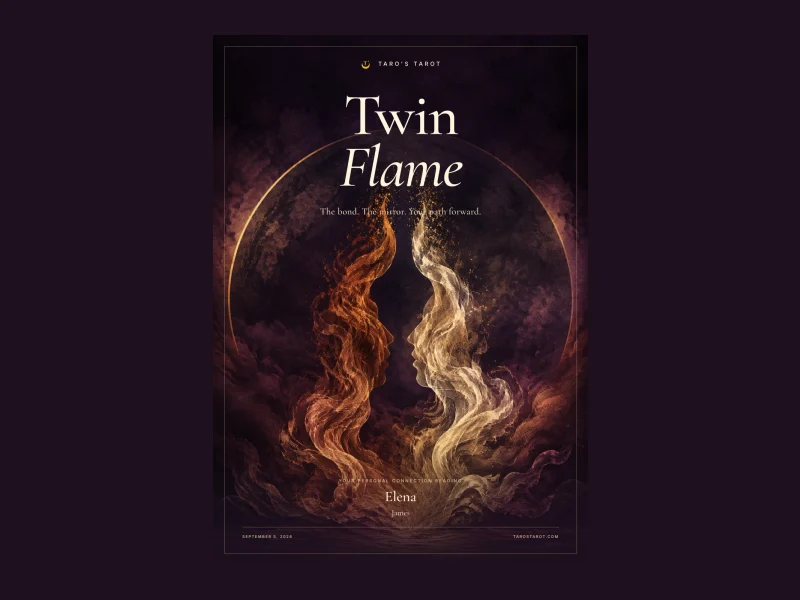
Inside the report: The Runner-Chaser Dynamic
Why do they keep pulling away?
The Tower card in the Runner position is a powerful indicator that Jordan's separation isn't rejection — it's a spiritual crisis. They're not running from you; they're running from the intensity of a connection that demands they dismantle every wall they've ever built...

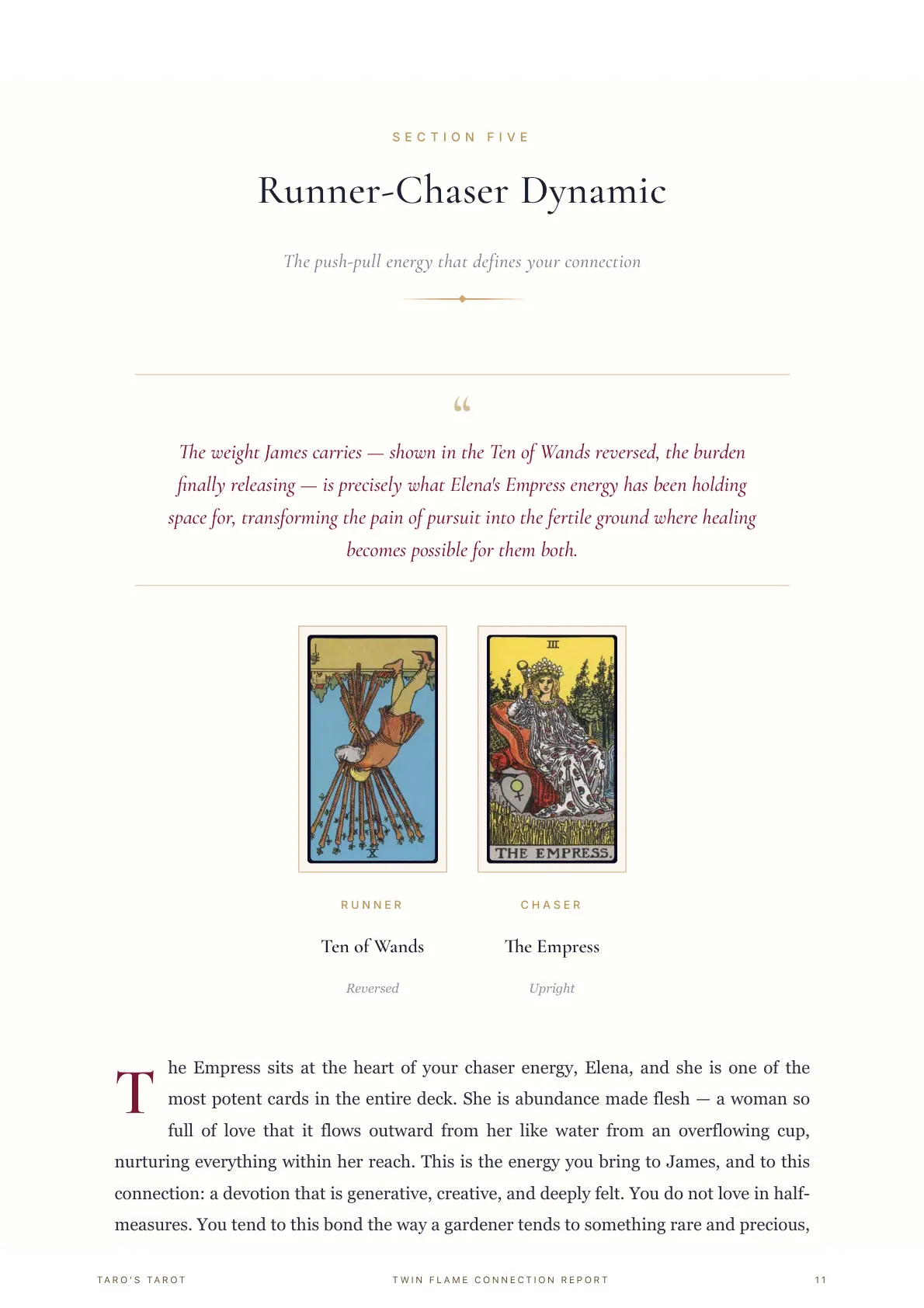
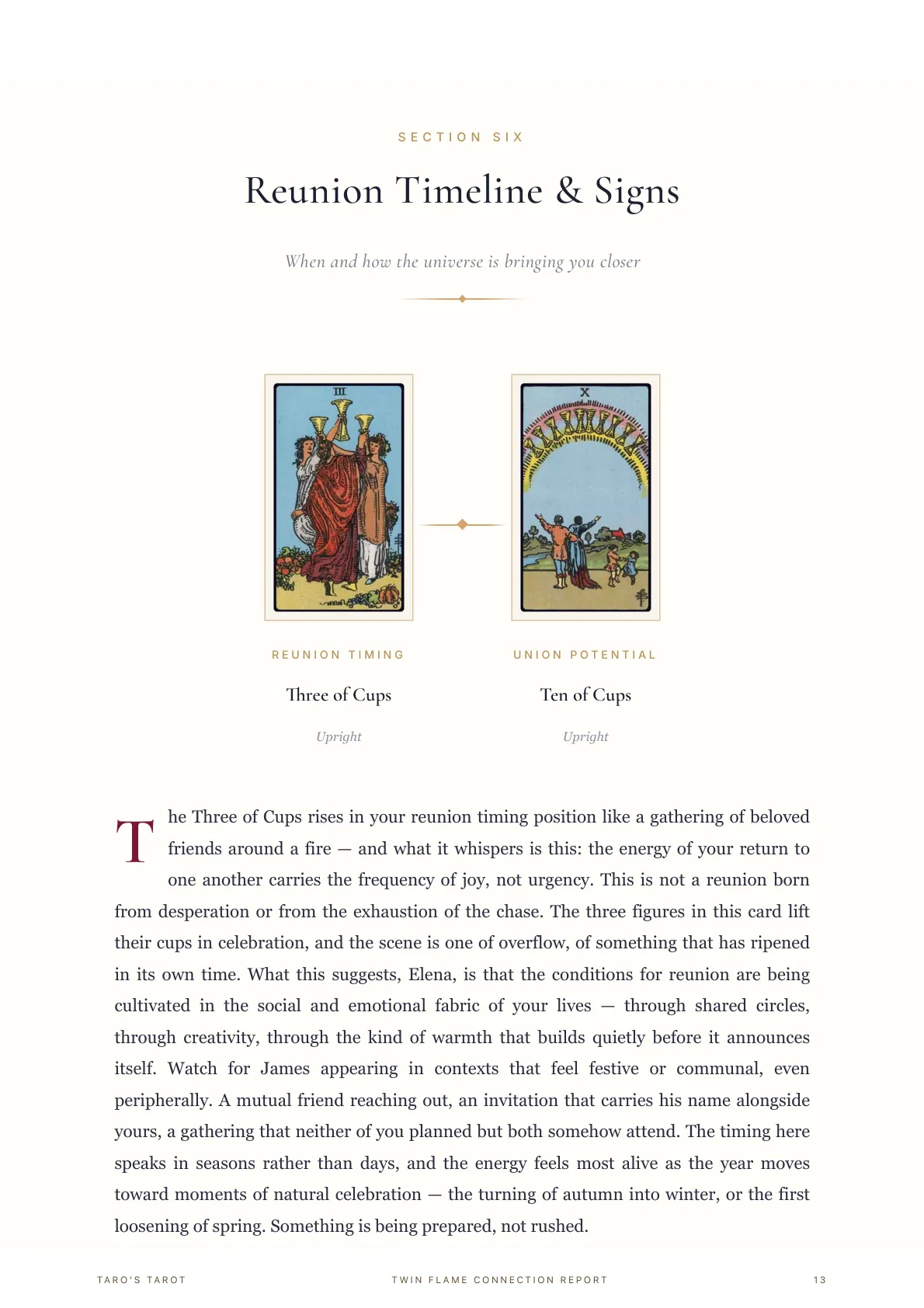
Sample pages from a real generated report — yours is written for you
$14.9930-day money-back guarantee — if your report doesn't feel genuinely specific to you, full refund, no questions asked.

Book
Twin Flames: The Honest Guide
The 8 stages, attachment theory, false twins, trauma bonds, and shadow work. Both frameworks, no fluff.
Get the Book — $14.99The Complete Twin Flame Journey
1
The Yearning
Preparation Phase
This stage occurs before you physically meet your twin flame. It's characterized by an unshakable sensation of incompleteness and a magnetic pull toward an unknown destination. During The Yearning, individuals often undergo what mystics call a "dark night of the soul"-a period of existential crisis that paradoxically prepares the psyche for the intensity ahead.
The Yearning is the soul's wake-up call, signaling that the monad (the unified soul in Theosophical terms) is preparing for division and eventual reunion in the physical plane. You may find yourself abruptly losing interest in superficial relationships, changing career paths, or feeling driven to resolve karmic debts. There's a subconscious "clearing of the decks" to create energetic space for the high-frequency connection. Many report vivid dreams of a faceless lover, increasing synchronicities (especially 11:11), and a persistent feeling that "something big is coming." This phase can last years or decades, depending on the individual's spiritual maturity and readiness.
Signs You're in This Stage:
- •Persistent feeling that "something big is coming"
- •Vivid, recurring dreams of an unknown lover
- •Increasing synchronicities, especially 11:11
- •Sudden loss of interest in superficial relationships
- •Unexplained urge to heal childhood wounds
- •Major life changes without clear external cause
2
The Awakening
The Encounter
This is the "Event Horizon"-the moment the two individuals meet in the physical dimension. It's rarely a lukewarm introduction. Instead, it's often described as a "recognition" or "remembering" rather than a first meeting. The connection is immediate and destabilizing, initiating what's known as the "bubble phase."
During The Awakening, twins enter a temporary suspended reality where time seems to collapse-hours feel like minutes in each other's presence. The attraction transcends the purely sexual; individuals report feeling their chakras activate with tingling sensations or heat in the presence of the other. Eye contact often feels like looking into a mirror of the soul. The scientific explanation involves neurochemistry-dopamine, oxytocin, and phenylethylamine flooding the brain-but experiencers describe something beyond chemistry: a sense of soul-level familiarity that defies rational explanation. This phase typically involves uncanny coincidences surrounding how you met, an immediate feeling of "home" or safety, and a sense that you've known this person across multiple lifetimes.
Signs You're in This Stage:
- •Intense, destabilizing recognition upon meeting
- •Immediate feeling of "coming home"
- •Uncanny coincidences surrounding the meeting
- •Physical sensations: heart racing, chakra activation
- •Time distortion when together
- •Instant trust despite being strangers
3
The Testing
Reality Sets In
As the euphoria of the meeting stabilizes, the reality of the "Soul Contract" sets in. The twins begin to explore the landscape of their connection, often realizing that while they share a core soul frequency, their human lives-timelines, existing relationships, geography, age gaps-may be radically incompatible.
This stage is where the "Mirror Effect" begins to activate in earnest. Unlike a soulmate who soothes your wounds, the twin flame provokes them. Their presence illuminates your insecurities, unhealed trauma, and shadow self with uncomfortable precision. Psychologically, this mirrors what Carl Jung called the process of individuation-the integration of unconscious content into conscious awareness. You may discover telepathic links (thinking of them the moment they text), shared past-life memories, or what attachment theorists call "complementary traumas"-for example, one partner with abandonment wounds attracting another with engulfment fears. This stage involves negotiating boundaries and testing whether the connection can survive the weight of real-world complications.
Signs You're in This Stage:
- •Discovery of telepathic or empathic links
- •Surfacing of past-life memories together
- •"Complementary traumas" become visible
- •Real-world incompatibilities emerge
- •First ego-triggers and minor conflicts
- •Testing each other's commitment
4
The Honeymoon
Glimpse of Union
This stage is a temporary period of harmony that serves as a "teaser trailer" for the final Union. It shows the twins what's possible if they do the necessary inner work. Sexual and emotional chemistry reaches its peak, and couples often feel invincible together.
During the Honeymoon phase, the couple may experience heightened states of consciousness-creativity flows, synchronicities multiply, and there's a sense of spiritual bliss that feels almost drug-induced (without substances). You might feel "high" constantly, see each other's names everywhere, or experience what some describe as a "merging of identities." However, spiritual teachers warn that this high is often "unrealistically high"-unsustainable without the foundational shadow work that comes later. The Honeymoon serves a purpose: it provides a visceral experience of what harmonious union could feel like, giving you something to remember during the darker phases ahead. But it typically ends when the accumulated baggage of past trauma can no longer be suppressed.
Signs You're in This Stage:
- •Feeling "high" without any substances
- •Intense synchronicities everywhere
- •Sense of merging identities
- •Peak creative and spiritual output
- •Feeling invincible as a couple
- •Others comment on your "glow"
5
The Crisis
The Breakdown
This is the pivotal turning point of the twin flame journey. The intensity of the mirror becomes intolerable for the ego. The accumulated baggage of past trauma, societal conditioning, and fear of intimacy surfaces explosively-often triggered by what seems like a trivial event.
In tarot terms, this is "The Tower" moment-structures built on unstable foundations must collapse. Arguments may erupt over trivial matters that serve as proxies for deep-seated fears. The partner with anxious attachment (often the future "Chaser") may try to cling tighter, while the partner with avoidant attachment (the future "Runner") begins pulling away to preserve their sense of self. What's actually happening is that the ego is fighting for survival. The twin flame connection demands ego death-a surrendering of the false self that has been constructed over a lifetime. Most egos aren't ready for this dissolution, leading to the explosive breakdown that characterizes this stage. Physical symptoms are common: anxiety, panic attacks, insomnia, and the feeling of "walking on eggshells."
Signs You're in This Stage:
- •Arguments erupting over trivial matters
- •Anxiety and panic attacks
- •Feeling of "walking on eggshells"
- •One partner begins pulling away
- •Ego defenses activate intensely
- •Sense that something fundamental must change
6
Runner/Chaser
The Separation
The most documented and painful stage of the twin flame journey. One twin flees the connection to protect their ego (the Runner), while the other pursues (the Chaser). This dynamic is the externalization of an internal split between the ego and the soul.
From a psychological perspective, the Runner/Chaser dynamic maps almost perfectly onto the Anxious-Avoidant trap described in attachment theory. The Runner is typically Dismissive-Avoidant-intimacy feels like a loss of autonomy, and the intensity of the twin flame bond triggers a primal "DANGER: Loss of Self" response in their nervous system. They may rationalize their flight with logic ("We live too far apart," "I'm not ready") and often enter "karmic" relationships or bury themselves in work to numb the connection. The Chaser, typically Anxious-Preoccupied, suffers what mystics call the "Dark Night of the Soul." The Runner's withdrawal confirms their core wound: "I am not loveable; people always leave." They become obsessed with seeking answers through psychics, tarot, and endless research-anything that explains the inexplicable. This stage is crucial because it's where the real work happens: the Chaser must learn wholeness independent of the twin; the Runner must learn that intimacy isn't annihilation.
Signs You're in This Stage:
- •Physical separation: ghosting, blocking, distance
- •Runner enters distracting relationships or work
- •Chaser obsessively seeks answers
- •"Dark Night of the Soul" for the Chaser
- •Both experience spiritual depression
- •The dynamic seems impossible to break
7
The Surrender
The Shift
The dynamic shifts when the Chaser stops chasing. They realize that the pursuit is pushing the Runner away and that the true journey is inward. Focus shifts from "we" to "me." This isn't giving up-it's releasing attachment to outcome.
Surrender is perhaps the most misunderstood stage. It doesn't mean giving up on the connection; it means releasing the desperate grasp that perpetuates separation. The Chaser engages in what Jung called "Shadow Work"-identifying and integrating the rejected parts of themselves that the Runner's presence illuminated. They begin healing their abandonment wounds independently of the twin. The paradox is that as the Chaser withdraws their energetic "grasp," the Runner often stops running. No longer feeling hunted, their nervous system can finally relax. However, surrender cannot be faked as a strategy to get the Runner back-the universe (or the subconscious) sees through manipulation. It must be genuine: "I love you, but I love myself more. I release the outcome." Signs of true surrender include sudden peace, return of joy independent of the twin's presence, and the ability to imagine a fulfilling future alone.
Signs You're in This Stage:
- •Sudden, unexpected feeling of peace
- •Release of obsessive thinking
- •Joy returns, independent of twin's presence
- •Focus shifts entirely to self-healing
- •Ability to imagine happy future alone
- •Paradoxically, Runner often reaches out
8
Harmonious Union
The Reunion
The return to oneness. This is not just a romantic reconciliation but a spiritual merger. The twins come together as two whole, healed individuals to fulfill a "shared mission" of service to others.
Harmonious Union represents the completion of the hero's journey-but it's a beginning, not an ending. The couple becomes what some call a "power couple," their combined energy greater than the sum of its parts. The relationship is characterized by a notable lack of drama, deep telepathic understanding, and a focus on external service rather than just interpersonal romance. Many twin flame couples in union launch joint ventures: healing centers, creative projects, humanitarian work, or teaching. The focus turns outward because the internal work has been done. However, it's crucial to note that not everyone reaches this stage. Free will is paramount. If one twin refuses to evolve-remains "asleep" or unwilling to do the inner work-the awakened twin may have to move on, possibly to a soulmate relationship, while maintaining the twin connection only in the spiritual (5D) plane. Union requires both twins to choose growth.
Signs You're in This Stage:
- •Lack of drama or toxic patterns
- •Deep telepathic understanding
- •Focus on shared mission and service
- •Synchronicities confirming union (1111, 222)
- •Others seek your guidance as a couple
- •Relationship feels like "coming home" permanently
The Psychology Behind the Stages
While the twin flame journey is often framed in spiritual terms, it maps remarkably well onto established psychological concepts. Understanding this dual lens-spiritual and psychological-provides a more complete picture of what's actually happening.
Attachment Theory
The Runner/Chaser dynamic almost perfectly mirrors the Anxious-Avoidant relationship trap. Runners typically exhibit Dismissive-Avoidant attachment (valuing independence, fearing engulfment), while Chasers show Anxious-Preoccupied attachment (fearing abandonment, seeking proximity). The twin flame journey can be understood as a forced confrontation with attachment wounds that might otherwise remain unconscious.
Jungian Shadow Work
The "mirroring" phenomenon-where your twin reflects your deepest insecurities-aligns with Carl Jung's concept of the Shadow: the rejected parts of self that we project onto others. The twin flame journey forces integration of the Shadow, which Jung considered essential for psychological wholeness (individuation).
Limerence vs. Love
It's crucial to distinguish twin flame connection from limerence-obsessive infatuation characterized by intrusive thinking and emotional dependency on reciprocation. Limerence drains and diminishes; true twin flame love, while painful, ultimately expands and transforms. If the connection is leading to stagnation and self-destruction rather than growth, it may be limerence masquerading as destiny.
Angel Numbers at Each Stage
In the twin flame framework, repeating number sequences are believed to be communications from the universe, validating your stage in the journey.
11:11
Awakening & Recognition
Stages 1-2
The "twin flame code." Signals initial awakening or that your twin is thinking of you.
222
Trust the Process
Stages 5-6
Reassurance during Runner/Chaser. The two halves are coming into alignment despite appearances.
333
Ascended Master Support
Dark Night
Higher spiritual beings are overseeing your connection. Protection during the hardest moments.
444
Foundation & Protection
Stage 7
Your connection has solid spiritual foundation. Grounding energy when you want to give up.
555
Major Change Coming
Transitions
Significant shift approaching-could be separation beginning or reunion imminent.
777
You're On the Right Path
Stage 7-8
Confirmation that the pain serves purpose. Reunion is being orchestrated behind the scenes.
Dive Deeper Into Your Journey
“The twin flame journey has eight stages, but they're not a ladder you climb once. Most people cycle through crisis, runner-chaser, and surrender multiple times before reaching union. Understanding where you are matters more than how fast you get through it.”
Twin Flame Stages FAQ
Common questions about the journey
Are the twin flame stages always in this exact order?
The journey is often described as non-linear or spiral-meaning you may revisit stages at higher octaves of consciousness. Some couples cycle through Crisis and Runner/Chaser multiple times before achieving genuine Surrender. The Eight Stage Model is the most widely cited framework in twin flame literature, appearing across major spiritual publishers, but individual experiences vary. Think of it as a map rather than a rigid rulebook-the terrain is real, but your path through it may wind differently than others.
How long does each twin flame stage last?
There's no universal timeline, which is one of the most frustrating aspects of the journey. The Yearning phase can last years or even decades before the meeting occurs. The Honeymoon is typically the shortest-weeks to a few months before reality intrudes. The Runner/Chaser stage is usually the longest and most painful, potentially lasting months, years, or in some cases, entire lifetimes. The key insight: stages end when the energy shifts, not when time passes. You cannot wait your way to Union-you must work your way there through genuine inner transformation.
Can you skip twin flame stages?
Generally, no-each stage serves a specific purpose in spiritual evolution. However, twins who have done significant prior healing work (through therapy, previous relationships, or spiritual practice) may move through early stages more quickly. The Crisis and Runner/Chaser stages seem unavoidable for most couples because they represent the core curriculum of the twin flame experience: ego dissolution and the development of unconditional love. Attempting to skip these stages usually results in cycling back through them later, often with greater intensity.
How do I know what stage I'm in?
Self-assessment clues: If you haven't met them yet but feel a strong pull toward "someone," you're likely in Yearning. If you're experiencing the high of new connection, that's Awakening or Honeymoon. If you're in intense pain from separation and obsessing over their return, you're in Runner/Chaser. If you feel genuinely peaceful about the outcome while focusing entirely on your own growth, you've entered Surrender. If you're together without drama, focused on shared purpose, you've reached Union. Our twin flame calculator can provide additional numerological insights into your connection.
Does everyone reach the Union stage with their twin flame?
No-and this is a crucial truth that much twin flame content glosses over. Free will is paramount in this journey. If one twin refuses to evolve, remains spiritually "asleep," or simply chooses not to do the inner work required, Union in this lifetime may not occur. Some twins maintain only a 5D (spiritual/energetic) connection while living separate 3D lives, sometimes with different partners. Awakened twins often eventually choose loving soulmate relationships rather than waiting indefinitely for a twin who may never be ready. This isn't failure-it's wisdom.
What's the difference between the Crisis and Runner/Chaser stages?
The Crisis is the breaking point-the explosive surfacing of unhealed trauma that makes the current dynamic unsustainable. It's often a single event or short period of intense conflict. Runner/Chaser is what happens after: one twin physically leaves (runs) while the other pursues (chases). Think of Crisis as the bomb going off and Runner/Chaser as the aftermath-the extended period of separation and longing that follows. Crisis can be sudden; Runner/Chaser is prolonged. Both are necessary: Crisis reveals what must be healed; Separation provides the space to heal it.
Is the twin flame journey the same as trauma bonding?
This is an important distinction. Genuine twin flame connections, while intense and sometimes painful, ultimately lead to growth, expansion, and becoming a better version of yourself. Trauma bonds lead to shrinking, stagnation, and loss of self. The key test: does this connection make you want to become better (true twin flame) or does it make you want to disappear (trauma bond or false twin flame)? If you're tolerating abuse, manipulation, or consistent cruelty under the label of "twin flame," reconsider whether the label applies. Spiritual concepts should never justify harm.
Still have questions? We're here to help!
Contact Support →Try Our Free Spiritual Calculators
Get deeper insights with our interactive tools