🔥
A Weekly Card for Your Journey
One card each Sunday to guide your path and the week ahead.

Inside the report: The Runner-Chaser Dynamic
Why do they keep pulling away?
The Tower card in the Runner position is a powerful indicator that Jordan's separation isn't rejection — it's a spiritual crisis. They're not running from you; they're running from the intensity of a connection that demands they dismantle every wall they've ever built...


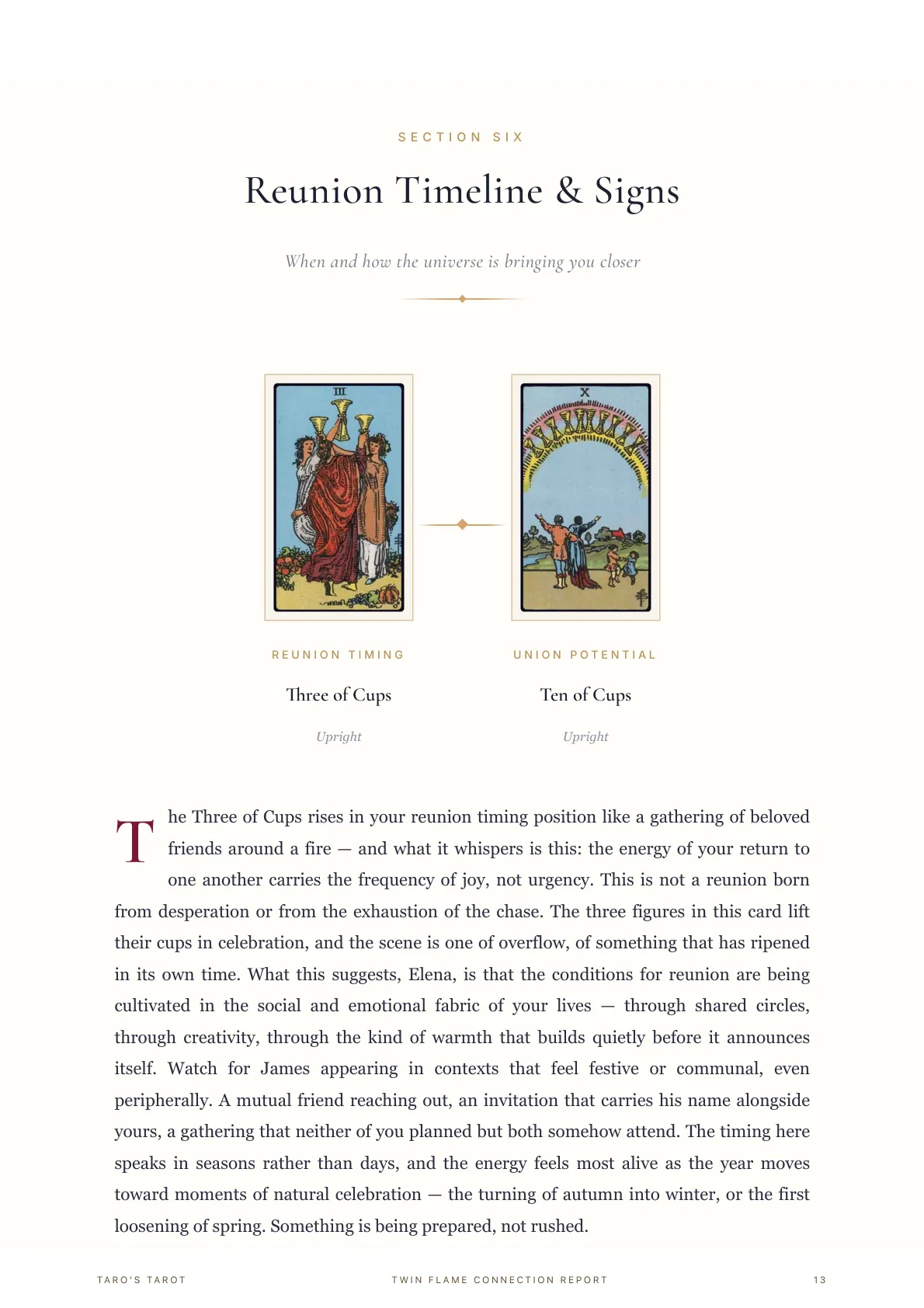
Sample pages from a real generated report — yours is written for you
$14.9930-day money-back guarantee — if your report doesn't feel genuinely specific to you, full refund, no questions asked.

Book
Twin Flames: The Honest Guide
The 8 stages, attachment theory, false twins, trauma bonds, and shadow work. Both frameworks, no fluff.
Get the Book — $14.99Why Does Separation Happen?
The energetic and psychological purpose of this painful phase
Separation isn't punishment, bad luck, or proof that the connection wasn't real. It's a structural requirement of the twin flame journey. Understanding WHY separation happens helps you navigate it with more grace.
Energetic Repulsion
When two people merge energy before they've healed individually, the intensity "blows the fuses" of the unhealed ego. If one twin vibrates in fear/lack (the Chaser, desperately pursuing) and the other in fear/avoidance (the Runner, desperately fleeing), they cannot hold harmonious frequency together.
The law of attraction, in this framework, means they will repel each other until their frequencies align. Separation forces individual "calibration"-the Chaser must learn wholeness alone, the Runner must learn safety in intimacy. Only then does reunion become possible.
What Separation Actually Heals
For the Chaser:
- • Codependency patterns
- • Seeking worth through others
- • Abandonment wounds
- • Inability to self-soothe
For the Runner:
- • Fear of intimacy
- • Avoidant attachment patterns
- • Engulfment wounds
- • Emotional suppression
The Four Stages of Separation
These stages are not strictly linear-you may cycle through them multiple times. The goal is progression: each cycle shorter, each passage less intense.
Stage 1
Devastation
Soul Shock
The immediate aftermath of separation. Your energetic system goes into shock. It's not just heartbreak-it's like losing half of yourself.
Soul Shock is recognized in the spiritual community as a specific phenomenon distinct from ordinary heartbreak. Where normal breakup grief follows a predictable emotional pattern, Soul Shock manifests physically: your autonomic nervous system goes into dysregulation because the energetic bond you shared is being forcibly severed. This is why the symptoms-inability to eat, sleep disturbance, chest pain-are so intense. Your body is registering a trauma that your mind hasn't fully processed yet. The intensity of this stage is actually evidence of the authenticity of your connection; shallow bonds don't produce this level of systemic disruption.
What You're Experiencing:
- •Physical withdrawal symptoms (similar to drug withdrawal)
- •Inability to eat or sleep normally
- •Chest pain and heart palpitations
- •Feeling like you can't breathe
- •Disbelief and denial-"this can't be happening"
- •Uncontrollable crying that comes in waves
What to Know:
This is Soul Shock-your energetic system reacting to the split. It's not weakness; it's the biological reality of twin flame separation. Your nervous system was attuned to another person's frequency, and now that frequency is absent. Let yourself grieve without judgment. This stage, while excruciating, is finite.
Stage 2
The Quest
Obsessive Seeking
Desperate need to understand WHY. You become obsessed with twin flame content, psychic readings, tarot, anything that explains what happened.
The Quest is your mind's attempt to regain control over something that feels fundamentally uncontrollable. The rational brain cannot process the twin flame experience-it's too intense, too "impossible"-so you seek frameworks that make sense of it. This is why twin flame content is so compelling during separation: it provides a narrative structure for chaos. The danger is that The Quest can become an avoidance mechanism. Instead of feeling the grief of Stage 1, you intellectualize it. Instead of doing your own inner work, you outsource your healing to psychics who tell you what you want to hear. Some time in The Quest is healthy and necessary. Years in The Quest is spiritual bypass.
What You're Experiencing:
- •Googling "twin flame" for hours daily
- •Getting multiple psychic readings seeking confirmation
- •Watching endless hours of tarot pick-a-cards
- •Reading every article and book on the topic
- •Seeking evidence they'll return rather than processing the loss
- •Analyzing every detail of the relationship for "signs"
What to Know:
Some seeking is natural and healthy-understanding what you're experiencing helps. But The Quest can become a trap. Seeking answers is healthy; obsessive seeking is avoidance of grief. Set time limits: one hour of twin flame content per day max. The answers you need are within, not in another YouTube video.
Stage 3
The Anger
Spiritual Disillusionment
Realization that spiritual "perfection" doesn't excuse 3D bad behavior. Anger at them, at the connection, at yourself for believing.
The Anger stage is crucial and often undervalued in spiritual communities that emphasize "love and light." This stage represents the return of your self-worth. You begin to see that "spiritual connection" doesn't justify poor treatment, that "they're running because they feel so much" doesn't excuse ghosting, that "it's part of the journey" doesn't make their choices okay. This is healthy differentiation. You're learning to hold BOTH truths: the connection may be real AND their behavior may have been unacceptable. The spiritual bypass is to skip this stage, to "forgive" prematurely before you've allowed yourself to be angry. Unexpressed anger turns inward and becomes depression. Let yourself be angry.
What You're Experiencing:
- •Rage at their treatment of you
- •Questioning whether any of it was real
- •Anger at the spiritual community for enabling toxicity
- •Feeling foolish for believing in "destiny"
- •Considering rejecting twin flame concepts entirely
- •Blaming yourself for allowing the suffering
What to Know:
This anger is healthy, necessary, and a sign of healing. It means you're recognizing your worth. The spiritual nature of a connection doesn't make mistreatment acceptable. You can acknowledge the authenticity of the bond while still holding them accountable for their choices. These are not contradictions.
Stage 4
The Surrender
Acceptance
Accepting the separation as necessary. Not giving up on them, but releasing attachment to outcome. "I love you, but I love myself more."
Surrender is the most misunderstood stage. It's NOT giving up, forcing yourself to stop caring, or pretending you're "over it." True surrender is releasing your grip on the outcome while staying open to the connection. It's "I love you AND I love myself enough to build a beautiful life regardless of whether you return." Paradoxically, this energy shift is often what precedes reunion-but it only works if it's genuine, not strategic. You can't fake surrender to manifest reunion; that's just chasing with extra steps. Real surrender comes when you genuinely don't need them to return to be happy. Your happiness stops being contingent on their choices.
What You're Experiencing:
- •Peace with uncertainty about the outcome
- •Focus returns to your own life and growth
- •Joy independent of their presence or absence
- •Release of obsessive thinking patterns
- •Ability to imagine a happy future alone or with someone else
- •Gratitude for the lessons, even the painful ones
What to Know:
Surrender isn't giving up-it's releasing control while staying open. Paradoxically, this energetic shift often precedes reunion because you're no longer vibrating in need/lack (which repels). But it must be genuine, not a strategy to get them back. The test: If they never returned, would you still be okay? If yes, you've surrendered. If no, you're still in The Quest.
The Psychology of Separation
What's actually happening in your brain and body
The twin flame separation experience maps remarkably well onto established psychological concepts. Understanding these can help you navigate the process more skillfully:
Attachment System Activation
When your attachment figure becomes unavailable, your nervous system goes into hyperactivation. This is why separation produces such intense physical symptoms-your body is literally in survival mode. The runner/chaser dynamic often reflects Anxious-Avoidant attachment pairing.
Healing path: Develop "earned secure attachment" through therapy, self-regulation practices, and building multiple sources of connection. The no contact rule explains why distance is often necessary for this healing.
Grief Processing
The separation stages parallel Kübler-Ross grief stages: Devastation (Denial/Depression), The Quest (Bargaining), The Anger (Anger), The Surrender (Acceptance). This isn't coincidence-you ARE grieving a profound loss, even if reunion is possible. Our guide to the stages of a breakup explains the neuroscience of heartbreak and why it feels like withdrawal.
Healing path: Allow yourself to grieve fully. Don't spiritual bypass ("it's all for growth!") to skip the necessary emotional processing.
Identity Reorganization
Intense relationships create shared identity. When they end, you must reorganize your sense of self-"who am I without them?" This is disorienting but ultimately growth-producing. The "Dark Night of the Soul" is often this identity death and rebirth.
Healing path: Use this time to rediscover who you are outside any relationship. What did you used to love before them? What dreams did you set aside?
Integration
The spiritual framework (twin flames, soul contracts) and the psychological framework (attachment, grief, identity) aren't contradictions-they're complementary lenses. Use both. The spiritual lens provides meaning; the psychological lens provides practical tools for healing. Neither alone is complete.
Healing During Separation
Separation is not passive waiting-it's active transformation. Here's what the work actually looks like:
Heal the Chaser Wound
The Chaser must learn to be whole WITHOUT the twin. This means healing codependency, finding worth outside the connection, and building a life that would be beautiful regardless of reunion. The question to answer: "Would I be okay if they never came back?" Until your honest answer is "yes," you haven't healed the Chaser wound.
Practical step: Create something that has nothing to do with them. Start a project, deepen friendships, pursue goals you abandoned.
Feel the Grief (Don't Bypass It)
Don't spiritually bypass your pain. "It's all for growth" is true but doesn't mean you shouldn't grieve. Feel the loss fully. Unexpressed grief stays stuck in the body and becomes depression, anxiety, or physical illness. Crying is not weakness-it's processing.
Practical step: Set aside time to grieve actively. Write letters you don't send. Allow yourself to feel without fixing.
Limit the Quest
Set boundaries on twin flame content. One hour a day maximum. Endless psychic readings won't bring them back-but they will keep you stuck in obsession rather than healing. Each reading that says "they're coming back" is a hit of dopamine that delays real processing.
Practical step: Delete bookmarks. Unsubscribe from channels. When tempted to seek, journal instead.
Do the Shadow Work
What wound did this connection trigger? Abandonment? Not-enoughness? Rejection? Do the inner child work. Heal what they mirrored. This is the actual point of separation-you can't do this work while merged with someone else.
Practical step: Work with a therapist familiar with attachment. Journal about your earliest experiences of this wound.
Cultivate Joy (Not Performance)
The fastest path to genuine surrender is finding happiness independent of them. Not fake "I'm fine" Instagram energy-actual joy. This is magnetic and often precedes reunion. But it must be real, not a strategy to get them back.
Practical step: What made you happy before you met them? Before any relationship? Return to those activities.
Important Distinctions
When separation might indicate something else
Separation vs. False Twin Realization
True twin flame separation, while painful, produces growth. You become better-starting projects, healing patterns, evolving. If years pass and you're only getting worse-more depressed, more obsessed, more diminished-this may be a false twin flame rather than true twin flame separation.
The test: Is this connection making you MORE of who you are, or LESS? True twin separation ultimately expands you. False twin "separation" just keeps you stuck.
When to Seek Professional Help
If you're experiencing thoughts of self-harm, inability to function at work/life for extended periods, or complete loss of interest in living, please seek professional support. A therapist familiar with relationship trauma can help. The spiritual journey doesn't preclude professional help-it often requires it. Your wellbeing matters more than any framework.
When Does Separation End?
Separation has no fixed timeline. It ends when the energy shifts, not when time passes. Signs that separation may be approaching its end:
✓
Dreams of them become peaceful, not anxious
Your subconscious is no longer in crisis mode
✓
Synchronicities intensify (555, 1111)
The universe signals impending change
✓
You genuinely feel okay without them
You've achieved real surrender, not performed surrender
✓
They appear in your life unexpectedly
The energetic pull has shifted
✓
Your anxiety about the outcome dissolves
You've released attachment to timeline
✓
You focus on mission, not reunion
Your energy has redirected toward purpose
The paradox: Detachment from outcome is often what magnetically draws reunion. You can't fake this-it must be genuine surrender. The universe responds to vibration, not performance. When you truly don't need them to return to be happy, you've shifted into the frequency where return becomes possible. See our reunion signs guide for more detailed indicators.
“Twin flame separation isn't punishment - it's the universe creating distance so both souls can do the individual healing that proximity made impossible. The pain is real, but so is the purpose behind it.”
Separation Stages FAQ
Common questions about navigating twin flame separation
How long does twin flame separation last?
There's no universal timeline-it can last months, years, or in some cases, the rest of this lifetime. Separation ends when the ENERGY shifts, not when time passes. Both twins must complete their individual healing work and arrive at emotional maturity. Trying to rush it by chasing or manipulating typically extends the separation. The only variable you control is your own growth. Learn more about the runner/chaser dynamic.
Why is twin flame separation so painful?
Because you're not just losing a relationship-you're losing what feels like part of your own soul. The twin flame bond is energetic, not just emotional or psychological. Your nervous systems were attuned; your energy fields merged. Now that merger is being forcibly separated. The pain is physiological as well as emotional-"Soul Shock" produces actual physical symptoms. The intensity of the pain is proportional to the authenticity of the bond.
Does the runner feel the separation too?
Yes, though typically differently. Runners tend to suppress and distract (overworking, substances, entering new relationships quickly) rather than processing directly. They feel the separation in their body and subconscious even when their conscious mind denies it. Their avoidance IS evidence of how much they feel-you don't run from something that doesn't threaten your carefully constructed defenses. Many runners report feeling "haunted" by the connection even while actively avoiding it.
Can I skip straight to Surrender?
Attempting to skip stages usually backfires. Pretending to be "over it" while still obsessing doesn't create the energetic shift of true surrender-it's just spiritual bypass with extra steps. You must move through grief (Devastation), processing (The Quest), and reclaiming your worth (Anger) to reach authentic acceptance (Surrender). Trying to skip creates false surrender, which the universe (and your subconscious) sees through. There are no shortcuts.
What if I keep cycling through these stages?
Cycling is normal-these stages are not strictly linear. You might feel surrendered one Monday and devastated by Thursday. The overall trend matters more than daily fluctuations. If you're progressing, each cycle is shorter and less intense. However, if you're cycling for years without any progress-stuck in the same patterns with no evolution-consider whether this is a false twin flame rather than a true twin flame separation.
Does separation mean it's over?
Not necessarily. Separation is often a REQUIRED phase for individual growth-many twins cannot handle harmonious union until they've healed individually. Many twins reunite after separation, sometimes multiple times. However, some separations are permanent in this lifetime; free will is paramount, and not all twin flames achieve union. Focus on your own healing regardless of outcome-that's the actual point of separation. See our guide to twin flame reunion signs for indicators separation is ending.
What's the "Dark Night of the Soul" in twin flame separation?
The Dark Night of the Soul is a period of deep existential crisis that often occurs during Stage 5-6 (Crisis/Runner-Chaser) of the overall twin flame journey. During separation, the Chaser typically experiences this: profound depression, loss of identity, questioning everything you believed. It's the death of the ego-painful but transformative. Many report their Dark Night leading to spiritual awakening, complete life changes, and ultimately becoming the person capable of harmonious union.
Should I reach out during separation?
Generally, no-especially if you're the Chaser. Reaching out from a place of need/anxiety reinforces the dynamic that caused separation. The paradox is that the space you give often determines the speed of reunion. If you feel compelled to reach out, wait. Sit with the impulse for 48 hours. If it's still there and comes from a place of peace (not panic), a brief, non-demanding message may be appropriate. But if you're reaching out to get something (reassurance, response, reunion), you're still in The Quest, not Surrender.
Still have questions? We're here to help!
Contact Support →Try Our Free Spiritual Calculators
Get deeper insights with our interactive tools