Understanding the Most Painful Stage
The Runner/Chaser dynamic is the most documented, discussed, and agonized-over stage of the twin flame journey. One twin flees the connection to protect their ego (the Runner), while the other pursues with increasing desperation (the Chaser). This isn't cruelty-it's the externalization of an internal split between the ego and the soul.
Understanding this dynamic through both spiritual and psychological lenses transforms suffering into opportunity. The Runner isn't a villain; the Chaser isn't a victim. Both are playing out attachment wounds and ego defenses that must be healed for genuine union to occur. The dance is painful, but purposeful.
From a psychological perspective, the dynamic maps almost perfectly onto what attachment theorists call the Anxious-Avoidant Trap-a relationship pattern where one partner's pursuit triggers the other's flight, which triggers more pursuit, which triggers more flight, in an endless loop. Breaking this loop requires understanding what drives each position. Take our attachment style quiz to discover whether you lean toward the anxious (Chaser) or avoidant (Runner) end of this spectrum.
Watch the breakdown
The Runner, the Chaser & the One Question That Matters
🔥
A Weekly Card for Your Journey
One card each Sunday to guide your path and the week ahead.

Inside the report: The Runner-Chaser Dynamic
Why do they keep pulling away?
The Tower card in the Runner position is a powerful indicator that Jordan's separation isn't rejection — it's a spiritual crisis. They're not running from you; they're running from the intensity of a connection that demands they dismantle every wall they've ever built...

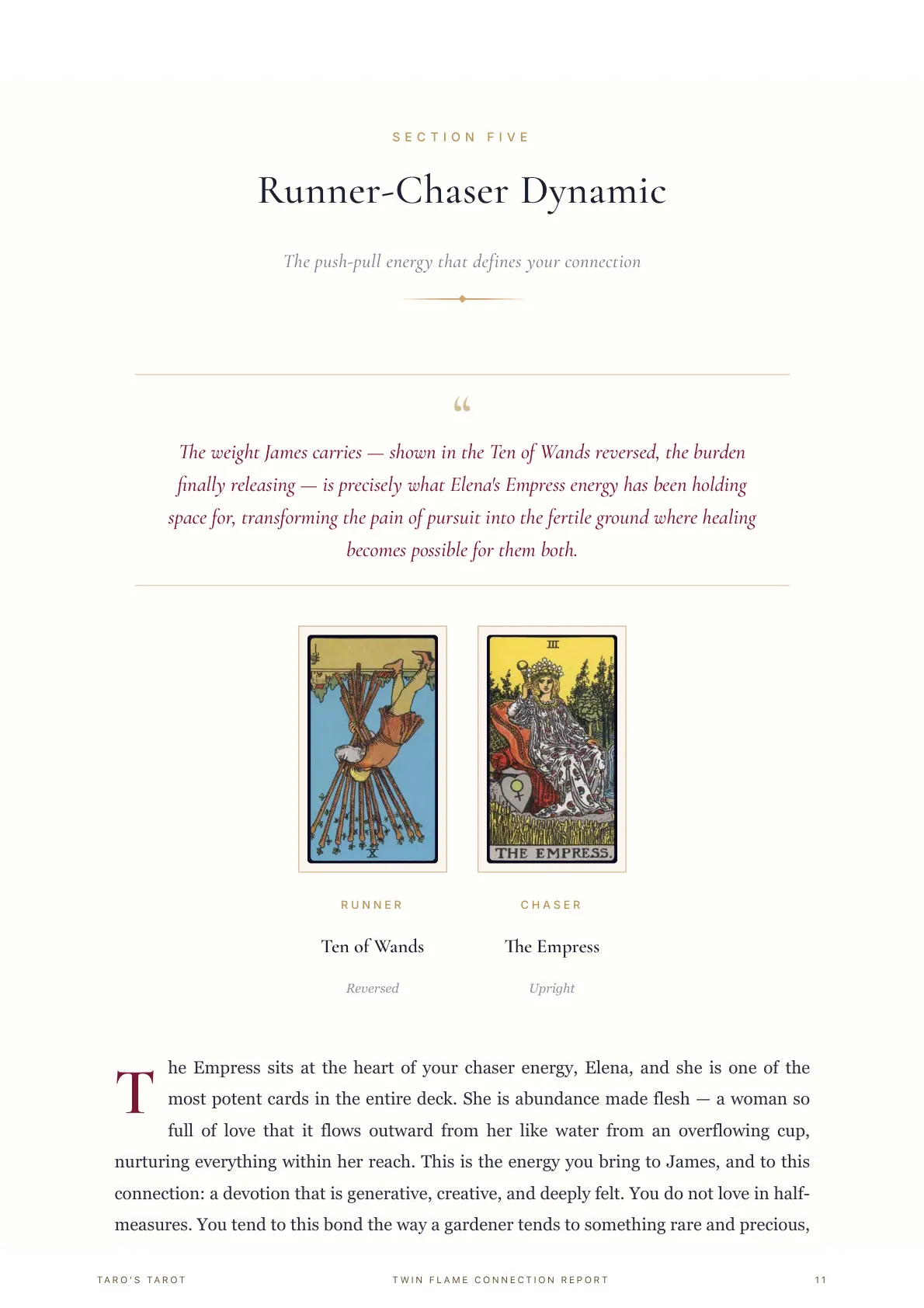
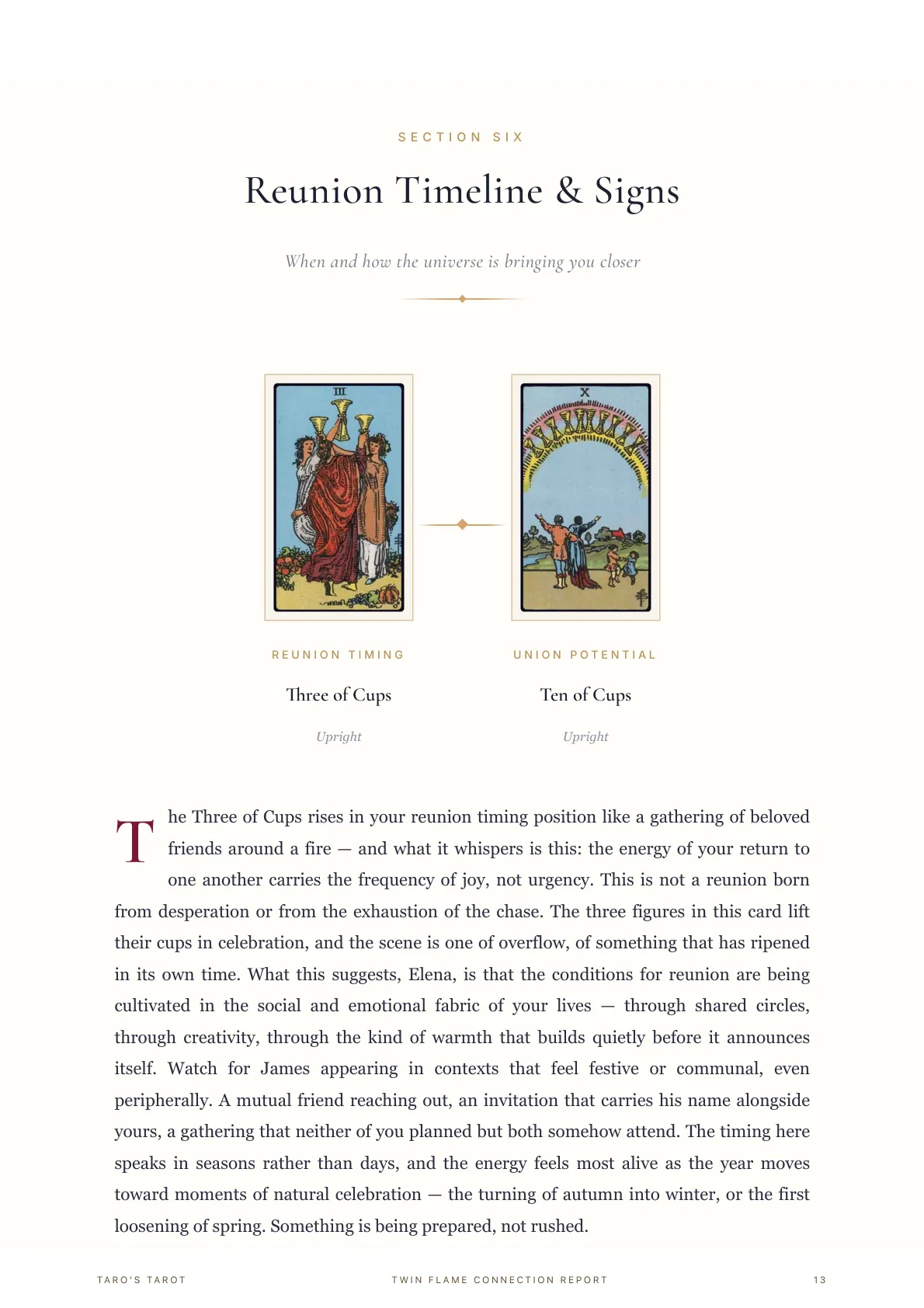
Sample pages from a real generated report — yours is written for you
$14.9930-day money-back guarantee — if your report doesn't feel genuinely specific to you, full refund, no questions asked.

Book
Twin Flames: The Honest Guide
The 8 stages, attachment theory, false twins, trauma bonds, and shadow work. Both frameworks, no fluff.
Get the Book — $14.99The Attachment Theory Lens
Understanding the psychological mechanics
Attachment theory, developed by John Bowlby and Mary Ainsworth, explains how our early relationships with caregivers shape our patterns in adult romantic relationships. The twin flame dynamic is essentially a high-intensity version of the Anxious-Avoidant trap-the most common and most painful relationship pattern.
Dismissive-Avoidant (Runner)
Formed when caregivers were emotionally unavailable or rejecting. The child learned that expressing needs leads to disappointment, so they suppress needs and value independence.
- • Discomfort with closeness and intimacy
- • High value on independence and self-reliance
- • Tendency to "deactivate" (suppress) emotions under stress
- • May not recognize their own need for connection
- • Flight response when relationships get "too close"
Anxious-Preoccupied (Chaser)
Formed when caregivers were inconsistently available-sometimes responsive, sometimes absent. The child learned hypervigilance to caregiver moods and anxiety around attachment security.
- • Craves closeness and fears abandonment
- • "Hyperactivates" emotions under stress (anxiety spikes)
- • Highly attuned to partner's moods and behaviors
- • Tendency toward protest behaviors when feeling disconnected
- • May lose sense of self in relationships
The Psychology of the Runner
Why they run-spiritual and psychological perspectives
The Runner is often called the "Divine Masculine" (energetically, not necessarily gendered). In attachment terms, they typically exhibit Dismissive-Avoidant patterns. Understanding their internal experience-rather than demonizing their behavior-is crucial for both Chasers seeking peace and Runners seeking self-awareness.
Fear of Engulfment
Spiritual Lens
The soul isn't ready for merger; ego defenses activate against dissolution.
Psychological Lens
Dismissive-Avoidant attachment style. Intimacy feels like loss of autonomy. The intensity of twin flame "soul merging" triggers a primal nervous system response: DANGER-Loss of Self.
Observable Behavior
Creating distance, needing space, feeling suffocated by closeness, valuing independence above connection.
"Not Good Enough" Wound
Spiritual Lens
Core unworthiness patterns preventing reception of unconditional love.
Psychological Lens
Deep-seated belief that they cannot meet the expectations the Chaser's adoration implies. They flee before they can disappoint-self-sabotage as preemptive protection.
Observable Behavior
Self-deprecating comments, downplaying the connection, "you deserve better than me" narratives.
Rationalization Defense
Spiritual Lens
The mind constructing logical barriers against what the soul recognizes.
Psychological Lens
Cognitive dissonance resolution. The intensity doesn't fit their worldview, so the mind creates "rational" reasons to dismiss it: "We live too far apart," "I'm not ready," "It's too intense to be real."
Observable Behavior
Logical arguments for why it can't work, focusing on practical obstacles, dismissing the spiritual dimension.
Trauma Response
Spiritual Lens
Past-life and current-life wounds activated by the mirror effect.
Psychological Lens
The twin's presence illuminates unhealed trauma. Rather than face it, the Runner flees the trigger source. The flight is actually away from their own pain-the twin is just the mirror showing it.
Observable Behavior
Shutting down emotionally when vulnerable, changing subject from deep topics, physical flight when intimacy deepens.
Identity Preservation
Spiritual Lens
Ego fighting dissolution; the false self resisting integration.
Psychological Lens
They've built their entire identity around independence and self-reliance. The vulnerability required for twin flame union feels like annihilation of who they've been.
Observable Behavior
Fiercely maintaining boundaries, resistance to "becoming one," insistence on individual identity.
The Psychology of the Chaser
Why they chase-spiritual and psychological perspectives
The Chaser is often called the "Divine Feminine" (energetically, not necessarily gendered). They typically exhibit Anxious-Preoccupied attachment patterns. The Chaser's suffering is often more visible-they're the ones researching, seeking readings, joining communities. But their pain isn't more valid than the Runner's; it's just more externalized.
Fear of Abandonment
Spiritual Lens
The soul desperately seeking reunion; codependency patterns emerging.
Psychological Lens
Anxious-Preoccupied attachment style. The Runner's withdrawal confirms their core wound: "I am not loveable; people always leave." Chasing is protest behavior designed to re-establish proximity.
Observable Behavior
Reaching out repeatedly, analyzing their behavior, seeking reassurance, difficulty accepting the separation.
Obsessive Quest
Spiritual Lens
Seeking divine confirmation; using spiritual tools to manage uncertainty.
Psychological Lens
The uncertainty of the Runner's intentions creates anxiety that demands resolution. Psychic readings, tarot, endless research-all attempts to gain control over an uncontrollable situation.
Observable Behavior
Multiple tarot readings per day, constant googling, joining twin flame communities, seeking external validation.
Spiritual Bypassing
Spiritual Lens
Using the "twin flame" label to override healthy self-protection.
Psychological Lens
The belief that it's "meant to be" justifies tolerating treatment that would be unacceptable in a normal context. "It's part of the process" becomes a shield against acknowledging red flags.
Observable Behavior
Excusing poor behavior as "their wounds," refusing to establish boundaries, waiting indefinitely.
Loss of Self
Spiritual Lens
Merging energy without the foundation of individual wholeness.
Psychological Lens
Codependency intensifies. Life becomes consumed by the connection-other relationships, work, health all suffer. The sense of self contracts rather than expands.
Observable Behavior
Neglecting friendships, decreased work performance, health declining, entire identity wrapped in the connection.
Bargaining
Spiritual Lens
Attempting to manifest reunion through specific actions or spiritual practices.
Psychological Lens
Illusion of control. "If I just do X, they'll come back. If I heal enough, prove myself enough, wait long enough..." The bargaining creates false hope cycles.
Observable Behavior
Constant self-improvement with ulterior motive, trying different manifestation techniques, "no contact" as strategy rather than healing.
The Self-Perpetuating Loop
This dynamic feeds itself: The more the Chaser chases, the more the Runner runs. The more the Runner runs, the more the Chaser chases. It's a closed loop that cannot be broken from within-only by changing the energy.
Chaser reaches out
Seeking connection, reassurance
Runner feels pressure
Nervous system triggers "danger"
Runner withdraws further
Creating distance, protecting self
Chaser's anxiety spikes
Abandonment wound activated
↻ Cycle repeats with increasing intensity until energy shifts
How the Dynamic Finally Breaks
The cycle stops only when the Chaser stops chasing-not as a manipulation strategy, but from genuine internal shift. This is called "The Surrender."
1
The Chaser Genuinely Stops
This is the circuit breaker. When the Chaser withdraws their energetic grasp-stops texting, stops seeking readings, stops obsessing-the pressure on the Runner lifts. Crucially, this must be authentic surrender, not strategic withdrawal. Fake surrender ("I'll pretend to not care so they come back") doesn't shift the energy.
2
Focus Shifts to Self-Healing
Instead of "we" and "them," the focus becomes "me." The Chaser engages in genuine Shadow Work-healing their abandonment wounds, building a fulfilling life independent of the connection, cultivating joy that doesn't depend on reunion. This isn't about becoming attractive enough to get them back; it's about becoming whole regardless of outcome.
3
Energetic Frequency Shifts
When the Chaser truly becomes secure-no longer emitting the "desperate" frequency that triggered the Runner's flight-the energetic dynamic transforms. The Chaser is no longer hunting; the Runner is no longer hunted. A new equilibrium becomes possible. Both nervous systems can finally relax.
4
Runner Often Returns
No longer feeling pursued, the Runner's defenses often relax. They may reach out. However-and this is crucial-without BOTH twins doing their individual work, the cycle will simply repeat. Return doesn't equal union. If the Chaser hasn't healed their anxiety and the Runner hasn't healed their avoidance, another cycle of crisis and separation is likely.
The Paradox of Surrender
The Chaser must reach a place where they would genuinely be okay if the Runner never came back. Not pretending, not strategizing-actually okay. This isn't giving up on love; it's releasing attachment to a specific outcome. Paradoxically, this authentic detachment often creates the conditions for return. But you can't fake it. The energy shift must be real. "I love you, but I love myself more. I release the outcome"-when this is genuine, everything changes.
When the Label Becomes Dangerous
The "twin flame" label should never justify staying in an abusive, manipulative, or consistently harmful dynamic. There's a critical difference between triggering wounds for healing and inflicting wounds through cruelty.
If your "twin flame" is gaslighting you, physically harming you, isolating you from support systems, or destroying your self-worth with no corresponding growth-this may be a false twin flame or simply a toxic relationship spiritualized.
Be especially wary of communities or teachings (like the now-infamous Twin Flames Universe) that weaponize the dynamic to keep people in harmful situations. True spiritual concepts don't require you to tolerate abuse. If the connection is destroying you rather than catalyzing growth, the label doesn't matter-your safety does.
Continue Your Journey
“The runner doesn't run because they don't love you. They run because the mirror you hold up reflects wounds they aren't ready to face. The chaser's work isn't to pursue harder - it's to stop running from their own wholeness.”
Runner/Chaser FAQ
Common questions about this dynamic
Why does my twin flame run when they say they love me?
Love and fear can coexist-this is the paradox at the heart of the Runner experience. Runners often DO love deeply; that's exactly why they run. The intensity of genuine twin flame love triggers their deepest wounds (fear of engulfment, unworthiness, fear of losing independence). Their nervous system interprets the intensity as danger. They're not running FROM you; they're running from the overwhelming transformation the connection demands. The love is real; the fear is also real. Both can be true simultaneously.
Am I the runner or the chaser?
If you're reading this article with desperate intensity, you're likely the Chaser. Runners rarely research twin flames-they're busy avoiding the topic entirely or convincing themselves it's not real. However, roles can switch. Some Chasers, after doing significant healing work and reaching genuine surrender, become Runners when their twin finally reaches out-the dynamic reverses. Some relationships cycle between both partners taking both roles at different times. The labels describe behavior patterns, not fixed identities.
Is the runner/chaser dynamic always avoidant vs anxious attachment?
Almost always, and attachment theory provides one of the most useful psychological lenses for understanding this dynamic. Runners typically exhibit Dismissive-Avoidant attachment (valuing independence, fearing intimacy, deactivating emotions under stress). Chasers typically show Anxious-Preoccupied attachment (fearing abandonment, hyperactivating emotions, seeking proximity). The twin flame connection activates these core attachment wounds like no other relationship because it demands the very thing each fears most: the Avoidant must embrace intimacy; the Anxious must tolerate uncertainty.
How long does the runner/chaser stage last?
This is typically the longest stage of the twin flame journey-lasting months, years, or sometimes decades. Crucially, it ends when the ENERGY shifts, not when time passes. You cannot wait your way to reunion. The dynamic typically dissolves when the Chaser achieves genuine surrender (not strategic withdrawal, but authentic peace with any outcome) and both twins have done significant individual healing work. Some twins never exit this stage in a given lifetime, remaining energetically connected while living separate lives.
Will my twin flame runner come back?
Many Runners do return, especially when the Chaser stops chasing. The energetic pressure that triggered their flight lifts, allowing their nervous system to relax. However, return doesn't guarantee union-Runners may return and run again if core wounds remain unhealed. Focus on your own healing rather than waiting for their return. Paradoxically, genuine detachment from outcome often creates the conditions for their return. But the healing must be authentic, not a manipulation strategy. The universe (or their subconscious) sees through strategic "surrender."
Is the runner aware of the twin flame connection?
Usually yes, even when they deny it. They feel the intensity viscerally-the physical symptoms, the telepathic flashes, the inexplicable pull. However, their conscious mind interprets this as danger rather than destiny. Some Runners are "unawakened"-experiencing the connection somatically and subconsciously while their ego-mind constructs elaborate logical reasons to dismiss it. Their denial is itself evidence of how powerful the connection is; we don't work so hard to rationalize away things that don't affect us.
How do I stop being the chaser?
The short answer: heal yourself into wholeness. The long answer: 1) Recognize that chasing pushes them away energetically. 2) Understand that your obsession is about YOUR wounds, not their value. 3) Set time limits on twin flame research/readings. 4) Redirect energy into your own life-career, health, friendships. 5) Do inner child work on abandonment wounds. 6) Cultivate genuine happiness independent of reunion. 7) Accept that you cannot control their choices. The goal is not to strategically stop chasing to get them back-it's to genuinely become whole whether they return or not.
Is the runner/chaser dynamic toxic?
The dynamic itself isn't inherently toxic-it's a growth opportunity that reveals attachment wounds requiring healing. However, it CAN become toxic when: the Chaser tolerates genuine abuse under the "twin flame" label, the dynamic prevents either party from functioning, years pass with no growth only repetition, or it's used to justify stalking or boundary violations. Healthy twin flame work involves recognizing the dynamic as a mirror for your own wounds and focusing on healing yourself, not changing them. If the dynamic is destroying your life rather than catalyzing growth, reconsider whether this is truly a twin flame or a false twin.
Still have questions? We're here to help!
Contact Support →Try Our Free Spiritual Calculators
Get deeper insights with our interactive tools