How to Read Runes
The complete beginner's method: choosing your runes, asking the right question, the three classic casting layouts, and reading reversals honestly.
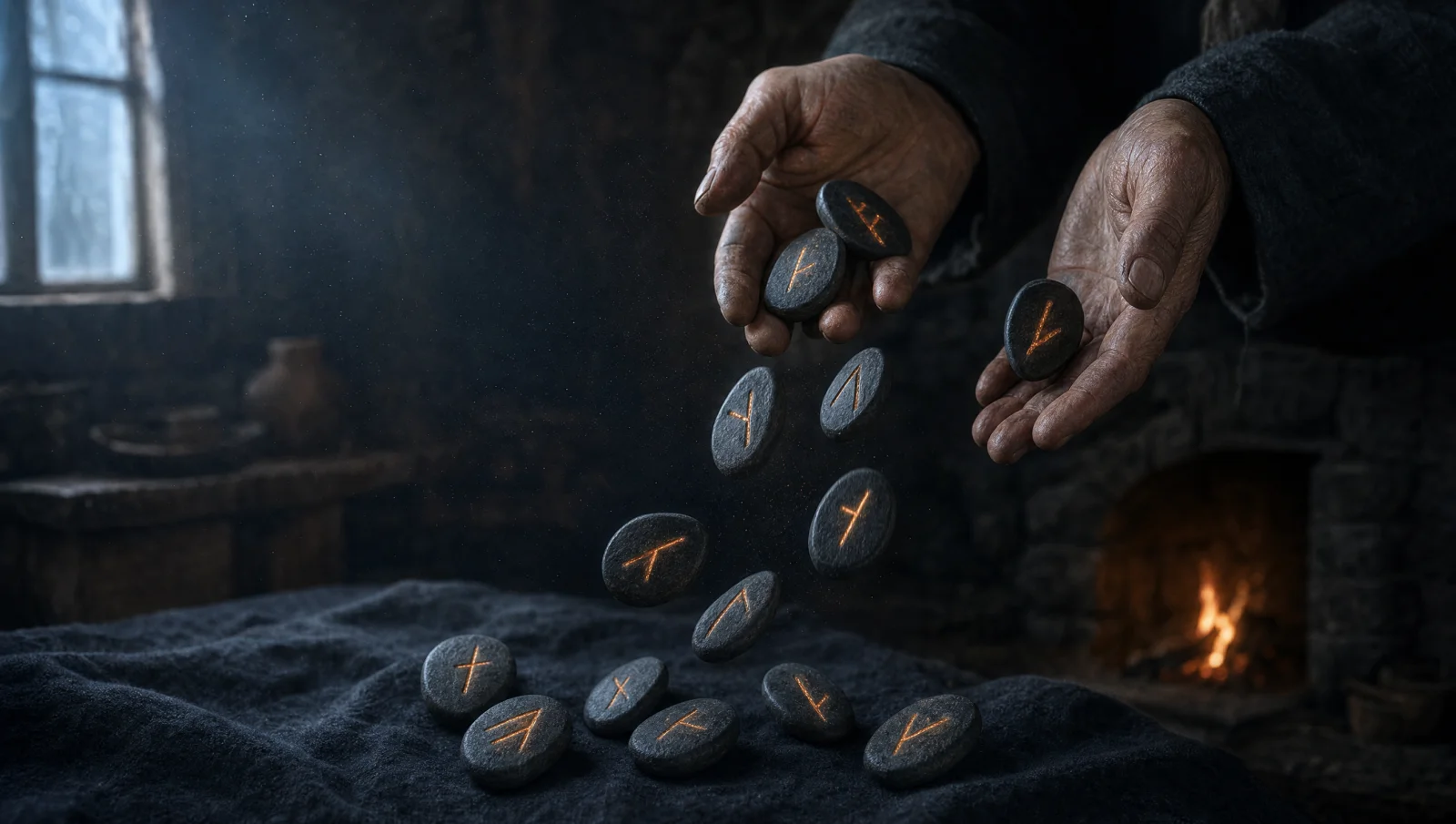
Rune reading is one of the oldest documented forms of divination in Europe. Writing in 98 AD, the Roman historian Tacitus described Germanic tribes cutting marked lots from a fruit-bearing tree, scattering them on a white cloth, and reading three of them while looking skyward. Two thousand years later the method is essentially unchanged: marked symbols, a deliberate question, a cast, and an interpretation. This guide teaches the modern practice built on the 24 runes of the Elder Futhark.
Step 1: Get a Rune Set (or Start Without One)
A rune set is 24 small stones, wood pieces, or clay tiles, each carved or painted with one Elder Futhark rune, usually kept in a drawstring bag. Wood is traditional — Tacitus specifies a nut-bearing tree — but stone, glass, and bone sets all work. What matters is that the pieces are uniform enough that you cannot identify a rune by touch, and that the set is yours: most readers keep one set, use it consistently, and let familiarity build.
You do not need to own a set to learn. A free online rune reading teaches the meanings and spread logic faster than flashcards, because you see real questions answered by real casts. Many readers practice online for a month before buying stones.
Step 2: Form the Question
The question is half the reading. Runes answer like a blunt elder, so ask accordingly: one situation per cast, phrased openly, aimed at your own path. “What do I need to understand about my job situation?” will draw a richer answer than “Will I get promoted?” — though yes/no questions have their own single-rune method (below). Avoid bundled questions; a cast asked about your relationship, your move, and your money at once will answer none of them clearly.
Step 3: Choose a Casting Method
The single draw — one rune, one answer
Hold the question, reach into the bag, draw one rune. This is the daily-draw method and the yes/no method: each rune carries a natural yes, no, or maybe affinity (Sowilo is the Futhark's clearest yes, Hagalaz its clearest no), and a reversed rune leans no. The single draw is also the best learning tool — one rune per day, read and journaled, teaches the whole Futhark in under a month.
The three-rune cast — past, present, future
The classic layout, and the one Tacitus described. Draw three runes and lay them left to right: the first shows the root of the situation (past), the second the energy at work now (present), the third the direction the current is moving (future). Read each rune in its position first, then read the three as one sentence — most casts tell a recognizable story once you look for the thread. This is the spread our free rune reading performs, with every position interpreted for you.
The cloth cast — the full scatter
The oldest method: take a handful of runes (or all 24) and cast them gently onto a cloth. Read only the runes that land face up — traditionally nine or fewer — giving weight to runes that land centrally or touch each other. Face-down runes are left unread: what the cast conceals is considered not yet yours to know. The cloth cast is an advanced method; its power is in the patterns between runes, which takes practice to see. Learn the three-rune cast fluently first.
Step 4: Read Reversals Honestly
Fifteen runes change meaning when they land inverted — read merkstave, their energy shifts from flowing to blocked. The discipline is to read the reversal as diagnosis, not doom: Ansuz reversed does not say “disaster,” it says “the miscommunication is here — fix this.” The reversed rune in a cast usually points at the part of the situation you already suspected and hoped to skip. Beginners are often tempted to soften or re-draw; resist it. The nine symmetrical runes (Gebo, Hagalaz, Nauthiz, Isa, Jera, Eihwaz, Sowilo, Ingwaz, Dagaz) always read upright.
Step 5: Weave the Thread — and Let the Cast Stand
After reading each rune in its position, step back and read the cast as one answer: where this came from, what is actually at work, where it flows if nothing changes. Say the thread out loud or write it in a sentence — the act of compressing it is where the insight usually lands. Then close the reading: the traditional rule is one cast per question per day. Re-casting until you hear what you want is not divination, it is negotiation, and every serious rune worker in history has said some version of the same thing.
Learning the 24 Meanings
You do not need the meanings memorized to start — you need them available. Keep the full rune meanings guide open beside your first casts and look up each rune as it lands: its core meaning, its orientation, and how it reads in that position. The meanings stick fastest through use. Most readers find that after twenty or thirty casts, the Futhark has quietly moved into memory — not as a list, but as 24 characters they know personally.
Practice With a Real Cast
The fastest way to learn is to watch the method work on your own question. Cast three runes now — every position and reversal interpreted for you.
Frequently Asked Questions
How do you do a rune reading for beginners?
Start with a single-rune draw: form one clear question, breathe, draw one rune, and read its meaning as the direct answer. Once that feels natural, move to the three-rune cast — past, present, future — which is the classic beginner spread and still the layout most experienced readers use daily.
Do I need my own rune set to start?
No. You can practice with a free online rune reading to learn the meanings and spread logic before buying a set. When you do buy one, choose stones or wood pieces that feel good in the hand — the material matters less than your consistency with them.
How many runes do you pull in a reading?
One rune for a direct answer or daily draw, three for the classic past-present-future cast, and five to nine for deep readings. More runes give more texture but demand more interpretive skill; most questions are fully answered by three.
What does it mean when a rune is reversed?
A reversed (merkstave) rune reads as its energy blocked, delayed, or turned inward — Fehu reversed is wealth leaking rather than arriving. Nine symmetrical runes (Gebo, Hagalaz, Nauthiz, Isa, Jera, Eihwaz, Sowilo, Ingwaz, Dagaz) have no reversed form.
How often should you do a rune reading?
A daily single-rune draw is a traditional practice, but the same question should only be cast once per day at most. Re-casting until you like the answer defeats the purpose — the discipline of letting a cast stand is part of the method.
Get Weekly Tarot Guidance
One card to guide your week — tarot wisdom in your inbox every Sunday.