THE WAY YOU CONNECT
Is My Relationship Over?
When you imagine actually breaking up, what's the first feeling — before you talk yourself out of it?
Choose the answer that feels most like you.
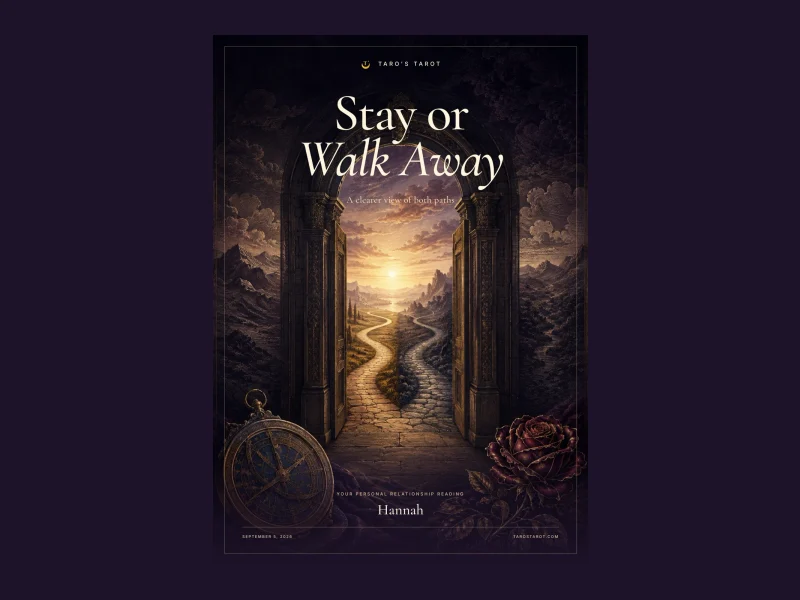
Inside the report: The Verdict Card
You've been asking yourself the same question for months.
The Eight of Cups does not arrive in the Verdict position by accident. Weighed against everything this spread has shown — the Four of Cups sitting where the love should be, the Star waiting on the far side of the door — the weight of this reading leans toward walking away. Not because nothing lives here, but because what lives here has stopped growing, and you have not. The choice remains yours. It always was...
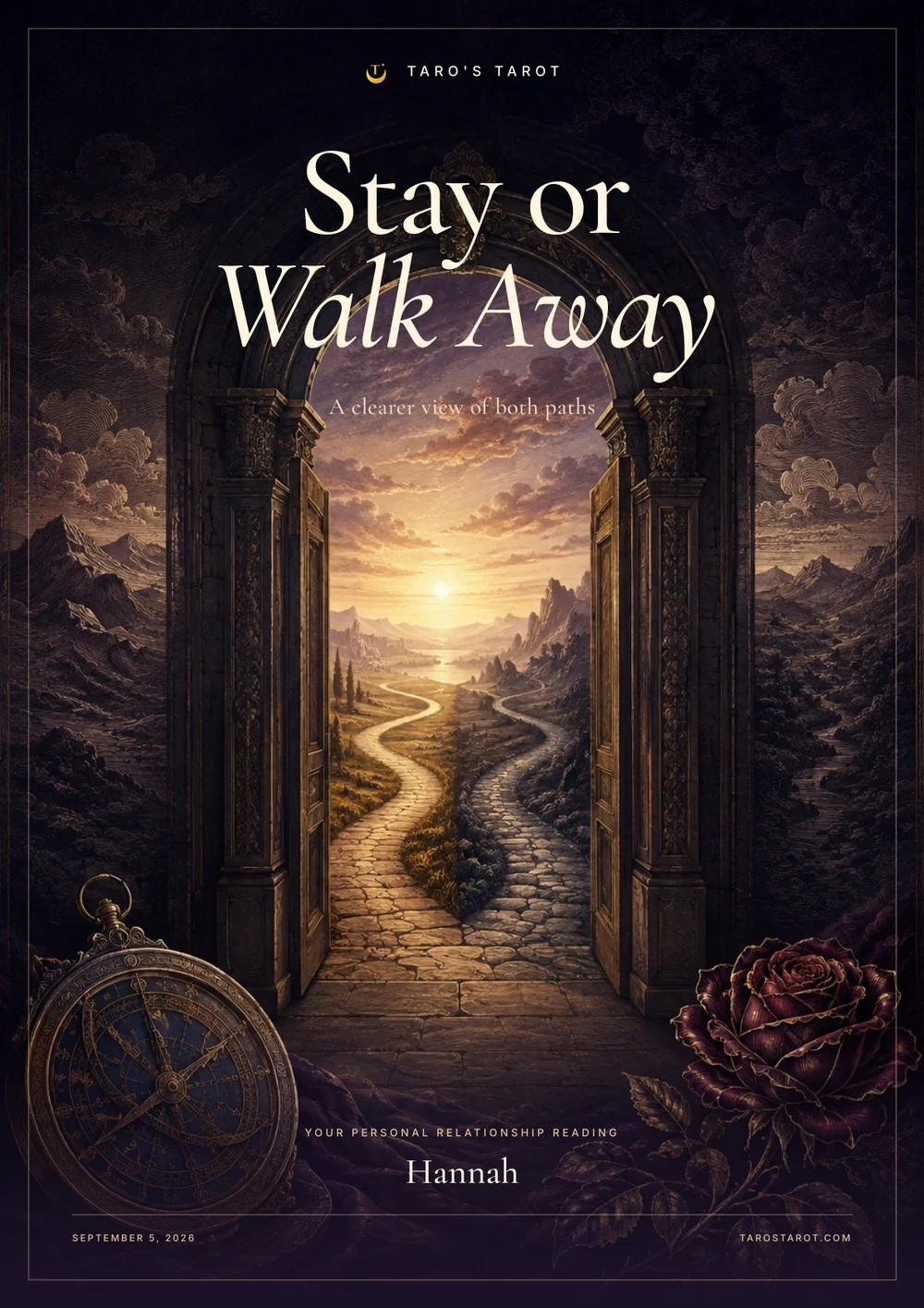
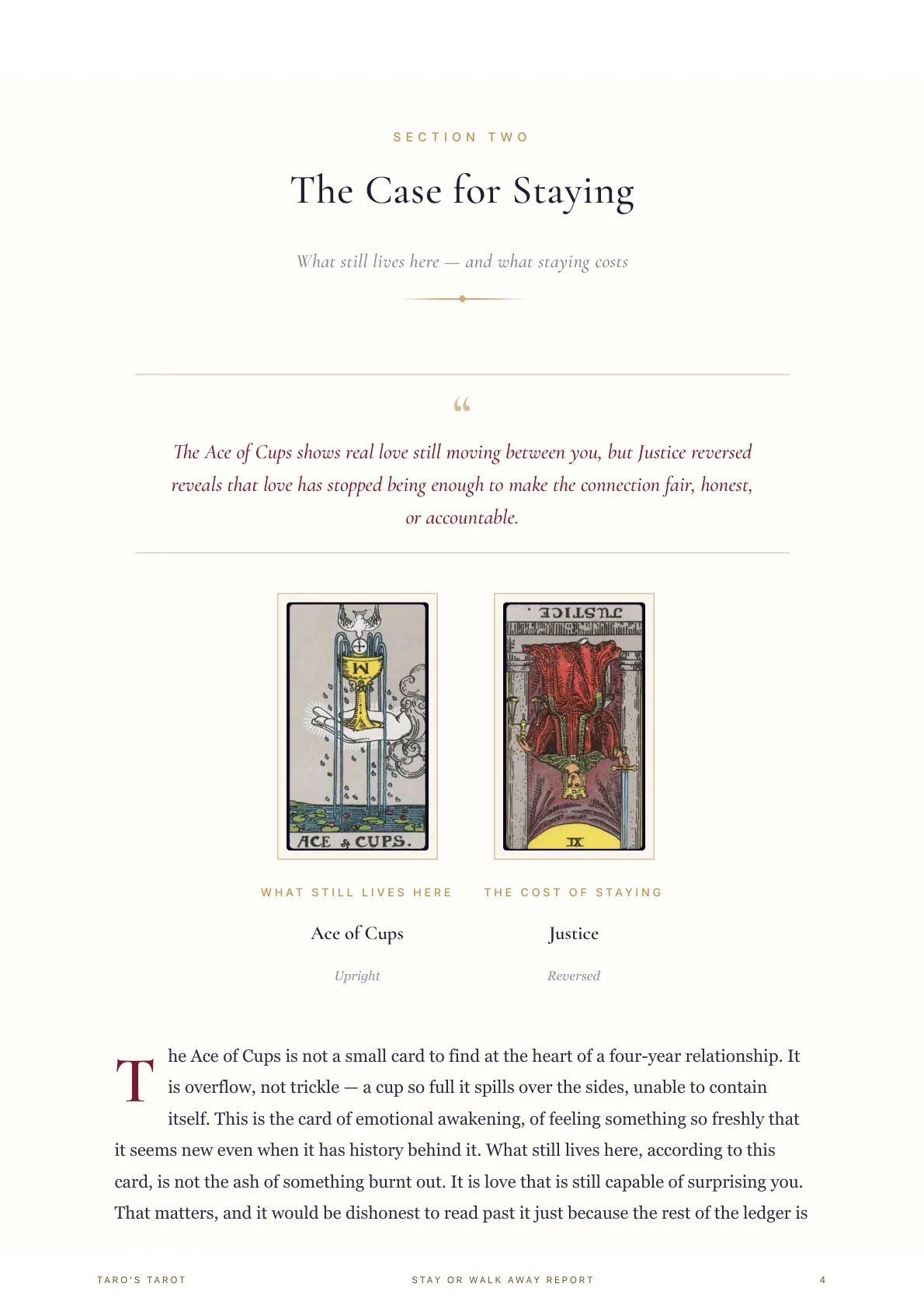
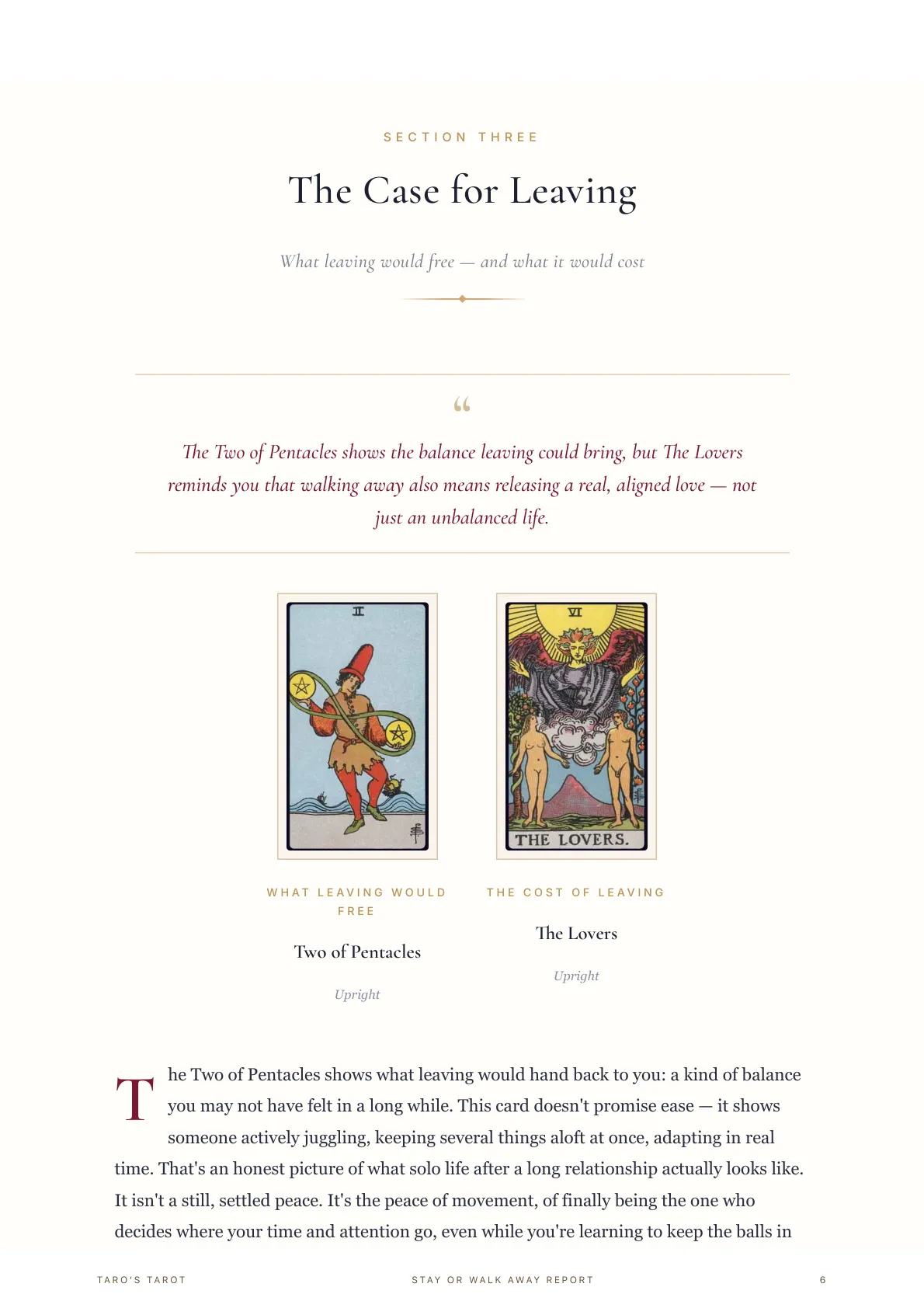
Sample pages from a real generated report — yours is written for you
$14.9930-day money-back guarantee — if your report doesn't feel genuinely specific to you, full refund, no questions asked.
“Most relationships don't end with a decision. They end with years of not deciding — and calling it patience.”
A note on safety: this quiz reads emotional connection — it cannot assess danger. If you feel afraid of your partner, monitor their moods to stay safe, or are being controlled, threatened, or hurt, that's a different situation than the one this quiz measures. The National Domestic Violence Hotline is available 24/7 at 1-800-799-7233, by texting START to 88788, or at thehotline.org. Our toxic relationship quiz also looks specifically at unhealthy and unsafe patterns.
Jump to a Relationship Outlook
The Five Relationship Outlooks
This quiz doesn't tell you to stay and it doesn't tell you to leave — it reads the evidence and names the pattern it fits. Each outlook comes with a tarot archetype and honest guidance for what to do next. Find the one that sounds like your relationship.
A Rough Season — Not an Ending
Your answers describe a relationship under real strain — but the strain is coming from outside the bond more than from inside it. Money, work, family, exhaustion: the pressure is real, and it's making everything feel worse than it is. Underneath it, the evidence says the connection is still alive: you're still on the same team, affection still surfaces, and the future is still a "we."
You came here asking "is it over?" because everything feels heavy — but notice what your answers didn't say. They didn't describe contempt, or indifference, or relief at the thought of leaving. They described two tired people carrying something difficult, and occasionally dropping it on each other. That's not a dying relationship; that's a stressed one. The risk isn't that the love is gone — it's that a long enough rough season can wear grooves that outlast the weather.
What Works in Your Favor
- The conflict is circumstantial, not fundamental — the best position a struggling couple can be in
- Affection and team-feeling still surface on their own, without effort
- You can name what's pressuring you — named pressures can be carried deliberately
- Neither of you has stopped trying, even if the trying is clumsy right now
What to Watch For
- Stress makes everything look like a relationship problem — including things that aren't
- A rough season handled badly can create real damage that outlasts the season
- Exhaustion mimics indifference; don't read your tiredness as proof the love is gone
- If the external pressure is permanent, "waiting it out" isn't a plan
Tarot Archetype
Strength — not the card of force, but of endurance with tenderness. A figure calms a lion not by fighting it but by staying gently present with it. Strength says the thing that feels like it might devour you can be tamed — if you face it together instead of turning on each other.
Guidance
Stop asking "is it over?" and start asking "what exactly is pressing on us?" Name the pressures out loud, together, as a shared enemy — the job, the money, the season — so the frustration lands on the problem instead of on each other. Protect one small ritual of connection a week and defend it like an appointment. And set an honest marker: if the season passes and the distance stays, that's new information. But don't bury something alive because it went quiet under the weight.
Drifting — But Repairable
Your answers describe distance without damage: no contempt, no betrayal, no core conflict — just two people who slowly stopped reaching for each other. The relationship isn't broken; it's under-fed. That's genuinely better news than most people taking this quiz get, with one hard catch: drift doesn't announce itself, and it doesn't stop on its own.
Somewhere along the way, maintenance replaced romance. You still function well together — the logistics run, the conversations happen, the goodwill is intact — but the deliberate reaching that made this feel like a relationship instead of an arrangement quietly stopped. Nobody decided this. That's the nature of drift: it's not a choice anyone makes, it's ten thousand small evenings on separate screens. The pull you feel toward "is it over?" isn't evidence that it is — it's the part of you that misses what this used to feel like, asking whether anyone else noticed.
What Works in Your Favor
- No contempt and intact goodwill — the two best predictors that repair can actually work
- What faded was effort, not compatibility — and effort is the one thing fully in your control
- When you two do genuinely connect, it still works — the machinery isn't broken
- Naming the drift (which you just did) is most of the battle; drift survives on not being noticed
What to Watch For
- Drift compounds quietly — every month of autopilot makes reaching feel more awkward
- Comfort can impersonate contentment for years before the gap becomes undeniable
- If only one of you does the reaching, repair curdles into resentment
- An unnamed drift eventually gets named by somebody — sometimes by someone outside the relationship
Tarot Archetype
Temperance — the card of patient, deliberate blending. An angel pours water between two cups, a little at a time, neither vessel emptied nor overfilled. Temperance says what you're missing isn't a grand gesture but a steady exchange, resumed on purpose, poured daily.
Guidance
Repair here isn't a summit meeting — it's resumed reaching. Start embarrassingly small: a real question at dinner, a hand on a shoulder in passing, one evening a week with the screens actually off. Then have the honest conversation, framed as missing them rather than indicting them: "I miss us — I want to fight for this before there's something to fight about." Watch what happens next, because it's your real answer: a partner who leans in confirms this outlook. A partner who shrugs is telling you which outlook you're actually in.
At a Real Crossroads
Your answers hold two true things at once: real love, and a real problem that has survived every attempt to fix it. This isn't drift and it isn't a rough patch — there's a specific unresolved thing at the center of this relationship, and you've been circling it long enough to know its shape. The question "is it over?" is really the question "can I live with this if it never changes?" — and you haven't let yourself answer it.
You've become fluent in your own ambivalence. You can argue both sides in your head — the case for staying, the case for going — and you've gotten so good at it that the argument itself has become a place to live. Every good week whispers "see, it's fine," and every collision with the core issue whispers "you already know." Meanwhile the deciding doesn't happen, and the limbo quietly charges rent: your peace, your plans, the version of you that isn't braced for the next round.
What Works in Your Favor
- You see the relationship accurately — both what's real in it and what's broken
- The love is genuine; this isn't staying out of fear or habit
- You can name the core issue precisely — most people in limbo can't
- Ambivalence this stable means the answer hinges on one question, not a hundred
What to Watch For
- Chronic indecision is a decision — it chooses the status quo daily, without the honesty of choosing it
- Good stretches keep resetting the clock; hope is doing maintenance work the relationship isn't doing
- The unresolved issue is likely a difference in needs or values — those negotiate; they rarely convert
- Limbo is costing you more than either answer would — and the cost is compounding
Tarot Archetype
Two of Swords — a blindfolded figure holds two crossed swords in perfect, exhausting balance. The sea churns behind her; the moon watches. The card's secret is that the blindfold is self-tied: the balance isn't peace, it's the effort of not looking. Every day the swords stay crossed, they get heavier.
Guidance
Stop re-litigating the whole relationship and reduce it to the one true question: "If the core issue never changes — not managed, not promised about, but never changes — do I stay?" You already know that fixing has been tried; the remaining variables are acceptance or departure. Give the question a real deadline and, if you can, a witness — a therapist, a wise friend, a structured reading — because private deadlines dissolve. Whichever answer you give, give it with your eyes open: a chosen relationship with a known flaw can be a good life. An unchosen limbo can't.
Running on Memory
Your answers describe a relationship being sustained by its past rather than its present: history, comfort, shared logistics, the fear of starting over — everything except present-tense wanting. When you reach for reasons to stay, you reach backward. The relationship isn't on fire and it isn't at war; it's running on stored fuel, and some part of you has started checking the gauge.
From the outside, everything looks fine — that's what makes this outlook so disorienting. There's no villain, no crisis, nothing you could point to in an argument. There's just the quiet fact that when you imagine the future, the feeling is duty rather than pull; that the best stories are all old ones; that what you'd miss most, if you're brutally honest, is the furniture of the life more than the person at the center of it. Staying like this is survivable for a long time. That's exactly its danger.
What Works in Your Favor
- What you built was real — the history you're running on was earned, not imagined
- There's no contempt or cruelty here; the foundation is worn, not poisoned
- Comfort and partnership are not nothing — you know precisely what you'd be giving up
- Your honesty about the gauge is rare; most people refuse to look at it for years
What to Watch For
- Memory is a non-renewable fuel — warmth from the past doesn't regenerate on its own
- Comfort postpones the question but answers it slowly, in years instead of words
- Staying from fear of starting over quietly teaches you that you're someone who settles
- The kindest-seeming option — changing nothing — is often the least kind to both of you
Tarot Archetype
Four of Cups — a figure sits beneath a tree, arms crossed, three cups standing before him while a fourth is offered from a cloud he doesn't see. The cups in front of him aren't empty; they're just no longer moving him. The card asks the only question that matters here: is the problem the cups — or the capacity to be moved?
Guidance
The question this outlook demands isn't "is it over?" — it's "is there present-tense life here, or only stored warmth?" Run one honest experiment before you decide: bring real, sustained effort for a set stretch — new experiences, actual pursuit, the kind of attention you gave at the start — and watch what your own heart does. If wanting reawakens, you were drifting deeper than you knew, and now you have a path. If you bring the effort and feel yourself performing it, that's not failure — that's your answer, given kindly. Either way, decide from evidence, not from the fear of an empty apartment.
Over in All but Name
This is the outlook nobody wants handed back, so it won't be softened: the pattern in your answers — the detachment, the stopped effort on both sides, the relief that flickers when you imagine it ending — is what a relationship looks like after it has ended, in every way except the announcement. You didn't come here to find out if it's over. You came here to hear someone else say it.
Somewhere in the past months or years, you stopped fighting — not because things got better, but because fighting requires believing the outcome can change. You've started living alongside your partner instead of with them: parallel routines, polite logistics, a silence that isn't peaceful so much as concluded. And when your mind drifts to a life after this, the feeling that surfaces before the guilt arrives is lightness. That lightness is not cruelty. It's the part of you that finished grieving early, waiting for the rest of you to catch up.
What Works in Your Favor
- You already know — the clarity you're asking for is clarity you have
- The detachment you feel means much of the grieving is already behind you
- No war, no villain: an ending from exhaustion can still be handled with dignity
- The relief you keep feeling is a compass, not a character flaw
What to Watch For
- Endings without a dramatic cause are the easiest to postpone indefinitely
- Guilt can keep you performing a relationship long after you've left it — which deceives you both
- Staying detached "for now" costs your partner honest years too, not just you
- The longer the name is withheld from what this is, the harder the eventual conversation becomes
Tarot Archetype
Ten of Swords — the card that looks like catastrophe and means completion. The figure lies still, the swords already fallen, and behind the scene the sky is doing the thing people miss: dawning. The Ten of Swords' mercy is finality — nothing here is in suspense anymore. The worst is not coming; it has finished happening.
Guidance
The work in front of you isn't deciding — it's finding the honesty and the kindness to say out loud what has already happened. Don't manufacture a fight to justify it, and don't wait for one; an ending doesn't need a villain to be legitimate. Plan the conversation with care: sober, private, unhurried, and without a list of their failures — "this has ended for me, and I think somewhere you know it too" is enough. If the practical entanglements are heavy, untangle them with the same dignity you'd want extended to you. And if any part of you is staying because you're afraid of what leaving says about you — hear this: leaving honestly says far better things than staying falsely.
Signs Your Relationship Is Over
Relationships rarely end at the breakup — they end quietly, earlier, and the breakup just announces it. The signs that most reliably mark an emotional ending cluster together:
- Effort has stopped on both sides — and nobody misses it. Struggling couples fight about effort. Finished couples stop mentioning it.
- Indifference has replaced conflict. Fighting means the outcome still matters. Polite, flat coexistence often means it doesn't.
- You feel relief when you imagine it ending. Dread says there's something to lose. Recurring relief is your honest answer arriving early.
- The relationship lives in the past tense. The good stories are all old ones, and you keep reaching further back to find them.
- You've stopped raising problems. Not because they're solved — because you no longer believe raising them changes anything.
- You're planning a future that quietly doesn't include them. Daydreams are data.
The honest counterweight: exhaustion, depression, and sustained outside stress can mimic several of these signs. That's why the quiz weighs the cluster and the cause — one flat month is a season; a flat year with no identifiable pressure is a verdict forming.
Rough Patch or the End? How to Tell the Difference
Every long relationship has seasons that feel like endings. The difference between a rough patch and an actual ending comes down to three questions. First: is there an identifiable cause? Rough patches have weather — a brutal work year, a new baby, grief, a move. Remove the weather in your imagination: if you can still feel the relationship underneath it, the relationship isn't the problem. Endings have no single storm you could wait out.
Second: does affection still surface on its own? In a rough patch, warmth breaks through without being scheduled — a reflexive hand, a laugh that escapes mid-argument. When every moment of closeness has to be manufactured, the spontaneous engine has stopped, and that's a different repair job entirely.
Third: do both people still want it to work? A rough patch can survive almost anything if both partners are still in the boat. An ending has usually already happened inside one person — quietly, sometimes a year before it's spoken. The quiz above is built to detect which side of these three lines your answers fall on.
Should I Break Up With Him — or Her?
"Should I break up" and "is it over" feel like the same question, but they aren't. "Is it over?" asks what has already happened — whether the bond is still alive. "Should I break up?" asks what to do about it — a decision that also weighs repairability, entanglement, and what you're willing to live with. This quiz answers the first question; the second deserves its own tools.
If your outlook lands on the fence — at a crossroads, or running on memory — take the decision itself to our Should I Break Up? tarot reading, or go deeper with the Stay or Walk Away Report — a 7-card reading that argues both cases honestly and tells you where the spread actually leans.
Frequently Asked Questions
How do I know if my relationship is over?
Watch the present tense, not the history: stopped effort that nobody misses, indifference where conflict used to be, relief when you imagine the ending, good stories that are all old ones, and problems you've stopped raising because nothing changes. Any one sign means a struggling relationship. The cluster, stable over months, usually means it has already ended emotionally.
Is it a rough patch or the end?
A rough patch has a nameable cause, affection that still surfaces uninvited, and two people who both want it to work. An ending has no storm to wait out and at least one person who has quietly left. Imagine the outside pressures gone tomorrow — if you can't find the relationship underneath them, the pressure was never the problem.
Should I stay or leave my relationship?
Reduce it to one question: if the core problem never changes, do you stay? A wholehearted yes means stay — fully, without one foot out the door. A no means the real question is how long you'll wait for a change you can't control. The most corrosive option is the one most people pick: years of unchosen limbo. Set a deadline and decide with your eyes open.
Can a relationship recover after falling out of love?
Often — if the love starved rather than being poisoned. Feelings that faded through neglect and autopilot regularly revive under deliberate, mutual effort. What rarely comes back is love ended by contempt, sustained betrayal, or wanting fundamentally different lives. Ask which one describes yours; the answer usually decides the rest.
This quiz is for self-reflection purposes only. It reads patterns, not futures, and it is not a substitute for couples counselling or professional support.
Explore More Quizzes
Discover more ways to explore your spiritual journey
Looking for more spiritual guidance?