GET TO KNOW YOURSELF
Four Temperaments Test
Which best describes your energy on an ordinary day?
Choose the answer that feels most like you.
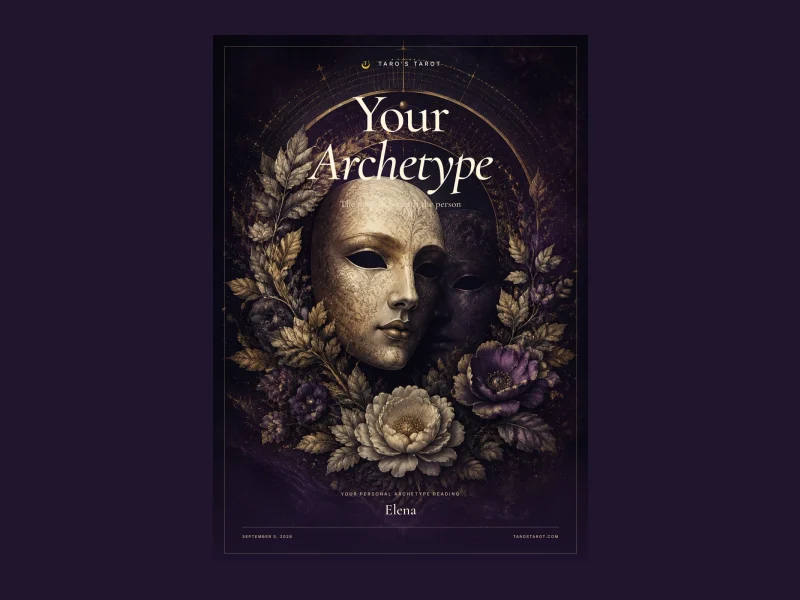
Inside the report: The Heart of Your Archetype
What is the core pattern that drives you?
The Empress in your Core Energy position names something you have always sensed but rarely claimed: your power moves through creation, not control. You do not push the world into shape — you grow it. The Knight of Wands beside it as your Driving Force reveals the restlessness underneath...
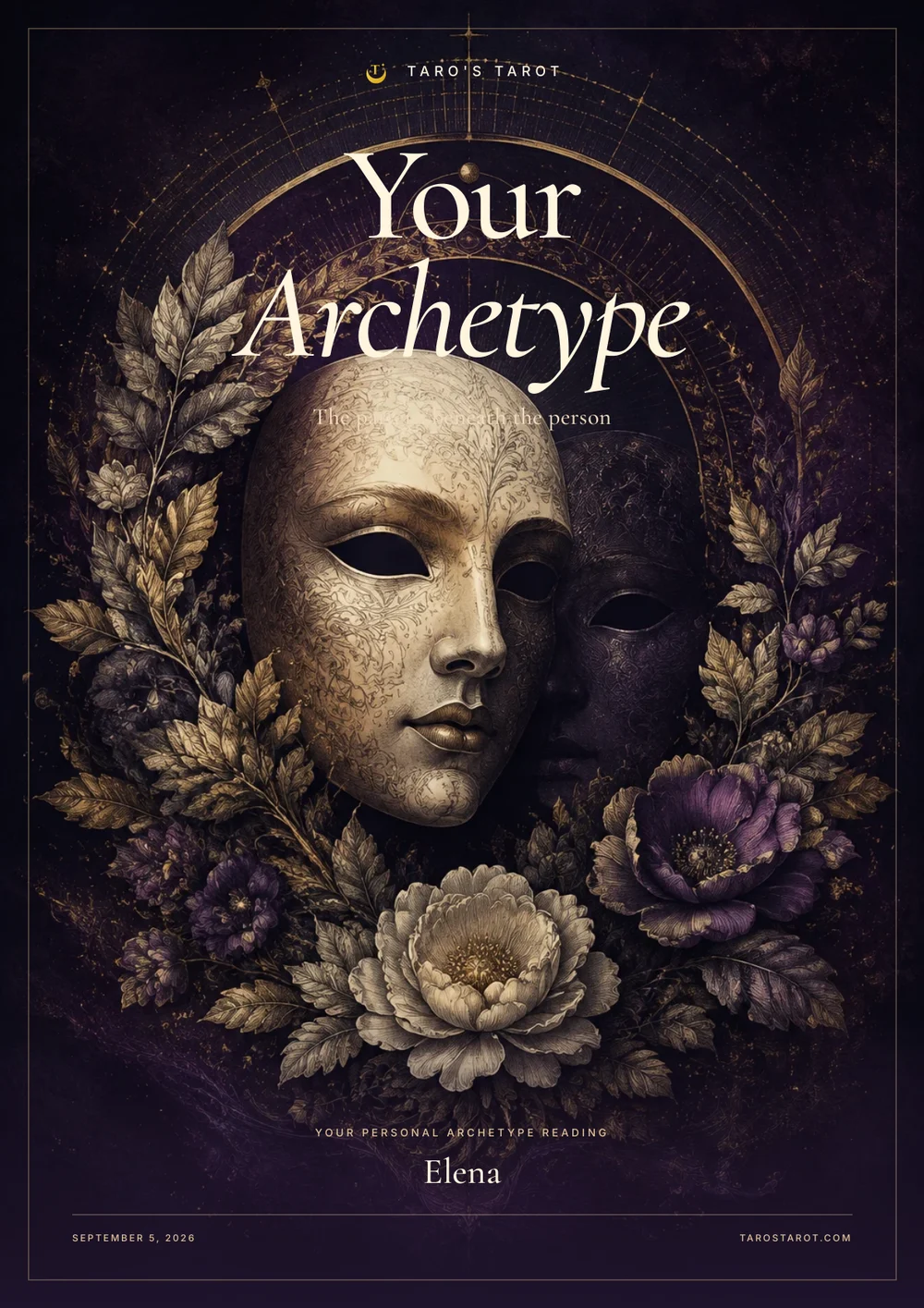
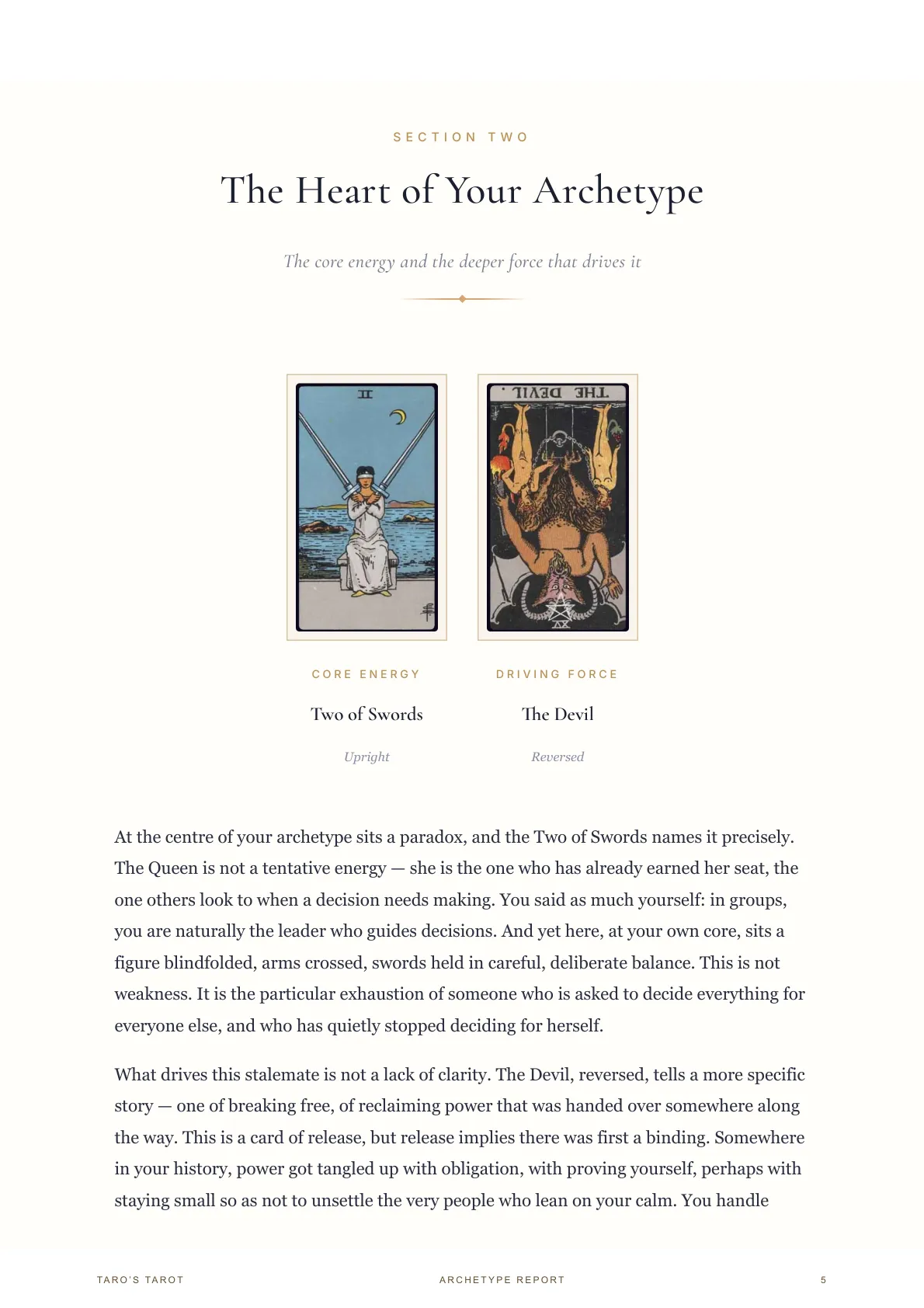
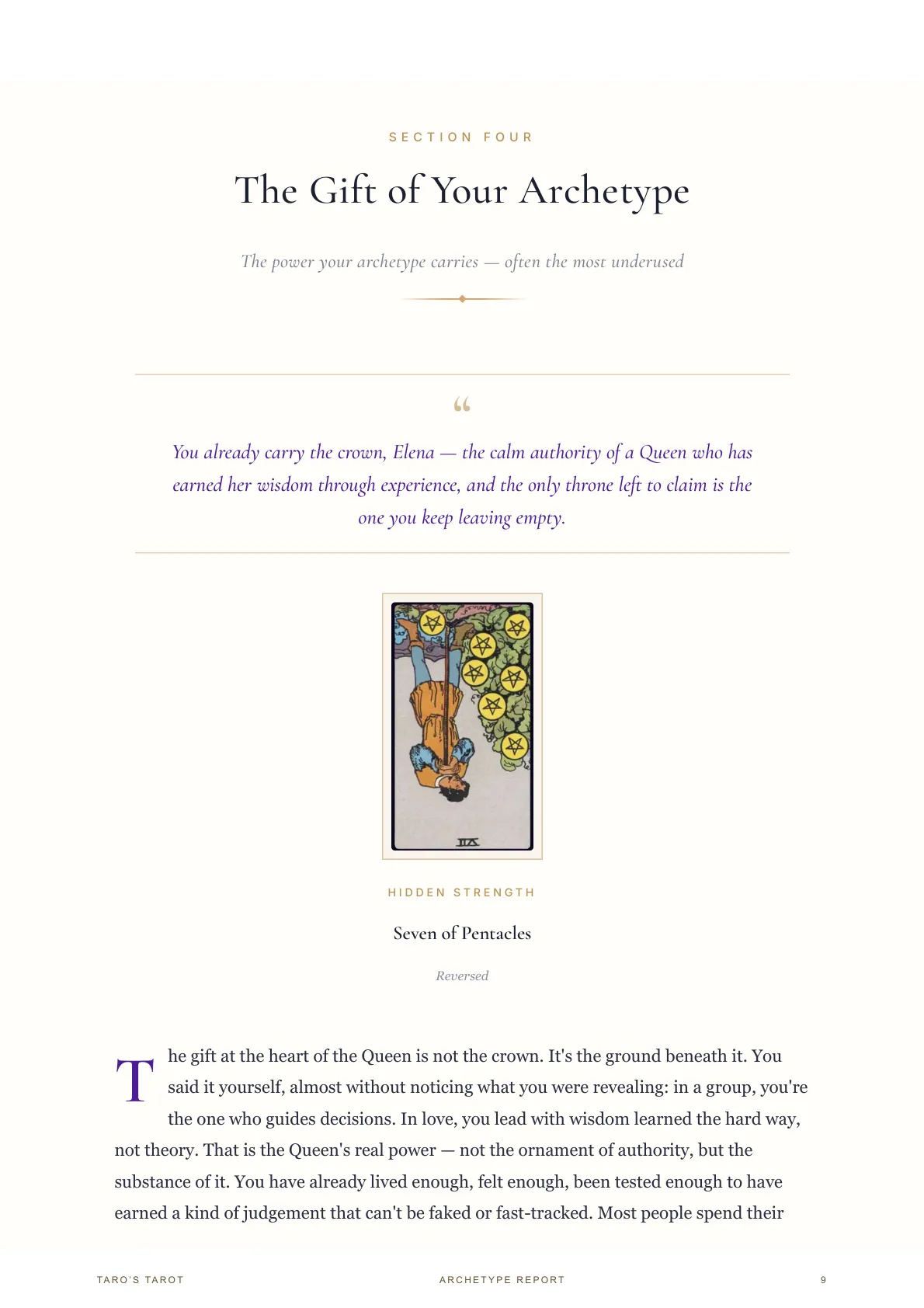
Sample pages from a real generated report — yours is written for you
$14.9930-day money-back guarantee — if your report doesn't feel genuinely specific to you, full refund, no questions asked.
“Every temperament has a strength that becomes its main problem under pressure. Knowing your temperament tells you which one to watch.”
Jump to a Temperament
The Four Temperaments
Each temperament below comes with its classical humor and element, its strengths and weak points, a tarot card from its element's suit, and what it means for love and work. None of the four is better than the others; each has real strengths and real weak points.
Choleric
Choleric is the temperament of action. Your answers describe someone who sets goals, makes decisions quickly and takes charge when nobody else will. In the old humoral model it belongs to yellow bile and to fire, hot and dry: energy that moves outward and wants results. In Hans Eysenck's two-dimension model it is the extraverted, emotionally changeable corner, which accounts for both the drive and the quick temper.
You think in outcomes. Given a problem, you would rather decide now and correct course later than wait for perfect information, and you get impatient with meetings that end without a decision. People often follow you because you are clear about what you want. The cost is that you can move faster than the people around you, treat disagreement as an obstacle, and forget to check how a decision landed with them. You do your best work when your energy has a real goal and someone you trust is allowed to tell you to slow down.
Strengths
- You make decisions and take responsibility for them
- You stay focused on the goal when a project gets hard
- You say what you think, so people know where they stand with you
- You are at your best in a crisis, when someone needs to take charge
What to Watch For
- Impatience: you can overrule people before they have finished explaining
- Anger comes quickly and can do damage you did not intend
- You may treat rest, feelings or small talk as wasted time
- Winning an argument can start to matter more than what the argument was about
Tarot Card
The King of Wands, from the suit of Wands, which the Golden Dawn and Rider-Waite tradition assign to fire. He holds a flowering wand on a throne carved with lions and salamanders (the creature old writers linked with fire), and a live salamander sits at his feet. It is the card of the leader who has a vision and acts on it, which is the choleric at its best; reversed, it points to the same force turned impatient and domineering.
Your Temperament in Love and Work
In love: you show care by doing things, solving problems and making plans. You need a partner who can stand up to you without taking offense and who will tell you plainly when you are pushing too hard. Practice asking "what do you need?" before offering a solution, and apologize quickly after a flare-up. At work: you suit roles with clear goals, authority and pace, such as running a team, a business, a campaign or a turnaround. Routine maintenance work and slow committees drain you. Work alongside someone who checks the details and someone who keeps the team steady, and listen to both.
Sanguine
Sanguine is the social temperament. Your answers describe someone who gets energy from people, says yes to new plans and recovers from setbacks quickly. In the humoral model it belongs to blood and to air, hot and moist, the warmest and lightest of the four. In Eysenck's model it is extraverted and emotionally stable, which fits the easy optimism sanguine people are known for.
You notice people first: who is in the room, who looks left out, what would make the evening better. You talk easily, make friends quickly and can make a dull task enjoyable for everyone doing it. You live in the present, which makes you good company and helps you bounce back after bad news. The same trait makes long projects and follow-through harder. Once an idea stops being new, your attention moves to the next one. You do your best work with a deadline, a partner who handles the details, and enough variety that the days do not feel the same.
Strengths
- You make people feel welcome, and groups work better with you in them
- You recover from disappointment faster than most people
- You are open to new ideas, places and people
- You can talk your way into opportunities and out of awkward moments
What to Watch For
- You start more than you finish, especially once the novelty wears off
- Promises made in a good mood can be hard to keep later
- You may keep things light to avoid difficult feelings, yours and other people's
- Being liked can matter more than you admit, which makes saying no hard
Tarot Card
The Page of Swords, from the suit of Swords, which the Golden Dawn and Rider-Waite tradition assign to air. A young figure stands on uneven ground in a strong wind, sword raised in both hands, with birds flying across the sky. The card is about curiosity, quick thinking and the restless wish to find out what happens next, which is sanguine energy. Its warning is the temperament's too: plenty of ideas and talk, not always the follow-through.
Your Temperament in Love and Work
In love: you fall quickly, show affection openly and keep a relationship fun. You need a partner who enjoys your social life, or at least does not compete with it, and who gives you attention without trying to control your time. Your work is staying present when a relationship gets serious or routine, and keeping the small promises. At work: you do well where people and variety are the job: sales, teaching, hospitality, events, media, anything with a crowd or a client. Long solo projects and detailed admin drain you. Write things down, set reminders, and team up with someone who enjoys finishing what you start.
Melancholic
Melancholic is the temperament of depth and high standards. Your answers describe someone who thinks before acting, notices what others miss and cares about doing things properly. In the humoral model it belongs to black bile and to earth, cold and dry. In Eysenck's model it is introverted and emotionally sensitive: feelings run deep and last a long time. The name comes from the Greek for "black bile"; here it describes a personality type, not clinical depression.
You prefer to understand something fully before you commit to it, whether that is a decision, a job or a person. You plan, you check, and you remember. People rely on you because your work is accurate and you keep your word. You are often creative or analytical, sometimes both. The difficulty is that you hold yourself to the same standards as your work, so you can replay mistakes, expect the worst, or delay starting until conditions are right. You need time alone to recharge and tend to keep a few close friends rather than many acquaintances.
Strengths
- Careful, accurate work that other people can depend on
- You see problems before they happen and plan for them
- Deep loyalty: once you commit to a person, you stay committed
- A strong sense of quality, meaning or principle that shows in what you make
What to Watch For
- Perfectionism that delays starting or finishing
- Replaying criticism or mistakes long after everyone else has moved on
- Expecting the worst, which others can read as negativity
- Withdrawing when hurt instead of saying what is wrong
Tarot Card
The Eight of Pentacles, from the suit of Pentacles, which the Golden Dawn and Rider-Waite tradition assign to earth. A craftsman sits at his bench carving pentacles one at a time, with finished ones displayed beside him and the town in the distance. It is the card of skill built through patience and attention to detail, which is the melancholic at its best. Its caution fits too: so absorbed in the work that the rest of life stays far away.
Your Temperament in Love and Work
In love: you take time to trust and commit fully once you do. You show love through attention: remembering what someone said, planning something thoughtful, being dependable. You need a partner who is patient with your need for time alone and who says clearly what they feel, because you tend to read between the lines and fill the gaps with worry. Say what hurt you instead of withdrawing. At work: you do well where precision and depth are valued: research, writing, design, engineering, finance, craft, medicine, law. Constant interruptions and noisy, rushed workplaces drain you. Set a "good enough" standard for low-stakes tasks and save your perfectionism for the work that deserves it.
Phlegmatic
Phlegmatic is the calm temperament. Your answers describe someone who stays even under pressure, listens more than they talk and prefers to keep the peace. In the humoral model it belongs to phlegm and to water, cold and moist. In Eysenck's model it is introverted and emotionally stable, which makes it the steadiest of the four. Phlegmatic people are often the ones others turn to when things go wrong.
You are easy to be around. You do not need to be the center of attention, you rarely hold a grudge, and you can see several sides of an argument, which makes you a natural mediator. You work at a steady pace and are reliable over the long run. The weak spots come from the same place: you can avoid conflict until a small problem becomes a big one, go along with other people's plans instead of stating your own, and put off decisions or change because the current situation is comfortable enough. Your calm is real, but so are your opinions, and people need to hear them.
Strengths
- You stay calm when others panic, which steadies the whole group
- You listen well, and people trust you with their problems
- Patience and consistency: you keep going on long tasks others abandon
- You see both sides of a conflict and help people settle it
What to Watch For
- Avoiding conflict until resentment builds up
- Going along with others instead of saying what you want
- Putting off decisions, and resisting change even when it is needed
- Your calm can be read as not caring, even when you do
Tarot Card
The King of Cups, from the suit of Cups, which the Golden Dawn and Rider-Waite tradition assign to water. He sits on a stone throne in the middle of a rough sea, holding a cup and a scepter, with a fish leaping on one side and a ship on the other, and the waves do not disturb him. It is the card of emotional balance and calm authority, which is the phlegmatic at its best. Reversed, it points to feelings held back so long that they stop being expressed at all.
Your Temperament in Love and Work
In love: you are a steady, accepting partner who makes a home feel peaceful, and you show love by being there consistently. The risk is keeping quiet about what you need until you have already pulled away. Tell your partner what you want early, even if it might start a disagreement: a small argument now prevents a bigger one later. At work: you do well in roles that need patience and a steady hand: counseling, nursing, teaching, administration, customer support, mediation, any team that needs someone everyone gets along with. High-pressure sales and constant competition drain you. Set your own deadlines, and say your idea in the meeting rather than afterwards.
The Four Temperaments and the Four Elements
In the classical model each temperament comes from a humor, each humor has a pair of qualities (hot or cold, moist or dry), and each pair of qualities matches an element. Tarot connects through the same elements. The Golden Dawn, a magical order founded in 1888, assigned fire to Wands, air to Swords, earth to Pentacles and water to Cups, and the Rider-Waite deck (1909), designed by Golden Dawn members Arthur Edward Waite and Pamela Colman Smith, follows those attributions. The ancient doctors never wrote about tarot; the link runs through the elements, which is why each temperament on this page has a card from its element's suit.
| Temperament | Humor | Qualities | Element | Tarot suit |
|---|---|---|---|---|
| Choleric | Yellow bile | Hot and dry | Fire | Wands |
| Sanguine | Blood | Hot and moist | Air | Swords |
| Melancholic | Black bile | Cold and dry | Earth | Pentacles |
| Phlegmatic | Phlegm | Cold and moist | Water | Cups |
The table also lines up with Hans Eysenck's 20th-century scheme (see below). The two hot temperaments (choleric and sanguine) are the extraverted ones, and the two dry temperaments (choleric and melancholic) are the more emotionally reactive ones. If you want your element directly rather than through your temperament, take our element quiz.
Temperament Blends: Choleric-Sanguine, Melancholic-Phlegmatic and More
Most people are not one pure type. Writers on the four temperaments, including Tim LaHaye, whose books made them popular from the 1960s on, describe a primary temperament plus a secondary one that changes how it shows up. This test gives you your strongest temperament; if a second description above also fits, these are the common pairs. Neighboring temperaments share one of Eysenck's two dimensions (extraversion and emotional stability), so they combine easily.
- Choleric-sanguine (both extraverted). Energetic, persuasive and fast. The sanguine side adds warmth and humor to the choleric drive, a mix suited to sales, leadership and anything that needs people persuaded quickly. Watch for taking on too much, deciding too fast and talking over quieter people.
- Sanguine-phlegmatic (both emotionally stable). Friendly, relaxed and easy to like: sanguine warmth without the restlessness, phlegmatic calm without the withdrawal. Watch for avoiding anything unpleasant, from hard conversations to deadlines.
- Melancholic-phlegmatic (both introverted). Quiet, careful and kind. The melancholic side brings standards and depth, the phlegmatic side patience and a steadier mood. Watch for holding back your opinions and letting other people make decisions that affect you.
- Melancholic-choleric (both emotionally reactive). High standards plus the drive to enforce them, which makes for excellent, demanding work. Watch for being hard on yourself and everyone around you, and for stress that turns into anger or worry.
- Opposite pairs (choleric-phlegmatic, sanguine-melancholic). These share neither dimension. If you land between opposites, check whether each side belongs to a different setting, such as work and home.
Which temperament comes first matters: a choleric-sanguine leads with drive and uses charm, while a sanguine-choleric leads with charm and pushes when needed. The personalised Archetype Report asks which second temperament colors yours and writes it into your reading.
Where the Four Temperaments Come From
The four temperaments began as medicine, not psychology. The Hippocratic writings of ancient Greece (5th to 4th century BC), especially the text On the Nature of Man, described the body as containing four humors: blood, phlegm, yellow bile and black bile. Health meant keeping them in balance. Each humor was matched with a pair of qualities, and later writers linked each one to an element.
In the 2nd century AD the Greek physician Galen, working in Rome, built on this in On Temperaments (De temperamentis), which explained the body's condition by its mixture of hot, cold, moist and dry, and in other writings he tied those mixtures to character. In medieval and Renaissance Europe the four names settled into personality types, and they survive in everyday English: a sanguine outlook, a phlegmatic response, a melancholy mood, a choleric temper.
Medicine abandoned humoral theory in the 19th century, but the temperaments lived on in psychology. In the 20th century the psychologist Hans Eysenck argued that the four types match two dimensions his questionnaires measured: extraversion versus introversion, and emotional stability versus instability (neuroticism). In his scheme:
- Choleric: extraverted and unstable
- Sanguine: extraverted and stable
- Melancholic: introverted and unstable
- Phlegmatic: introverted and stable
"Unstable" is Eysenck's term for quicker, stronger emotional reactions, not a judgment of character. Modern psychology keeps the idea that people differ in stable, measurable ways: extraversion and neuroticism are two of the Big Five traits used in research today. It drops the body fluids, and it drops the four boxes: traits are measured on a scale, most people score somewhere in the middle, and nobody is purely one type.
The four temperaments had a popular revival in the 1960s through Christian self-help books such as Tim LaHaye's Spirit-Controlled Temperament (1966), which is why many churches still teach them. Treat this test the same way: a historical model that gives you useful words for self-reflection, not a medical or clinical test. For another framework built on types, try the enneagram test or the Jungian archetype quiz.
Frequently Asked Questions
What are the four temperaments?
Choleric, sanguine, melancholic and phlegmatic, a way of sorting personality that comes from ancient Greek medicine. Choleric people are driven and decisive, sanguine people sociable and lively, melancholic people thoughtful and thorough, and phlegmatic people calm and steady. Each was tied to one of the four humors (yellow bile, blood, black bile, phlegm) and one of the four elements (fire, air, earth, water).
Is the four temperaments test scientifically valid?
No. It is a historical model, and the body-fluid explanation was abandoned by medicine long ago. The types line up loosely with two dimensions psychologists still measure, extraversion and emotional stability, which is why the descriptions often feel accurate. Use it for self-reflection, not as a clinical or psychometric assessment; for a research-based measure, look for a Big Five personality inventory.
Can you be a mix of two temperaments?
Yes, and most people are. Writers such as Tim LaHaye describe a primary temperament plus a secondary one that changes how it shows up. This test gives you your strongest temperament; if a second description also fits, the temperament blends section above explains how the common pairs combine.
What is the difference between temperament and personality?
In modern psychology, temperament is the inborn, early-appearing part of how you react: activity level, how strongly you feel things, how you respond to new situations. Personality is the wider pattern built on top of it, including habits, values and what you have learned.
Can your temperament change?
The core tends to be stable, but it is not fixed. Research on personality traits finds that people change gradually through adulthood; on average they become more emotionally stable and more conscientious with age. A choleric person can learn patience and a phlegmatic person can learn to speak up, even if the underlying tendency stays the same.
This test is for self-reflection and entertainment. The four temperaments are a historical model of personality, not a medical or clinical assessment.
Explore More Quizzes
Discover more ways to explore your spiritual journey
Looking for more spiritual guidance?